

Concrete Anchor Load Calculator
Professional-grade estimation for mechanical anchor safety.
🏗️ Pro Engineering: How We Calculate Your Results
Our system is inspired by the rigorous ACI 318 Strength Design provisions utilized by professional structural engineers worldwide. To provide you with the most reliable data for your project, this Concrete Anchor Load Calculator evaluates the specific “Demand-Capacity” ratio of your unique installation.
By using the Concrete Anchor Load Calculator, you are ensuring that the structural integrity of your fastening system meets modern engineering standards.
🛡️ Critical Safety Checks Included
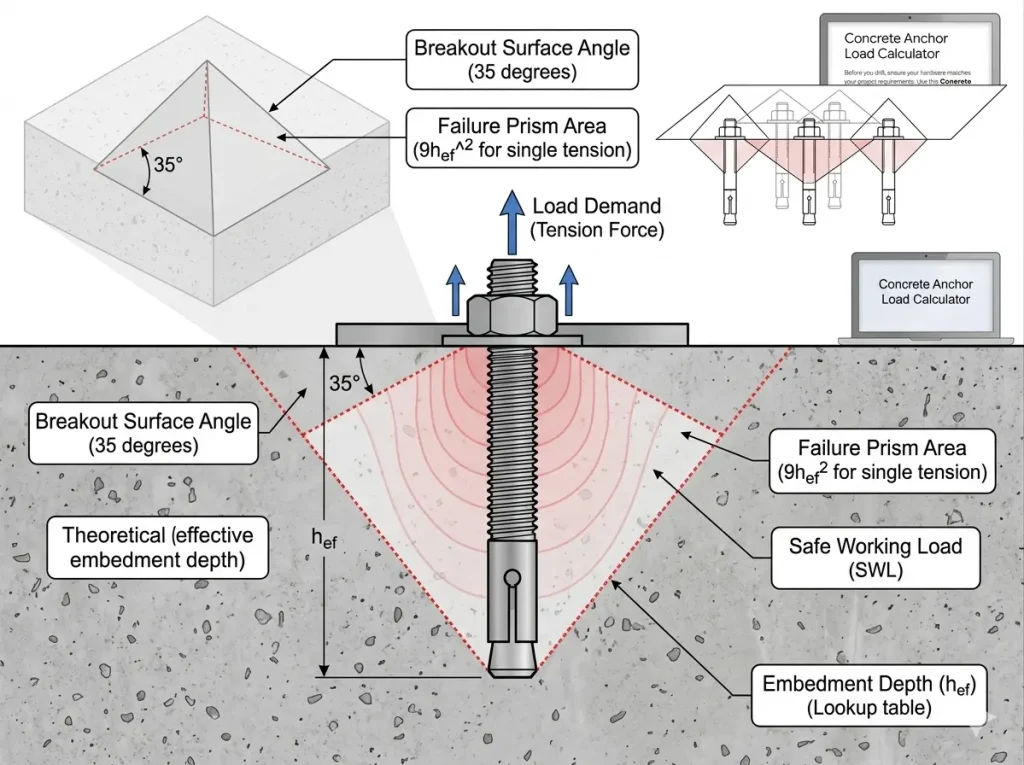
To maintain the highest safety standards, the software performs several automated engineering checks:
- Concrete Breakout Strength: 💥 We evaluate if the substrate will pull away in a structural “cone” shape under tension or shear forces.
- Pullout Strength Verification: ⛓️ This check ensures the fastener head will not simply pull through the material based on its specific embedment depth.
- Side-Face Blowout Analysis: 📐 A vital calculation performed by the Concrete Anchor Load Calculator for anchors placed near a slab edge with shallow embedment.
- Steel Strength Validation: 🔩 We ensure the metal bolt itself is rated to handle the factored tension and shear loads before reaching its breaking point.
- Interaction Ratios: 🔄 The system evaluates combined tension and shear—if this calculated ratio exceeds 1.0, the design is flagged as a failure.
🚫 5 Common Anchor Design Pitfalls to Avoid
Even when utilizing the Concrete Anchor Load Calculator, avoid these common installation issues:
- Ignoring Minimum Edge Distances: 📏 Fasteners located too close to the edge of a slab or footing suffer from significantly reduced load-bearing strength.
- Underestimating Uplift Forces: 💨 It is a common mistake to neglect wind or overturning forces that want to pull the hardware directly out of the ground.
- Incorrect Embedment Depth: 🕳️ Selecting a depth that is too shallow is the leading cause of pullout failure in masonry projects.
- Uniform Load Assumptions: ⚖️ Do not assume weight is distributed perfectly even across all bolts; always verify base plate behavior.
- Neglecting Seismic Requirements: 🌋 In high-seismic regions, results must be tempered with special ductile detailing requirements.
🏛️ Design Methodology & Engineering Assumptions
Our Concrete Anchor Load Calculator operates under several core engineering assumptions aligned with international building codes:
- Standard Substrate Type: The tool assumes anchors are installed into normal-weight concrete with a specified compressive strength ($f’c$).
- Complex Load Resolution: All user inputs are resolved into factored tension and shear acting specifically on the anchor group.
- Advanced Failure Mode Analysis: We evaluate breakout strength in both tension and shear using the latest design provisions.
- Steel Capacity Verification: The inherent strength of the anchor steel is verified against specified grades to prevent snapping.
- Interaction Logic: Combined tension and shear forces are evaluated using standard interaction equations to ensure total demand never exceeds capacity.
❓ FAQ (Engineering Edition)
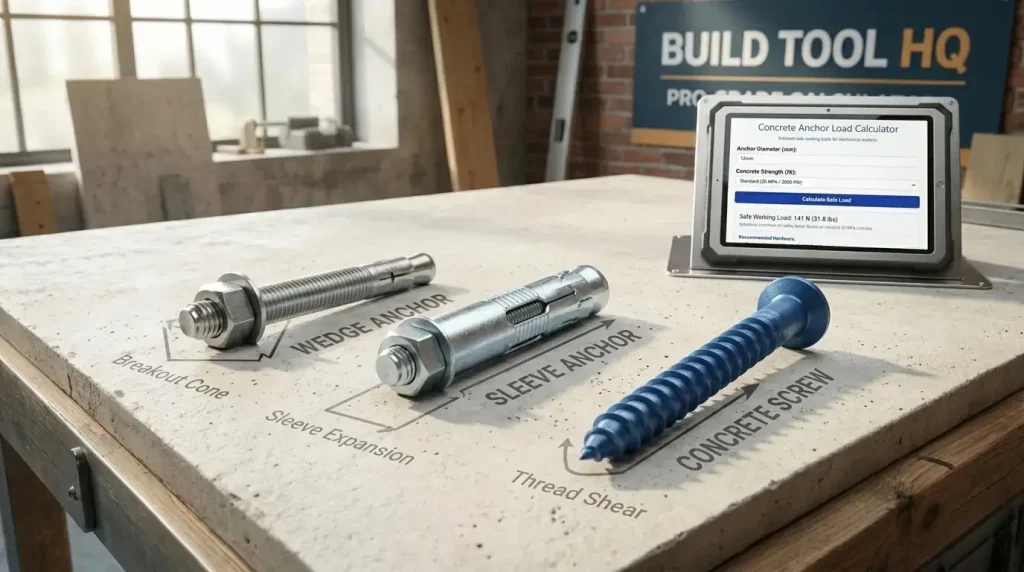
- What design standard is used here? The methodology is based on ACI 318, checking for concrete breakout, pullout, and steel strength.
- Does this tool account for edge distance? Yes! 📐 Accurate edge distance is an essential input because anchor strengths are automatically reduced when the software detects anchors placed too near concrete edges.
- Is this a substitute for a licensed engineer? No. 🛑 This Concrete Anchor Load Calculator is intended as a technical aid for professionals and students. All final designs for structural projects should be reviewed and approved by a licensed structural engineer familiar with your local building codes.
📊 Summary of Benefits
The Concrete Anchor Load Calculator provides a rapid and reliable way to verify your fastener designs against governing limit states without the need for complex hand-calculations.
Table of Contents
📚 Expand Your Knowledge: Concrete & Masonry Guides
If you found the Concrete Anchor Load Calculator helpful, you may also need these professional guides to ensure your project is successful from start to finish:
Core Anchor & Load Resources
- Best Concrete Anchors for Home Use (2026 Guide) – Find the right hardware for your specific load requirements.
- How Much Weight Can Concrete Anchors Hold? – A deep dive into the weight capacities of different fastener types.
- Concrete Anchor Spacing & Edge Distance Guide – Essential reading to avoid the “Breakout Cone” failure discussed above.
- Types of Concrete Anchors Explained – Detailed breakdown of Wedge, Sleeve, and Tapcon systems.
Drilling & Installation Prep
- Best Drill for Concrete Walls (2026 Guide) – The top-rated tools for preparing your anchor holes.
- How to Drill Into Concrete Safely – A step-by-step guide to perfect hole preparation.
- What Size Drill Bit Should You Use for Concrete Anchors? – Never guess your bit size again; ensure a tight, safe fit every time.
- Best Drill Bit for Concrete (Masonry & SDS Bits Explained) – Choose the right bit geometry for faster, cleaner drilling.
Troubleshooting & Safety
- Common Concrete Anchor Mistakes (And How to Avoid Them) – Learn why installations fail before you start your project.
- How Deep Can You Drill Into Concrete? – Understanding the relationship between depth and structural integrity.