
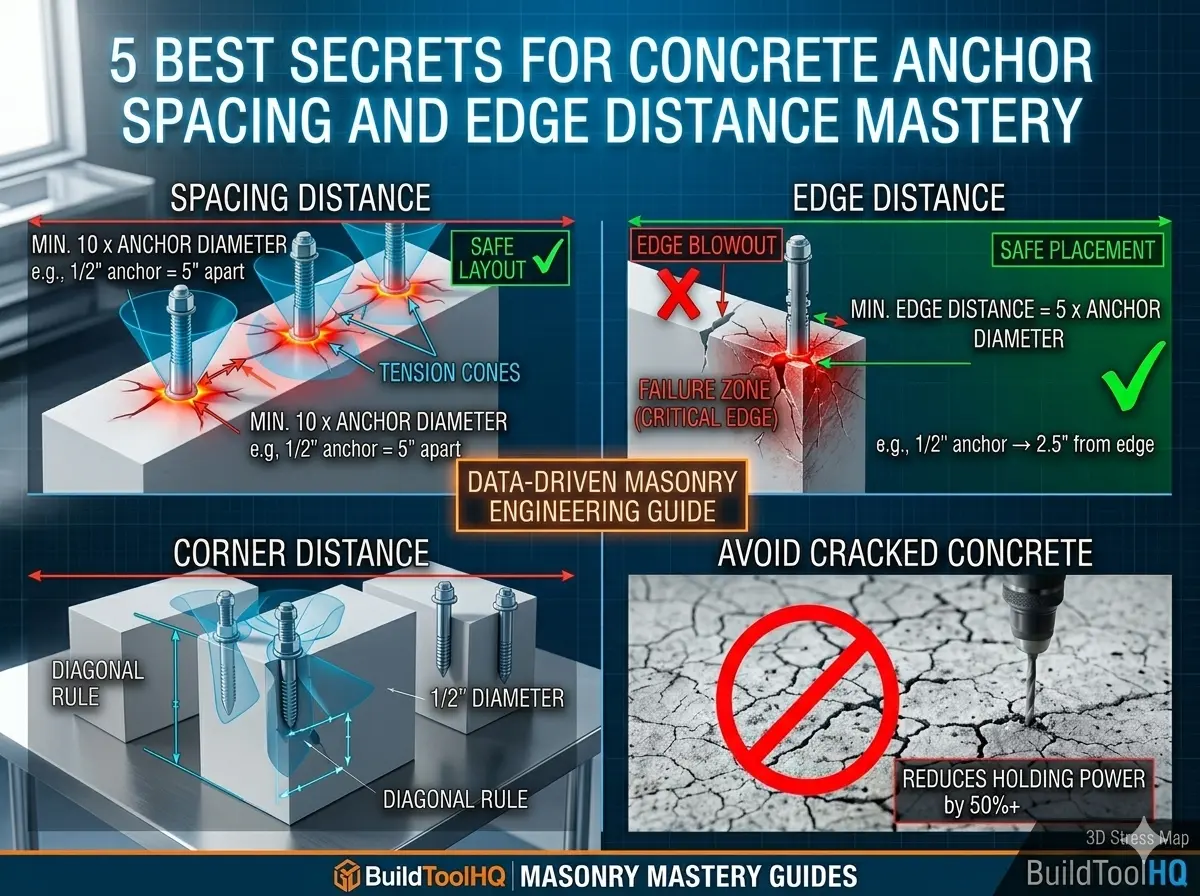
When performing professional masonry or DIY installations, concrete anchor spacing and edge distance play a critical role in the safety and structural integrity of your project. Even high-quality fasteners can fail if concrete anchor spacing and edge distance requirements are ignored.
To achieve professional mastery, follow these 5 essential rules for every masonry mount:
- 1. The 10x Diameter Rule for Spacing: To ensure 100% load capacity, the minimum distance between two fasteners should be 10 times the diameter of the anchor.
- 2. The 5x Diameter Rule for Edge Distance: To prevent “edge blowouts,” never install a mechanical anchor closer than 5 times its diameter to the edge of the concrete slab.
- 3. Avoid the “Cone Failure” Zone: Improper concrete anchor spacing and edge distance can cause overlapping stress zones, leading to the concrete pulling out in a “cone” shape.
- 4. Material Density Matters: Concrete anchor spacing and edge distance must be increased when working with softer materials like brick or hollow block to prevent structural cracking.
- 5. Proper Tool Selection: Using a hammer drill and the correct carbide bit is the best secret to ensuring your holes are precise enough to maintain these spacing requirements.
The Physics of Failure: Why Precision Matters
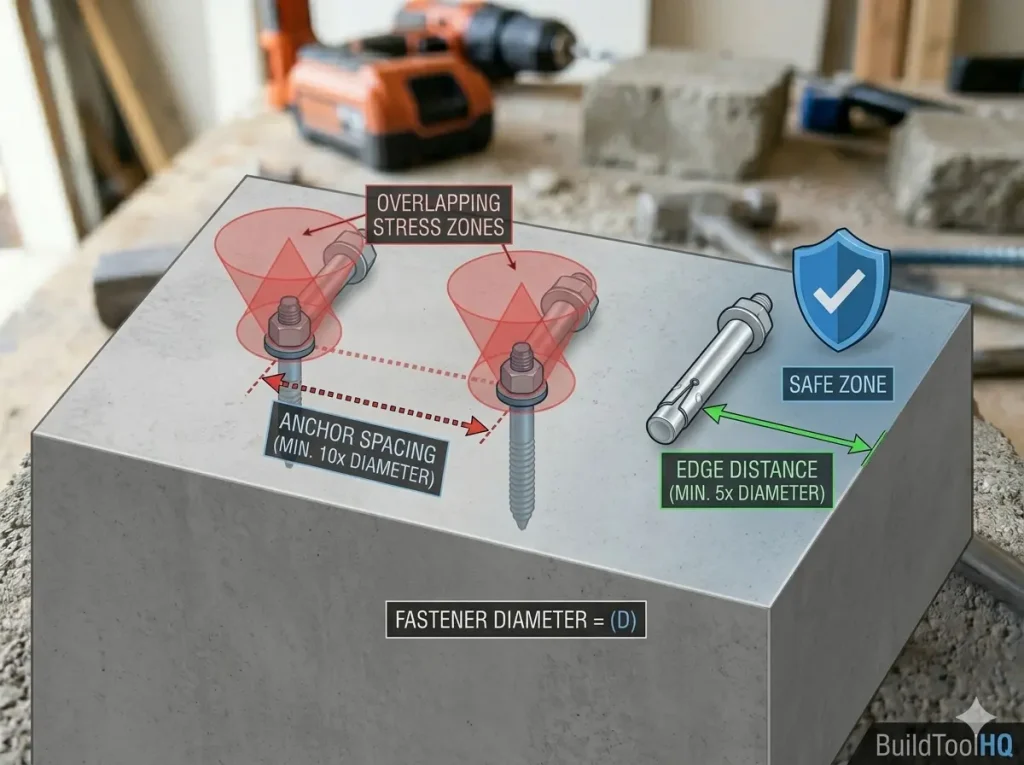
Concrete is an engineering paradox: it is incredibly strong in compression but remarkably weak in tension. To ensure a professional installation, you must understand how concrete anchor spacing and edge distance counteract these physical limitations.
Here are the 5 essential secrets to managing internal stress zones:
- Structural Integrity Mastery: Adhering to the 5 essential rules prevents spalling and cracking, ensuring that each fastener is surrounded by a dedicated “safety zone” of solid masonry.
- Outward Bursting Pressure: Every time an anchor is expanded or loaded, it generates a “stress cone” within the material. Proper concrete anchor spacing and edge distance ensure these cones do not overlap.
- The Overlap Effect: If your concrete anchor spacing and edge distance are too tight, the tension zones from multiple fasteners merge, creating a massive weak point that can lead to “Concrete Cone Failure.”
- Slab Perimeter Vulnerability: Placing a fastener too close to a perimeter without the correct concrete anchor spacing and edge distance results in an “Edge Blowout,” where the pressure simply shears off the side of the concrete slab.
- Tension vs. Compression: Because anchors rely on friction (tension), they are essentially “pushing” against the concrete from the inside. Mastery of concrete anchor spacing and edge distance is the only way to balance these forces safely.
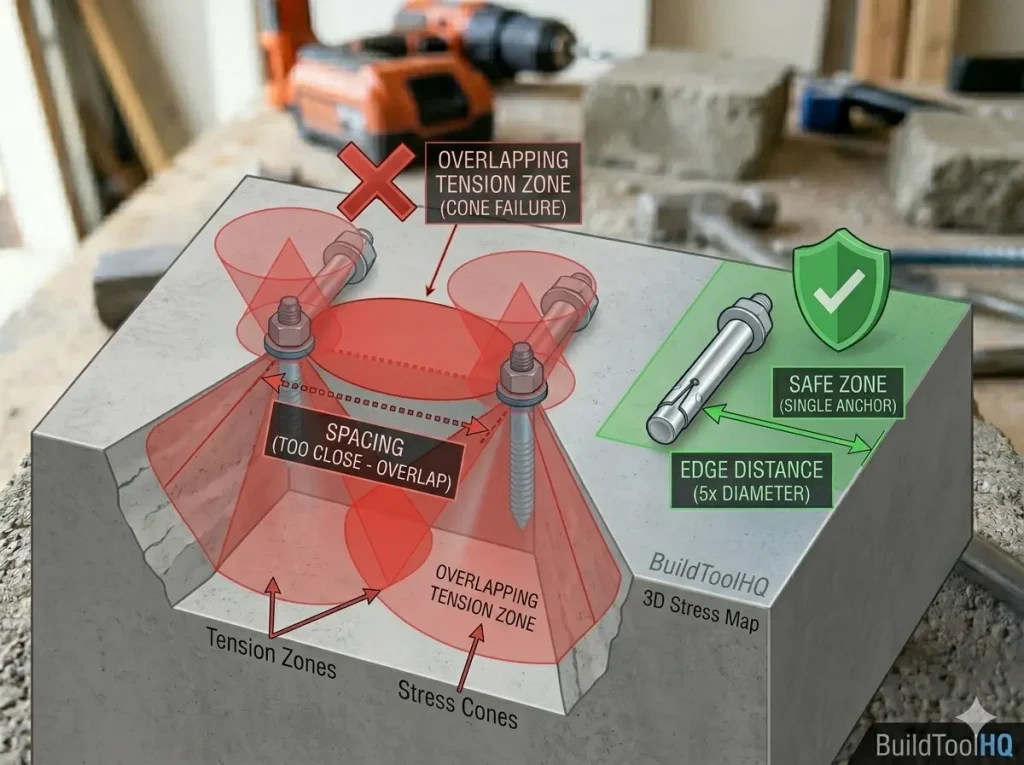
Even anchors selected correctly using (Best Concrete Anchors for Home Use – 2026 Guide) will not perform at their rated strength if spacing and edge-distance rules are ignored.
Minimum Edge Distance (General Guidelines)
Edge distance is the minimum space required between an anchor and the nearest concrete edge.
General Rules of Thumb (Non-Structural Use)
- Wedge anchors
➜ Minimum 5–7× anchor diameter
(Example: ½″ anchor = 2½″–3½″ from edge) - Sleeve anchors
➜ Minimum 3–5× anchor diameter - Drop-in anchors
➜ Minimum 4–6× anchor diameter - Tapcon concrete screws
➜ Minimum 1½″–2″ from edge
If installation near an edge is unavoidable, Tapcon screws and sleeve anchors are usually safer options than wedge anchors due to lower expansion force.
Minimum Anchor Spacing (Between Anchors)
Anchor spacing refers to the distance between two adjacent anchors.
Typical Spacing Guidelines
- Wedge anchors
➜ Minimum 10× anchor diameter - Sleeve anchors
➜ Minimum 6–8× anchor diameter - Drop-in anchors
➜ Minimum 8–10× anchor diameter - Tapcon screws
➜ Minimum 3–4″ apart
Example:
Two ½″ wedge anchors should be spaced at least 5″ apart, and more spacing is recommended for heavier loads.
To understand how spacing affects holding strength, review (How Much Weight Can Concrete Anchors Hold?).
Spacing Guidelines for Common Home Projects
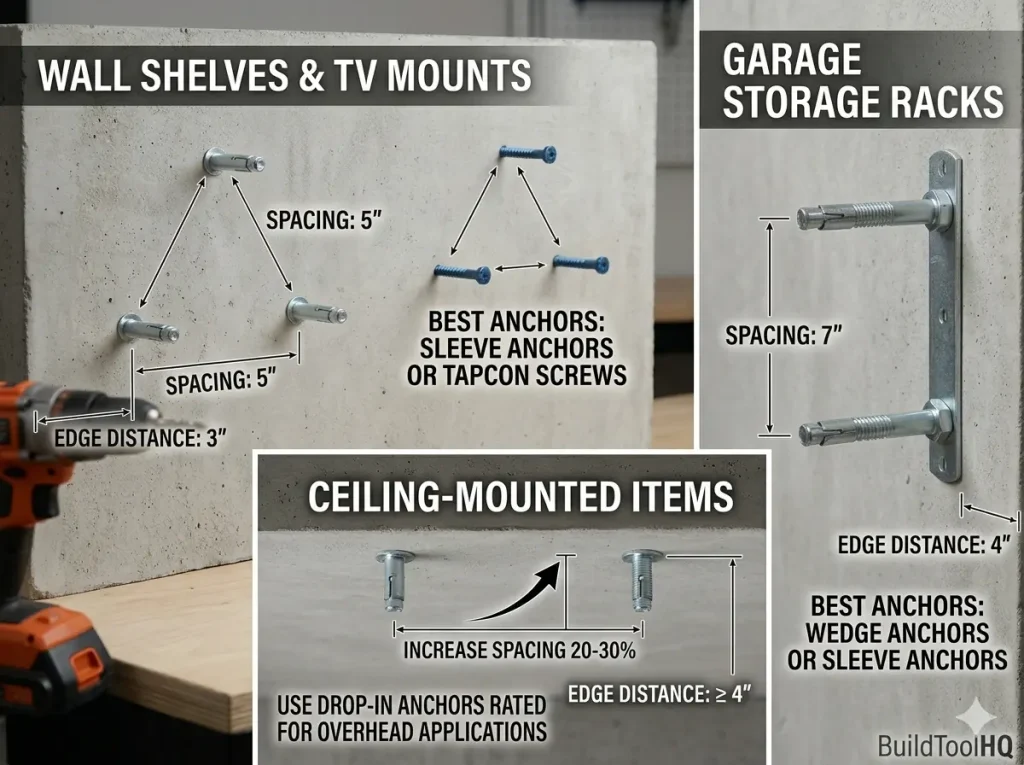
Wall Shelves & TV Mounts
- Edge distance: ≥ 2½″
- Anchor spacing: 4″–6″
- Best anchors: Sleeve anchors or Tapcon screws
Garage Storage Racks
- Edge distance: ≥ 3″
- Anchor spacing: 6″–8″
- Best anchors: Wedge anchors or sleeve anchors
Ceiling-Mounted Items
- Increase spacing by 20–30%
- Use drop-in anchors rated for overhead applications
Proper drilling technique is just as important as spacing. If you’re unsure your drill is suitable, see (Best Drill for Concrete Walls (2025 Guide)) before starting.
What Happens If Anchors Are Installed Too Close?
Ignoring spacing and edge-distance rules can lead to:
- ❌ Cracked or spalled concrete
- ❌ Reduced holding capacity
- ❌ Anchor pull-out under load
- ❌ Premature failure over time
Even light-duty installations can fail if anchors are clustered too tightly or installed near weak edges.
Brick & Block Spacing Considerations
Spacing rules change significantly when working with masonry instead of solid concrete.
- Brick: Install anchors only in mortar joints
- Concrete block (CMU): Use hollow-wall anchors or chemical anchors
- Spacing adjustment: Increase spacing by 25–50% compared to solid concrete
If you’re working with masonry, review (Can You Use Concrete Anchors in Brick or Block?) before drilling.
Common Spacing Mistakes to Avoid
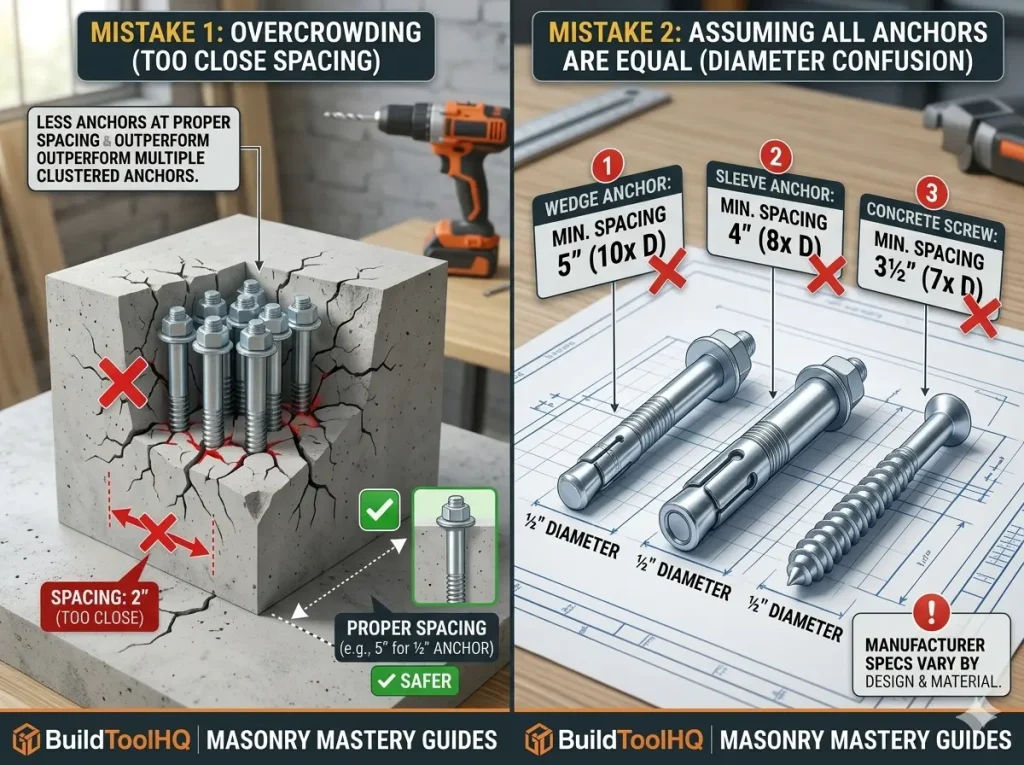
One of the most common homeowner mistakes is placing anchors too close together to compensate for heavy loads. In many cases, fewer anchors installed at proper spacing will outperform multiple anchors installed too close.
Another frequent error is assuming all anchors of the same diameter have identical spacing requirements. Manufacturer specifications vary by design and material, so always confirm requirements before drilling.
For a broader overview of installation errors, see (Common Mistakes When Installing Concrete Anchors (And How to Avoid Them)).
Final Takeaway
Correct concrete anchor spacing and edge distance are just as important as choosing the right anchor. When in doubt:
- Stay farther from edges
- Space anchors wider
- Use Tapcons or sleeve anchors near edges
Following these guidelines dramatically improves safety, holding strength, and long-term reliability for DIY and home-improvement projects.
For anchor selection, installation steps, and load guidance, cross-reference (Best Concrete Anchors for Home Use – 2026 Guide) before starting your project.
Related Concrete Anchor Guides
(Best Drill for Home Use – 2026 Guide)
(How to Install Concrete Anchors Correctly – Step-by-Step Guide)
(Concrete Anchor Selection Chart – Homeowner’s Quick Reference Guide)
(Types of Concrete Anchors Explained (Sleeve, Wedge, Drop-In, Tapcon))
Below are answers to the most common questions about concrete anchor spacing and edge distance.
FAQ – Concrete Anchor Spacing & Edge Distance
How far apart should concrete anchors be?
Most concrete anchors should be spaced at least 8–12 times the anchor diameter apart to maintain proper holding strength. For example, a 3/8-inch anchor typically requires about 3 to 4 inches of spacing between anchors. Proper spacing prevents stress in the concrete and reduces the risk of cracking.
For heavy loads or structural installations, manufacturers may recommend larger spacing distances, so always verify the anchor specifications before installation.
How close can a concrete anchor be to the edge?
Concrete anchors should typically be placed at least 5–10 anchor diameters away from the edge of the concrete.
For example:
| Anchor Diameter | Minimum Edge Distance |
|---|---|
| 1/4 inch | 1.5 – 2.5 inches |
| 3/8 inch | 2 – 3.5 inches |
| 1/2 inch | 3 – 5 inches |
Anchors placed too close to an edge may cause concrete breakout or cracking, especially when under load.
What happens if anchors are too close together?
If concrete anchors are installed too close together, several problems can occur:
- Reduced load capacity
- Concrete cracking or spalling
- Anchor pull-out failure
- Uneven load distribution
Spacing anchors properly allows the concrete around each anchor to fully develop its holding strength.
Does anchor type affect spacing requirements?
Yes. Different anchors require different spacing because they expand or grip the concrete differently.
For example:
| Anchor Type | Typical Spacing Requirement |
|---|---|
| Wedge anchors | 8–10 diameters |
| Sleeve anchors | 6–10 diameters |
| Concrete screws (Tapcon) | 6–8 diameters |
| Drop-in anchors | 8–12 diameters |
Always consult the manufacturer’s load charts for critical applications.
Do heavier loads require more anchor spacing?
Yes. When anchors carry heavier loads, increasing the spacing helps prevent the concrete failure zone of each anchor from overlapping.
For structural installations such as:
- railing posts
- steel brackets
- heavy equipment mounts
engineers may specify larger spacing distances than standard guidelines.
Can anchors be installed closer together in thicker concrete?
Thicker concrete can sometimes allow slightly reduced spacing, but the minimum recommended spacing should still be followed to maintain safe load capacity.
Concrete thickness mainly affects:
- embedment depth
- load capacity
- pull-out resistance
Spacing guidelines are still important to avoid cracking.