Tag: tapcon screws

  • Best Concrete Anchor Kits for Homeowners (2026 Review)

    Best Concrete Anchor Kits for Homeowners (2026 Review)

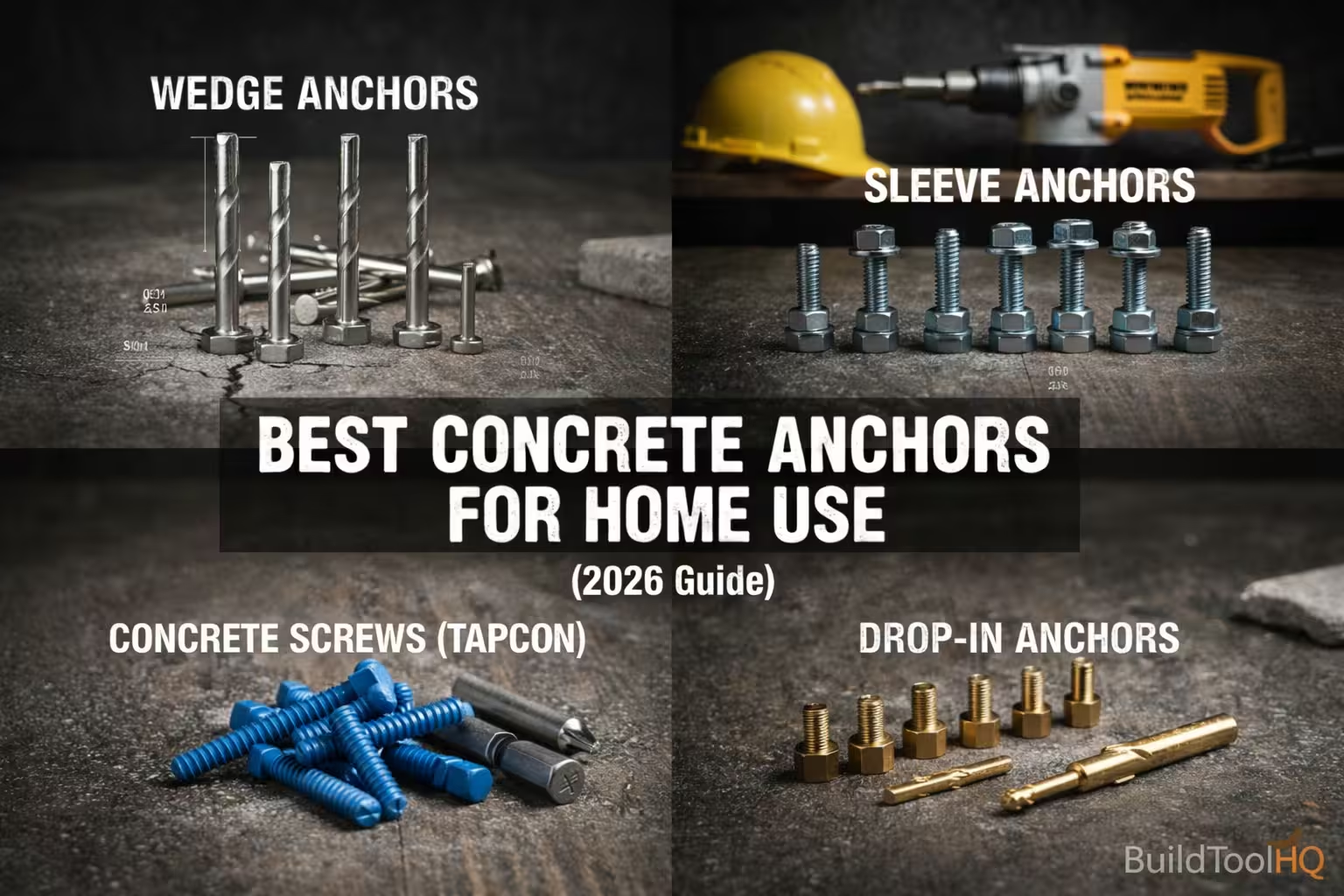
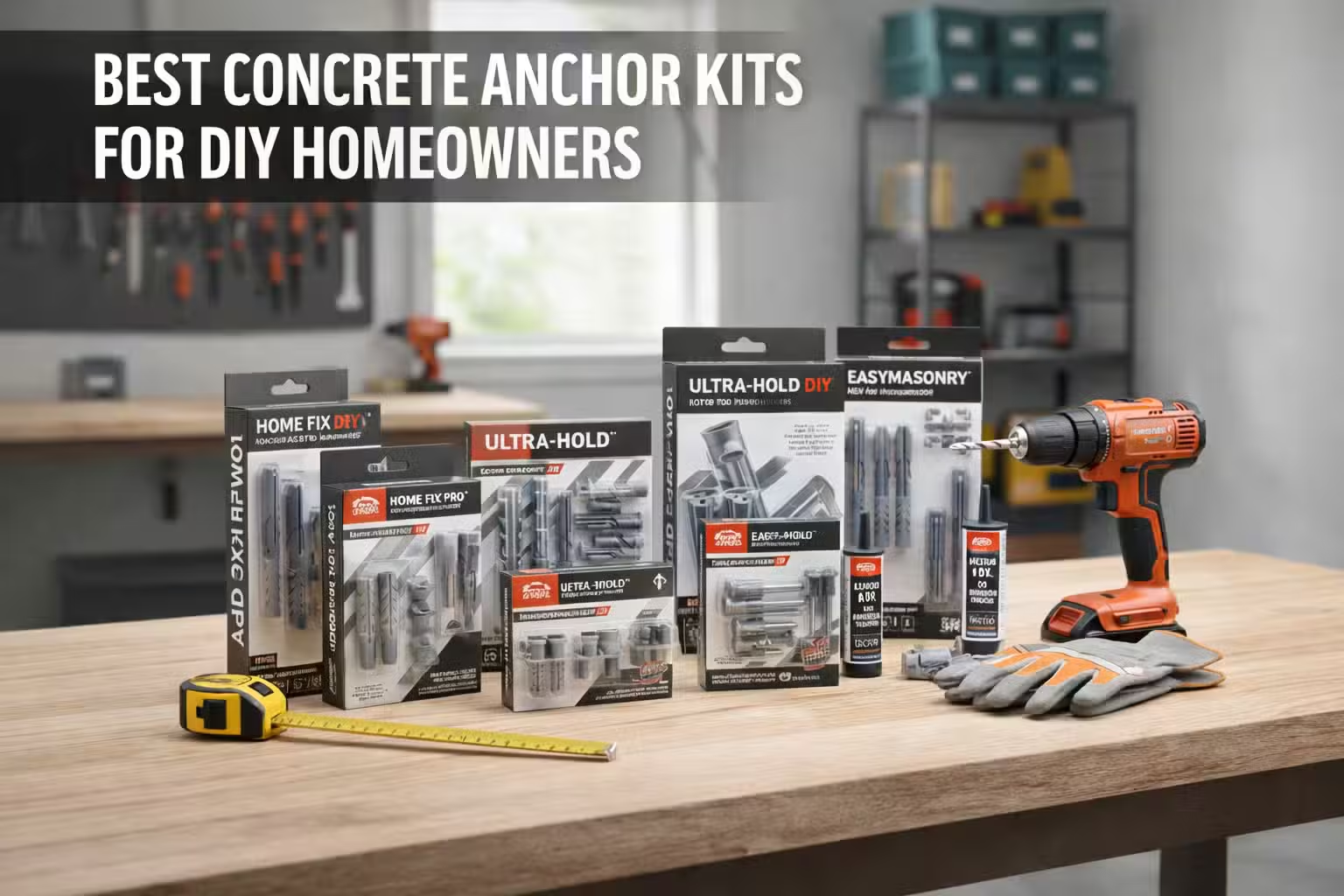
    The best concrete anchor kits for homeowners make it easier to tackle a wide range of DIY projects without buying anchors one by one. Whether you’re mounting shelves, securing a TV, installing garage storage, or working on light outdoor projects, a quality anchor kit provides the right sizes and anchor types for safe, reliable fastening in concrete and masonry.

    If you’re new to concrete anchoring, start with👉 (Best Concrete Anchors for Home Use – 2026 Guide) to understand anchor basics before choosing a kit.

    Ready to calculate your specific load limits? Try our free👉 Concrete Anchor Load Calculator.


    What Is a Concrete Anchor Kit?

    A concrete anchor kit is a bundled assortment of anchors designed to handle multiple household applications. Instead of buying individual fasteners for each project, a kit gives you a range of sizes and styles in one package.

    Most homeowner-focused kits include:

    • Tapcon-style concrete screws
    • Sleeve anchors
    • Small wedge anchors or drop-in anchors
    • Masonry drill bits (in higher-quality kits)

    If you’re unsure which anchor is best for each job, use👉 (Concrete Anchor Selection Chart – Homeowner’s Quick Reference Guide) before installing.


    Best Types of Concrete Anchor Kits for DIY Homeowners

    Not all anchor kits are created equal. The best homeowner kits prioritize versatility, safety, and ease of installation.


    1️⃣ Tapcon Screw Kits (Best for Light-Duty Projects)

    Tapcon screws are ideal for:

    • Wall-mounted shelves
    • TV mounts into concrete
    • Wood-to-concrete fastening

    They’re quick to install, removable, and forgiving for DIY use. However, they are not designed for heavy structural loads.

    For a full comparison, see👉 (Tapcon Screws vs Concrete Anchors: Which Should You Use?).


    2️⃣ Sleeve Anchor Kits (Best All-Around Option)

    Sleeve anchors are the most versatile anchors found in homeowner kits. They perform well in:

    • Solid concrete
    • Brick
    • Concrete block (CMU)

    Because sleeve anchors distribute expansion forces more evenly, they’re safer for mixed masonry projects.

    If you plan to anchor into masonry, read👉 (Can You Use Concrete Anchors in Brick or Block?) before choosing wedge anchors.


    3️⃣ Wedge Anchor Kits (For Heavier Loads)

    Some premium kits include small wedge anchors for:

    • Deck posts
    • Railings
    • Structural brackets

    Wedge anchors provide the highest holding strength, but they require proper drilling, spacing, and edge distance.

    Before using them, review👉 (How Much Weight Can Concrete Anchors Hold?) to confirm safety limits.


    What to Look for in the Best Concrete Anchor Kits (2026)

    When comparing kits, focus on quality and usability, not just the number of pieces.


    ✔ Multiple Sizes

    A good homeowner kit should include at least:

    • 3/16″
    • 1/4″
    • 3/8″

    Using the correct size allows you to match anchor strength to the job instead of over- or under-engineering.


    ✔ Clear Load Ratings

    Avoid kits that don’t specify load capacity. Improper load matching is one of the most common DIY mistakes, explained in👉 (Common Concrete Anchor Mistakes (And How to Avoid Them)).


    ✔ Corrosion Resistance

    For garages, basements, or outdoor projects, zinc-plated or stainless anchors last significantly longer.


    ✔ Correct Drill Bits Included

    Using the wrong drill bit can ruin anchor performance. Always match bit size exactly, as explained in👉 (What Size Drill Bit for Concrete Anchors?).

    If you’re unsure your drill is suitable, review👉 (Best Drill for Concrete Walls (2025 Guide)) or👉 (Best Drill for Home Use (2026 Guide)) before starting.


    Are Concrete Anchor Kits Safe for Heavy Loads?

    Concrete anchor kits are best suited for light to medium-duty household projects. For overhead or safety-critical applications—such as suspended piping, water heaters, or structural steel—individual anchors rated for the exact load are safer than general-purpose kits.

    Spacing and edge distance also matter. Poor placement weakens even strong anchors, so review👉 (Concrete Anchor Spacing & Edge Distance: How Far Apart Should Anchors Be?) before heavier installations.


    Installation Tips for Kit-Based Anchors

    Even the best anchor kit will fail if installed incorrectly. Always:

    • Drill to the correct depth
    • Clean dust from the hole
    • Avoid cracked or deteriorated concrete
    • Tighten anchors to recommended torque

    For a complete walkthrough, follow👉 (How to Install Concrete Anchors Correctly – Step-by-Step Guide).


    Final Verdict: Are Concrete Anchor Kits Worth It?

    Yes—for most DIY homeowners.

    Concrete anchor kits save money, reduce trips to the hardware store, and ensure you always have the right fastener on hand. The best kits combine Tapcon screws and sleeve anchors, cover multiple sizes, and provide clear load guidance.

    For heavy or safety-critical installations, individual anchors remain the better choice—but for everyday home projects, a quality concrete anchor kit is one of the most practical additions to your toolbox.


    Frequently Asked Questions

    Q: Are concrete anchor kits strong enough for home use?
    A: Yes. Most kits are designed for light to medium-duty household projects such as shelves, TV mounts, and garage storage.

    Q: What anchor types are usually included in concrete anchor kits?
    A: Most kits include Tapcon screws, sleeve anchors, and sometimes wedge or drop-in anchors in multiple sizes.

    Q: Can I use concrete anchor kits in brick or block?
    A: Some anchors in kits work in brick or CMU, but sleeve anchors are usually the safest option for masonry applications.
    Related Concrete Anchor Guides

  • How to Install Concrete Anchors Correctly (Step-by-Step Guide)

    How to Install Concrete Anchors Correctly (Step-by-Step Guide)

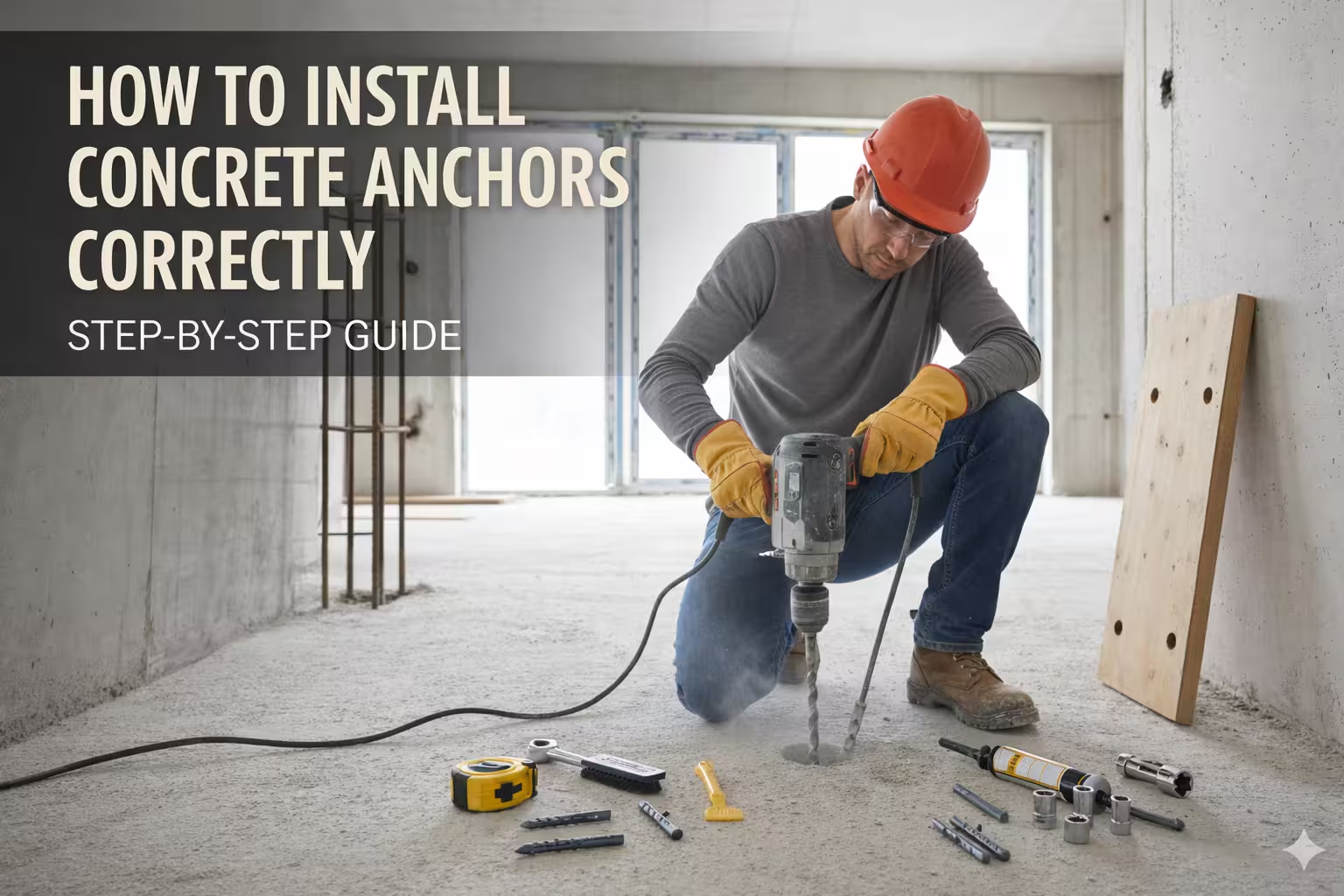
    Installing concrete anchors correctly is critical for safety, strength, and long-term durability. Even the best anchor can fail if it’s installed improperly. This step-by-step guide explains how to install concrete anchors correctly, whether you’re mounting shelves, TVs, electrical panels, or heavy equipment.

    If you haven’t chosen an anchor yet, start with (Best Concrete Anchors for Home Use (2026 Guide)) before drilling.


    Tools and Materials You’ll Need

    Before starting, gather the following:

    • Hammer drill or rotary hammer
    • Correct masonry drill bit
    • Concrete anchors (wedge, sleeve, drop-in, or Tapcon)
    • Vacuum, compressed air, or hole-cleaning brush
    • Wrench or torque wrench
    • Safety glasses and gloves

    If you’re unsure about drill bit sizing, review (What Size Drill Bit for Concrete Anchors?) first.


    Step 1: Mark Anchor Locations Carefully

    Begin by marking your anchor locations with a pencil or marker. Make sure anchors are spaced correctly and not too close to slab edges.

    Incorrect spacing is one of the most common causes of anchor failure. Always follow spacing guidelines in (Concrete Anchor Spacing & Edge Distance Guide) before drilling.


    Step 2: Drill the Hole to the Correct Size and Depth

    Use a hammer drill with the correct masonry bit. Drill straight and perpendicular to the surface.

    Key drilling tips:

    • Drill slightly deeper than the anchor embedment length
    • Do not wobble the drill bit
    • Avoid drilling into cracked or weak concrete

    If you’re unsure whether your drill is suitable, see (Best Drill for Concrete Walls (2025 Guide)).


    Step 3: Clean the Hole Thoroughly (Critical Step)

    Hole cleaning is not optional. Dust left inside the hole prevents anchors from expanding or gripping properly.

    Clean the hole using:

    • Compressed air
    • A vacuum
    • A wire hole-cleaning brush

    Skipping this step can reduce holding power by 30–50%. This mistake is explained in (Common Concrete Anchor Mistakes (And How to Avoid Them)).


    Step 4: Insert the Anchor Correctly

    Insert the anchor according to its type:

    Wedge Anchors

    Tap the anchor into the hole until fully seated, then tighten the nut to expand the wedge.

    Sleeve Anchors

    Insert the anchor through the fixture and into the hole, then tighten gradually.

    Drop-In Anchors

    Insert the anchor flush with the surface and use a setting tool to expand it.

    Tapcon Screws

    Drive the screw directly into the pre-drilled hole without over-tightening.

    For a breakdown of anchor types, see (Types of Concrete Anchors Explained (Wedge, Sleeve, Drop-In, Tapcon)).


    Step 5: Tighten to the Correct Torque

    Over-tightening is one of the fastest ways to damage concrete or strip anchors.

    • Tighten only to manufacturer specifications
    • Use a torque wrench when possible
    • Stop immediately if the anchor spins or cracks appear

    For strength limits, refer to (How Much Weight Can Concrete Anchors Hold?).


    Step 6: Inspect the Installation

    After tightening, check for:

    • No movement or wobble
    • No visible cracks in the concrete
    • Proper seating of the anchor head

    If the anchor spins or feels loose, remove it and install a new anchor in a different location.


    Special Considerations for Brick and Block

    Concrete anchors do not behave the same way in brick or block. Installing into the wrong area can cause bricks to crumble or hollow block to fail.

    If you’re working with masonry, read (Can You Use Concrete Anchors in Brick or Block?) before installing.


    Common Installation Mistakes to Avoid

    Avoid these frequent errors:

    • Using the wrong drill bit size
    • Skipping hole cleaning
    • Installing too close to edges
    • Over-tightening anchors
    • Anchoring into cracked concrete

    Each of these mistakes can significantly reduce holding power or cause sudden failure.


    Final Installation Tips for Homeowners

    If you remember only three rules:

    1. Drill the correct hole size
    2. Clean the hole thoroughly
    3. Do not over-tighten

    Following these steps ensures your anchors perform at their rated strength and remain secure over time.

    For a quick decision overview, bookmark (Concrete Anchor Selection Chart (Homeowner’s Quick Reference Guide)).


    When to Call a Professional

    For structural loads, overhead installations, or safety-critical equipment, consider hiring a licensed professional. Incorrect anchor installation in these cases can result in serious injury or property damage.

  • Can You Use Concrete Anchors in Brick or Block? (What You Need to Know)

    Can You Use Concrete Anchors in Brick or Block? (What You Need to Know)

    Can you use concrete anchors in brick or block the same way you would in solid concrete? Many homeowners assume the answer is yes, but that assumption often leads to cracked masonry, loose fixtures, or complete anchor failure.

    While some concrete anchors can be used in masonry, brick and concrete block behave very differently than poured concrete and require more careful anchor selection.

    This guide explains when concrete anchors are safe to use in brick or block, which anchor types work best, and what mistakes to avoid so your installation remains secure and damage-free.


    Concrete vs Brick vs Concrete Block: Why Material Matters

    Before choosing any anchor, it’s important to understand how these materials differ:

    • Concrete: Dense, solid, and strong in compression
    • Brick: Brittle, may be solid or hollow, prone to cracking
    • Concrete block (CMU): Hollow cores with thinner outer walls

    Anchors rated for solid concrete may not perform safely in brick or block, especially when load forces are involved. Understanding these differences is critical before selecting anchors outlined in (Types of Concrete Anchors Explained (Wedge, Sleeve, Drop-In, Tapcon)).


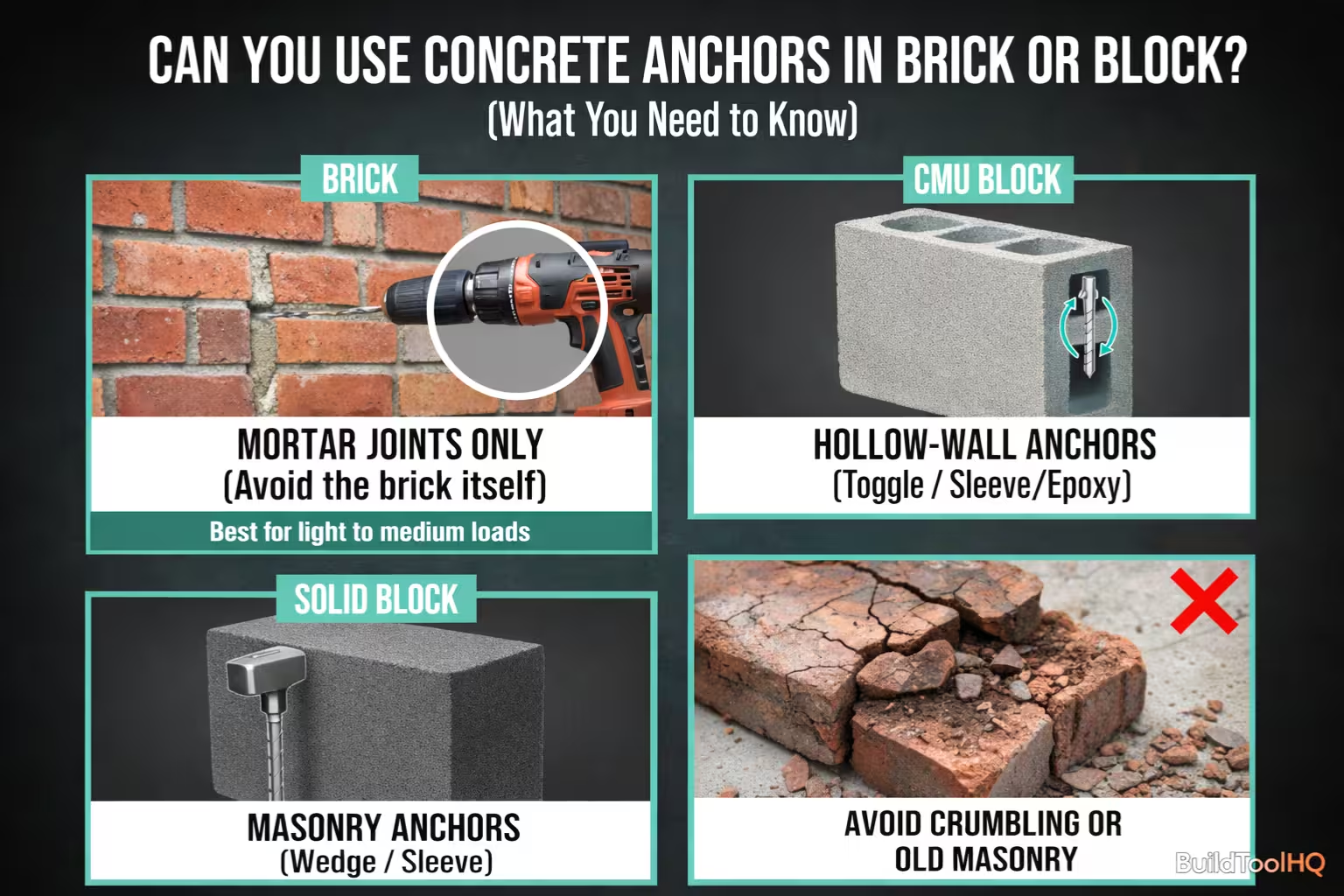
    Can You Use Concrete Anchors in Brick?

    ⚠️ Sometimes — but only with caution

    Brick cracks easily under expansion pressure. Expansion-style anchors can split brick faces or damage mortar joints if the wrong anchor is used.

    Anchors that MAY work in brick:

    • Sleeve anchors (light to medium loads)
    • Masonry screws (Tapcon-style)
    • Plastic anchors (very light-duty only)

    Anchors to AVOID in brick:

    • Large wedge anchors
    • Heavy expansion anchors

    Improper anchor selection in brick is one of the most common failure causes discussed in (Common Mistakes When Installing Concrete Anchors (And How to Avoid Them)).


    Can You Use Concrete Anchors in Concrete Block?

    ⚠️ Only specific anchors work safely

    Concrete block is hollow, meaning traditional expansion anchors may expand into empty space instead of gripping solid material.

    Best anchor options for concrete block:

    • Sleeve anchors with shallow embedment
    • Masonry screws
    • Toggle or specialty hollow-wall anchors
    • Chemical anchors (for higher loads)

    Before selecting anchors, compare options using (Concrete Anchor Selection Chart (Homeowner’s Quick Reference Guide)) to ensure compatibility with hollow masonry.


    Should You Drill Into Brick or Mortar?

    This decision directly affects strength and repairability.

    Drilling into brick:

    • Stronger hold (if brick is solid)
    • Higher risk of cracking

    Drilling into mortar:

    • Easier to repair
    • Lower holding strength

    For light-duty applications, mortar may be acceptable. For heavier loads, always verify anchor capacity using (How Much Weight Can Concrete Anchors Hold?) before drilling.


    Best Anchor Types for Masonry Applications

    Base MaterialRecommended Anchors
    Solid concreteWedge, sleeve, drop-in
    BrickSleeve anchors, masonry screws
    Concrete blockSleeve anchors, toggles, chemical anchors

    Correct installation is just as important as anchor choice. Always follow procedures outlined in (How to Install Concrete Anchors Correctly – Step-by-Step Guide).


    Installation Tips for Brick and Block

    Masonry requires a gentler approach than solid concrete.

    • Use smaller-diameter anchors
    • Drill slowly to prevent cracking
    • Avoid expansion-heavy anchors
    • Clean holes thoroughly
    • Never overtighten

    Overtightening is especially dangerous in brick and block and is covered in detail in (Common Mistakes When Installing Concrete Anchors (And How to Avoid Them)).


    Tool Selection Matters More Than You Think

    Using the wrong drill or bit increases the risk of cracking brick or damaging block. Hammer drills should be used carefully, and bit size must match the anchor exactly.

    If you’re unsure whether your drill is suitable, review (Best Drill for Concrete Walls (2025 Guide)) before starting.


    When NOT to Use Concrete Anchors in Masonry

    Do not use standard concrete anchors if:

    • Brick is cracked, spalling, or weathered
    • Block cores are thin or damaged
    • Load is structural or overhead
    • Manufacturer does not list masonry compatibility

    In these situations, professional guidance or specialty anchoring systems are strongly recommended.


    Can You Use Concrete Anchors in Brick or Block for Heavy Loads?

    For heavy loads such as wall-mounted TVs, cabinets, or overhead fixtures, using concrete anchors in brick or block requires extra caution. Masonry does not distribute expansion forces the same way solid concrete does, which is why anchor type, placement, and spacing are critical.

    Always confirm load ratings and spacing rules using (Best Concrete Anchors for Home Use – 2026 Guide) before attempting heavier installations.


    Final Thoughts

    While some concrete anchors can be used in brick or block, anchors are not interchangeable across materials. Choosing the wrong anchor can result in cracking, failure, or unsafe installations.

    Always match the anchor type to:

    • The base material
    • The load being supported
    • The installation method

    For anchor comparisons, installation steps, spacing rules, and load guidance, refer back to (How Much Weight Can Concrete Anchors Hold? (Load Ratings Explained)) before starting your project.


    Related Concrete Anchor Guides


  • Common Mistakes When Installing Concrete Anchors (And How to Avoid Them)

    Common Mistakes When Installing Concrete Anchors (And How to Avoid Them)

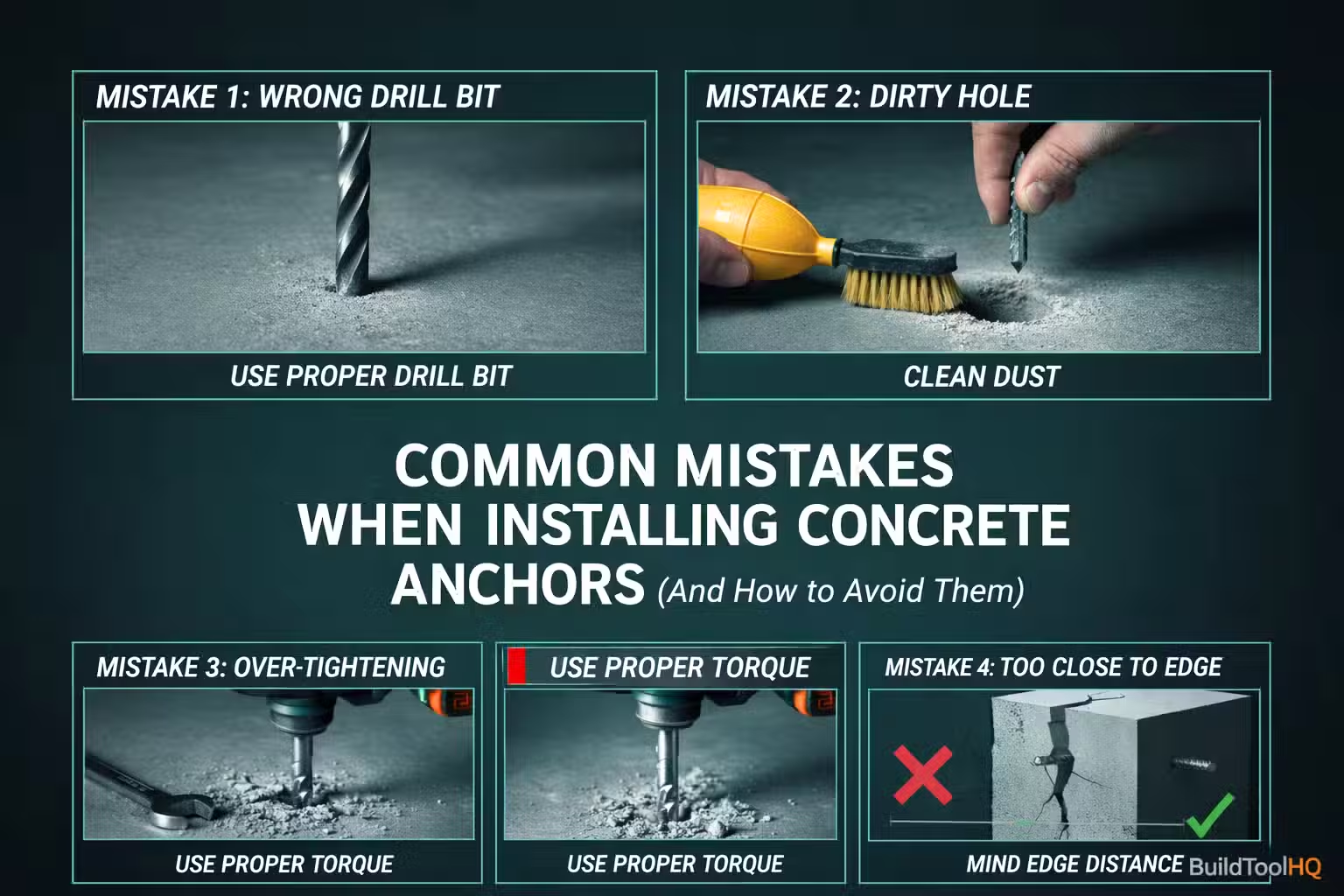
    Common mistakes when installing concrete anchors can dramatically reduce holding strength or cause anchor failure, even when using high-quality fasteners. In most cases, anchor problems aren’t caused by the anchor itself—but by avoidable installation errors that compromise safety and performance.

    This guide covers the most common mistakes homeowners make when installing concrete anchors and explains how to avoid them using proven best practices.


    Why Installation Mistakes Matter

    Concrete anchors rely on precise drilling, correct embedment, and proper expansion to achieve their rated strength. Even anchors selected using (Best Concrete Anchors for Home Use – 2026 Guide) can fail prematurely if installation steps are skipped or done incorrectly.

    Common consequences of installation mistakes include:

    • Reduced load capacity
    • Anchor spinning or pull-out
    • Cracked or damaged concrete
    • Unsafe overhead installations

    Mistake #1: Using the Wrong Drill Bit Size

    One of the most frequent—and damaging—errors is drilling the wrong hole diameter.

    • Oversized holes prevent proper expansion
    • Undersized holes cause binding or concrete cracking

    Always match the drill bit exactly to the anchor size, as explained in (What Size Drill Bit for Concrete Anchors?).

    ✅ How to avoid it

    Never “eyeball” drill bits. Verify the anchor diameter and use the manufacturer-specified bit.


    Mistake #2: Skipping Hole Cleaning

    Dust and debris left inside the hole reduce friction and prevent anchors from gripping properly. This mistake is especially common with expansion-style anchors.

    This issue is frequently seen with anchors outlined in (Types of Concrete Anchors Explained (Wedge, Sleeve, Drop-In, Tapcon)).

    ✅ How to avoid it

    Vacuum, blow out, or brush the hole thoroughly before inserting the anchor.


    Mistake #3: Drilling Too Shallow or Too Deep

    Incorrect hole depth directly affects anchor performance:

    • Too shallow → anchor won’t seat fully
    • Too deep → anchor may not expand as designed

    This impacts load capacity and long-term reliability.

    ✅ How to avoid it

    Drill slightly deeper than the anchor length (usually about ¼″) and keep the drill straight.


    Mistake #4: Overtightening the Anchor

    Many DIYers assume tighter is stronger—but overtightening can:

    • Strip threads
    • Crack surrounding concrete
    • Reduce holding strength

    This mistake is especially common with Tapcon screws and wedge anchors.

    ✅ How to avoid it

    Tighten until snug and stop when resistance becomes firm. Use hand tools instead of high-torque impact drivers whenever possible.


    Mistake #5: Installing Anchors Too Close to Concrete Edges

    Concrete edges are weaker and more prone to cracking. Anchors placed too close to edges increase the risk of:

    • Concrete spalling
    • Anchor pull-out

    Correct spacing is critical and often overlooked.

    ✅ How to avoid it

    Follow edge distance and spacing rules outlined in (Concrete Anchor Spacing & Edge Distance Guide).


    Mistake #6: Using the Wrong Anchor for the Load

    Not all anchors are designed to handle the same loads. For example:

    • Tapcon screws → light-duty applications
    • Sleeve anchors → medium loads
    • Wedge anchors → heavy structural loads

    Using the wrong anchor can result in failure even if installed correctly.

    ✅ How to avoid it

    Match the anchor type to the application using (Concrete Anchor Selection Chart (Homeowner’s Quick Reference Guide)) and verify load limits before installation.


    Mistake #7: Installing Anchors in Weak or Damaged Concrete

    Cracked, old, or crumbly concrete dramatically reduces anchor performance. Even properly installed anchors may fail if the base material itself is compromised.

    ✅ How to avoid it

    Inspect the surface carefully. If concrete crumbles during drilling, consider relocating the anchor or using alternative mounting methods.


    Mistake #8: Ignoring Manufacturer Instructions

    Anchor specifications vary by:

    • Brand
    • Diameter
    • Material
    • Installation method

    Relying on “experience” instead of instructions is a common cause of failure.

    ✅ How to avoid it

    Always follow manufacturer guidelines and compare them with the step-by-step process in (How to Install Concrete Anchors Correctly – Step-by-Step Guide).


    When Installation Mistakes Become Safety Hazards

    Installation errors are especially dangerous for:

    • Overhead anchors
    • Wall-mounted TVs and furniture
    • Garage storage systems
    • Structural attachments

    These applications require strict adherence to load limits and best practices.


    Final Thoughts

    Most concrete anchor failures are completely preventable. By avoiding common mistakes—wrong drill bit size, poor hole cleaning, overtightening, improper spacing, and incorrect anchor selection—you can achieve the full rated strength of your anchors and ensure long-term safety.

    For anchor selection, installation, spacing, and load guidance, refer back to (Best Concrete Anchors for Home Use – 2026 Guide).


    Related Concrete Anchor Guides

  • How Much Weight Can Concrete Anchors Hold? (Load Ratings Explained)🧱⚙️

    How Much Weight Can Concrete Anchors Hold? (Load Ratings Explained)🧱⚙️

    If you’ve ever asked How Much Weight Can Concrete Anchors Hold, you’re not alone. Homeowners, DIYers, contractors, and installers ask this question every day before mounting shelves, TVs, railings, cabinets, gym equipment, or structural fixtures.

    The truth is that How Much Weight Can Concrete Anchors Hold depends on several scientific factors: anchor type, diameter, embedment depth, concrete strength, spacing, edge distance, installation quality, and the direction of force.

    That means there is no one-size-fits-all answer.

    Ready to calculate your specific load limits? Try our free👉 Concrete Anchor Load Calculator.

    In this complete guide, we’ll explain How Much Weight Can Concrete Anchors Hold using real engineering principles, comparison tables, safety margins, and practical examples.

    For top product picks first, visit 👉 (Best Concrete Anchors for Home Use (2026 Guide)).


    Quick Answer: How Much Weight Can Concrete Anchors Hold 🏆

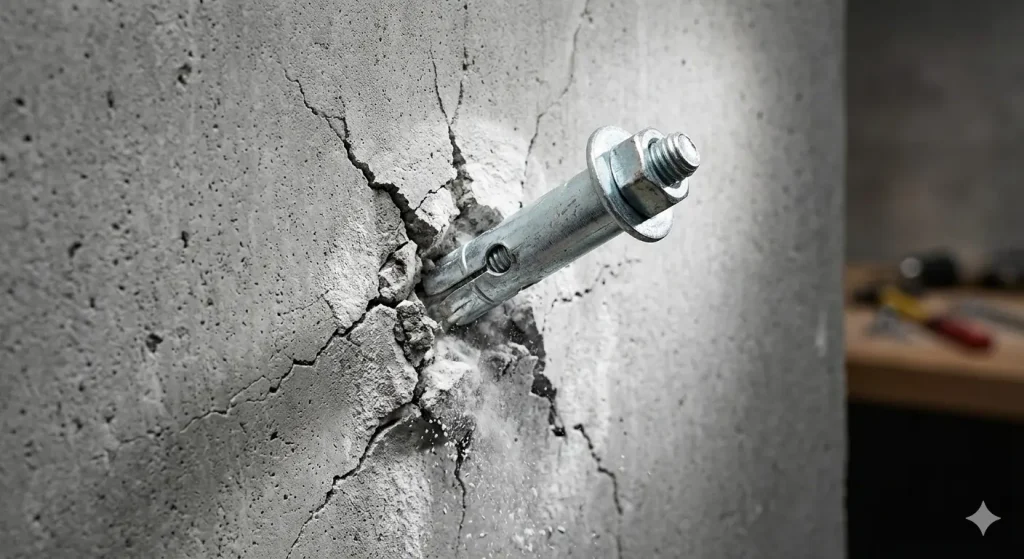
    A dramatic, vivid close-up photograph of a silver sleeve anchor that has partially failed in a grey concrete wall. The central focus is the massive, star-shaped cracks spiderwebbing dramatically outward from the base of the anchor. A prominent cloud of stark white concrete dust contrasts sharply with the darker grey concrete, emphasizing the fracture and breakout failure. The scene is illuminated by a focused work light. How Much Weight Can Concrete Anchors Hold?
    This is what failure looks like: Exceeding an anchor’s rated load can cause dramatic concrete breakout, ruining your wall and potentially dropping heavy fixtures. Avoid this by understanding proper loading and safety factors.

    Most properly installed concrete anchors can hold anywhere from:

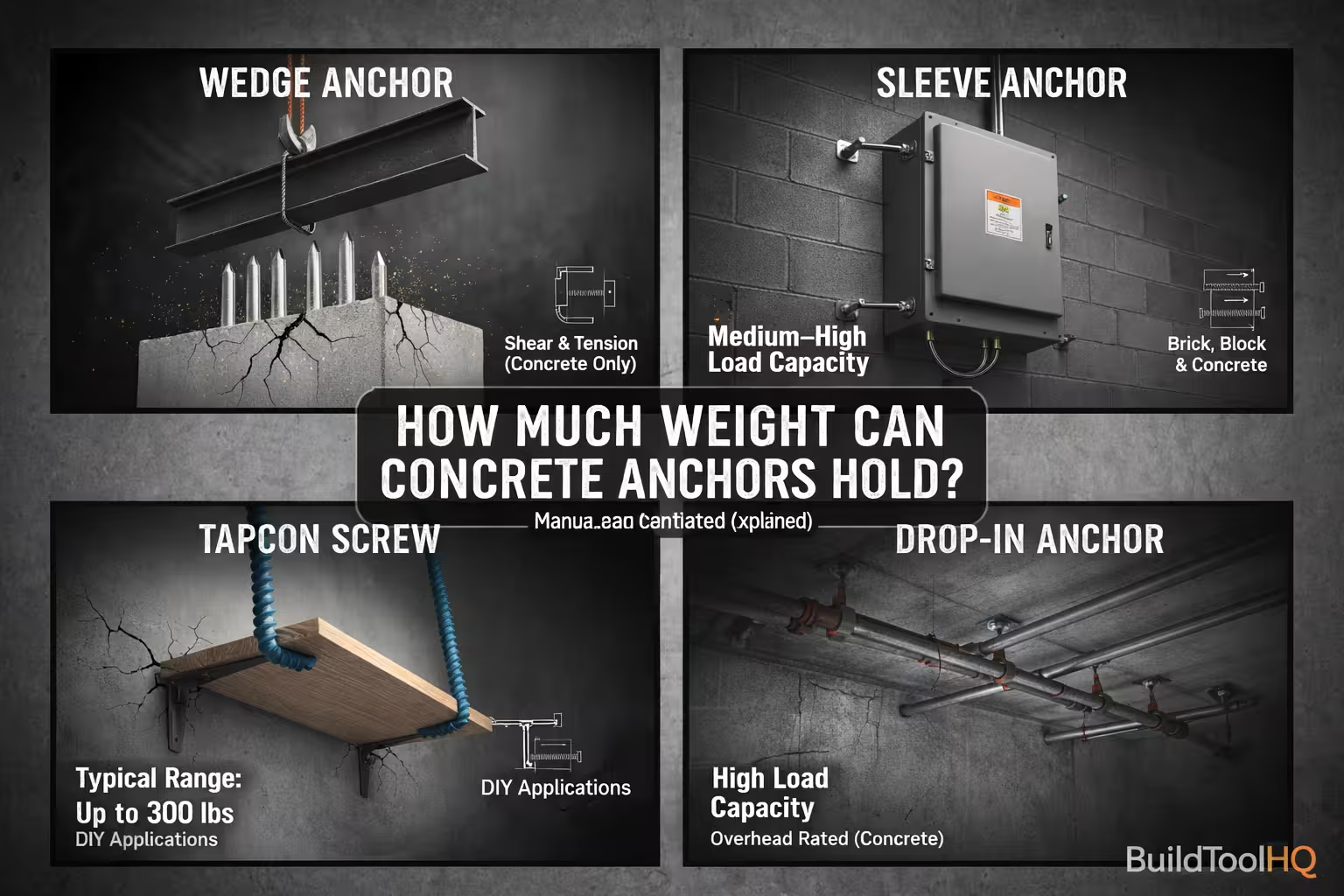
    Anchor TypeApprox Light DutyMedium DutyHeavy Duty
    Plastic Anchor10–30 lbs
    Tapcon Screw50–250 lbs300+ lbsDepends
    Sleeve Anchor100–400 lbs500+ lbsModerate
    Wedge Anchor250–1,000+ lbs2,000+ lbsExcellent
    Drop-In Anchor200–800 lbs1,500+ lbsStrong

    So when asking How Much Weight Can Concrete Anchors Hold, the real answer is: it depends on the anchor system and installation conditions.


    Why There Is No Single Number 🔬

    Many people search How Much Weight Can Concrete Anchors Hold expecting one exact answer. But load ratings are affected by multiple variables:

    Main Variables:

    • Anchor diameter
    • Anchor length
    • Embedment depth
    • Concrete PSI strength
    • Distance from edge
    • Spacing between anchors
    • Static vs dynamic load
    • Shear vs pull-out force
    • Proper torque during install
    • Cracked vs non-cracked concrete

    That’s why two anchors of the same size may hold different loads in different slabs.


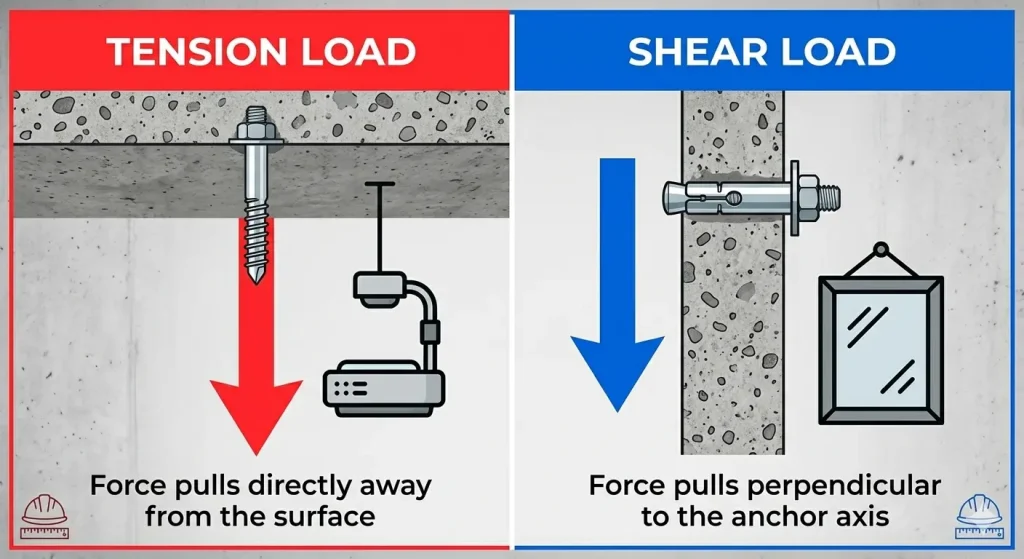
    Tensile Load vs Shear Load Explained 📐

    To understand How Much Weight Can Concrete Anchors Hold, you need to know the two main force directions.

    Load TypeMeaningExample
    Tensile LoadPulling straight outHanging shelf
    Shear LoadSideways forceWall bracket
    A high-contrast technical infographic split vertically. The overall background is the grey concrete texture established in image_8.png and image_9.png. The left side, labeled "TENSION LOAD" in bold white text on a bright red header banner, shows a wedge anchor (like image_8.png) installed in a concrete ceiling. A large, thick, vivid scarlet arrow points straight down, pulling directly away from the ceiling, representing tension. A high-quality graphic icon of a heavy overhead projector hangs from the anchor. The right side, labeled "SHEAR LOAD" in bold white text on a bright blue header banner, shows a sleeve anchor (like image_9.png) installed in a vertical concrete wall. A large, thick, vivid royal blue arrow points straight down, parallel to the wall, representing shear. A high-quality graphic icon of a heavy framed mirror hangs from the anchor. Small graphic icons of safety helmets and rulers are subtly integrated into the bottom corners of each panel. The lighting is bright and even, making the colors pop intensely. The diagram is clear, intuitive, and highly eye-catching.
    To understand an anchor’s true capacity, you must know the direction of force. This diagram highlights the critical difference between Tension Load (pulling out) and Shear Load (sliding down).

    Example:

    A wedge anchor may hold:

    • 1,200 lbs tensile
    • 2,000 lbs shear

    This is why How Much Weight Can Concrete Anchors Hold depends on how the force is applied.


    Anchor Type Matters Most ⚙️

    One of the biggest factors in How Much Weight Can Concrete Anchors Hold is anchor type.

    Common Anchor Types:

    Anchor TypeStrength LevelBest Use
    TapconMediumShelves, brackets
    Sleeve AnchorMedium-HighFixtures
    Wedge AnchorHighHeavy loads
    Drop-In AnchorHighMachinery
    Plastic PlugLowVery light duty

    Learn more in 👉 (Types of Concrete Anchors Explained (Wedge, Sleeve, Drop-In, Tapcon))


    How Much Weight Can Concrete Anchors Hold by Diameter 📏

    Larger anchors generally hold more weight.

    DiameterTypical Capacity Range
    1/4″Light to medium
    3/8″Medium to heavy
    1/2″Heavy
    5/8″+Very heavy

    When researching How Much Weight Can Concrete Anchors Hold, diameter is one of the first specifications engineers check.


    Embedment Depth Changes Everything 🧱

    Embedment depth means how deep the anchor sits in solid concrete.

    Shallow embedment = less holding power.
    Deeper embedment = stronger load capacity.

    Example:

    A 3/8″ wedge anchor at 2″ depth may hold far less than the same anchor at 3.5″ embedment.

    That means How Much Weight Can Concrete Anchors Hold is directly tied to drilling depth and proper hole cleaning.

    Need proper drilling specs? Read 👉 (What Size Drill Bit for Concrete Anchors?)


    Concrete Strength (PSI) Matters 🔬

    Concrete is not all the same.

    Concrete PSITypical Strength
    2,500 PSILight residential
    3,000 PSIStandard
    4,000 PSIStrong residential
    5,000+ PSICommercial

    Higher PSI concrete resists breakout forces better.

    So if you ask How Much Weight Can Concrete Anchors Hold, concrete strength is a major part of the answer.


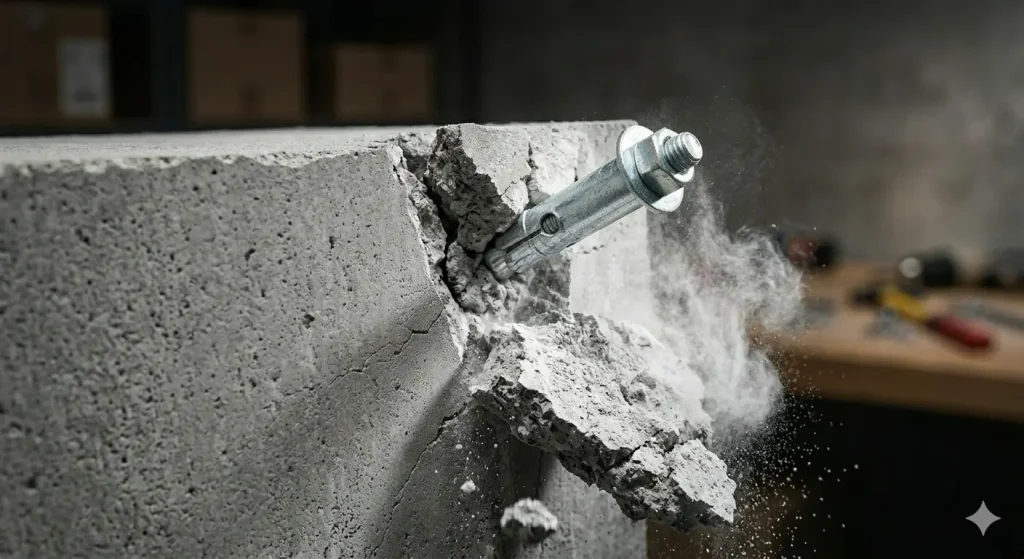
    Edge Distance Can Reduce Strength ⚠️

    An extreme close-up photograph capturing catastrophic concrete edge failure on a rough, grey foundation wall, referencing the specific anchor model and texture from image_16.png. A single polished silver wedge anchor, identical to the style in image_16.png, is installed precariously close to the upper corner of the concrete slab. Instead of just a large crack, this image shows a substantial, complex section of the concrete corner completely sheared away, leaving a jagged, exposed fracture zone of broken aggregate. The wedge anchor, its expanding mechanism fully deployed and biting into the remaining solid material, is now completely exposed and hanging over the new edge. A heavy, prominent cloud of bright white concrete dust, contrasting sharply with the dark grey concrete, is suspended in the air around the fresh fracture. Small concrete chunks are visible below the failure. Dramatic work lighting from the right highlights the raw textures and destructive failure. The background is a softly blurred, dimly lit workshop workbench with tools and boxes.
    Installing an anchor too close to an edge is a recipe for disaster. As this wedge anchor demonstrates, exceeding the safe edge distance causes total catastrophic failure—literally breaking the corner off the concrete slab.

    Anchors placed too close to an edge may crack concrete under load.

    Example:

    An anchor near slab edge may fail long before its rated load.

    This is why professional installers always calculate edge spacing.

    Read 👉(Concrete Anchor Spacing & Edge Distance Guide)

    Whenever people ask How Much Weight Can Concrete Anchors Hold, edge distance is often overlooked.


    Spacing Between Anchors 🧰

    Two anchors installed too close together can weaken each other.

    Instead of doubling capacity, poor spacing may reduce total strength.

    Example:

    4 anchors badly spaced ≠ 4x strength.

    This is another reason How Much Weight Can Concrete Anchors Hold depends on layout, not just anchor size.


    Cracked vs Non-Cracked Concrete 🪨

    Concrete with existing cracks may have lower holding power.

    Examples:

    • Old basement floors
    • Exterior freeze/thaw slabs
    • Expansion crack zones

    A cracked slab may significantly reduce anchor performance.

    So the question How Much Weight Can Concrete Anchors Hold changes if concrete condition is poor.


    Indoor vs Outdoor Anchors 🌧️

    Moisture, corrosion, and freeze cycles matter.

    Outdoor Recommendations:

    • Stainless steel anchors
    • Hot-dip galvanized hardware
    • Corrosion-resistant fasteners

    Rust can weaken anchor systems over time. Long-term durability is part of How Much Weight Can Concrete Anchors Hold.


    Real Homeowner Examples 🏠

    TV Wall Mount

    Load: 70 lbs static
    Recommended: Multiple Tapcons or sleeve anchors

    Garage Shelf

    Load: 200 lbs distributed
    Recommended: Sleeve or wedge anchors

    Stair Rail

    Load: Human impact force
    Recommended: Wedge anchors

    Home Gym Rack

    Load: Dynamic shock load
    Recommended: Heavy wedge anchors

    This shows why How Much Weight Can Concrete Anchors Hold must include real-world usage, not just numbers.


    Dynamic Load vs Static Load ⚡

    Static load = weight sitting still.
    Dynamic load = movement, vibration, shock.

    Examples of dynamic load:

    • Pull-up bars
    • Garage racks with movement
    • Railings
    • Machinery

    Dynamic loads need larger safety margins.

    When asking How Much Weight Can Concrete Anchors Hold, dynamic force is critical.


    Safety Factor Rule 📊

    A responsible approach to load ratings is critical. If you are struggling with the engineering concepts of anchor selection, or want to see a demonstration of safety factors in the real world, the best resource on the internet is Essential Craftsman. In the video below, Scott explains precisely why safety factors matter and how to visualize failure so you can make confident, safe anchor selections.

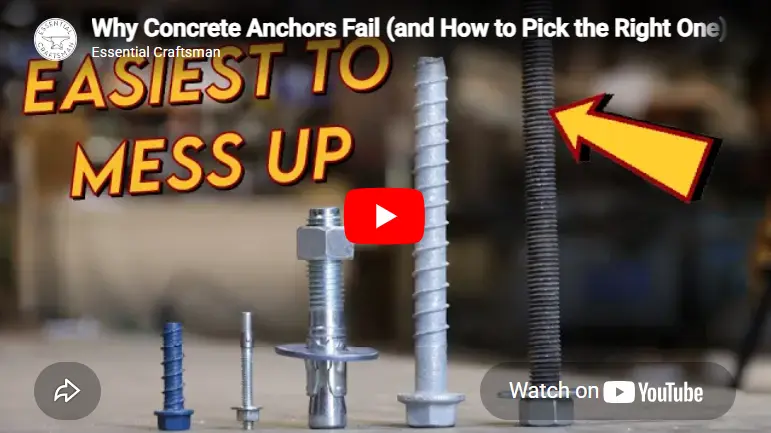
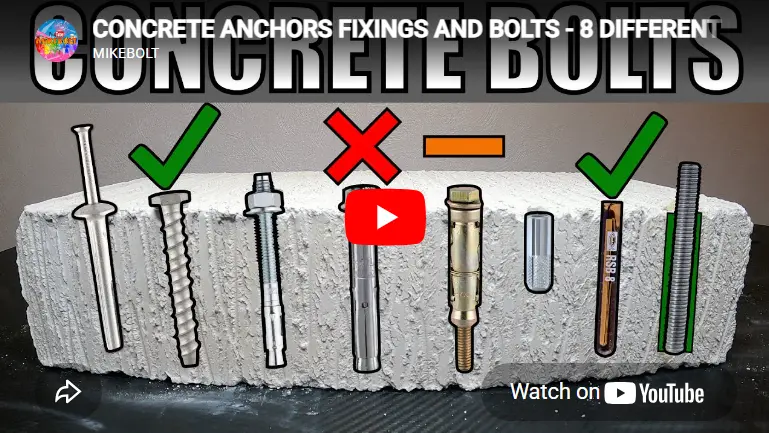
    Watch Essential Craftsman video: Why Concrete Anchors Fail (and How to Pick the Right One)

    Professionals rarely load anchors to maximum rating.

    Example:

    If an anchor is rated 1,000 lbs ultimate load:

    Recommended working load may be:

    • 250 lbs
    • 333 lbs
    • 500 lbs depending on standard

    That’s why searching How Much Weight Can Concrete Anchors Hold should focus on safe working load—not maximum failure load.


    Tapcon vs Wedge Anchor Comparison 🔩

    FeatureTapconWedge Anchor
    Easy InstallExcellentGood
    RemovableYesNo
    Light LoadsGreatGood
    Heavy LoadsModerateExcellent
    CostLowerMedium

    Read 👉 (Tapcon Screws vs Concrete Anchors: Which Should You Use?)

    This comparison helps answer How Much Weight Can Concrete Anchors Hold for common homeowner projects.


    Common Installation Mistakes ❌

    Even strong anchors fail if installed poorly.

    Mistakes:

    • Wrong hole size
    • Dust left in hole
    • Under-tightening
    • Over-tightening
    • Too close to edge
    • Too shallow embedment
    • Weak concrete zone

    Avoid these with 👉 (How to Install Concrete Anchors Correctly (Step-by-Step Guide))

    Also read 👉 (Common Concrete Anchor Mistakes (And How to Avoid Them))

    Many failures blamed on anchors are actually installation errors affecting How Much Weight Can Concrete Anchors Hold.


    Can Anchors Work in Brick or Block? 🧱

    Yes—but capacities are often lower than solid concrete.

    Hollow block especially changes load ratings.

    Read 👉 (Can You Use Concrete Anchors in Brick or Block?)

    This matters because How Much Weight Can Concrete Anchors Hold in brick is usually different than poured concrete.


    Homeowner Quick Reference Table 🏆

    Weight NeededSuggested Anchor
    Under 50 lbsTapcon / light anchor
    50–150 lbsTapcon / sleeve
    150–400 lbsSleeve / wedge
    400–1,000 lbsWedge anchor
    1,000+ lbsEngineered system
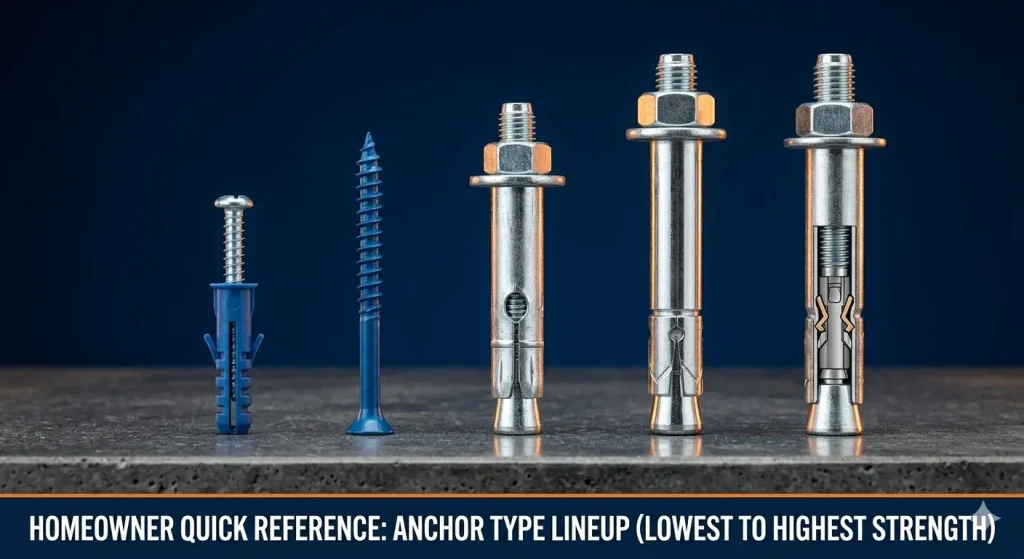
    A professional "hero shot" studio photograph presenting a linear lineup of five common concrete anchor types, ordered from lowest to highest holding strength, referencing the specific models and textures from image_9.png and image_16.png. The lineup is set against a deep navy blue background with subtle orange gradient accents that make the metallic textures pop. From left to right, they are: 1. A small blue plastic plug anchor with a silver screw. 2. A vibrant blue 1/4" diameter Tapcon masonry screw. 3. A 3/8" diameter silver-zinc plated sleeve anchor (identical to the style in image_9.png). 4. A large 1/2" diameter polished silver wedge anchor (identical to the style in image_16.png). 5. A 1/2" diameter silver drop-in anchor with a detailed cross-section graphic overlay revealing its internal expanding plug mechanism. Each anchor is perfectly clean and oriented consistently. The lineup rests on a dark grey, polished concrete slab that matches the aggregate texture from image_16.png. Precise studio lighting emphasizes the contrasting finishes (blue plastic, blue coating, silver plating, polished metal). Below the lineup, a crisp white text banner reads: 'HOMEOWNER QUICK REFERENCE: ANCHOR TYPE LINEUP (LOWEST TO HIGHEST STRENGTH)'. The image is vivid and eye-catching.
    The Anchor Power Lineup: This visual comparison shows the five primary anchors mentioned in our load rating table, ordered from lowest strength (Plastic Plug) to highest strength (Wedge/Drop-In). Use this guide to quickly identify the right system for your project’s weight requirements.

    Need shopping help? See 👉 (Best Concrete Anchor Kits for Homeowners (2026 Review))

    And 👉 (Concrete Anchor Selection Chart (Homeowner’s Quick Reference Guide))


    FAQ: How Much Weight Can Concrete Anchors Hold 🤔

    Can one anchor hold 500 lbs?

    Yes, many wedge anchors can under proper conditions.

    Can Tapcons hold heavy shelves?

    Yes, when properly sized and installed.

    Are four anchors stronger than two?

    Usually yes—but only with proper spacing.

    What causes anchor failure?

    Bad concrete, poor installation, overload, corrosion, edge breakout.

    Is bigger always better?

    Not always. Proper design matters more than size alone.


    Final Verdict: How Much Weight Can Concrete Anchors Hold 🏁

    So, How Much Weight Can Concrete Anchors Hold?

    The honest answer is anywhere from 10 lbs to several thousand pounds, depending on:

    • Anchor type
    • Diameter
    • Depth
    • Concrete PSI
    • Edge distance
    • Spacing
    • Installation quality
    • Load direction
    • Safety factor

    For light home projects, Tapcons or sleeve anchors may be perfect. For serious loads, wedge anchors or engineered systems are often best.

    The smartest way to answer How Much Weight Can Concrete Anchors Hold is not guessing—it’s choosing the right anchor, installing it correctly, and using safe working loads.

  • What Size Drill Bit for Concrete Anchors should you use?

    What Size Drill Bit for Concrete Anchors should you use?

    What size drill bit for concrete anchors you use directly affects holding strength, safety, and whether the anchor installs correctly in concrete, brick, or block. Even a high-quality anchor will fail if the hole is too large, too small, or drilled incorrectly.

    In this guide, you’ll learn what size drill bit to use for concrete anchors, how bit size varies by anchor type, and how to avoid common drilling mistakes that weaken holding strength.


    Why Drill Bit Size Matters for Concrete Anchors

    Concrete anchors rely on precise hole dimensions to grip properly.
    If the hole is oversized, the anchor won’t expand or bite correctly.
    If the hole is undersized, the anchor may not seat fully — or worse, crack the concrete.

    If you’re still choosing which anchor to use, start with (Best Concrete Anchors for Home Use – 2026 Guide) before drilling.


    General Rule: Drill Bit Size = Anchor Diameter

    For most concrete anchors, the rule is simple:

    The drill bit size should match the anchor diameter exactly.

    Examples:

    • 3/8″ anchor → 3/8″ masonry bit
    • 1/2″ anchor → 1/2″ masonry bit

    This applies to most expansion anchors and drop-in anchors.


    Drill Bit Size by Anchor Type

    Different anchor types have slightly different requirements. Here’s how they break down.


    Sleeve Anchors

    Drill bit size: Same diameter as the anchor
    Example:

    • 3/8″ sleeve anchor → 3/8″ masonry bit

    Sleeve anchors rely on even expansion along the sleeve, so hole accuracy is critical.

    Sleeve anchors are commonly discussed in (Types of Concrete Anchors Explained – Sleeve, Wedge, Drop-In, Tapcon).


    Wedge Anchors

    Drill bit size: Same diameter as the anchor
    Hole depth: Slightly deeper than anchor length

    Wedge anchors expand aggressively at the base, so:

    • Hole must be straight
    • Dust must be cleared
    • Depth must allow full expansion

    Incorrect drilling is a common issue covered in (Common Concrete Anchor Installation Mistakes – And How to Avoid Them).


    Drop-In Anchors

    Drill bit size: Exact anchor diameter
    Special note: Requires a setting tool

    Drop-in anchors sit flush with the surface and depend on internal expansion, making precise hole size non-negotiable.

    These anchors are often used for heavier loads discussed in (How Much Weight Can Concrete Anchors Hold? – Load Ratings Explained).


    Tapcon Screws (Concrete Screws)

    Tapcon screws are different.

    Drill bit size:

    • Determined by the screw size, not the head size
    • Always follow manufacturer specs

    Common examples:

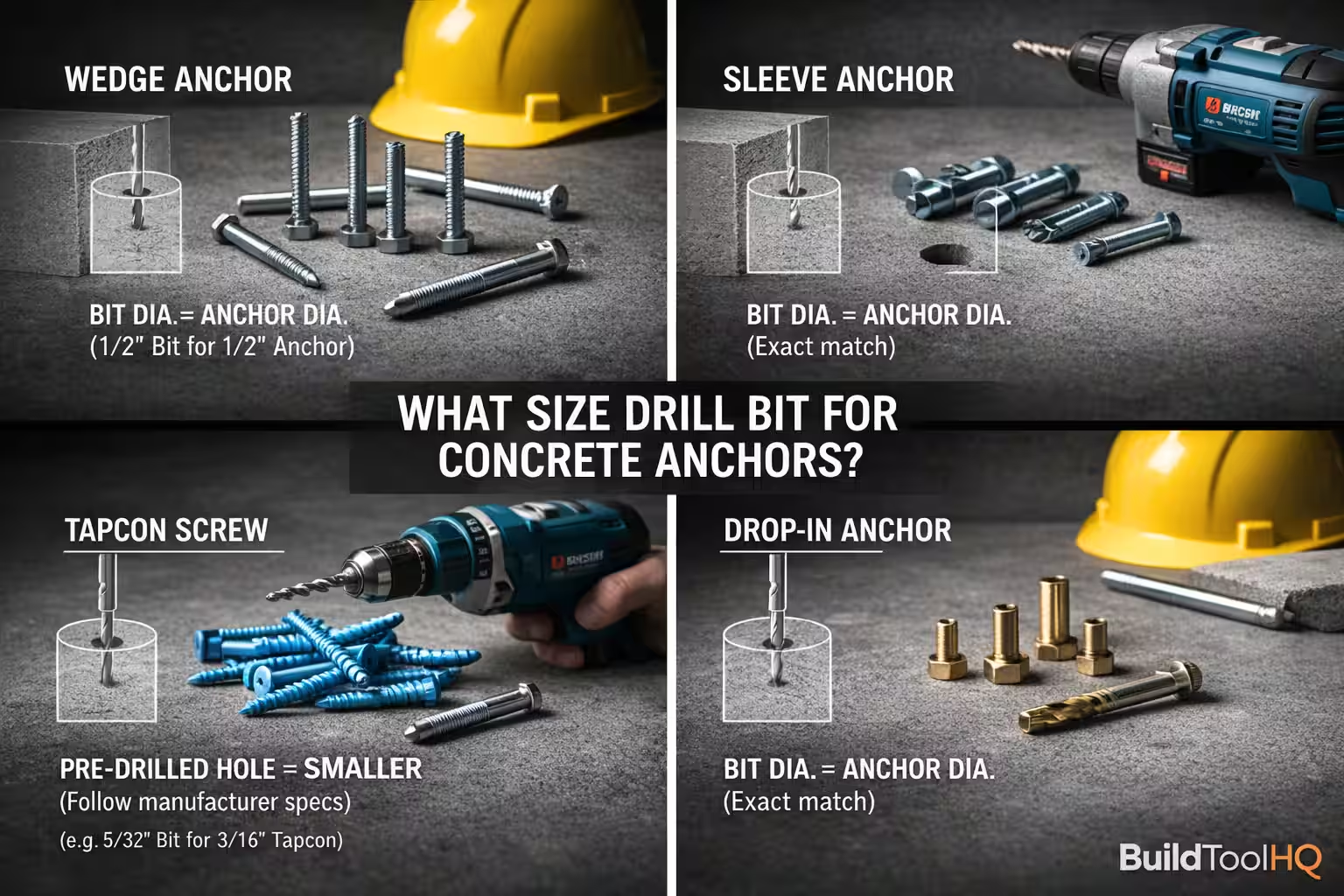
    • 3/16″ Tapcon → 5/32″ masonry bit
    • 1/4″ Tapcon → 3/16″ masonry bit

    This difference is why Tapcons are often misinstalled. For a full comparison, see (Tapcon Screws vs Concrete Anchors: Which Should You Use?).


    Plastic Masonry Anchors

    Drill bit size: Matches anchor body diameter

    Plastic anchors are forgiving but not strong, and they should only be used for lightweight projects.

    For anchor selection by surface, see (Best Anchors for Brick vs Concrete vs Block Walls).


    How Deep Should You Drill?

    As a rule:

    • Drill at least 1/4″ deeper than the anchor length
    • This allows space for dust and full expansion

    Failing to drill deep enough is one of the most common DIY mistakes.


    Drill Bit Type Matters Too

    Always use:

    • Carbide-tipped masonry bits
    • Sharp bits only
    • Hammer drill mode for concrete

    Recommended guides:


    Step-by-Step: Drilling the Perfect Anchor Hole

    1. Mark the hole location
    2. Select the correct masonry bit
    3. Drill straight at a steady speed
    4. Drill slightly deeper than anchor length
    5. Clear dust with air or vacuum
    6. Insert anchor or screw

    For a full walkthrough, see (How to Drill Into Concrete Safely – Step-by-Step Guide).


    Common Drill Bit Size Mistakes to Avoid

    Avoid these errors:

    • Guessing bit size instead of measuring
    • Using worn or dull bits
    • Skipping dust removal
    • Using wood or metal bits on concrete

    These mistakes reduce holding strength and are often blamed on the anchor itself.


    Final Recommendation

    If you remember only one thing:

    Use the exact drill bit size recommended for your anchor type — every time.

    Correct drilling improves:

    • Holding power
    • Safety
    • Long-term durability

    For choosing the right fastener overall, return to (Best Concrete Anchors for Home Use – 2026 Guide).


    Continue Learning

    Next guides :

  • Tapcon Screws vs Concrete Anchor Bolts: The 2026 Mastery Guide

    Tapcon Screws vs Concrete Anchor Bolts: The 2026 Mastery Guide

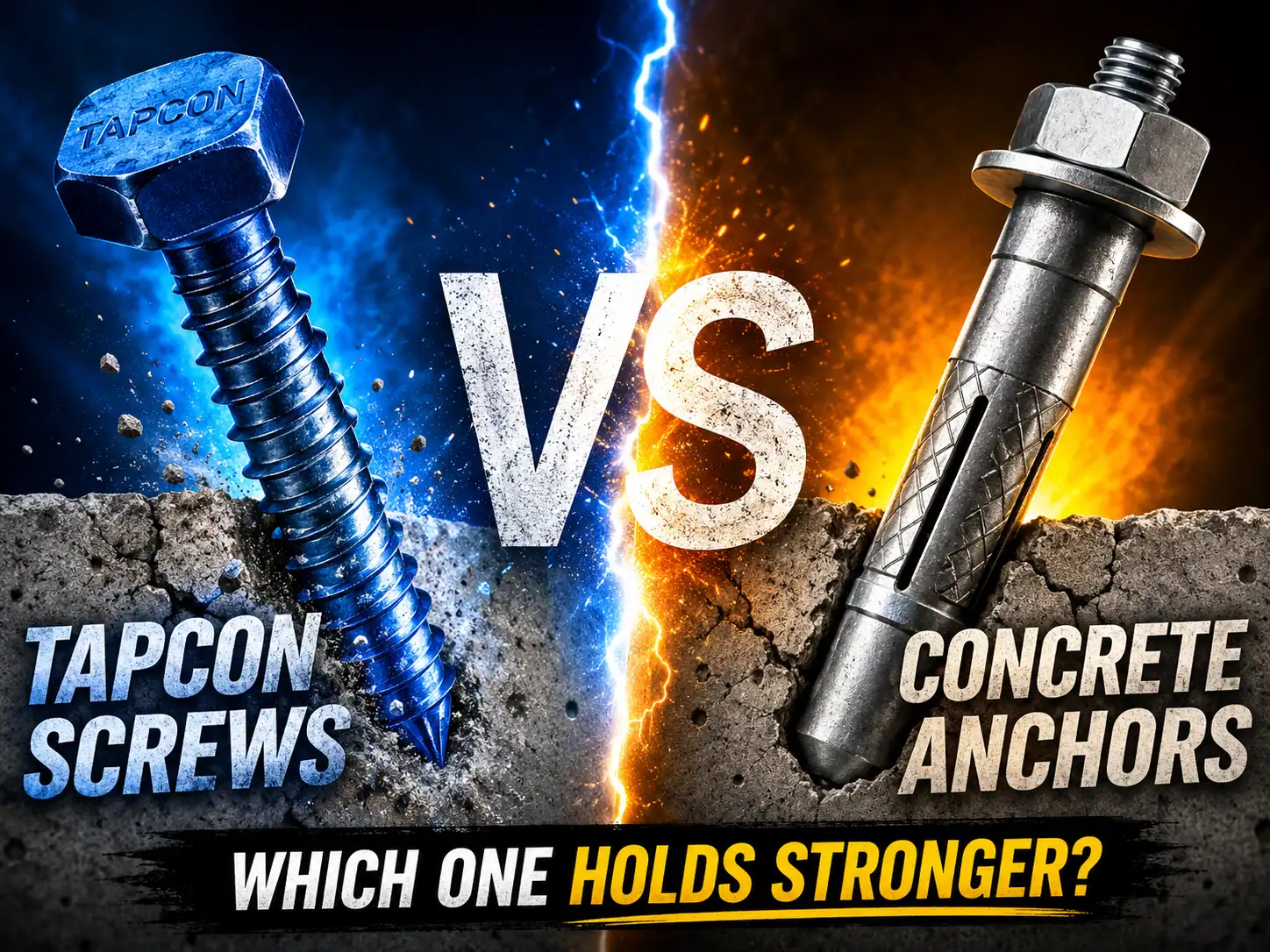
    When fastening into concrete, brick, or block, homeowners often face the same critical question: should you use Tapcon screws vs. concrete anchors for your specific home project? While both options are high-performance masonry fasteners, they serve very different structural purposes. 🏗️

    Choosing the wrong fastener doesn’t just lead to a weak mount—it can cause snapped screw heads, permanently damaged masonry, or total installation failure. To achieve a professional-grade result, you must master the mechanics of Tapcon screws vs. concrete anchors. 🧱

    What You’ll Master in This Guide: 🔍

    • The 5 Essential Secrets: Uncovering the truth about load capacity and material density.
    • Holding Power: A side-by-side comparison of Tapcon screws vs. concrete anchors in solid concrete and hollow block.
    • Installation Speed: Why one option is significantly faster for multi-point mounting.
    • Specialized Tooling: The drill bits and drivers required for Tapcon screws vs. concrete anchors.
    • Failure Prevention: How to avoid “over-torque” and “edge blowout” during installation.

    Whether you are mounting a TV on a basement wall or securing a heavy ledger board to a slab, mastering the nuances of Tapcon screws vs. concrete anchors is the only way to ensure your project stands the test of time. ⏳ This guide provides the definitive breakdown of holding power, removal options, and durability, giving you the mastery needed to choose between Tapcon screws vs. concrete anchors with total confidence. 🛠️

    Pro Tip: Don’t forget that even the best hardware fails if placed incorrectly. Always check our technical guide on ( Concrete Anchor Spacing and Edge Distance ) to ensure your Tapcon screws vs. concrete anchors don’t crack your masonry! 🛡️


    What Are Tapcon Screws?

    Best Secrets for Tapcon Screws vs Concrete Anchors Comparison
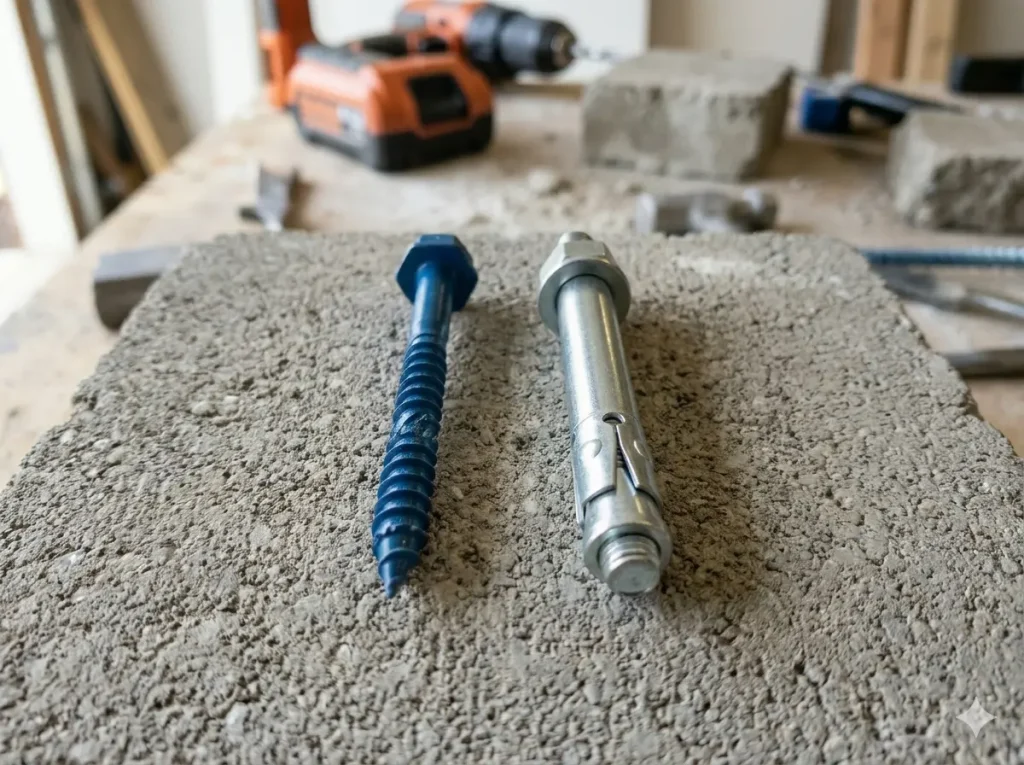
    A side-by-side comparison of Tapcon thread-cutting screws and traditional expansion anchors.

    Tapcon screws (also called concrete screws) are hardened fasteners designed to cut threads directly into concrete or masonry. Unlike expansion anchors, Tapcons rely on thread engagement, not outward pressure, to hold in place.

    Tapcon screws are commonly used for:

    • Shelves
    • Light fixtures
    • Electrical boxes
    • Temporary or adjustable mounts

    For a broader overview of fastener options, see (Types of Concrete Anchors Explained – Sleeve, Wedge, Drop-In, Tapcon).


    What Are Concrete Anchors?

    Concrete anchors include expansion and mechanical fasteners such as:

    • Sleeve anchors
    • Wedge anchors
    • Drop-in anchors

    These anchors hold by expanding inside the drilled hole, creating strong outward pressure against the concrete.

    If you’re comparing all anchor options first, start with (Best Concrete Anchors for Home Use – 2026 Guide).


    Tapcon Screws vs Concrete Anchors: Key Differences

    Essential Secrets for Tapcon Screws vs Concrete Anchors Installation.
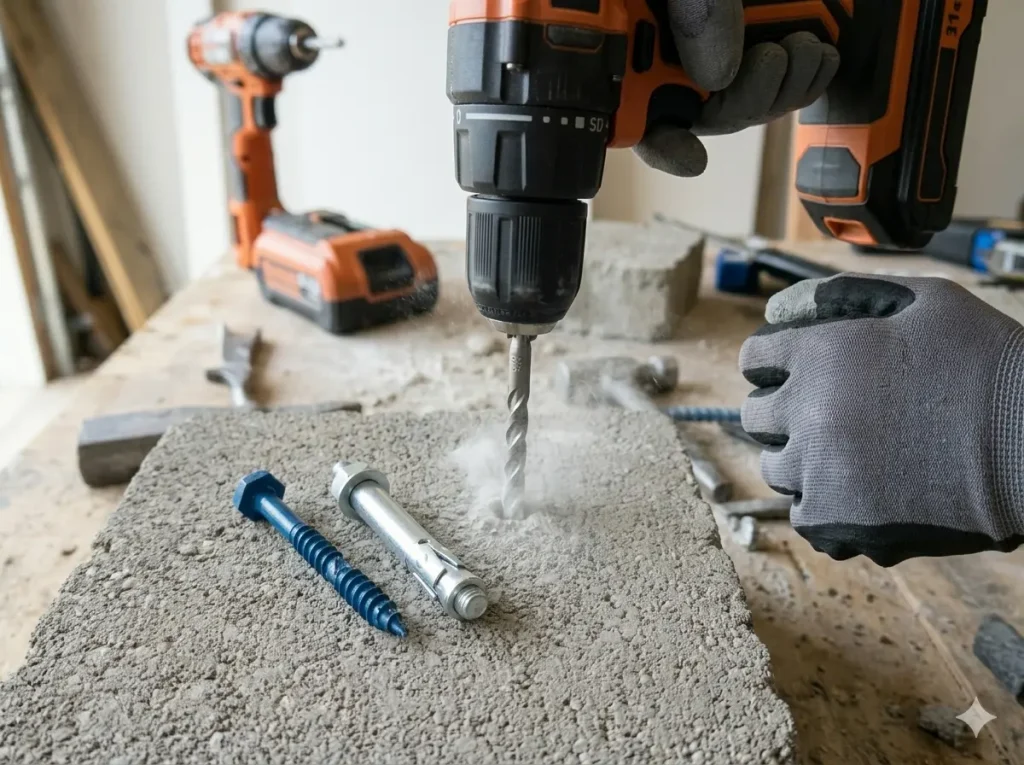
    A hammer drill with a carbide bit creating a 1/4″ pilot hole next to the Tapcon screw and expansion anchor.

    🔩 Installation Method

    • Tapcon screws thread directly into the hole
    • Concrete anchors expand inside the hole when tightened

    Tapcons are generally faster to install, especially for DIYers.


    🧱 Load Capacity

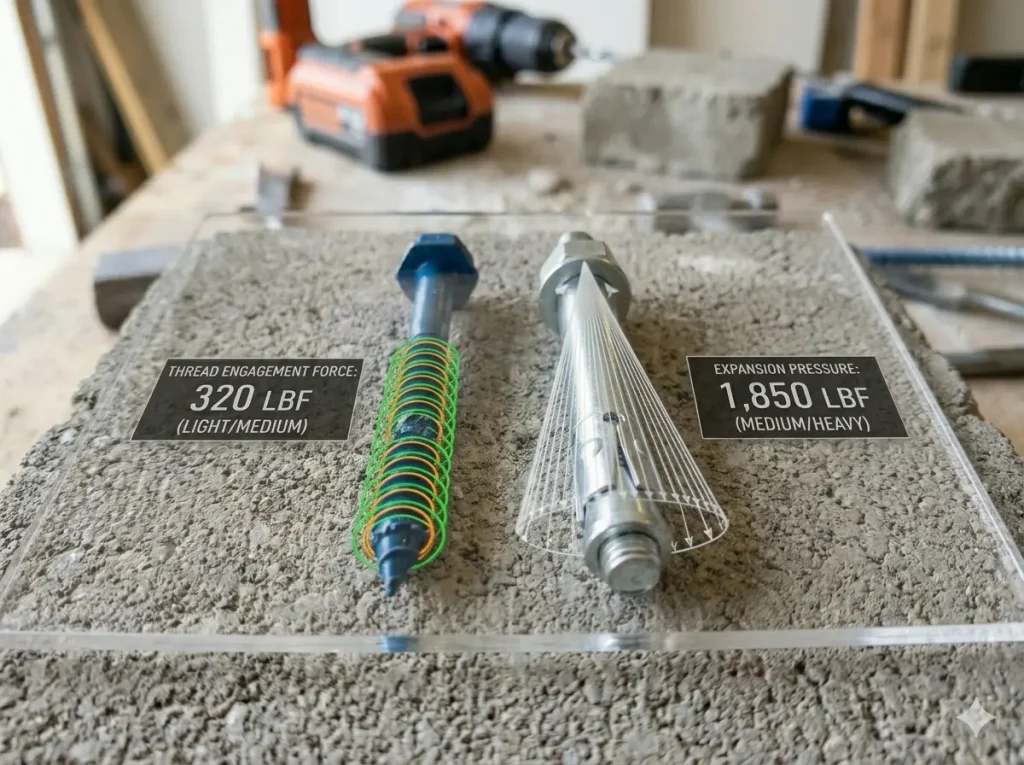
    Technical visualization comparison of Tapcon Screws vs Concrete Anchors: An analytical overlay on image_9.png showing localized thread engagement force (320 LBF - Light/Medium) on the blue screw versus the massive, conical expansion pressure (1,850 LBF - Medium/Heavy) generated by the traditional wedge anchor in a concrete block, maintaining workshop continuity
    Technical visualization of thread engagement versus powerful conical expansion pressure in solid concrete.
    • Tapcon screws: light to medium loads
    • Concrete anchors: medium to heavy loads

    For exact weight limits, see (How Much Weight Can Concrete Anchors Hold? – Load Ratings Explained).


    🔧 Removability

    • Tapcon screws: removable and reusable (in some cases)
    • Concrete anchors: usually permanent

    If you expect to reposition or remove fixtures later, Tapcons have a clear advantage.


    🛠️ Tools Required

    • Tapcon screws: drill + masonry bit
    • Concrete anchors: drill + masonry bit + wrench or setting tool

    Correct drilling technique matters — review (How to Drill Into Concrete Safely – Step-by-Step Guide) if you’re unsure.


    When to Use Tapcon Screws

    Tapcon screws are best when:

    • Loads are light to medium
    • You want fast installation
    • The mount may need removal later
    • You’re working in brick or block and want minimal expansion stress

    Common Tapcon projects:

    • Mounting shelves
    • Attaching furring strips
    • Installing conduit or brackets

    Make sure your bit size is exact — see (What Size Drill Bit Should You Use for Concrete Anchors?) (Tapcons are very size-sensitive).


    When to Use Concrete Anchors

    Traditional concrete anchors are better when:

    • Loads are heavy
    • Safety is critical (TVs, handrails)
    • Long-term, permanent mounting is required
    • You’re anchoring into solid concrete

    Concrete anchors are commonly recommended for:

    • TV mounts
    • Structural brackets
    • Railings
    • Heavy cabinets

    If you’re mounting into different masonry types, read (Best Anchors for Brick vs Concrete vs Block Walls).


    Tapcon Screws vs Concrete Anchors: Quick Comparison

    FeatureTapcon ScrewsConcrete Anchors
    Load capacityLight–MediumMedium–Heavy
    InstallationEasyModerate
    RemovableYesUsually no
    Expansion stressNoneYes
    Best forDIY projectsHeavy fixtures

    Common Mistakes to Avoid

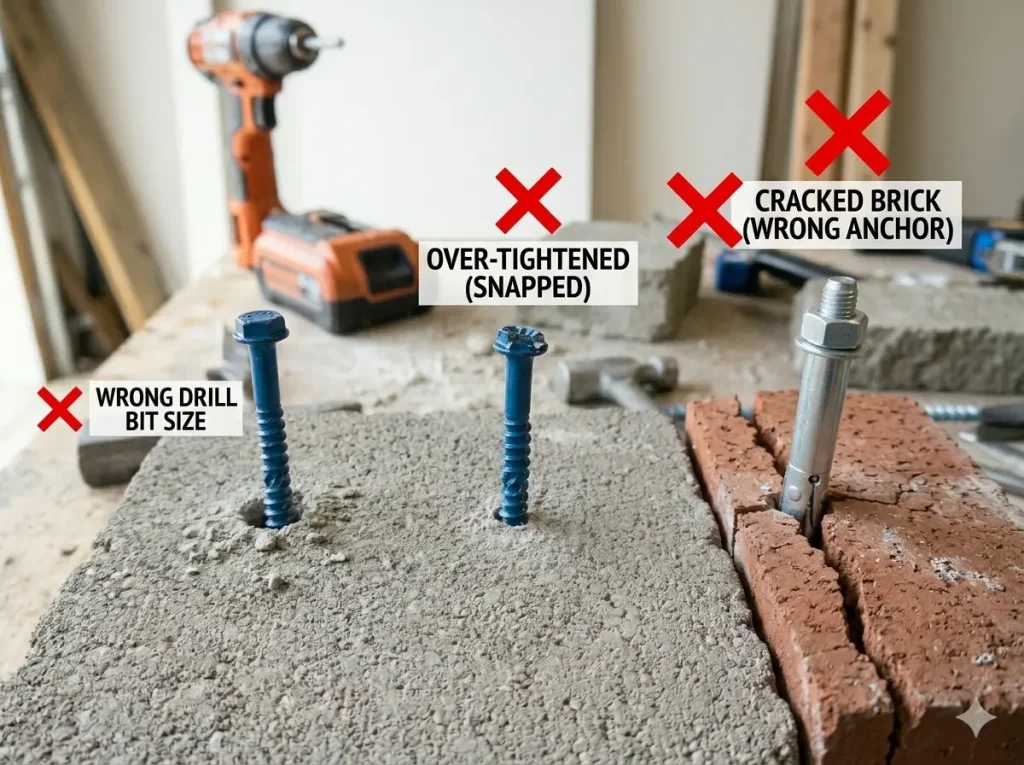
    Essential Secrets for Tapcon Screws vs Concrete Anchors: A technical failure analysis visualization on a concrete block and red brick. Labeled errors include a blue Tapcon screw with a loose fit from an incorrect drill bit size, a snapped Tapcon head from over-tightening, and a heavy-duty silver wedge anchor causing structural cracks in a brick wall due to excessive expansion pressure, shot in a 4:3 ratio to maintain workshop continuity with the series.
    Labeled examples of concrete fastening failures: over-drilling a Tapcon, a snapped Tapcon head, and a traditional expansion anchor cracking brick.

    Avoid these frequent errors:

    • Using Tapcons for heavy loads
    • Over-tightening Tapcon screws
    • Using expansion anchors in weak brick
    • Drilling incorrect hole sizes

    These issues are covered in detail in (Common Concrete Anchor Installation Mistakes – And How to Avoid Them).


    Best Drill & Bits for Both Options

    Regardless of fastener choice:

    • Use carbide-tipped masonry bits
    • Drill straight and clean out dust
    • Avoid oversized holes

    Recommended guides:


    Final Verdict: Which One Should You Choose?

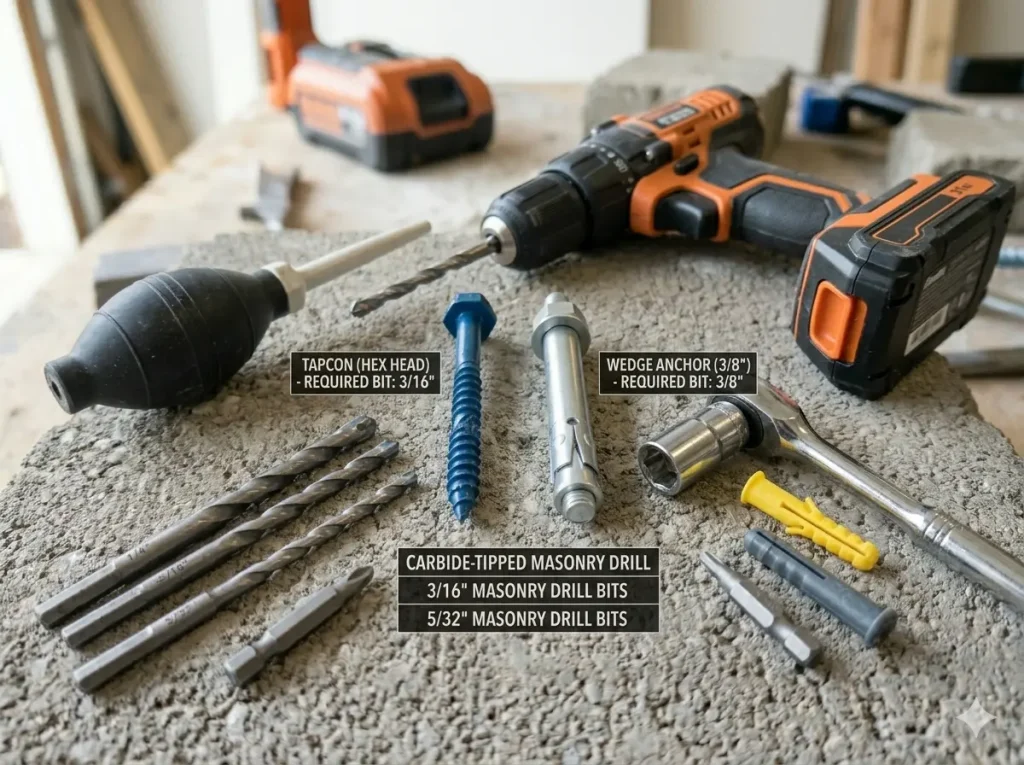
    Essential Secrets for Tapcon Screws vs Concrete Anchors Tools: A professional 4:3 knolling layout on a concrete block featuring a hammer drill, a dust blow-out bulb, and carbide-tipped masonry bits. Labeled details specify the 3/16 inch bit required for hex-head Tapcons and the 3/8 inch bit needed for silver wedge expansion anchors, maintaining strict workshop continuity with the previous failure analysis and load capacity diagrams.
    Labeled organization of all required tools and bits: the 3/16″ and 3/8″ masonry bits are key differentiators for Tapcon screws vs. traditional wedge anchors.

    Choose Tapcon screws if:

    • You’re mounting lighter items
    • You want easy installation
    • You may remove the fastener later

    Choose concrete anchors if:

    • Loads are heavy
    • Safety matters
    • You want maximum holding power

    For mixed DIY projects, anchor kits can be useful — see (Best Concrete Anchor Kits for Homeowners – 2026 Review).

    If you are trying to decide between Tapcon screws vs concrete anchors, watching the actual installation process can make your choice much clearer. The video below provides a detailed breakdown of how Tapcon screws vs concrete anchors behave during high-torque applications.

    You will see exactly how Tapcon screws are drilled and driven into masonry, along with professional tips for choosing the correct screw length to ensure a secure hold. Understanding the mechanical differences in this Tapcon screws vs concrete anchors demonstration is one of the best secrets to avoiding common installation failures like stripped threads or cracked concrete blocks.


    Continue Learning

    Next, explore:

    These guides will help you fasten into concrete safely and confidently.

    Frequently Asked Questions About Tapcon Screws vs Concrete Anchors

    FAQ: Tapcon Screws vs Concrete Anchors

    Are Tapcon screws as strong as concrete anchors?

    Tapcon screws are strong enough for light to medium-duty applications, but they generally do not match the load capacity of expansion anchors like wedge anchors or sleeve anchors. Concrete anchors create outward pressure inside the hole, which provides stronger holding power for heavy loads such as railings, TV mounts, or structural brackets.

    Can Tapcon screws replace concrete anchors?

    In some cases, yes. Tapcon screws can replace concrete anchors when the load is relatively light and the installation does not require maximum holding strength. For heavier items or safety-critical installations, traditional expansion anchors are usually the better choice.

    Do Tapcon screws work in brick and block?

    Yes. Tapcon screws work well in brick, concrete, and concrete block, as long as the correct drill bit size is used. They are often preferred in brick or hollow block because they do not create expansion pressure that could crack weaker masonry materials.

    Can Tapcon screws be removed and reused?

    Tapcon screws can usually be removed, which makes them useful for temporary mounts or adjustable installations. However, the threads cut into the concrete may wear out after removal, so the same hole may not hold the screw as securely if it is reinstalled.


    What size drill bit do Tapcon screws require?

    Tapcon screws require a precise masonry drill bit size, which depends on the screw diameter. Using the correct bit size is critical because the screw cuts threads directly into the hole. If the hole is too large, the screw may not hold properly.

    When should you use concrete anchors instead of Tapcons?

    oncrete anchors are better when:
    Loads are heavy
    Safety is critical
    A permanent installation is needed
    The fastener must support structural weight
    Examples include mounting TV brackets, railings, heavy cabinets, or structural supports.

    Do Tapcon screws require a hammer drill?

    A hammer drill is recommended when drilling into hard concrete, but Tapcon screws can sometimes be installed using a regular drill with a masonry bit in softer materials like brick or block.

    Are concrete anchors permanent?

    Are concrete anchors permanent?
    Most concrete anchors are considered permanent fasteners. Once installed, they are difficult to remove without damaging the anchor or the surrounding concrete. This makes them ideal for long-term installations that require maximum strength.

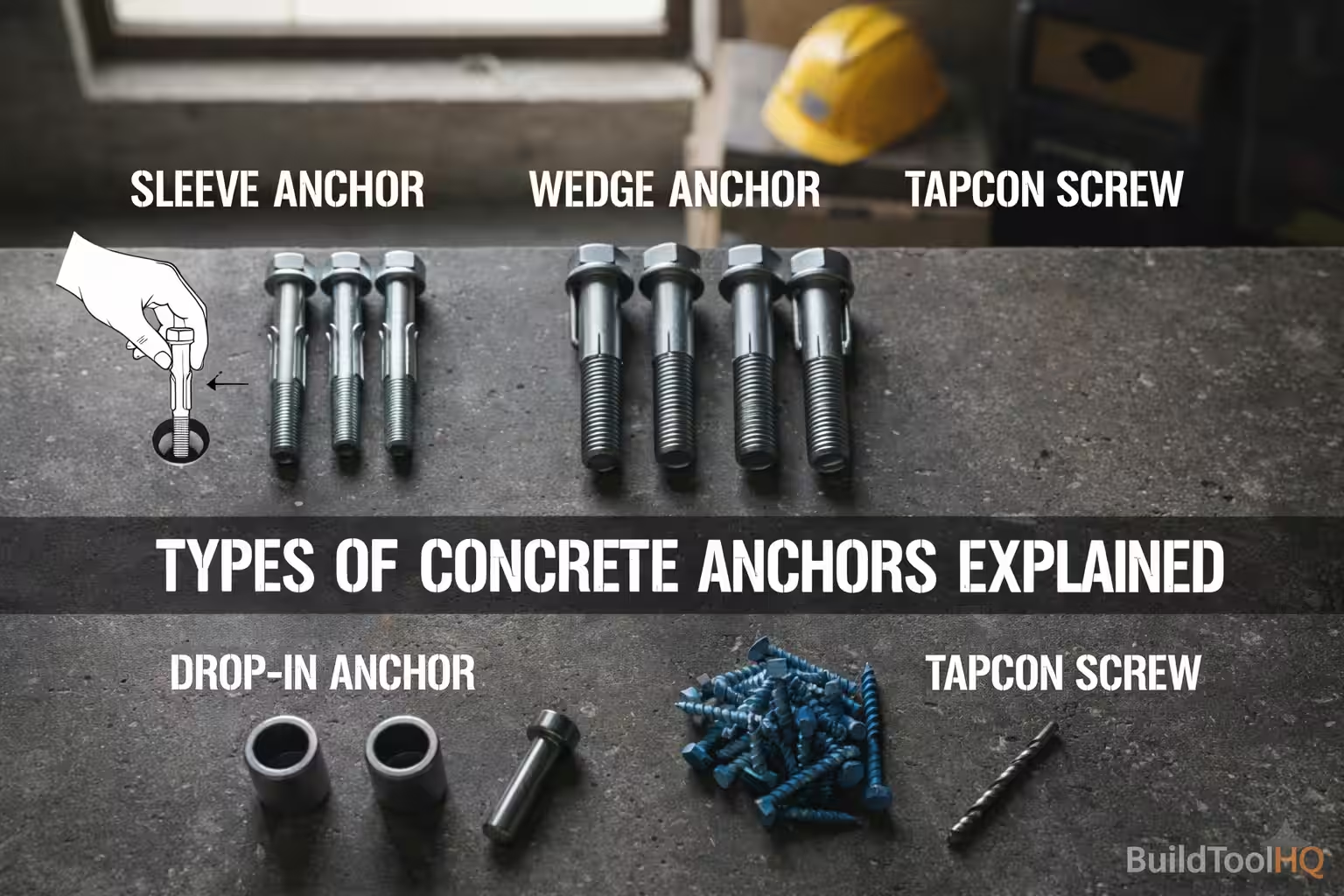
  • Types of Concrete Anchors Explained (Sleeve, Wedge, Drop-In, Tapcon)

    Types of Concrete Anchors Explained (Sleeve, Wedge, Drop-In, Tapcon)

    Types of concrete anchors vary by design, strength, and application, and choosing the right one is essential for safe and secure installations in concrete, brick, and block walls. Each anchor type is designed to work in specific materials and load conditions, and using the wrong one can lead to cracked masonry, loose fixtures, or dangerous failures.

    In this guide, we’ll clearly explain the different types of concrete anchors, how they work, and when homeowners should use each one.


    What Are Concrete Anchors?

    Concrete anchors are fasteners designed to secure objects into solid masonry such as concrete, brick, or concrete block. They rely on expansion, threading, or mechanical locking to hold firmly inside drilled holes.

    If you’re new to anchors or deciding what to buy, start with (Best Concrete Anchors for Home Use – 2026 Guide) to understand which types are best for typical household projects.


    The Main Types of Concrete Anchors

    Below are the most common anchor types homeowners will encounter.


    Sleeve Anchors

    Best for: Brick, block, and concrete
    Load rating: Medium to heavy

    Sleeve anchors use a metal sleeve that expands evenly against the walls of the drilled hole when tightened. This even expansion makes them ideal for brick and block, where aggressive expansion could cause cracking.

    Pros:

    • Works in multiple masonry materials
    • Even expansion reduces cracking risk
    • Good for TV mounts, railings, shelves

    Cons:

    • Not removable once installed
    • Requires precise hole depth

    Sleeve anchors are commonly recommended for home installations covered in (Best Anchors for Brick vs Concrete vs Block Walls).


    Wedge Anchors

    Best for: Solid concrete only
    Load rating: Heavy-duty

    Wedge anchors expand aggressively at the base of the anchor when tightened, creating an extremely strong hold. They are commonly used for structural applications.

    Pros:

    • Extremely strong
    • Ideal for heavy loads

    Cons:

    • Concrete only (not brick or block)
    • Permanent installation

    Using wedge anchors incorrectly is one of the issues discussed in (Common Concrete Anchor Installation Mistakes – And How to Avoid Them).


    Drop-In Anchors

    Best for: Flush-mounted applications in concrete
    Load rating: Heavy-duty

    Drop-in anchors sit flush with the surface of the concrete and require a setting tool to expand them internally.

    Pros:

    • Clean, flush finish
    • High load capacity
    • Professional-grade

    Cons:

    • Requires special setting tool
    • Concrete only

    Drop-in anchors are commonly used in commercial settings but can be useful for advanced DIYers installing heavy fixtures.


    Concrete Screws (Tapcon-Style)

    Best for: Light to medium-duty home projects
    Load rating: Light to medium

    Concrete screws thread directly into concrete or masonry without expansion. They are popular because they’re easy to install and removable.

    Pros:

    • Easy installation
    • Removable
    • No expansion stress

    Cons:

    • Lower load capacity
    • Requires precise drilling

    If you’re deciding between screws and anchors, see (Tapcon Screws vs Concrete Anchors: Which Should You Use?).


    Plastic Masonry Anchors

    Best for: Very light-duty projects
    Load rating: Light

    Plastic anchors expand when a screw is driven in. They are best suited for lightweight fixtures.

    Pros:

    • Inexpensive
    • Easy to install

    Cons:

    • Limited strength
    • Not suitable for heavy loads

    For weight considerations, review (How Much Weight Can Concrete Anchors Hold? – Load Ratings Explained).


    Choosing the Right Anchor for Your Project

    Here’s a quick homeowner decision guide:

    • Shelves & light fixtures → Concrete screws
    • TV mounts → Sleeve anchors
    • Structural loads → Wedge anchors
    • Flush installations → Drop-in anchors
    • Lightweight items → Plastic anchors

    Before drilling, make sure your bit size is correct — see (What Size Drill Bit Should You Use for Concrete Anchors?).


    Drill Bits and Hole Preparation Matter

    No anchor will hold properly without a clean, correctly sized hole.

    Best practices:

    • Use carbide-tipped masonry bits
    • Drill straight and to full depth
    • Clean dust from the hole

    For recommended tools, read (Best Drill Bits for Concrete and Masonry) and (Best Drill for Concrete Walls – 2025 Guide).


    Common Mistakes When Choosing Anchor Types

    Avoid these errors:

    • Using wedge anchors in brick
    • Undersizing or oversizing holes
    • Choosing anchors based only on price
    • Ignoring load ratings

    These mistakes are covered in detail in (Common Concrete Anchor Installation Mistakes – And How to Avoid Them).


    Final Thoughts: Which Anchor Type Is Best?

    There’s no single “best” anchor — only the right anchor for the job.

    For most homeowners:

    • Concrete screws handle small projects
    • Sleeve anchors cover most medium-duty needs
    • Wedge anchors are reserved for heavy loads

    For a full buying overview, return to (Best Concrete Anchors for Home Use – 2026 Guide).


    Continue Learning

    Next, you may want to explore:

    These guides will help you choose and install anchors safely and correctly.

  • Best Concrete Anchors for Home Use (2026 Guide)

    Best Concrete Anchors for Home Use (2026 Guide)

    Best concrete anchors for home use are the literal foundation of a safe DIY project. Whether you are mounting a heavy 75-inch TV, installing floating garage shelves, or securing kitchen cabinets into masonry, the difference between a professional result and a structural failure comes down to one thing: selecting the correct fastener. 🧱

    Choosing the wrong concrete anchor doesn’t just lead to a loose mount—it can cause permanent edge blowout, shattered brickwork, or catastrophic equipment damage. This guide breaks down the high-performance hardware you need for concrete, brick, and hollow block walls, ensuring your installations remain rock-solid for years. 🛠️

    What You’ll Master in This Guide:

    • The Top 5 Concrete Anchors: Comparing wedge anchors, sleeve anchors, tapcons, and more.
    • Material Matching: How to pick the right anchor for poured concrete vs. cinder block.
    • Load Ratings: Understanding shear vs. tension strength for heavy home fixtures.
    • Pro Installation: Linking your hardware choice to proper concrete anchor spacing and edge distance and expert drilling techniques.

    Pro Tip: Even the world’s strongest anchor will fail if installed too close to a corner. Always cross-reference your hardware choice with our specialized guide on (Concrete Anchor Spacing and Edge Distance Mastery) to avoid critical masonry blowout.


    What Are Concrete Anchors? (Defining the Mechanics) ⚙️

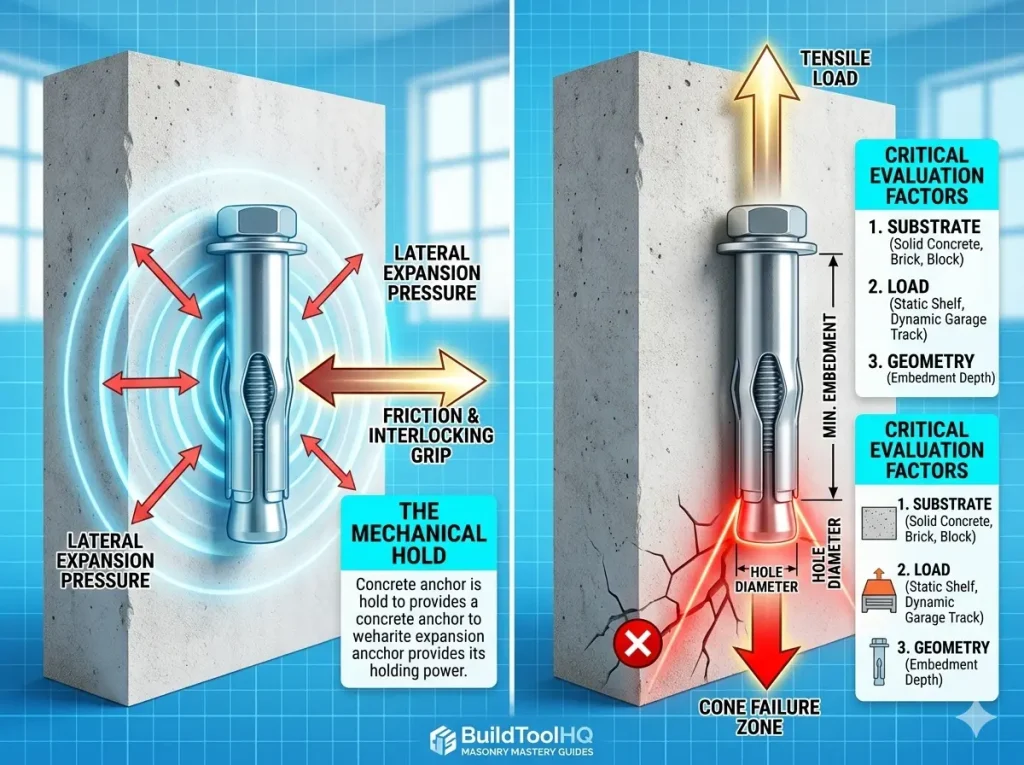
    Technical diagram of a concrete expansion anchor in a split 4:3 infographic, defining THE MECHANICAL HOLD with radiating blue friction zones and red force arrows, and listing critical data for SUBSTRATE, LOAD, and GEOMETRY. Best Concrete Anchors for Home Use
    diagram visualizing the mechanical hold and internal forces for the best concrete anchors for home use, including static and dynamic load vectors.

    At their core, concrete anchors are specialized masonry fasteners engineered to provide a permanent, high-load attachment point in materials where standard screws would simply strip out. Unlike wood or drywall, masonry is brittle and non-compressive; therefore, the best concrete anchors for home use utilize expansion, keying, or mechanical threading to “bite” directly into the substrate. 🏗️

    When you drive an anchor into a pre-drilled hole, it creates a powerful mechanical hold by converting torque into lateral pressure against the masonry walls. This structural bond is what allows a small piece of steel to support hundreds of pounds of tensile and shear force without budging. 🔩

    3 Critical Factors to Evaluate Before You Drill: 🔍

    Before selecting your hardware, you must analyze these three variables to ensure a safe, long-lasting installation:

    1. The Substrate Material: Are you working with solid poured concrete, clay brick, or hollow cinder block? 🧱 An anchor designed for solid concrete (like a heavy-duty wedge anchor) may shatter a hollow block or fail to grip effectively in soft mortar joints.
    2. The Load Requirement (Static vs. Dynamic): You must calculate the total weight of the item. ⚖️ Are you mounting a static shelf or a dynamic object like a heavy garage door track? Always choose an anchor with a safe working load (SWL) that exceeds your item’s weight by a 4:1 safety factor.
    3. Hole Geometry and Depth: Precision is key to a professional finish. 📏 Every anchor has a specific embedment depth requirement. Drilling too shallow prevents the expansion mechanism from engaging, while drilling too deep can compromise the structural integrity of the masonry unit.

    If you’re not sure how drilling affects anchor strength, start with How Deep Can You Drill Into Concrete? and How to Drill Into Concrete Safely – Step-by-Step Guide


    Types of Concrete Anchors (Quick Overview) 🛠️

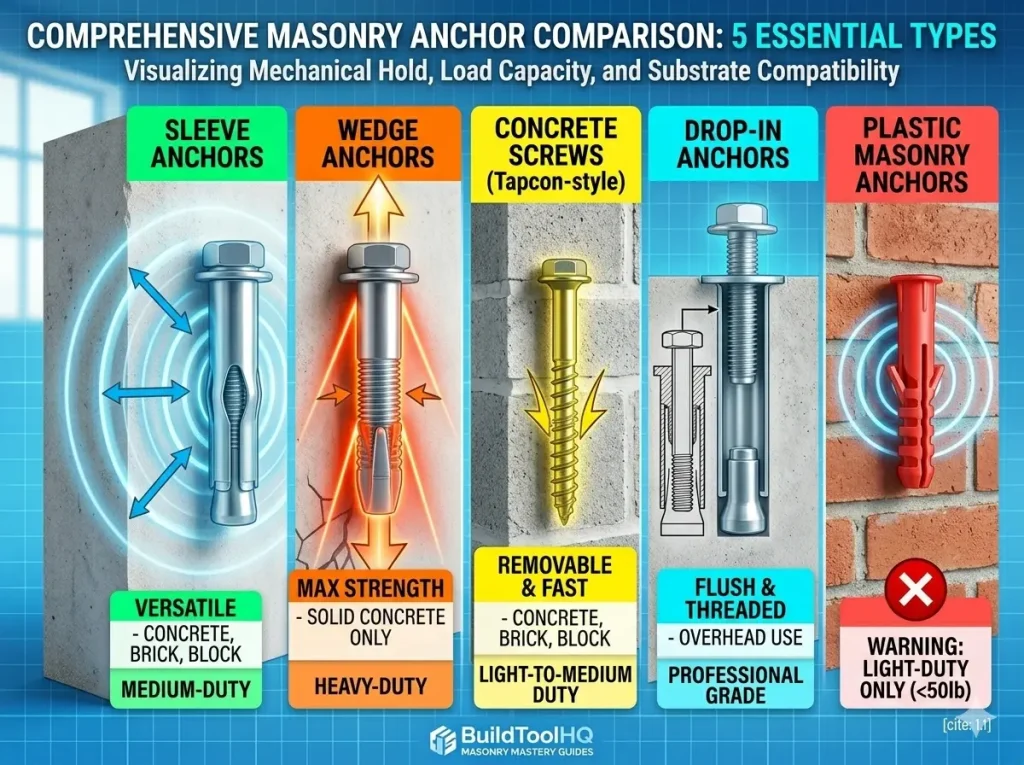
    infographic comparison of 5 types of masonry anchors, including Sleeve, Wedge, Drop-In, Tapcon-style, and Plastic Plug. Each visualization shows the internal expansion mechanism, vivid tension cones (blue, orange, yellow, cyan, red), load vectors, and labeled text for substrate matching and load rating, set against a bright technical grid background with natural daylight and BuildToolHQ workshop continuity. Best Concrete Anchors for Home Use
    comparison chart illustrating five distinct types of masonry fasteners—Sleeve, Wedge, Drop-In, Tapcon-style, and Plastic Plug—visualizing their load capacity, substrate matching, and internal mechanical hold.

    There are several common anchor types used by homeowners, but they are not interchangeable. Using a heavy-duty wedge in a hollow brick or a plastic plug for a TV mount is a recipe for disaster. ⚠️ Each fastener has a specific engineering profile designed for different load capacities and masonry substrates.

    For a deep-dive technical analysis of each fastener’s internal mechanics, check out our comprehensive guide: [Types of Concrete Anchors Explained – Sleeve, Wedge, Drop-In, Tapcon].

    Common Masonry Anchor Types: 🔩

    • Sleeve Anchors: The ultimate “all-rounder” for DIYers. These are highly versatile and offer a reliable mechanical hold in both solid concrete, brick, and cinder block. 🏠
    • Wedge Anchors: These are the heavy hitters of the masonry world. Engineered for maximum tensile strength, they are for solid poured concrete only and should never be used in brick or block. 💪
    • Drop-In Anchors: A favorite for overhead or flush-mounted applications. These provide a professional-grade internal thread for bolts, allowing you to remove the fixture while the anchor stays permanent. 🏗️
    • Concrete Screws (Tapcon-style): These high-performance fasteners cut their own threads into the masonry. They are incredibly fast to install and are the only option that is truly removable, making them perfect for light-to-medium duty projects. ⚡
    • Plastic Masonry Anchors: These are for light-duty only (think picture frames or small smoke detectors). Never rely on plastic expansion in concrete for items that carry significant weight or safety risks. 🖼️

    Best Concrete Anchors for Common Home Projects

    🧱 Best for Shelves & Light Fixtures

    Concrete screws (Tapcon-style)

    • Easy installation
    • Removable
    • Ideal for shelves, towel bars, small cabinets

    Make sure your hole size is correct — see (What Size Drill Bit Should You Use for Concrete Anchors?).


    📺 Best for TV Mounts & Heavy Wall Loads

    Sleeve anchors or wedge anchors

    • High load capacity
    • Strong expansion grip

    If you’re comparing tools, (Hammer Drill vs Regular Drill: Which One Do You Need?) explains why hammer drills are often required for these anchors.


    🧰 Best for Brick or Block Walls

    Sleeve anchors

    • Even expansion prevents cracking
    • Works well in hollow materials

    Avoid wedge anchors in brick — this mistake is covered in (Common Mistakes When Drilling Into Concrete – And How to Avoid Them).


    🔩 Best for DIY Homeowners

    Concrete anchor kits

    • Multiple sizes included
    • Ideal for mixed projects

    We review the best options in (Best Concrete Anchor Kits for Homeowners – 2026 Review).


    How Much Weight Can Concrete Anchors Hold?

    Anchor strength depends on:

    • Anchor type
    • Diameter and embedment depth
    • Concrete quality
    • Installation accuracy

    For real-world numbers and safety margins, read (How Much Weight Can Concrete Anchors Hold? – Load Ratings Explained).

    ⚠️ Tip: Always derate manufacturer ratings by 25–30% for home projects.


    Concrete Anchors vs. Wall Plugs (The Golden Rule) 📏

    A common mistake that leads to failed DIY projects is confusing a standard plastic wall plug with a high-performance mechanical concrete anchor. While they might look similar in a toolbox, their engineering profiles and weight capacities are worlds apart. 🌍 Understanding this distinction is vital for ensuring your heavy home fixtures don’t end up on the floor. 💥

    The Load-Bearing Rule of Thumb: ⚖️

    • Plastic Wall Plugs (Light-Duty): These rely on simple friction and are designed for lightweight masonry or brick applications. 🖼️ Use these exclusively for items like picture frames, light mirrors, or smoke detectors. They lack the tensile strength required to hold structural weight or dynamic loads.
    • Concrete Anchors (Medium to Heavy-Duty): These are engineered for high-stakes projects like mounting TVs, water heaters, or structural shelving. 📺 Unlike plugs, these fasteners create a high-pressure mechanical hold by expanding steel against the masonry, making them the best concrete anchors for home use when safety is the top priority.

    ⚠️ Warning: Never substitute a wall plug for a concrete anchor when the item weighs more than a few pounds. Overloading a plastic plug in concrete will eventually lead to “creep,” where the plug slowly slides out of the hole, resulting in a sudden and dangerous failure. 🛡️

    We break this down clearly in (Types of Concrete Anchors Explained (Sleeve, Wedge, Drop-In, Tapcon).


    Drill Bits Matter More Than You Think

    The anchor is only as strong as the hole it’s installed in.

    Always use:

    • Carbide-tipped masonry bits
    • Correct diameter (never oversize)
    • Clean holes (dust reduces grip)

    If you’re unsure which bit to buy, see (Best Drill Bits for Concrete and Masonry).


    How to Install Concrete Anchors Correctly (Summary) 🛠️

    Even when you purchase the best concrete anchors for home use, simple installation errors can lead to total fastener failure, property damage, or safety hazards. Avoiding these frequent masonry anchor mistakes is critical to maintaining the structural integrity of your project and ensuring the best concrete anchors for home use provide a permanent mechanical hold. 📉

    Top 4 Critical Installation Errors: 🚫

    1. Selecting the Wrong Type for the Substrate: A major risk is choosing the best concrete anchors for home use based on price rather than engineering. For example, using a wedge anchor in hollow cinder block—even if it is rated as one of the best concrete anchors for home use—will result in immediate pull-out. ❌ You must match the hardware to your specific masonry surface.
    2. Improper Embedment Depth: Drilling too shallow prevents the expansion sleeve of the best concrete anchors for home use from fully engaging. Conversely, drilling too deep can cause the bolt to “bottom out.” 📏 Always follow the manufacturer’s minimum embedment depth to ensure the best concrete anchors for home use reach their maximum shear strength.
    3. Overtightening the Anchor Bolt: Excessive torque can crush the concrete internally or snap the bolt of even the best concrete anchors for home use. ⚙️ This compromises the structural bond and creates a hidden weakness, meaning the best concrete anchors for home use may fail unexpectedly under a heavy load.
    4. Ignoring Spacing and Edge Distance: Installing the best concrete anchors for home use too close to the edge of a slab or too close to each other creates cumulative tension. 🧱 This leads to edge blowout, even with the best concrete anchors for home use. Always consult our technical layout guide for safe concrete anchor spacing and edge distance.

    Pro Tip: Most failures involving the best concrete anchors for home use aren’t caused by the hardware itself, but by poor hole preparation. 🌬️ Never skip the dust clean-out step, as residual grit acts as a lubricant against the expansion mechanisms of the best concrete anchors for home use.

    For a full walkthrough, follow (How to Install Concrete Anchors Correctly – Step-by-Step Guide).


    Common Concrete Anchor Mistakes to Avoid (and How to Prevent Failure) ⚠️

    Avoid these frequent errors:

    • Using the wrong anchor type
    • Drilling too shallow or too deep
    • Overtightening
    • Installing anchors too close to edges

    We cover these in detail in (Common Concrete Anchor Installation Mistakes – And How to Avoid Them).


    Best Tools for Installing Concrete Anchors

    For most home projects:

    • Hammer drill for concrete
    • Standard drill for light masonry
    • Cordless drills for small anchors

    Compare your options in:


    Final Recommendation: Which Concrete Anchor Should You Choose?

    Quick decision guide:

    • Shelves / fixtures → Concrete screws
    • TV mounts → Sleeve anchors
    • Structural loads → Wedge anchors
    • Mixed DIY jobs → Anchor kits

    If you’re still deciding between fastening methods, see (Tapcon Screws vs Concrete Anchors: Which Should You Use?).


    Next Steps

    Now that you understand concrete anchors, continue with:

    These guides will ensure your installations are safe, strong, and long-lasting.

    Frequently Asked Questions About Concrete Anchors :


    What are the best concrete anchors for home use?

    The best concrete anchors for home use are usually concrete screws (Tapcon-style), sleeve anchors, or wedge anchors, depending on the weight of the item being installed. Concrete screws are ideal for light fixtures and shelves, while sleeve or wedge anchors are better for heavy loads such as TV mounts or cabinets.

    Can you use regular screws in concrete?

    No. Regular wood or drywall screws will not hold properly in concrete. Concrete requires specialized anchors or concrete screws designed to grip masonry surfaces and provide a secure hold.

    What drill bit should you use for concrete anchors?

    Concrete anchors require carbide-tipped masonry drill bits that match the diameter recommended by the anchor manufacturer. Using the wrong drill bit size can reduce the anchor’s holding strength.

    Do you need a hammer drill for concrete anchors?

    A hammer drill is strongly recommended when drilling into solid concrete. The hammering action helps break the concrete while the drill rotates, making drilling faster and more accurate.

    How deep should you drill for concrete anchors?

    The hole should usually be drilled slightly deeper than the anchor length to allow dust and debris to settle at the bottom. This helps the anchor seat fully and achieve maximum holding strength.

    How much weight can concrete anchors hold?

    Concrete anchor strength depends on:
    Anchor type
    Diameter and embedment depth
    Concrete quality
    Installation accuracy

    Heavy-duty anchors like wedge anchors or sleeve anchors can support hundreds of pounds when properly installed.

    Can you install concrete anchors in brick or block walls?

    Yes. Many concrete anchors can be installed in brick, mortar joints, or concrete block walls, but some anchors—such as wedge anchors—are designed specifically for solid concrete.

    Why do concrete anchors fail?

    Concrete anchors may fail due to:
    Incorrect hole size
    Dust left in the hole
    Overtightening
    Installing too close to edges
    Using the wrong anchor type for the material
    Proper drilling and installation techniques are essential for a secure hold.

    Are concrete screws removable?

    Yes. Concrete screws (Tapcon-style anchors) can usually be removed and reinstalled, making them a popular option for DIY homeowners who may need to adjust or relocate fixtures.