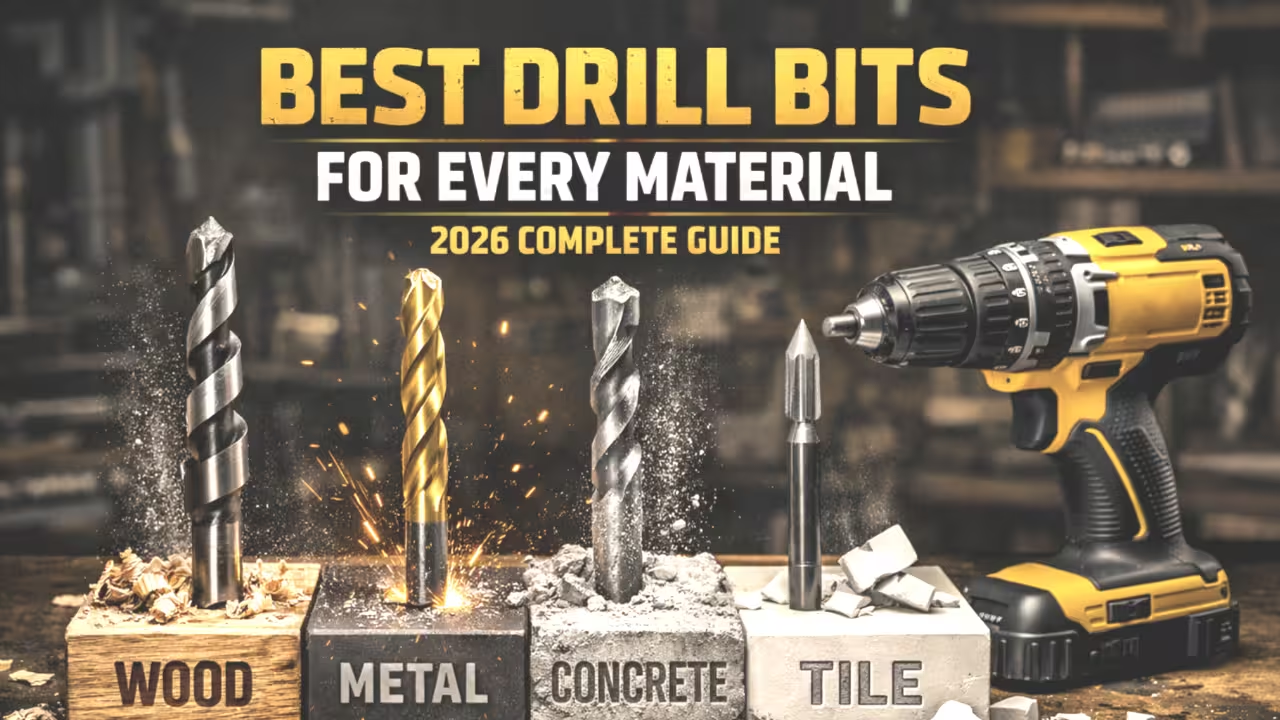
Choosing the Best Drill Bit For Every Material isn’t just about making a hole; it’s a high-stakes game of metallurgy, thermal management, and matching the right geometry to your substrate. At BuildToolHQ, we’ve spent thousands of hours testing HSS, Cobalt, and Carbide across every imaginable surface—from soft pine to hardened industrial alloys—to bring you this definitive 2026 guide. 🧬
Whether you are a professional contractor managing a job site or a weekend DIYer tackling a home renovation, understanding the Best Drill Bit For Every Material will save you a fortune in snapped bits and ruined workpieces. In this expanded guide, we dive deep into the mechanical science of cutting to ensure your toolkit is ready for the most demanding technical challenges. 🚀
🏗️ The Core Hierarchy: Matching Bit to Substrate
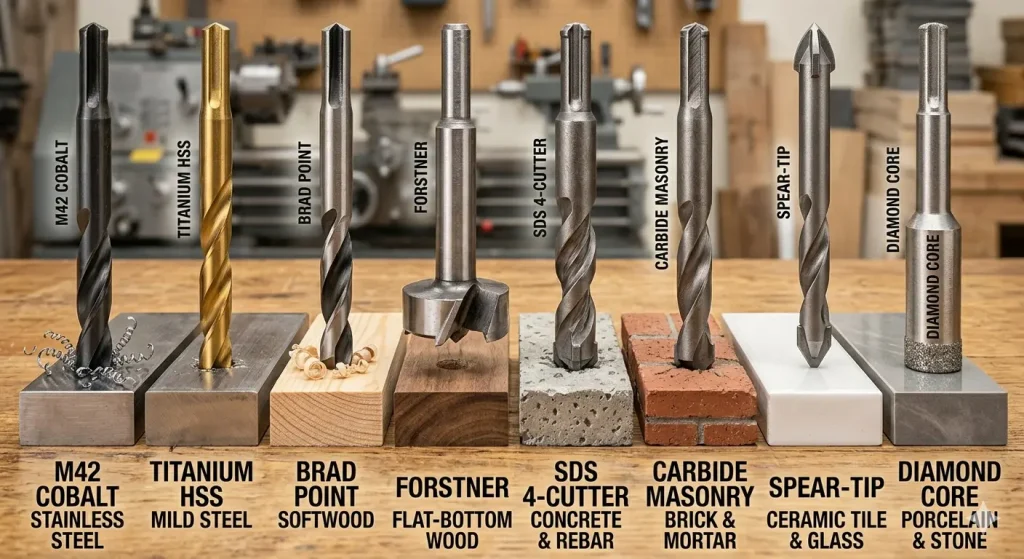
Selecting the Best Drill Bit For Every Material begins with identifying the “Hardness Gap” between your bit and the workpiece. If your bit isn’t significantly harder than the material, you aren’t drilling—you’re just generating friction and smoke. 🔥
1. Ferrous and Non-Ferrous Metals 🔩
For general metalworking, High-Speed Steel (HSS) is the baseline. However, as industrial drilling standards have evolved, we now see a massive shift toward Cobalt and Titanium coatings for heat resistance.
- Best for Mild Steel: Titanium-coated HSS.
- Best for Stainless Steel: M42 Cobalt.(Read our full guide to the👉 [Best Drill Bit for Steel and Metal] ).
2. Masonry: Concrete, Brick, and Stone 🧱
These require a percussive “hammering” action. You cannot use a standard twist bit here; you need a tungsten carbide tip that can withstand the impact of a rotary hammer.
(Read our full guide to the👉 [Best Drill Bit for Brick and Masonry] here).
3. Specialty Surfaces: Tile, Glass, and Porcelain 💎
Porcelain and glass are incredibly brittle. They require “Diamond Grit” or “Spear-head” bits designed to grind the material away rather than shave it.
(Read our full guide to the👉 [Best Drill Bit for Glass] ).
🧬 Metallurgy 101: Why Your Bit Matters
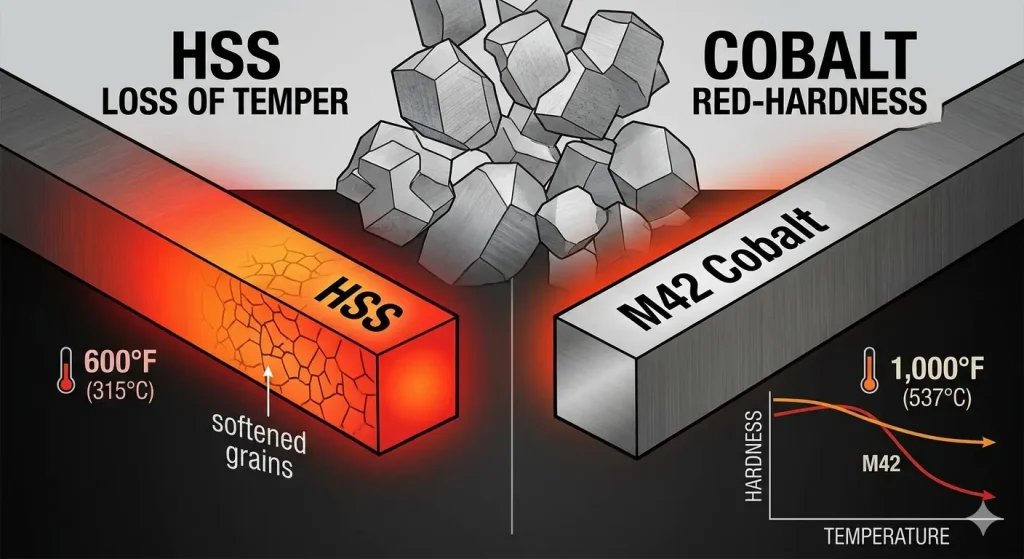
To truly find the Best Drill Bit For Every Material, we must look at the atomic level. The material of your bit dictates its “red-hardness”—the ability to maintain a sharp cutting edge while glowing hot in the middle of a deep bore. 🌡️
HSS vs. Cobalt Performance: The 2026 Standard
Standard HSS is excellent for plastics and softwoods. However, HSS loses its “temper” and softens at approximately 600°F (315°C). Once this temperature is reached, the bit is effectively dead. 💀
In contrast, Cobalt bits (M35 or M42) are engineered for superior heat dissipation:
- M35 Cobalt (5% Cobalt): The gold standard for most home workshop stainless steel applications.
- M42 Cobalt (8% Cobalt): This is the Best Drill Bit For Every Material involving high-grade industrial alloys or hardened bolts. Cobalt remains stable past 1,000°F (537°C), allowing you to drill through high-friction zones without the edge rounding off.
(Read our full comparison on👉 [Titanium vs Cobalt Drill Bits: Which Is Better?] here).
🔥 Thermodynamics: The Friction-Heat-Dull Cycle
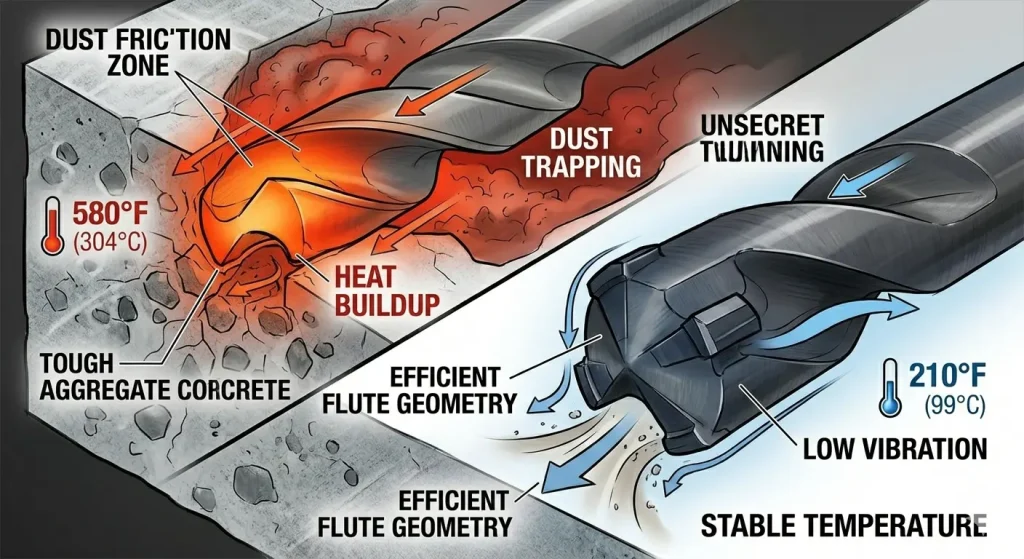
The biggest enemy of the Best Drill Bit For Every Material is the Friction-Heat-Dull cycle. As the bit rotates, friction generates heat. If that heat isn’t evacuated via the “flutes” (the spiral grooves), the cutting edge expands and loses its sharpness. 📉
4-Cutter Geometries in SDS Bits 🛠️
In heavy masonry work, heat buildup is extreme. Modern 4-cutter geometries in SDS bits reduce vibration and heat buildup compared to the old 2-cutter style. Instead of two cutting faces fighting the aggregate, four faces distribute the load, which:
- Prevents the bit from seizing on rebar. 🏗️
- Creates a perfectly round hole for better anchor setting.
- Extends the life of your rotary tool accessories.
(Read our full guide to the👉 [Best Drill Bit for Concrete (Masonry & SDS Bits Explained)] here).
📊 The 2026 RPM & Pressure Reference Table
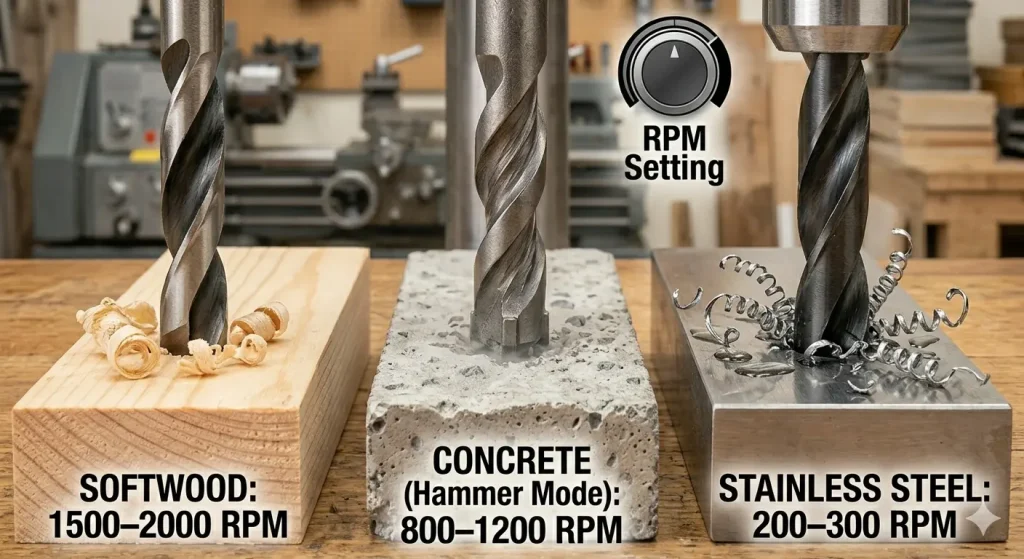
Using the Best Drill Bit For Every Material effectively requires the correct speed. Faster is rarely better when it comes to hard substrates. Use this table to calibrate your drill press or handheld driver. ⏱️
| Material | Bit Type | Recommended RPM (1/4″ Bit) | Pressure Level |
| Mild Steel | HSS/Cobalt | 400–500 RPM | Medium/High 🏋️ |
| Stainless Steel | Cobalt (M42) | 200–300 RPM | High/Consistent 🔨 |
| Softwood | Brad Point | 1500–2000 RPM | Light ☁️ |
| Concrete | SDS Carbide | 800–1200 RPM (Hammer) | Medium 🏗️ |
| Porcelain | Diamond Grit | 100–200 RPM | Very Light 💧 |
| Cast Iron | Carbide Tipped | 300–400 RPM | Medium |
🌲 Woodworking: Precision Over Power
When seeking the Best Drill Bit For Every Material in a wood shop, you aren’t fighting heat; you’re fighting “tear-out” and grain splintering. 🪚
- Brad Point Bits: These feature a sharp center spur that prevents “walking” and ensures the hole is exactly where you marked it.
- Forstner Bits: These are the Best Drill Bit For Every Material involving flat-bottomed holes for hinges or clean-exit holes in cabinetry.(Read our full guide to the👉 [Best Drill Bit for Wood (Clean Holes & Fast Drilling)].
💎 The Fragile Frontier: Tile, Glass, and Porcelain
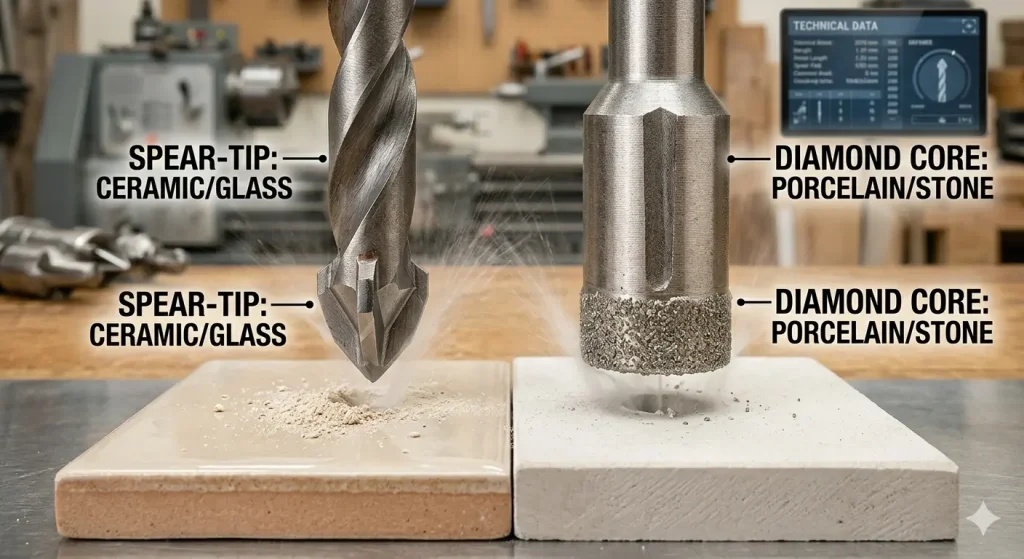
Drilling into a $100 porcelain slab requires the Best Drill Bit For Every Material designed for abrasion. If you use a standard twist bit, the tile will crack instantly. 💔
- Carbide Spear-Tip: Perfect for basic ceramic tiles and non-tempered glass.
- Diamond Core Bits: These are essential for modern porcelain. They don’t “cut”; they grind. Pro-Tip: Always use water as a coolant to prevent the diamond bond from melting. 💦(Read our full guide to the👉 [Best Drill Bit for Tile and Porcelain].
🏗️ Masonry vs. Concrete: Decoding the Substrate
Many beginners confuse these two, but the Best Drill Bit For Every Material list separates them for a clear reason: Reinforcement.
- Standard Masonry Bits: Use a “shoveling” action perfect for brick, mortar, and cinder blocks. (Read our full guide to 👉[Masonry Drill Bits vs Concrete Drill Bits] here).
- SDS Concrete Bits: Designed for the high-impact energy of a rotary hammer, these bits can handle the heavy aggregate and occasional rebar strikes found in structural concrete.
⚠️ Why Drill Bits Burn or Break (And How to Prevent It)
Even the Best Drill Bit For Every Material will fail if you ignore the laws of physics. Understanding the “Why” is just as important as the “How.” 🚩
- Excessive RPM: Running a bit too fast for the material creates a “glaze” on the metal, making it impossible to cut further.
- Lack of Lubrication: When drilling metal, cutting oil is non-negotiable. It reduces friction and carries heat away.
- Side Loading: Drill bits are designed for vertical pressure, not lateral force. Tilting the drill mid-hole is the #1 cause of snapped bits. 🚫
(Read our full guide on👉 [Why Drill Bits Burn or Break (And How to Prevent It)] .
🛠️ Specialized Tooling: Beyond the Standard Twist Bit
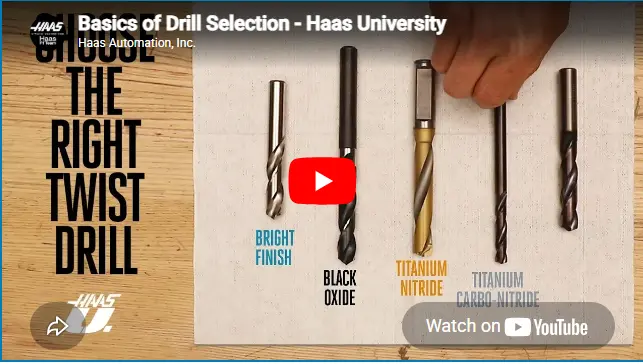
🛠️ BuildToolHQ Recommended Watch: To see the science of the ‘Best Drill Bit For Every Material’ in action, check out Haas Automation’s ‘Basics of Drill Selection.’ It’s a masterclass in how industrial standards for coatings and geometries ensure maximum tool life and precision.
To be the Best Drill Bit For Every Material expert, you must know when to move beyond the standard spiral.
- Step Bits (Unibits): The ultimate tool for thin sheet metal and PVC. They allow you to enlarge holes without the bit “grabbing” the material. 🪜
- Self-Feeding Auger Bits: Best for boring deep, large-diameter holes through thick timber or landscape ties.
- Countersink Bits: Essential for ensuring screw heads sit flush with the surface for a professional finish.
🛡️ Pro-Tips for Workshop Success
🔥 Pro-Tip: The “Peck Drilling” Technique
When drilling deep holes in metal or wood, use a “pecking” motion. Pull the bit out every 1/4 inch to clear the chips. This prevents the flutes from clogging and keeps the temperature down.
🛠️ Safety Warning: Eye Protection
When using the Best Drill Bit For Every Material, especially metal or masonry, high-velocity shards are guaranteed. Always wear ANSI Z87.1 rated safety glasses. 👓
❓ Frequently Asked Questions (FAQ)
Can I use a metal bit to drill through wood? 🪵
Technically yes, but HSS metal bits often leave “fuzz” or significant tear-out on the backside of the wood. For furniture-grade results, a Brad Point bit is the Best Drill Bit For Every Material involving timber.
Is Titanium really better than Cobalt? 🧪
It depends. Titanium bits are HSS bits with a surface coating. They are great for high-speed drilling in soft metals. However, once the coating wears off, it’s just a standard HSS bit. Cobalt is an alloy—the heat resistance goes all the way through the bit, allowing you to resharpen it.
Why is my masonry bit glowing red and smoking?
You are likely using too high an RPM or haven’t cleared the dust from the hole. In concrete, dust acts as an insulator, trapping heat. Pull the bit back frequently to “pump” the dust out.
What is the best bit for hardened steel or Grade 8 bolts? ⚡
Standard bits will fail. You need M42 Cobalt or a solid Tungsten Carbide bit. Use very low RPM and extremely high pressure.
How do I know if my bit is dull? 🛑
If the bit produces fine powder instead of “chips” (swarf) in metal, or if you see “blueing” (heat discoloration) on the tip, it is dull. Stop immediately to avoid damaging your drill motor.
Final Thoughts on Selection 🏆
Finding the Best Drill Bit For Every Material is a balance of metallurgy, geometry, and patience. By investing in M42 Cobalt for your metals, 4-cutter Carbide for your masonry, and Diamond grit for your fragile porcelain, you ensure that every project meets the “BuildToolHQ” standard of excellence.
Remember, the Best Drill Bit For Every Material is the one that stays cool, stays sharp, and gets the job done safely. Happy drilling! 🛠️✨
Leave a Reply