Category: Beginner Guides

  • CNC Bit Maintenance: The Professional Guide to Sharpening, Cleaning, and Storage

    CNC Bit Maintenance: The Professional Guide to Sharpening, Cleaning, and Storage

    You’ve invested hundreds, perhaps thousands, of dollars into your tooling library. From the high-performance [Upcut vs. Downcut vs. Compression Bits: When to use each for edge finish] that power your roughing passes to the elite [Diamond Coated & Specialized Bits: For composites and abrasive materials] used for aerospace composites, these tools are the heart of your workshop. However, many operators treat bits as disposables. The reality is that the cost of neglect is far higher than the cost of upkeep.

    Proper CNC bit maintenance isn’t just about aesthetics; it’s about preventing “runout,” reducing spindle strain, and ensuring your centerpiece projects don’t fail due to a resin-clogged flute. In this comprehensive guide, we’ll cover the chemical, physical, and environmental pillars of tool longevity. This expertise is a core part of our [The Ultimate Guide to CNC Router Bits: Selection, Speeds, and Materials].


    1. The “Resin Trap”: Why Dirty Bits Actually Break
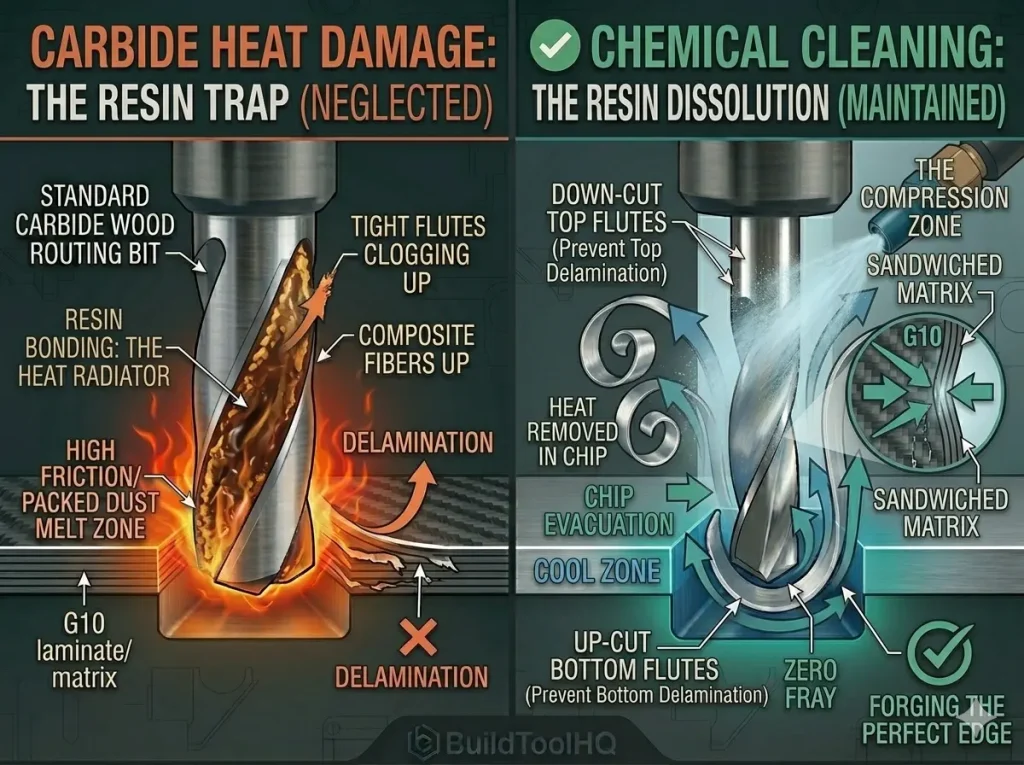
    Comparison diagram visualizing a standard standard upcut bit (left, orange) vs. a PCD diamond compression bit (right, teal) cutting a G10 composite, physically proving how the compression zone prevents top and bottom delamination fraying.
    Why compression is king: This technical diagram visualizes the victory. A standard 2-flute bit (left) quickly creates delamination fraying in G10. The diamond coated compression bit (right) uses top-down and bottom-up flutes to create "THE COMPRESSION ZONE." The exploded view (right) shows how this sandwiches the G10 core matrix together with support, allowing the PCD edge (from image_107.png) to slice the supported fibers cleanly, guaranteeing a zero-fray finish in abrasive materials with diamond coated CNC bits.

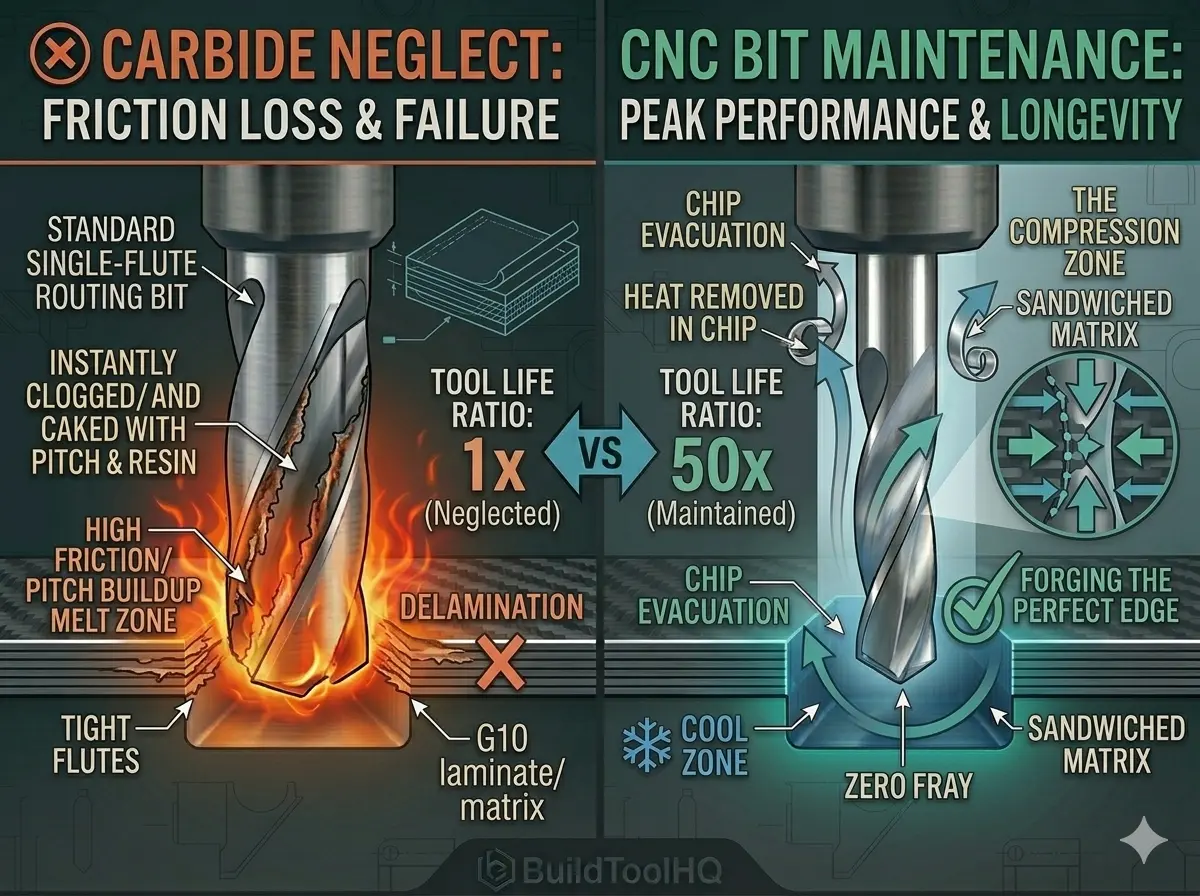
    The most common cause of premature tool failure isn’t actually a loss of sharpness—it’s pitch and resin buildup. When you cut softwoods like pine or even dense hardwoods like walnut and cherry, the friction of the cut melts the natural resins in the wood. These resins then bond to the carbide surface, making consistent CNC bit maintenance nearly impossible without intervention.

    The Friction Feedback Loop

    Once resin builds up in the “gullet” (the valley of the flute), it creates a catastrophic feedback loop:

    1. Increased Friction: The resin creates a sticky surface that prevents chips from sliding out.
    2. Heat Spikes: Because chips can’t eject (a principle we emphasize in [Aluminum Cutting with CNC: Single-flute secrets and lubrication]), they get re-cut, generating intense heat.
    3. Tempering Loss: This heat can eventually reach a point where it compromises the cobalt binder in your carbide, leading to a “cooked” bit that snaps under the slightest load.

    2. The Professional Chemical Cleaning Protocol

    To keep your CNC bit maintenance schedule efficient, you need a dedicated cleaning station. Don’t wait for the bit to turn black; clean it as soon as you see a “dull” film forming on the flutes.

    • The Solvent Bath: Submerge the cutting flutes in a non-corrosive solvent. For stubborn melted plastics from [O-Flute Bits for Plastics and Acrylics: Managing heat and preventing melting] runs, use a specialized resin remover.
    • The Dwell Time: Let the bits sit for 10–15 minutes. This allows the chemicals to penetrate the bond between the resin and the carbide.
    • The Brass Brush: Use a brass-bristled brush. Brass is softer than carbide and will not damage the cutting edge, but it is stiff enough to whisk away softened pitch.
    • Immediate Drying: After rinsing, dry the bit with a microfiber cloth and apply a moisture-displacing spray to prevent microscopic oxidation on the edge.

    3. The Sharpening Decision: To Hone or to Replace?

    A major question in CNC bit maintenance is when to send a tool for professional sharpening.

    4. Proper Storage: The “No-Touch” Rule

    Carbide’s greatest strength (hardness) is its greatest weakness (brittleness). If you keep your bits in a loose drawer where they can clink together, the edges are effectively “hammering” each other, leading to micro-fractures. Effective CNC bit maintenance requires a vertical storage block where no two cutting edges can touch.

    Climate-Controlled Tooling

    If your CNC is in a garage, humidity is your enemy. Store your primary bit collection in a weather-sealed “dry box” with silica gel packs. This prevents the “pitting” of the carbide surface that occurs in high-moisture environments, a step often overlooked in standard CNC bit maintenance routines.


    5. Collet Maintenance: The “Silent Killer” of Bits
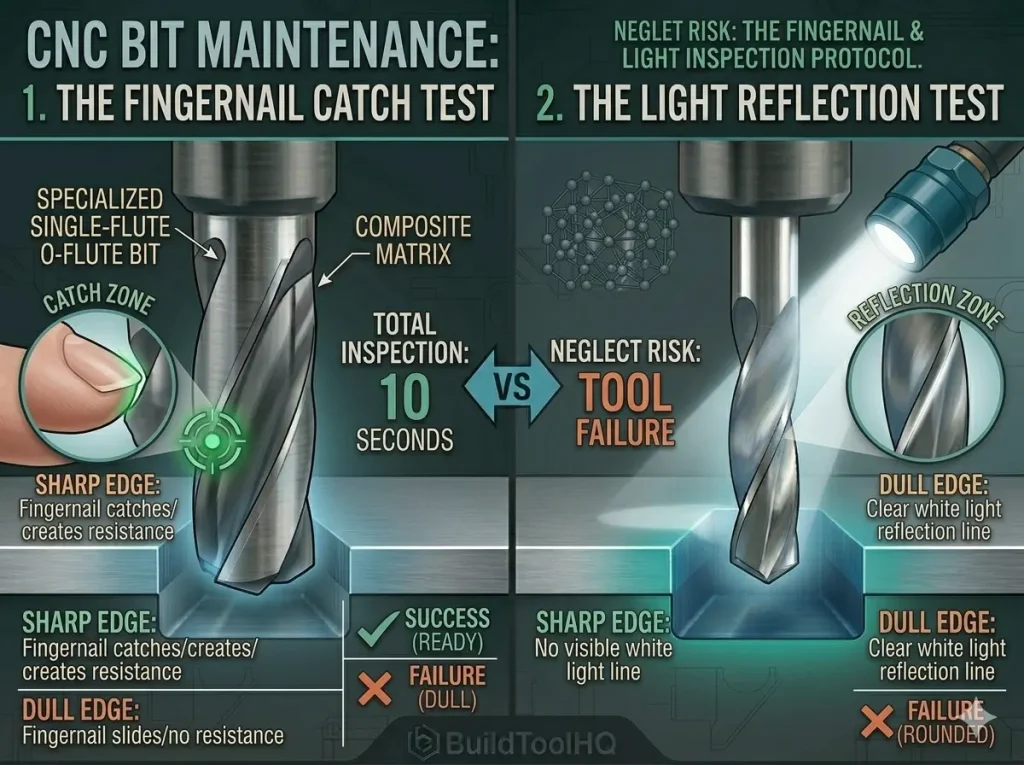
    Technical infographic diagram visualizing the two critical 10-second inspection protocols: The Fingernail Catch Test (left, sharp catch) and The Light Reflection Test (right, sharp dark line vs dull white line), using the specific single-flute O-flute bit detailed in BuildToolHQ guide
    Understanding sharpness: This diagram visualizes the critical 10-second inspection protocol. By mastering (left) the Fingernail Catch Test (where a sharp edge must catch the nail) and (right) the Light Reflection Test (where a sharp edge shows a dark line with no reflection, as seen in image_115.png), you prevent cutting with dull bits, which kill professional results and destroy the expensive tools

    You can have a perfectly clean bit, but if your collet is dirty, you will experience runout (the bit spinning off-center). Even 0.001″ of runout can reduce tool life by 50% by putting uneven pressure on the flutes.

    As part of your CNC bit maintenance routine, blow out the collet and the spindle taper with compressed air every time you change a bit. Replace your primary collets every 400–600 hours of run time to ensure a perfect “grip” on your precision [Ball Nose vs. Tapered Ball Nose: The nuances of 3D carving and finishing passes].


    6. Pre-Flight Visual Inspection (The 10-Second Test)

    Before hitting “Cycle Start,” perform these three CNC bit maintenance checks:

    1. The Fingernail Test: Gently drag your nail across the edge (away from the point). If it slides without “biting,” the tool is dull.
    2. The Color Check: Look for “bluing.” If the carbide has a blue or purple tint, the bit has exceeded its thermal limits and is now “softened.”
    3. The Shank Check: Look for circular scratches, which mean your bit was spinning inside the collet, leading to massive heat buildup.

    7.Strategic Maintenance for Heavy Clearance Tools

    Many users forget that CNC bit maintenance applies most critically to their largest tools. After leveling a massive slab, your [Surfacing bit for CNC router] will have accumulated significant resin due to the sheer volume of material removed.

    Cleaning the removable carbide inserts on these bits is far more cost-effective than allowing them to dull prematurely. By integrating this into your CNC bit maintenance workflow, you ensure your leveling passes remain glass-smooth without the “burn lines” associated with dirty cutters.

    Conclusion: Turning Maintenance into Profit

    Consider investing in tools that aid in your CNC Bit Maintenance process for improved efficiency.

    A disciplined CNC bit maintenance routine can double or triple the lifespan of your tooling. By treating your bits as precision scientific instruments rather than consumables, you ensure that every cut is as clean as the first and that your machine remains a profitable, high-precision asset.

    Frequently Asked Questions

    Effective CNC Bit Maintenance includes regular inspections to catch potential issues early.

    How often should I clean my CNC bits?

    You should clean your CNC bits as soon as you notice a visible “film” or dark residue on the flutes. For materials like pine or plywood, this may be after every 2–4 hours of run time. For plastics or aluminum, clean them immediately if you notice any “gumming” to prevent permanent heat damage.

    Can I use WD-40 to clean my CNC router bits?

    WD-40 is excellent as a post-cleaning moisture displacer, but it is not a dedicated resin solvent. For CNC bit maintenance, use a specialized pitch and resin remover or a concentrated degreaser like Simple Green to break down the organic bonds of wood resin without damaging the carbide.

    How do I know if my CNC bit is too dull to use?

    Perform the “Fingernail Test”: gently drag your nail across the cutting edge. If it slides smoothly without catching, the bit is dull. Other signs include “bluing” of the carbide (indicating over-heating), increased spindle noise, or fuzzy/burned edges on your workpiece.

    Is it worth it to sharpen small 1/4″ carbide CNC bits?

    Generally, no. The cost of professional sharpening for a 1/8″ or 1/4″ bit often equals or exceeds the cost of a new high-quality tool. Sharpening is best reserved for large-diameter surfacing bits or custom profiles where the replacement cost is over $50–$100.

    Can diamond coated CNC bits be sharpened at home?

    No. (Diamond coated CNC bits) require specialized Electrical Discharge Machining (EDM) to sharpen because diamond is harder than any standard grinding wheel. Attempting to sharpen these at home will destroy the microscopic diamond lattice and ruin the tool.
  • Upcut vs. Downcut vs. Compression: The Ultimate CNC Edge Quality Guide

    Upcut vs. Downcut vs. Compression: The Ultimate CNC Edge Quality Guide

    In the world of precision manufacturing, your CNC machine is only as capable as the few millimeters of carbide meeting the workpiece. For the BuildToolHQ community, understanding the difference between Upcut vs. Downcut CNC bits versus Compression tooling isn’t just about knowing which shape to buy—it’s about mastering the intersection of material science, geometry, and mechanical physics.

    Understanding the nuances between Upcut vs Downcut CNC bits is essential for any CNC machining project.

    Familiarizing yourself with Upcut vs Downcut CNC bits can lead to superior results in your crafting.

    Choosing the wrong geometry results in more than just a “bad cut.” It leads to workholding failure, shortened spindle life, and potentially dangerous tool breakage. This guide is designed to transform you from a “user” into a “technician,” providing a deep dive into Upcut vs Downcut CNC bits and Compression bits so you can achieve a zero-sanding finish every time.

    As we established in our foundational [The Ultimate Guide to CNC Router Bits: Selection, Speeds, and Materials], the way a tool interacts with wood fibers dictates the success of the entire carve.

    1. The Physics of the Cut: Why Geometry Matters

    When discussing Upcut vs Downcut CNC bits, it’s important to consider their impact on different materials.

    A proper understanding of Upcut vs Downcut CNC bits ensures better finishes on your projects.

    Side-by-side comparison of plywood tear-out using upcut vs downcut CNC bits for edge quality.
    Notice the severe splintering on the left caused by an upcut bit pulling fibers upward, compared to the clean finish on the right.

    To master the selection of Upcut vs Downcut CNC bits and Compression bits, you first have to understand how wood reacts to a spinning blade at high RPM. Wood is not a solid block; it is a bundle of cellulose fibers. If you pull those fibers away from their support (the rest of the board), they splinter—this is the “tear-out” that ruins expensive slabs.

    The “spiral” or “flute” of a CNC bit acts like a screw thread. Depending on the direction of that screw, the bit is either pushing those fibers into the wood core or pulling them out. The choice between Upcut vs. Downcut vs. Compression is essentially a choice of where you want the “stress” of the cut to be directed.

    2. The Upcut Spiral: The Workhorse of the Shop

    The Upcut spiral is the most common tool for a reason: it is incredibly efficient at moving material and evacuating heat.

    Mechanical Action & Airflow

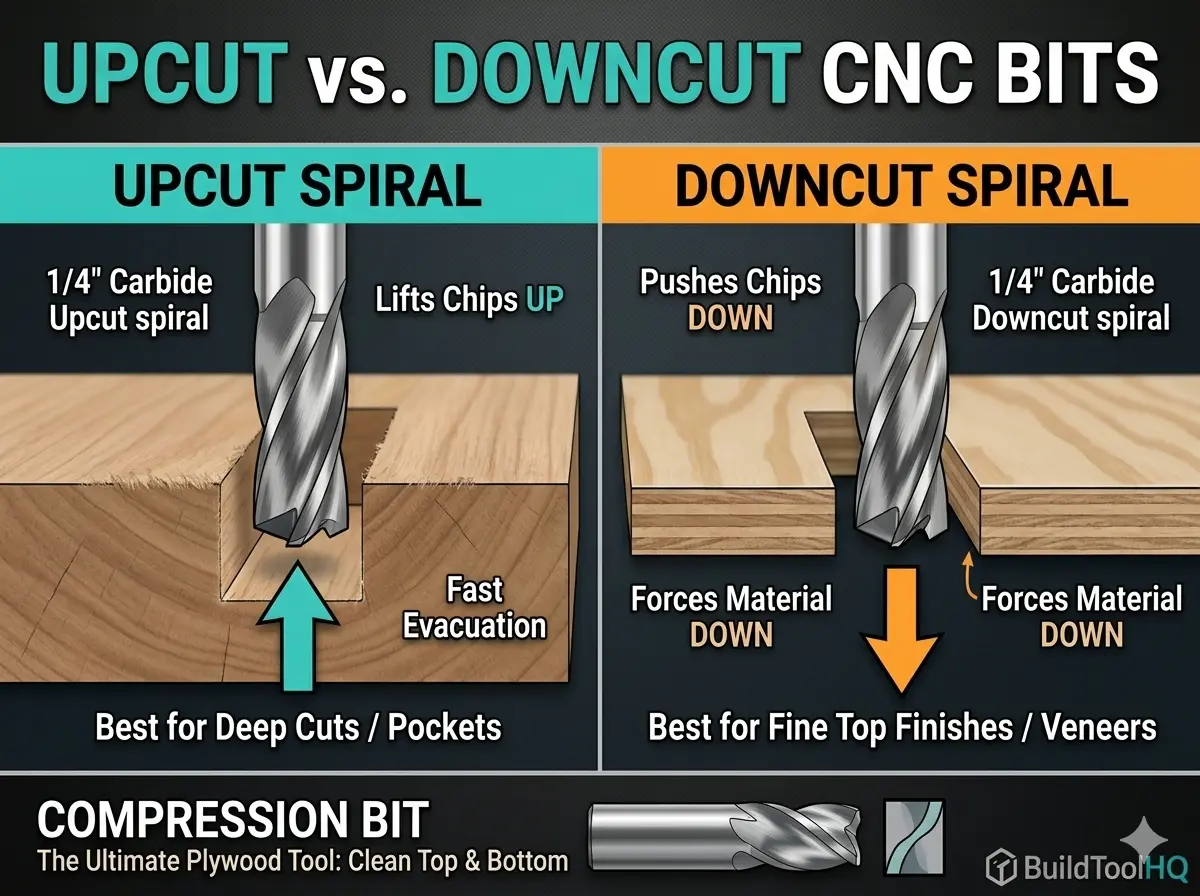
    The flutes wrap upward toward the shank. As the bit spins, it acts like a high-speed vacuum, pulling chips and heat up and away from the workpiece. This creates a “cooling effect” that preserves the life of your carbide.

    • The Pro: Superior chip evacuation. This is vital for deep mortises or slotting where chips would otherwise get trapped, causing “re-cutting” and friction fire.
    • The Con: It pulls the top surface fibers up. On materials like Baltic Birch plywood or melamine, this results in a “fuzzy” or splintered top edge that requires heavy sanding.
    • Best Use Case: Roughing passes, cutting solid natural wood where the top edge will be rounded over, or deep slotting where bit breakage is a concern.

    If you are calculating your chip load to prevent tool wear, remember that the upcut bit is the most forgiving geometry for heat management. See our core guide on [The Ultimate Guide to CNC Router Bits: Selection, Speeds, and Materials] for the specific physics of heat dissipation.

    In summary, understanding Upcut vs Downcut CNC bits can greatly enhance your proficiency.

    For detailed work, the choice of Upcut vs Downcut CNC bits can greatly influence the outcome.

    3. The Downcut Spiral: Precision for the “Show Side”

    If your project relies on a perfect top surface—like the intricate details found in [V-Carve Bits and Sign Making: Achieving crisp detail and sharp corners]—the Downcut bit is your best friend.

    The Downward Pressure Advantage

    The flutes on a downcut bit are reversed. As the tool rotates, it shears the wood fibers downward, pressing them against the core of the material.

    • The Pro: It creates a flawlessly clean top edge. Because it pushes down, it also acts as an “extra clamp,” helping hold thin materials flat against the wasteboard without the part lifting.
    • The Con: It pushes chips into the cut. In deep grooves, these chips can pack tightly, leading to heat buildup or “charring” on the edges.
    • Technical Tip: To run a downcut bit safely, you must use high-quality carbide. We discuss the thermal benefits of different coatings in our section on [Diamond Coated & Specialized Bits: For composites and abrasive materials].

    For a crisp finish, understanding Upcut vs Downcut CNC bits is vital.

    4. The Compression Bit: The Best of Both Worlds

    Detailed anatomy of a compression bit showing upcut vs downcut CNC bits transition zone.
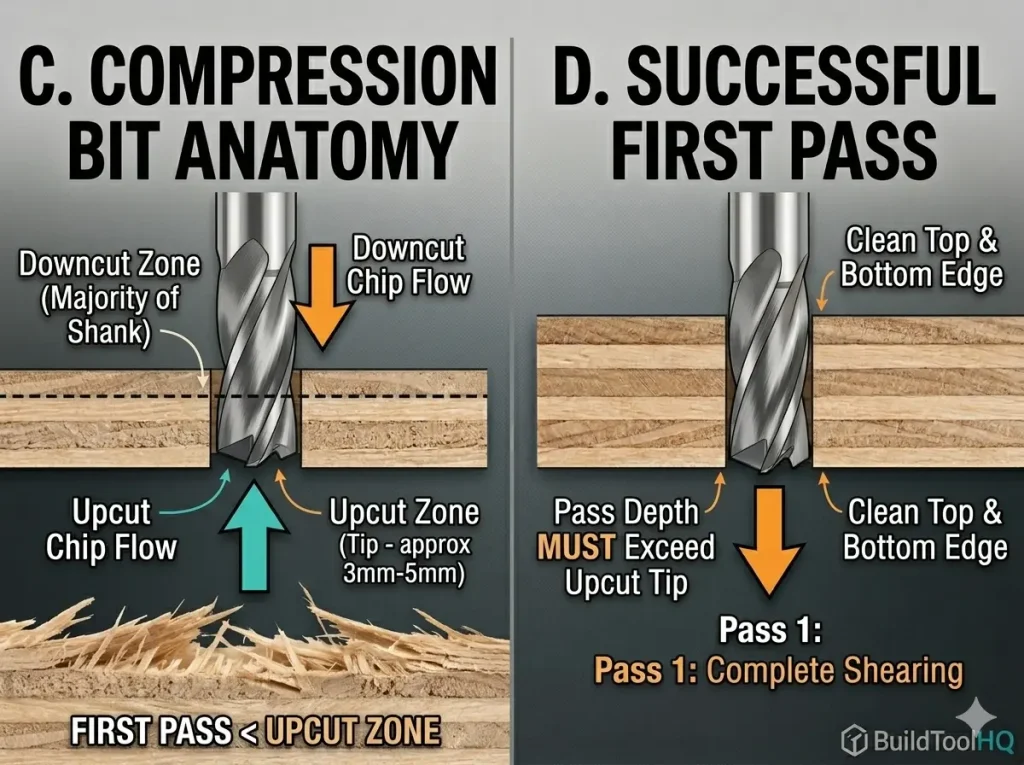
    A compression bit works by combining upcut and downcut geometries; the first pass must exceed the upcut length to protect the top surface

    Understanding Upcut vs Downcut CNC bits is critical for achieving the desired outcome.

    For professionals cutting double-sided laminates or expensive plywood, the Compression bit is the ultimate evolution of Upcut vs. Downcut vs. Compression technology.

    Your choice of Upcut vs Downcut CNC bits can greatly enhance the quality of your work.

    Understanding the “Transition Zone”

    A compression bit is a hybrid. The bottom 3-5mm of the bit features an upcut geometry, while the remainder of the cutting length is a downcut.

    In woodworking, the debate of Upcut vs Downcut CNC bits is crucial for optimal results.

    1. The Bottom: Pulls the bottom fibers up toward the center.
    2. The Top: Pushes the top fibers down toward the center.
    3. The Result: The material is “sandwiched,” leaving a clean, sharp edge on both sides of the board.

    Ultimately, the choice of Upcut vs Downcut CNC bits can determine your project’s success.

    Utilizing the right Upcut vs Downcut CNC bits is essential for high-quality finishes.

    The Golden Rule of Compression: Your first pass must be deeper than the upcut portion. If you only cut 2mm deep with a compression bit, you are only using the upcut part, and you will still get tear-out! This precision is similar to the “step-over” logic used in [Ball Nose vs. Tapered Ball Nose: The nuances of 3D carving and finishing passes].

    5. Material Matching Matrix

    Selecting the right tool depends entirely on your material. Below is a quick-reference guide for the BuildToolHQ community:

    Material TypeRecommended BitReason
    Baltic Birch PlywoodCompressionPrevents splintering on the veneer.
    Natural HardwoodUpcutBest for chip removal and tool cooling.
    Melamine / LaminateCompressionEssential for clean top/bottom edges.
    Softwood (Pine/Cedar)DowncutPrevents “fuzzing” on the soft fibers.
    Acrylic & PlasticsUpcut (O-Flute)Prevents melting by removing heat fast.
    MDFUpcut or DowncutMDF is uniform; choice depends on finish.

    When selecting tools, consider the implications of Upcut vs Downcut CNC bits.

    6. The Physics of Deflection and Rigid Seating

    One often overlooked aspect of choosing between Upcut vs. Downcut vs. Compression bits is how they affect tool deflection. Upcut bits exert “pulling” force, while downcut bits exert “pushing” force.

    To minimize “chatter” (vibration marks on your edge), you must ensure your bit is seated properly. Tool deflection increases by the cube of the length it protrudes from the collet. Always seat your bits as deeply as possible. For a guide on ensuring your collet is clean enough to handle this pressure, check out [CNC Bit Maintenance: Sharpening, cleaning, and storage for longevity].

    7. Troubleshooting Common Edge Issues

    Even with the right Upcut vs. Downcut vs. Compression bits, you might face these three common shop problems:

    The differences in Upcut vs Downcut CNC bits can ultimately affect your project quality.

    When using CNC tools, the differences in Upcut vs Downcut CNC bits can lead to varied results.

    A. Burnt Edges

    This usually happens with Downcut bits because the chips aren’t escaping. Solution: Increase your Feed Rate or decrease your RPM. You want the bit to “bite” the wood, not “rub” it.

    B. Part Shifting

    Proper knowledge about Upcut vs Downcut CNC bits allows for better project planning.

    The choice of Upcut vs Downcut CNC bits can prevent various machining issues.

    Upcut bits can pull small parts right off the table. Solution: Switch to a Downcut bit. The downward pressure acts as a mechanical clamp.

    C. Excessive Vibration

    Often caused by using a bit with too much “stick out” from the collet. This is especially common when using wide-diameter tools. Learn more about managing these forces in [Surfacing and Slab Leveling Bits: Mastering large-area clearing].


    8. Conclusion: Investing in the Right Tooling

    Mastering the choice of Upcut vs. Downcut vs. Compression bits is the fastest way to upgrade your shop’s output. While it is tempting to use a cheap upcut bit for everything, the time you save in sanding alone will pay for a specialized compression bit within a single project.

    Familiarity with Upcut vs Downcut CNC bits is a key factor for success in CNC operations.

    Keep your tools clean, calculate your chip loads carefully, and always match your geometry to your material. For a deeper look at the specific bits needed for cabinetry, revisit our guide on [Best CNC Bits for Plywood and Hardwoods: A deep dive into wood-specific geometry].

    Final Pro-Tip: The “Sound” of Success

    One often overlooked aspect of choosing between upcut vs downcut CNC bits is the acoustic feedback. Upcut bits tend to have a higher-pitched “scream” because they are actively vibrating the material upward. Downcut bits often sound more “muffled” because they are compressing the material against the table. If you hear excessive whistling or chatter, it may be time to revisit your Chip Load calculations or check for tool wear.

    Choosing between Upcut vs Downcut CNC bits can affect both aesthetics and functionality.

    The effectiveness of Upcut vs Downcut CNC bits can significantly impact your project timeline.

    Frequently Asked Questions:

    Why is my downcut bit burning the wood, but my upcut bit isn’t?

    Burning is almost always a result of heat being trapped in the cut. Because downcut bits push chips downward, they pack the “gullet” (the space between flutes) with sawdust. If your feed rate is too slow, the bit rubs against the same dust repeatedly, generating friction.
    The Fix: Increase your feed rate or decrease your RPM. You want the bit to slice off a physical chip that carries the heat away, rather than grinding wood into flour.

    Can I use a compression bit for shallow pocketing or engraving?

    Technically yes, but it won’t work as intended. A compression bit only “compresses” the fibers when the “upcut portion” at the tip is fully buried in the material. If you are only carving $2mm$ deep on a bit with a $5mm$ upcut length, you are effectively just using an upcut bit.
    The Pro Tip: For shallow work, stick to a dedicated downcut bit to ensure a crisp top edge.

    Which bit is safest for small parts that might fly off the table?

    When cutting small parts—especially those without a vacuum table—downcut bits are the safest choice. The downward spiral geometry exerts mechanical pressure that helps hold the part against the wasteboard. Conversely, an upcut bit acts like a corkscrew, trying to lift the part, which often leads to “part fly-off” and tool breakage.

    Do upcut vs. downcut vs. compression bits require different maintenance?

    The physics of the cut stays the same, but downcut and compression bits tend to accumulate resin faster because they don’t evacuate chips as efficiently as upcut bits. Resin acts as a thermal insulator, which “cooks” the carbide.
    The Fix: Check your bits every hour for “pitch” buildup. For the best cleaning protocols, refer to our guide on [CNC Bit Maintenance: Sharpening, cleaning, and storage for longevity].

    How do I know when my compression bit is dull?

    If you start seeing “fuzzing” or splintering on the top and bottom of your plywood, the transition zone of your compression bit is likely rounded over. You can also perform the “light reflection test” we detailed in the [The Ultimate Guide to CNC Router Bits: Selection, Speeds, and Materials] to see if the edge is reflecting light (a sign of dullness).

    Are these bits interchangeable for Aluminum or Acrylic?

    Generally, no. While you can use an upcut bit for metal, it is better to use specialized geometry. Aluminum is “gummy” and requires the single-flute clearance found in [Aluminum Cutting with CNC: Single-flute secrets and lubrication]. For plastics, a standard wood bit may generate too much heat and melt the material; instead, use [O-Flute Bits for Plastics and Acrylics: Managing heat and preventing melting].

  • The Ultimate Guide to CNC Router Bits: Selection, Speeds, and Materials

    The Ultimate Guide to CNC Router Bits: Selection, Speeds, and Materials

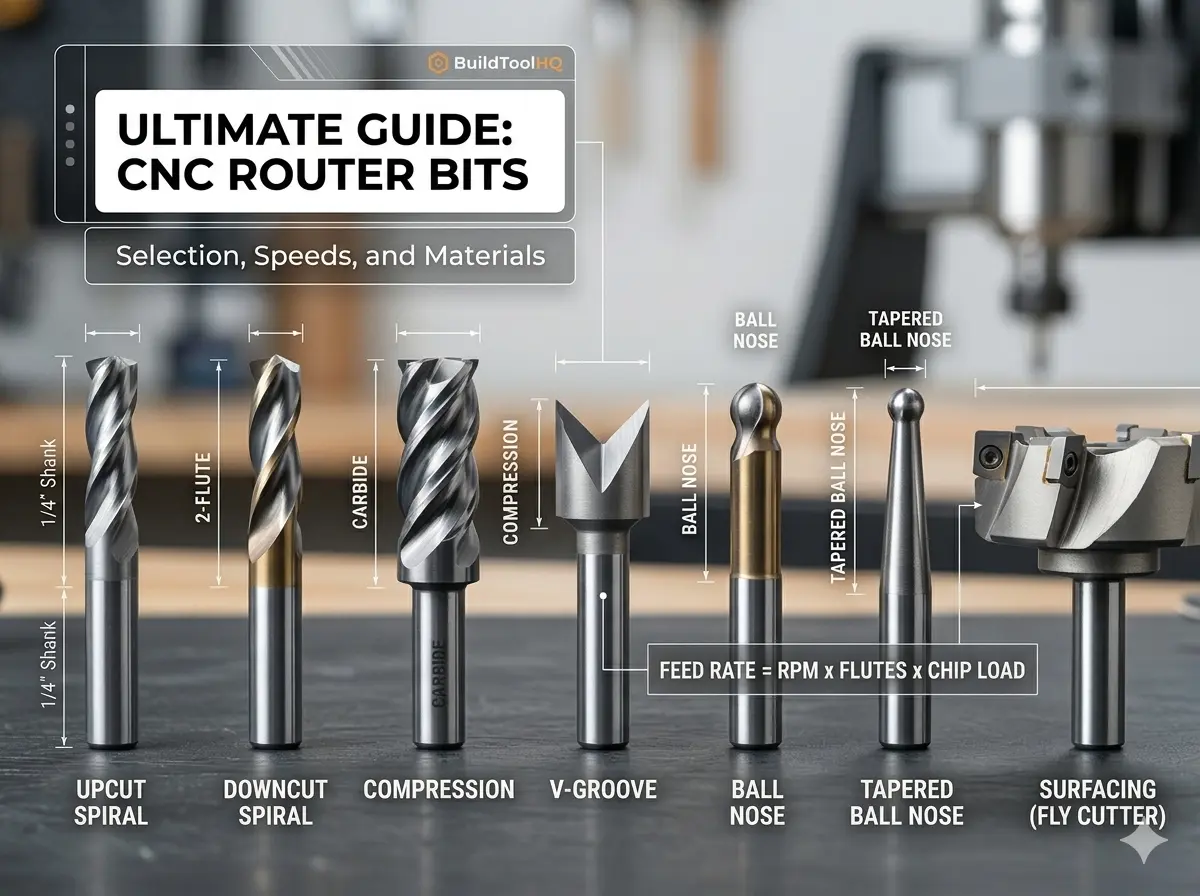
    In the world of precision manufacturing, your CNC machine is only as capable as the few millimeters of carbide meeting the workpiece. For the BuildToolHQ community, understanding CNC router bits isn’t just about knowing which shape to buy—it’s about mastering the intersection of material science, geometry, and mechanical physics.

    Choosing the wrong CNC router bits doesn’t just result in a “bad cut.” It leads to workholding failure, shortened spindle life, and potentially dangerous tool breakage. This guide is designed to transform you from a “user” into a “technician,” covering everything from basic flute geometry to the advanced math of chip loads.

    1. Understanding CNC Router Bits: Anatomy, Shanks, and Flutes

    To master the CNC, you must first speak the language of the tool. Every bit is a balance of trade-offs between rigidity, chip clearance, and finish quality.

    The Shank: The Foundation of Rigidity

    The shank is the un-ground part of the router bits held by the collet. While standard sizes like $1/4″$ and $1/2″$ are ubiquitous, the physics of deflection are often overlooked.

    • The Rule of Rigidity: Tool deflection increases by the cube of the length it protrudes from the collet.
    • BuildToolHQ Advice: Always seat your router bits as deeply into the collet as possible (leaving just a tiny gap before the flutes start) to minimize vibration and “chatter.”

    Flute Count and Performance

    The flutes are the helical channels that evacuate waste.

    • Single Flute: These are the “secret weapon” for plastics and soft metals. Because there is only one cutting edge, you can run higher feed rates at lower RPMs, preventing the material from melting. Learn more about it here : (best CNC bit for cutting acrylic)
    • Two Flutes: The industry standard for woodworking They provide a balance between a high feed rate and a smooth finish.
    • Three or Four Flutes: Primarily used for finishing passes in hardwoods or machining non-ferrous metals like Aluminum. They offer a superior finish but require massive feed rates to avoid “rubbing.”

    2. Types of CNC Router Bits: Upcut, Downcut, and Compression

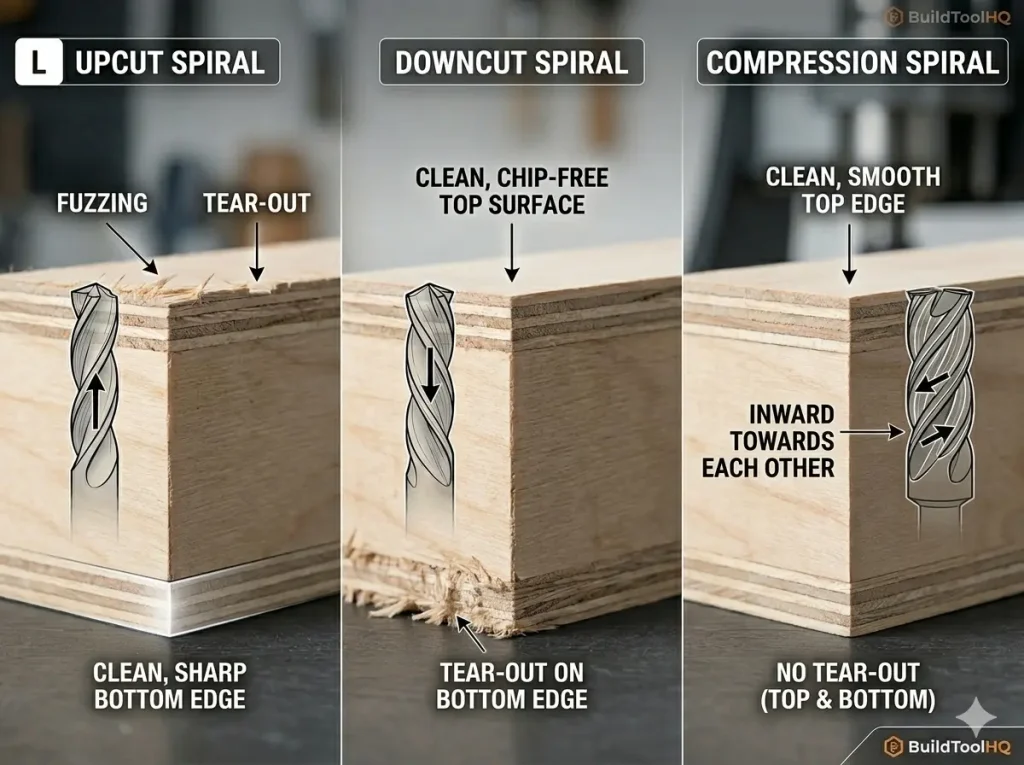
    CNC router bit comparison: Upcut vs Downcut vs Compression edge finish results on plywood
    Notice how the direction of the flutes (indicated by the arrows) dictates whether the tear-out occurs on the top or bottom of the workpiece

    The most frequent question we see is: “Which way should the chips go?” The answer depends entirely on your material’s “skin.” Selecting the right CNC router bits for the job requires understanding directional physics.

    Upcut CNC Router Bits: The Clearing Specialist

    Upcut bits pull chips toward the spindle.

    • Pros: Excellent chip evacuation; perfect for deep mortises or slotting.
    • Cons: They tend to lift the material and “fuzz” the top grain of plywood or veneers.

    Downcut CNC Router Bits: The Surface Master

    Downcut bits push chips into the cut.

    • Pros: They provide a perfectly clean top surface and help push the material down into the wasteboard.
    • Cons: They pack sawdust into the bottom of deep grooves, which can cause heat buildup in your CNC router bits.

    Compression CNC Router Bits: The Professional’s Choice

    A compression bit features a downcut spiral on the top and an upcut spiral on the very tip.

    • The Magic Moment: When the transition point is buried, the bit “sandwiches” the wood toward the center. This results in a “chip-free” edge on both the top and bottom of laminated sheets.

    Internal Resource: For a visual breakdown of these geometries, see our guide: [Upcut vs. Downcut vs. Compression Bits: A Visual Comparison].


    3. Material Science of CNC Router Bits: Carbide vs. HSS

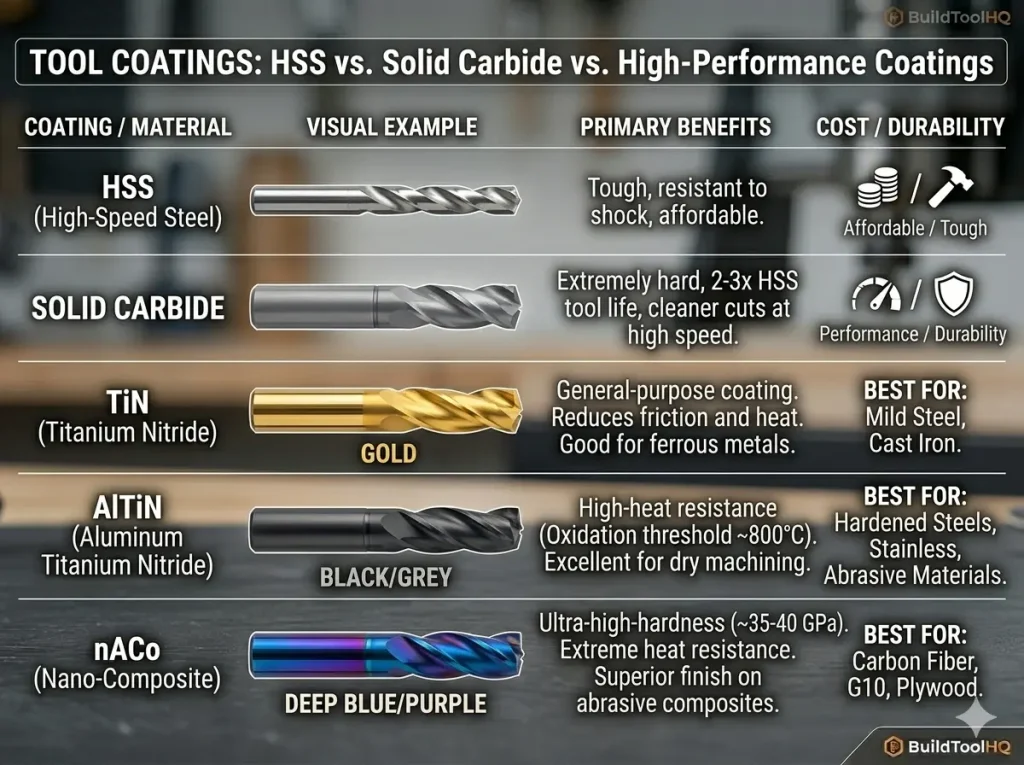
    CNC tool coatings comparison: HSS, Solid Carbide, TiN (Gold), AlTiN (Black), and nACo (Blue) end mills chart.
    This technical chart visually compares tool life and application best practices for standard HSS, Solid Carbide, and high-performance TiN, AlTiN, and nACo coatings.

    While High-Speed Steel (HSS) bits remain common in hand-held routing due to their lower price point, professional CNC operations almost exclusively demand Solid Carbide. According to technical standards for industrial tooling, carbide provides the extreme thermal stability required to withstand the high-speed friction generated by modern spindles.

    FeatureHigh-Speed Steel (HSS)Solid Carbide CNC Bits
    Heat ResistanceModerateExtreme
    Edge RetentionLowHigh (up to 50x longer)
    FlexibilityHigher (Vibration dampening)Low (Brittle/Rigid)
    Best ForSoftwoods / Short runsHardwoods, Composites, Metals

    At BuildToolHQ, we always recommend investing in high-quality carbide CNC router bits. While the initial cost is higher, the “cost per linear foot of cut” is significantly lower because carbide maintains a razor-sharp edge longer. This is especially critical when moving into high-performance fabrication; for example, standard carbide fails quickly in abrasive materials like carbon fiber or G10, requiring the elite durability found in our guide on ( diamond coated CNC bits ) And (aluminum cutting with CNC) guide.


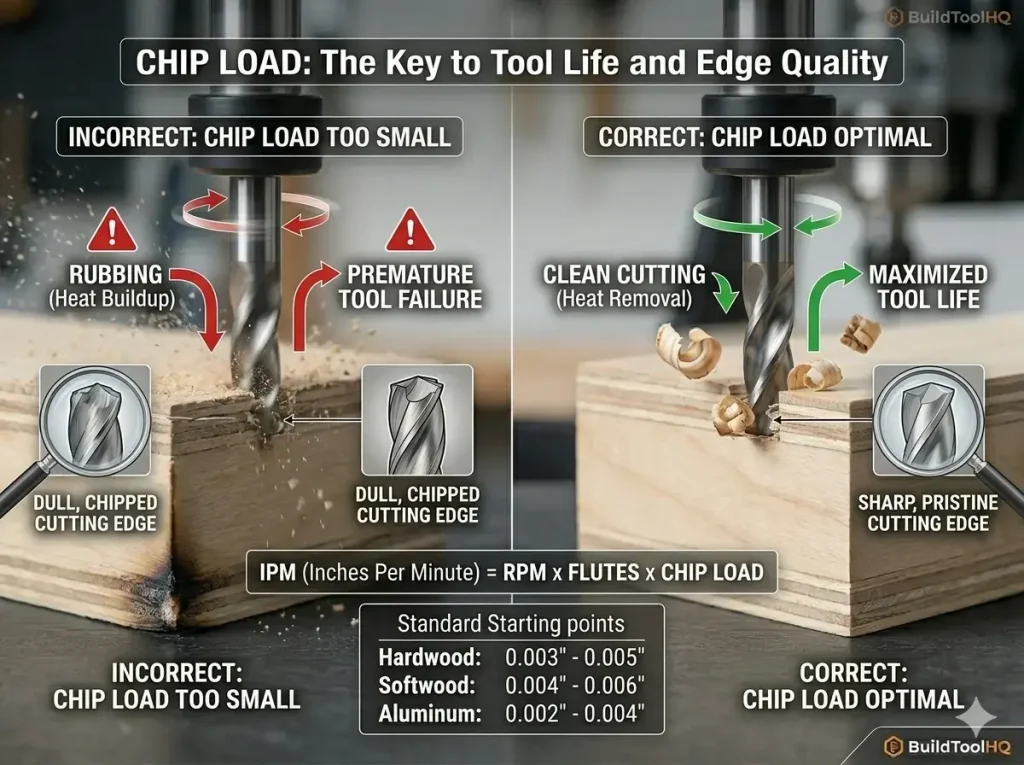
    4. Calculating Chip Load for CNC Router Bits

    CNC chip load comparison: Incorrect rubbing vs optimal chip load for tool life
    Proper chip load isn’t just about speed; it’s the primary way heat is removed from the cutting edge. Notice the flying chips on the right versus the burn marks on the left

    This is where most hobbyists fail and pros excel. If you hear your machine “screaming” or see smoke, your chip load is wrong, and you are killing your CNC router bits.

    Chip Load is the actual thickness of the chip each flute removes per revolution.

    • Too Small: The bit “rubs” the wood, causing friction heat that kills the tool’s temper.
    • Too Large: You risk snapping your CNC router bits or “missing steps” on your stepper motors.

    The Formula for Success

    Use this formula to calculate your starting points for any new CNC router bits:

    $$Feed\ Rate\ (IPM) = RPM \times Number\ of\ Flutes \times Chip\ Load$$

    Target Technical Specs:

    • Hardwood: $0.003″ – 0.005″$ chip load.
    • Softwood: $0.004″ – 0.006″$ chip load.
    • Aluminum: $0.002″ – 0.004″$ chip load.

    5. Specialty CNC Router Bits for Precision Tasks

    A well-stocked workshop needs more than just end mills. Specialized CNC router bits allow for complex 3D geometry and professional sign-making.

    V-Carve Bits and Sign Making

    Used for “V-carving” text and intricate patterns. The angle (usually $60°$ or $90°$) determines the depth and detail of the carve.

    Ball Nose vs. Tapered Ball Nose

    Essential for 3D contouring and organic shapes. The tapered variety offers the detail of a small radius with the strength of a thicker shank, making them some of the most versatile CNC router bits in your drawer.

    Slab Leveling and Surfacing

    If you are working with live-edge slabs, these wide-diameter CNC router bits are your best friend. They often feature replaceable carbide inserts for cost-effectiveness.


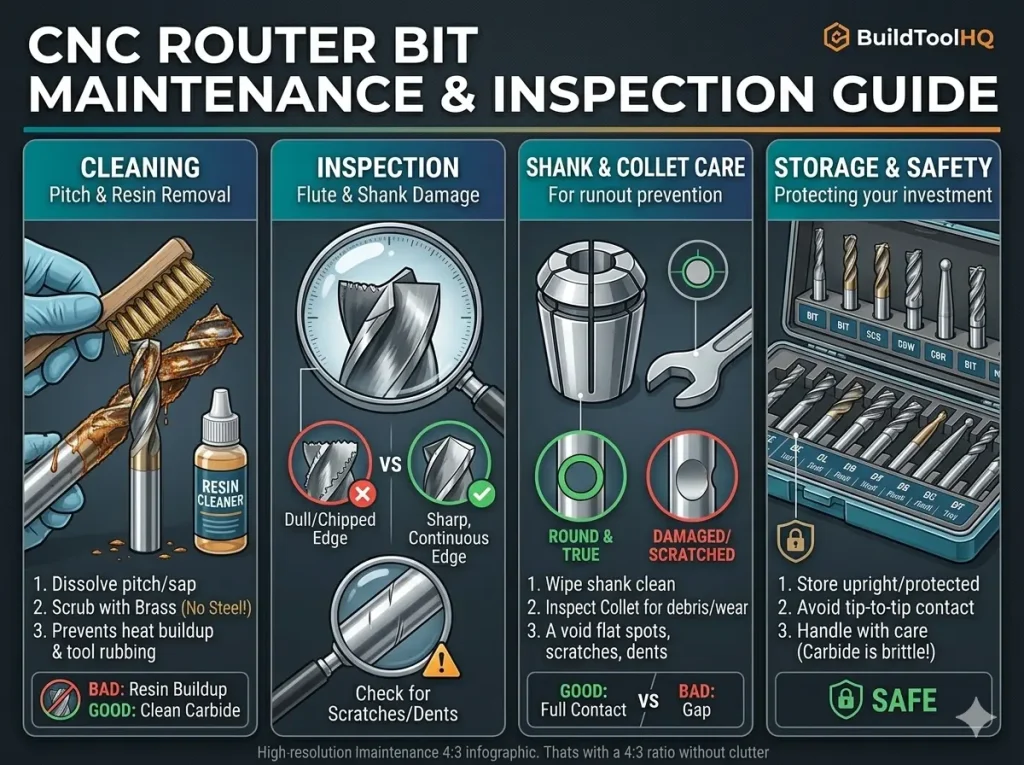
    6. Best Practices for CNC Router Bits Maintenance

    CNC router bit maintenance guide: cleaning pitch, inspecting flutes, collet care, and safe storage
    Regular inspection and proper maintenance are key to ensuring safe cuts and maximizing the life of your expensive CNC tooling investment

    A dull bit is a dangerous bit. To make your CNC router bits last, you must manage “Pitch” and heat.

    1. The Solvent Soak: After cutting resinous woods like Pine, soak your CNC router bits in a pitch remover. Resin acts as an insulator, keeping heat trapped in the carbide cutting edge.
    2. Collet Cleaning: A dirty collet introduces Runout (the bit spinning slightly off-center). Even $0.001″$ of runout can significantly reduce the life of your CNC router bits.
    3. Storage: Never let carbide CNC router bits touch each other. Use a dedicated bit tray or the original plastic packaging.

    Internal Resource: See our step-by-step on [CNC Bit Maintenance: Cleaning and Sharpening].


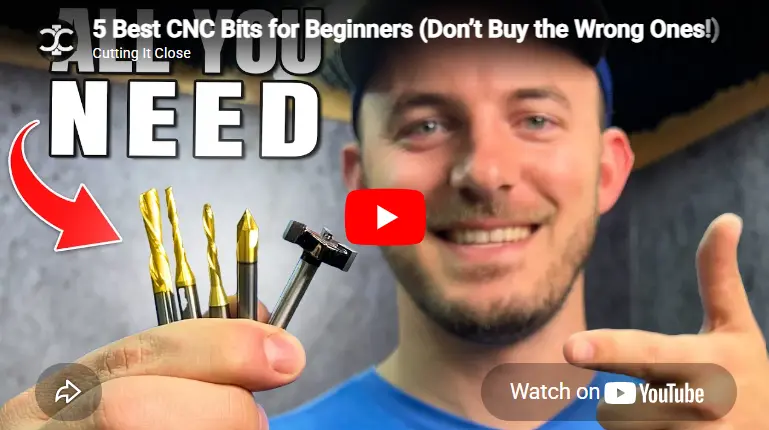
    New to CNC and overwhelmed by bit choices? These 5 essential CNC bits will help you achieve cleaner cuts, reduce tear-out, and maximize efficiency without wasting money on unnecessary tools. Whether you’re cutting wood, engraving, or surfacing, this guide covers the best CNC bits for beginners

    7. FAQ: Common Questions About CNC Router Bits


    Why is my bit burning the wood?

    Burning is almost always caused by an RPM that is too high for your Feed Rate. Increase your speed or lower your RPM to help your CNC router bits carry the heat away in the chips.

    When should I replace my CNC router bits?

    If you notice increased noise, visible burning, or a “fuzzy” finish that wasn’t there before, your bit is likely dull. If you have to slow down your feed rate to get a clean cut, it’s time for new tooling.

    How many flutes do I need for Aluminum?

    Always start with a single-flute O-flute. Aluminum is “gummy” and likes to stick to the tool; a single flute gives the chip plenty of room to escape.

    Final Thoughts for the BuildToolHQ Community

    Mastering CNC router bits is a journey of trial and error, but starting with the right technical knowledge puts you miles ahead of the competition. By matching your bit geometry to your material and dialing in your chip load, you’ll achieve the professional results your projects deserve.

    Explore our specialized cluster posts to master every specific material in your shop.

  • Why Drill Bits Burn or Break (And How to Prevent It)

    Why Drill Bits Burn or Break (And How to Prevent It)

    Why drill bits burn or break is one of the most common problems DIYers face when drilling into materials like steel, concrete, or hardwood. Burnt or broken drill bits are extremely common for DIYers and homeowners, but in most cases the cause is simple and preventable.

    Drill bits are designed to handle significant friction and pressure, but when the wrong technique or equipment is used, heat builds up quickly and the bit can fail.

    In this guide, you’ll learn the most common reasons drill bits burn or break, how to prevent these issues, and how to extend the life of your tools.

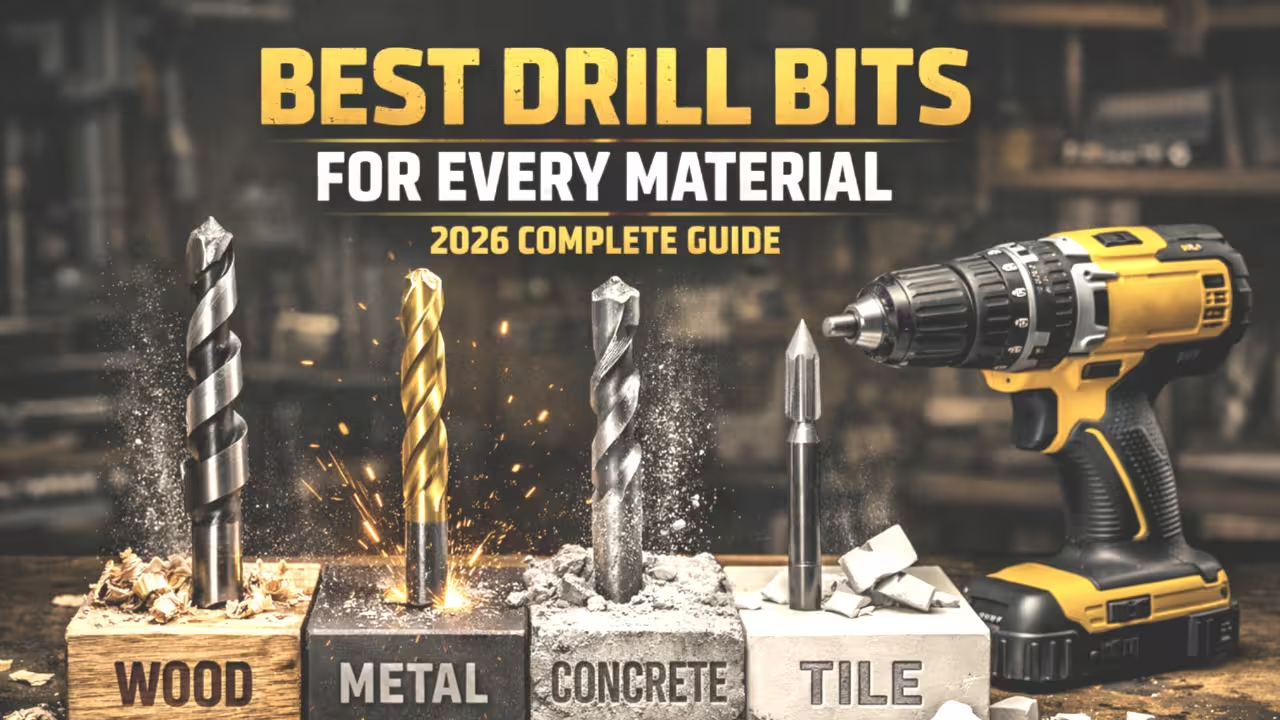
    (Best Drill Bits for Every Material (2026 Complete Guide))


    The Most Common Reasons Drill Bits Burn or Break

    There are several factors that can cause drill bits to fail. Most of them relate to heat, pressure, or improper technique.

    The most common causes include:

    • Excessive drilling speed
    • Too much pressure
    • Using the wrong drill bit type
    • Lack of lubrication
    • Dull drill bits
    • Poor quality materials

    Understanding these problems can help you avoid damaging your tools.


    1. Excessive Drilling Speed

    One of the biggest causes of burnt drill bits is drilling too fast.

    When drilling into hard materials like steel or concrete, high speed generates extreme friction. This heat can quickly damage the cutting edge of the drill bit.

    Signs of overheating include:

    • The bit turning blue or purple
    • Smoke coming from the drilling area
    • Reduced drilling performance

    Hard materials require slower drilling speeds to allow the bit to cut effectively.

    For example:

    • Steel → low speed
    • Concrete → medium speed with hammer mode
    • Wood → higher speed

    (Best Drill Bit for Steel and Metal (Complete Guide))


    2. Applying Too Much Pressure

    Another common mistake is pushing the drill too hard.

    Many people assume that more pressure means faster drilling, but this actually causes more friction and heat buildup.

    Excessive pressure can cause:

    • Broken drill bits
    • Bent drill bits
    • Damaged drill motors

    Instead, apply steady and moderate pressure and allow the drill bit to do the cutting.


    3. Using the Wrong Drill Bit for the Material

    Different materials require different drill bit designs.

    Using the wrong bit can quickly destroy the cutting edge.

    Examples include:

    • Using a wood bit on steel
    • Using a metal bit on concrete
    • Using a standard bit on hardened materials

    Each material requires a specific type of drill bit.

    For example:

    Concrete → masonry bits
    Steel → cobalt or titanium bits
    Wood → brad point bits

    (Best Drill Bits for Concrete and Masonry)
    (Best Drill Bit for Wood (Clean Holes & Fast Drilling))


    4. Lack of Lubrication When Drilling Metal

    When drilling into metal, lubrication is extremely important.

    Metal drilling creates significant friction, and without lubrication the drill bit can overheat in seconds.

    Lubricants help by:

    • Reducing friction
    • Cooling the drill bit
    • Improving cutting performance

    Common drilling lubricants include:

    • Cutting oil
    • Machine oil
    • Specialized drilling fluid

    Even a small amount of lubrication can greatly extend the life of a drill bit.


    5. Dull Drill Bits

    A dull drill bit requires much more force to cut into materials.

    Instead of cutting cleanly, the bit starts grinding and generating heat, which leads to burning.

    Signs of a dull drill bit include:

    • Difficulty starting holes
    • Increased heat and smoke
    • Rough or uneven holes

    If your drill bit becomes dull, you can either sharpen it or replace it.

    Regular maintenance helps prevent this problem.

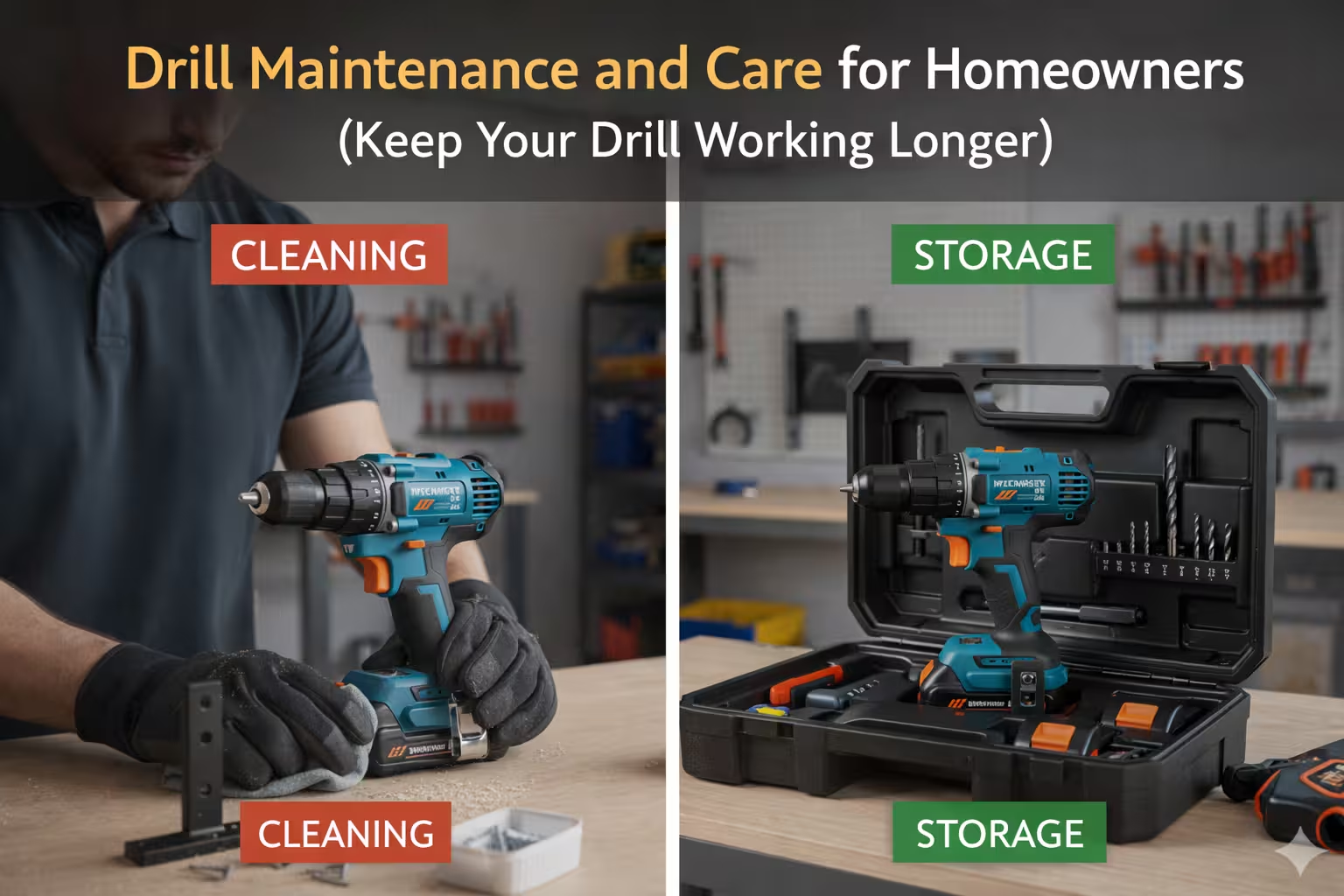
    (Drill Maintenance and Care for Homeowners (Keep Your Drill Working Longer))


    6. Poor Quality Drill Bits

    Not all drill bits are created equal.

    Cheap drill bits often use softer steel or poor carbide tips, which wear down much faster than professional-grade bits.

    Low-quality bits are more likely to:

    • Overheat quickly
    • Lose their cutting edge
    • Break under pressure

    Investing in high-quality drill bits usually saves money in the long run because they last significantly longer.


    How to Prevent Drill Bits from Burning or Breaking

    Preventing drill bit damage is easier than many people think. By following a few simple techniques, you can greatly extend the lifespan of your tools.

    Use the Correct Speed

    Always adjust the drill speed based on the material you’re drilling.

    Harder materials require slower speeds.

    Use Proper Drill Bits

    Choose drill bits designed specifically for the material you’re working with.

    (Best Drill Bits for Every Material (2026 Complete Guide))

    Clear Dust and Debris

    When drilling into concrete or masonry, pull the drill bit out occasionally to remove dust and debris.

    This reduces heat buildup.

    Use Lubrication for Metal

    When drilling steel or other metals, apply cutting oil to reduce friction.

    Let the Tool Do the Work

    Avoid forcing the drill into the material. Proper technique produces better results and protects the drill bit.


    Warning Signs Your Drill Bit Is About to Fail

    Knowing the early warning signs can prevent a drill bit from breaking mid-project.

    Watch for:

    • Discoloration on the drill bit
    • Smoke or burning smell
    • Slow drilling speed
    • Excessive vibration

    If you notice these signs, stop drilling immediately and allow the bit to cool down.

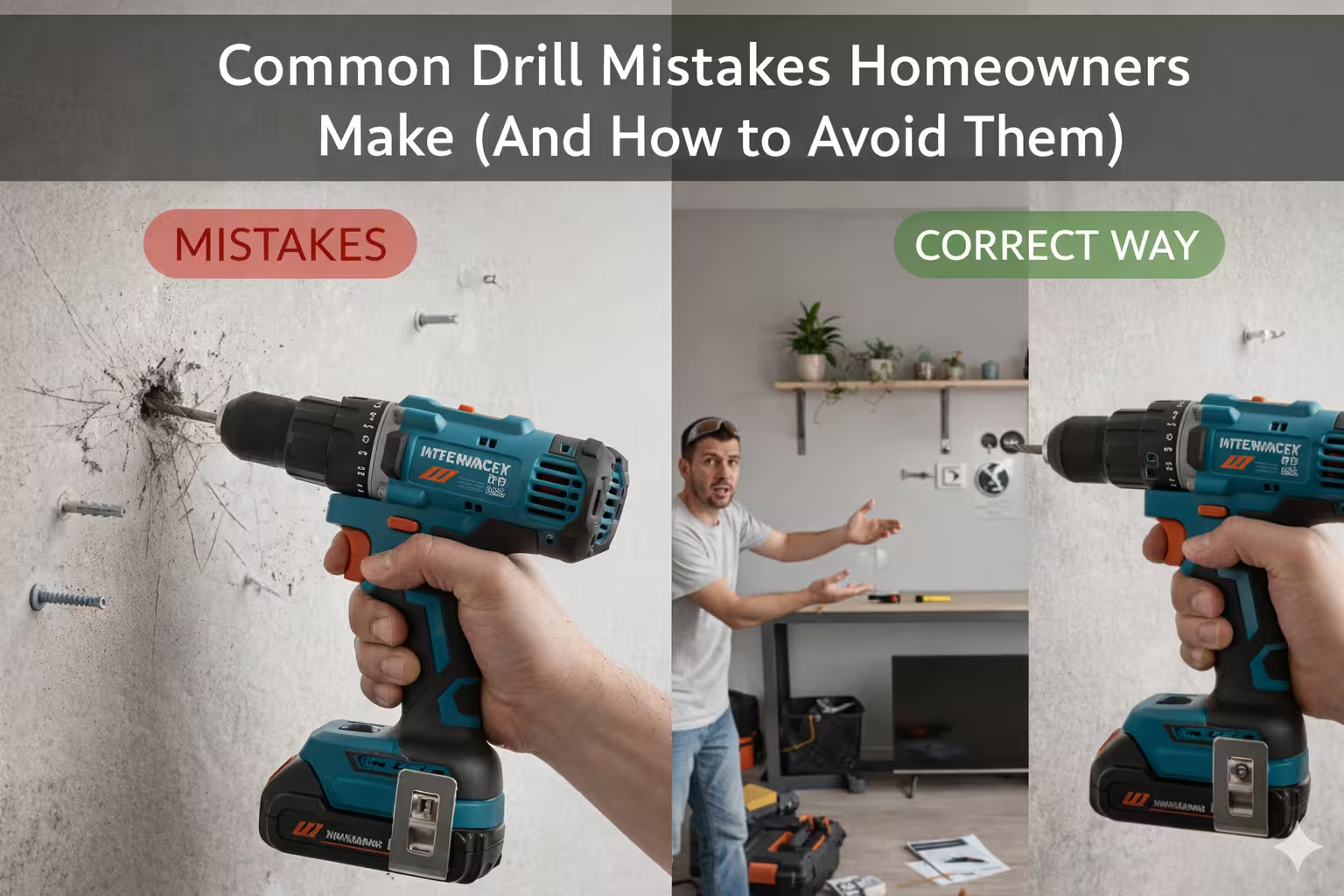
    (Common Drill Mistakes Homeowners Make (And How to Avoid Them))


    Choosing the Right Drill Power

    Another factor many people overlook is drill power.

    Underpowered drills struggle with harder materials and can cause excessive friction.

    For example:

    • Light drills → best for wood and drywall
    • Medium drills → suitable for metal and brick
    • Hammer drills → required for concrete

    Choosing the right drill power improves efficiency and protects your drill bits.

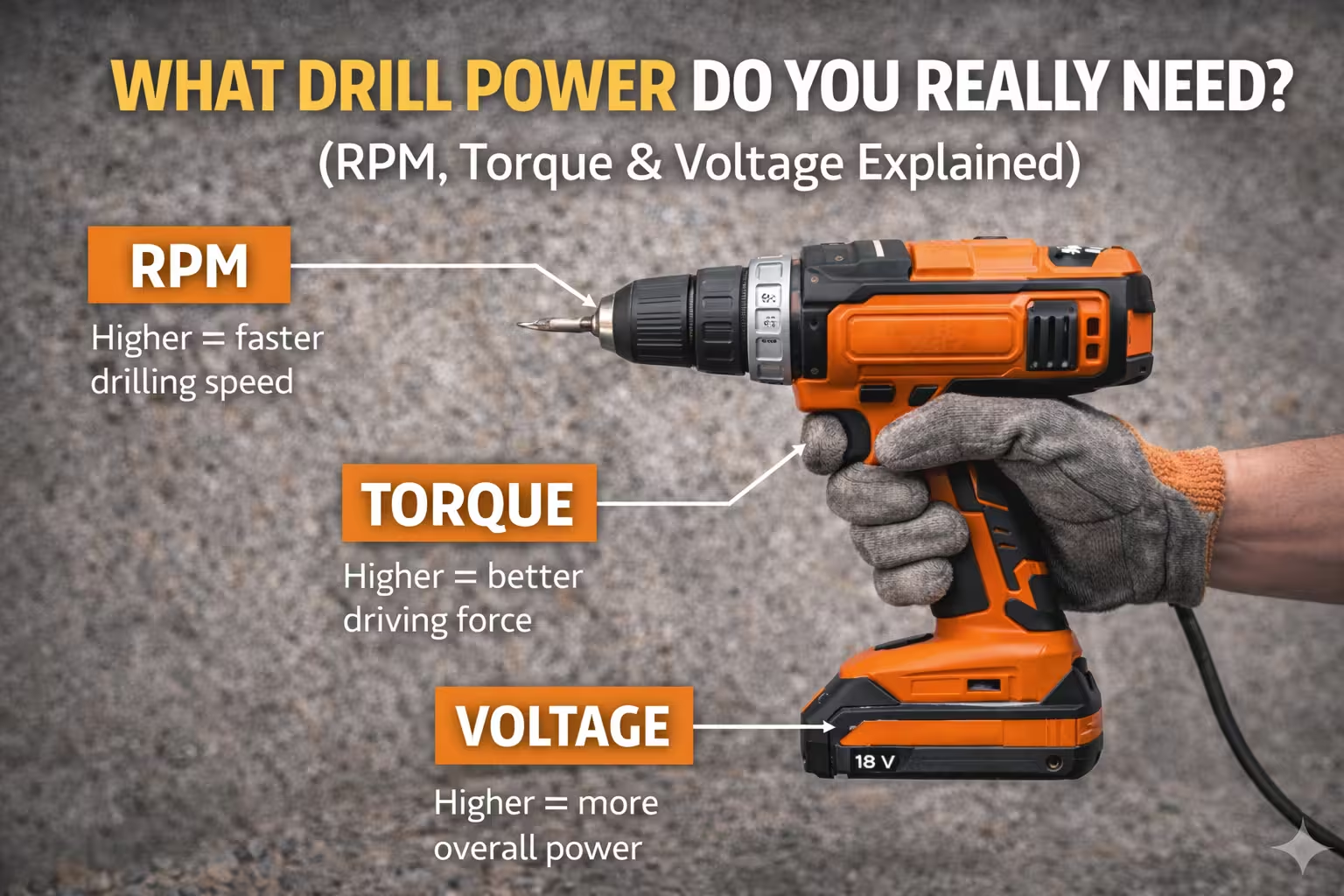
    (What Drill Power Do You Really Need? (RPM, Torque & Voltage Explained))


    Final Thoughts

    Burnt or broken drill bits are usually the result of improper speed, pressure, or drill bit selection.

    By using the correct drill bits, controlling drilling speed, and applying proper technique, you can significantly extend the life of your tools and achieve cleaner, faster drilling results.

    Taking the time to understand why drill bits fail will not only save money on replacements but also make your drilling projects easier and more efficient.

    Drill Bit Troubleshooting FAQs

    Frequently Asked Questions About Burnt or Broken Drill Bits

    Why do drill bits burn while drilling?

    Drill bits usually burn because of excessive heat caused by high drilling speed, dull drill bits, or too much pressure. When friction builds up, the bit overheats and can leave burn marks on wood or metal surfaces.


    Why do drill bits turn blue?

    Drill bits often turn blue or purple when they overheat during drilling. This color change indicates that the metal has been exposed to very high temperatures, which can weaken the cutting edge and reduce the bit’s lifespan.


    Why do drill bits break during drilling?

    Drill bits can break due to excessive pressure, incorrect drill speed, misalignment, or using the wrong drill bit for the material. Small diameter bits are especially prone to breaking if they are forced into hard materials.


    How can you prevent drill bits from overheating?

    To prevent overheating:

    • Use lower drilling speeds
    • Apply steady pressure
    • Use cutting oil or lubricant when drilling metal
    • Pull the drill bit out periodically to remove chips and dust

    These steps help reduce friction and heat buildup.


    Do you need cutting oil when drilling metal?

    Yes. Cutting oil or drilling lubricant reduces heat and friction when drilling metal. It also helps remove metal chips and improves the life of the drill bit.


    Why do drill bits get dull quickly?

    Drill bits can become dull quickly when used on hard materials, at high speeds, or without lubrication. Using the correct drill bit type for the material significantly improves durability.


    Can burnt drill bits be sharpened?

    Yes. Many drill bits can be resharpened using a bench grinder or drill bit sharpener. However, if the bit has been severely overheated, the metal may have lost its hardness and may not perform as well after sharpening.


    What drill speed should you use for different materials?

    Different materials require different drilling speeds:

    • Wood: medium to high speed
    • Metal: low to medium speed
    • Concrete or masonry: moderate speed with hammer action

    Using the correct speed reduces heat and prevents drill bit damage.


    What drill bits are most resistant to heat?

    Cobalt drill bits and carbide-tipped drill bits are the most heat-resistant. These bits are commonly used for drilling hard metals and masonry materials.

  • Best Drill Bit for Glass (2026 Guide): Drill Glass Without Cracking

    Best Drill Bit for Glass (2026 Guide): Drill Glass Without Cracking

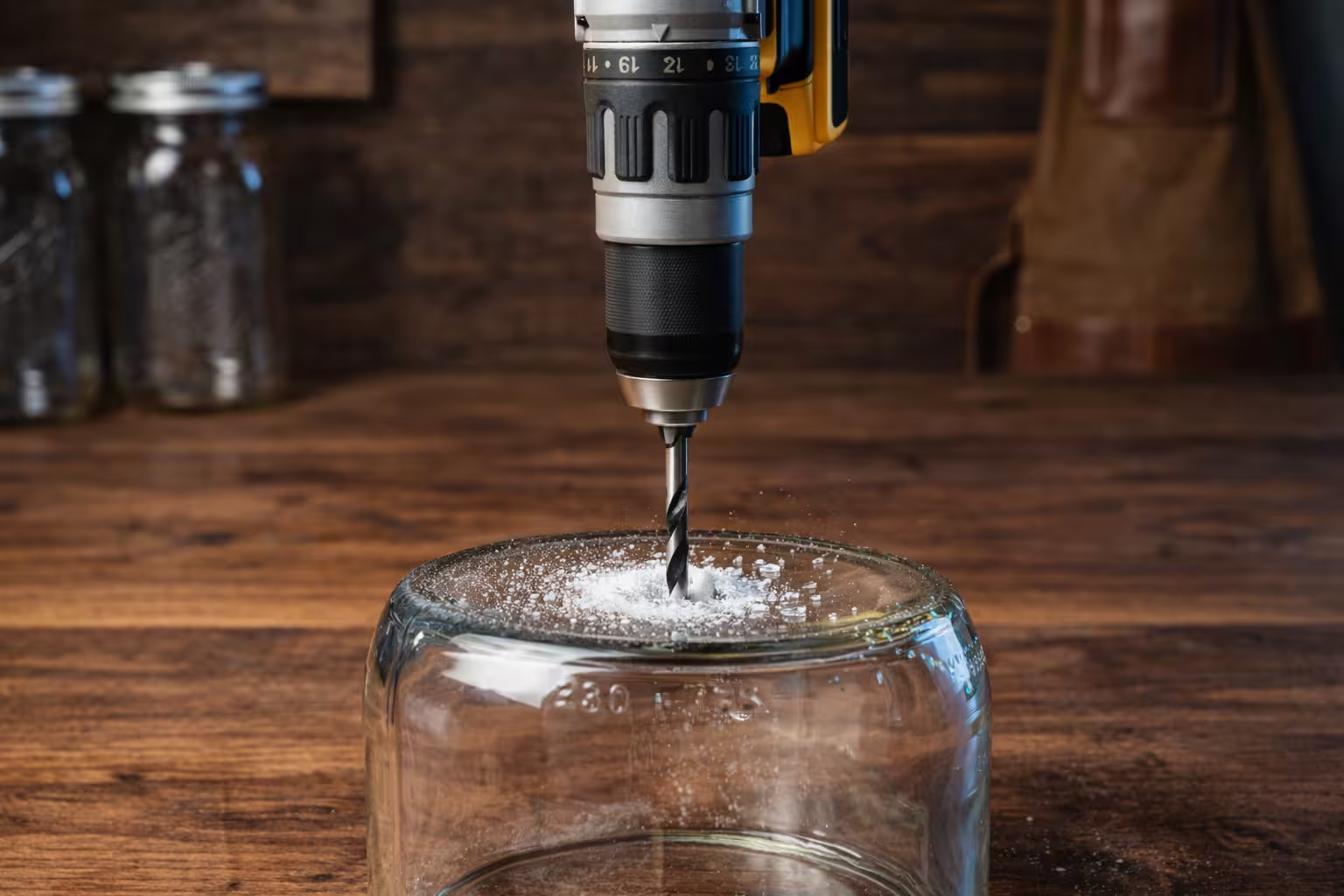
    Best drill bit for glass is usually a diamond-coated drill bit designed to cut brittle materials without cracking them. Drilling glass can seem risky, but with the right drill bit and proper technique, homeowners and DIYers can safely drill glass bottles, mirrors, tiles, and panels without breaking them.The good news is that with the right drill bit and proper technique, drilling glass is actually quite manageable—even for DIY homeowners.

    In this guide, we’ll cover the best drill bits for glass, how they work, and the safest techniques for drilling through glass bottles, mirrors, tiles, and panels without breaking them.

    If you’re still building your drill bit toolkit, check our full guide on (Best Drill Bits for Every Material).


    What Is the Best Drill Bit for Glass?

    The best drill bit for glass is a diamond-coated drill bit.

    Diamond bits are specifically designed to cut extremely hard and brittle materials like:

    • Glass
    • Porcelain
    • Ceramic
    • Stone
    • Marble

    The diamond particles on the cutting surface grind through the glass slowly and precisely instead of aggressively cutting it. This reduces stress on the material and helps prevent cracking.

    Why Diamond Drill Bits Work Best

    Diamond bits offer several advantages when drilling glass:

    • Extremely hard cutting surface
    • Smooth grinding action instead of chipping
    • Minimal vibration
    • Reduced cracking risk
    • Long lifespan

    These bits are commonly used by professionals when working with glass panels, bottles, aquariums, and mirrors.


    Carbide Glass Drill Bits

    The second option for drilling glass is carbide spear-point drill bits.

    These bits have a pointed spear-shaped carbide tip designed to pierce glass and tile surfaces.

    They are commonly used for:

    • Glass tile
    • Mirrors
    • Thin glass
    • Ceramic tile

    Carbide bits are usually more affordable than diamond bits, but they tend to wear out faster and require more careful drilling technique.

    You’ll often see them used interchangeably with tile drill bits, which we cover in (Best Drill Bit for Tile and Porcelain (Clean Holes Without Cracking)).


    Best Drill Bit for Glass: Diamond vs Carbide Drill Bits

    FeatureDiamond Drill BitCarbide Glass Bit
    Cutting methodGrindingPiercing
    Best forThick glass, bottlesThin glass, mirrors
    DurabilityVery highMedium
    SpeedSlow drillingModerate
    PriceHigherLower

    Which One Should You Choose?

    Choose diamond drill bits if:

    • You are drilling thick glass
    • You want maximum reliability
    • You are drilling bottles or aquariums

    Choose carbide spear bits if:

    • You are drilling thin glass
    • You are working with mirrors
    • You need a cheaper option for occasional use

    How to Drill Glass Without Breaking It

    Drilling glass requires patience and precision. The key is low speed, steady pressure, and proper cooling.

    Follow these steps for the safest results.

    1. Use the Correct Drill

    A standard cordless drill works perfectly for drilling glass. You do not need a hammer drill.

    If you’re looking for a reliable tool, see our guide on (Best Drill for Home Use).

    Never use hammer mode when drilling glass.


    2. Secure the Glass

    Place the glass on a stable surface with padding underneath.

    Good support materials include:

    • Rubber mat
    • Cardboard
    • Wood board
    • Foam pad

    This prevents vibrations and reduces cracking.


    3. Mark the Drilling Spot

    Glass surfaces are slippery, so drill bits can easily wander.

    Use one of these tricks:

    • Masking tape over the drilling spot
    • Mark with a permanent marker
    • Use a drilling template

    This helps keep the bit centered.


    4. Start Drilling Slowly

    Start drilling at very low speed.

    Apply only light pressure and let the bit grind slowly into the glass.

    Too much pressure is the most common reason glass breaks.


    5. Keep the Bit Cool

    Heat buildup can crack glass quickly.

    Use water to cool the bit while drilling.

    Common cooling methods include:

    • Spray bottle
    • Dripping water
    • Wet sponge
    • Small water reservoir

    Cooling also extends the life of the drill bit.


    6. Reduce Pressure Near the End

    When the drill bit is about to break through the glass, reduce pressure even further.

    The last few millimeters are where cracks most commonly happen.


    Common Mistakes When Drilling Glass

    Even experienced DIYers sometimes break glass because of simple mistakes.

    Drilling Too Fast

    High speed creates heat and vibrations.

    Always drill glass slowly.


    Applying Too Much Pressure

    Let the drill bit do the work.

    Pressing too hard can instantly crack the glass.


    Not Using Cooling Water

    Glass drilling generates heat very quickly.

    Without cooling, the glass can fracture.


    Using the Wrong Drill Bit

    Regular HSS metal drill bits will not work well on glass.

    Always use:

    • Diamond drill bits
    • Carbide spear-point bits

    Best Glass Drilling Projects for DIY

    Glass drilling is surprisingly useful for many DIY projects.

    Popular uses include:

    • Drilling holes in glass bottles for lamps
    • Installing towel bars in glass tile
    • Creating drainage holes in glass planters
    • Mounting hardware in mirrors
    • Aquarium modifications

    Once you understand the proper technique, glass drilling becomes a valuable skill for home improvement projects.


    Final Thoughts

    The best drill bit for glass is a diamond-coated drill bit, especially for thicker glass and more demanding projects.

    Carbide spear-point bits are also useful for thinner glass and tile, but diamond bits provide the best durability and reliability.

    Remember the three key rules when drilling glass:

    • Drill slowly
    • Use cooling water
    • Apply minimal pressure

    Following these steps will help you drill glass cleanly without cracks or damage.

    If you’re building your drill bit collection, be sure to explore our full guide on (Best Drill Bits for Every Material).

    Frequently Asked Questions

    What is the best drill bit for glass?

    The best drill bit for glass is usually a diamond-coated drill bit. Diamond bits grind through glass slowly and reduce the risk of cracking.

    Can you drill glass with a regular drill bit?

    No. Standard metal drill bits will usually crack or shatter glass. You should use a diamond drill bit or a carbide spear-point drill bit designed for glass and tile.

    What speed should you drill glass?

    Glass should always be drilled at low speed with light pressure to prevent overheating and cracking.

    Do you need water when drilling glass?

    Yes. Cooling the drill bit with water helps prevent heat buildup and greatly reduces the risk of breaking the glass.

  • Best Drill Bit for Tile and Porcelain (Clean Holes Without Cracking)

    Best Drill Bit for Tile and Porcelain (Clean Holes Without Cracking)

    Drilling into tile and porcelain can be challenging because these materials are extremely hard but also very brittle. Using the wrong drill bit or drilling technique can easily cause cracks, chipped edges, or broken tiles.

    Choosing the best drill bit for tile and porcelain ensures clean holes, reduces the risk of damage, and makes installation projects much easier.

    Whether you’re installing bathroom fixtures, mounting shelves, or running plumbing through tile surfaces, the correct drill bit and drilling technique are essential.

    If you want a broader overview of drill bits used for different materials, see (Best Drill Bits for Every Material (2026 Complete Guide)).


    Tile Drill Bit Types Comparison

    Different drill bits can be used to drill tile depending on the hardness of the material.

    Drill Bit TypeBest ForMaterialKey Feature
    Diamond Drill BitPorcelain tilePorcelain, ceramicExtremely hard cutting edge
    Carbide Tile BitCeramic tileCeramicSpear-shaped carbide tip
    Glass Drill BitGlass and soft tileGlass, ceramicSharp spear point
    Hole Saw Diamond BitLarge holesPorcelain, tileCircular diamond cutting edge

    Using the correct drill bit significantly reduces the risk of cracking tiles.


    Diamond Drill Bits

    Diamond drill bits are the best drill bit for porcelain tile and extremely hard surfaces.

    These bits use industrial diamond particles embedded in the cutting edge to grind through hard materials instead of cutting them aggressively.

    Diamond drill bits are commonly used for:

    • porcelain tile
    • granite tile
    • stone surfaces
    • glass

    Because porcelain tiles are very dense, diamond drill bits are often the safest and most effective option.

    They produce smooth holes and reduce the chance of cracking the tile.


    Carbide Tile Drill Bits

    Carbide tile drill bits are commonly used for drilling ceramic tiles.

    They feature a spear-shaped carbide tip that helps the drill bit slowly penetrate the tile surface.

    These bits are ideal for:

    • bathroom tile installation
    • kitchen backsplash drilling
    • mounting fixtures on ceramic tiles

    Carbide tile bits are effective for softer tiles but may struggle with very dense porcelain tiles.

    For extremely hard tiles, diamond bits typically perform better.


    Diamond Hole Saw Drill Bits

    When large holes are required, diamond hole saw drill bits are often the best option.

    These bits create clean circular holes and are commonly used for installing:

    • plumbing pipes
    • shower fixtures
    • electrical outlets
    • faucet connections

    Diamond hole saw bits grind through tile surfaces while maintaining smooth hole edges.

    Because they cut slowly and evenly, they reduce the risk of cracking tiles.


    Why Tiles Crack During Drilling

    Tile cracking is one of the most common problems homeowners encounter when drilling into tile.

    This usually happens when too much pressure or speed is applied during drilling.

    Common causes include:

    Drilling too fast

    High speeds generate excessive heat and stress.

    Using the wrong drill bit

    Standard drill bits are not designed for tile surfaces.

    Applying too much pressure

    Too much pressure can fracture the tile.

    Using hammer mode

    Hammer drills should never be used when starting holes in tile.

    If drill bits frequently overheat or break, see (Why Drill Bits Burn or Break (And How to Prevent It)).


    Tips for Drilling Tile Without Cracking

    Using the correct technique is just as important as using the right drill bit.

    Use masking tape

    Applying tape over the drilling area helps prevent the drill bit from slipping across the tile surface.

    Drill slowly

    Low speed helps prevent overheating and cracking.

    Use water for cooling

    Water reduces heat buildup when drilling hard tiles like porcelain.

    Start with light pressure

    Allow the drill bit to slowly grind into the tile.

    These techniques significantly reduce the risk of damaging tile surfaces.


    Porcelain vs Ceramic Tile

    Understanding the difference between porcelain and ceramic tiles helps determine the best drill bit to use.

    Ceramic tiles

    • softer material
    • easier to drill
    • carbide tile bits work well

    Porcelain tiles

    • extremely dense
    • harder to drill
    • diamond drill bits recommended

    Because porcelain tiles are fired at higher temperatures, they become much harder than ceramic tiles.

    This is why diamond drill bits are often required for porcelain surfaces.


    Choosing the Right Drill

    The drill itself can also affect drilling performance.

    For tile drilling, a standard drill with variable speed control is usually recommended.

    Hammer mode should always be turned off when starting a hole in tile.

    Once the tile layer is drilled through, hammer mode may sometimes be used when drilling into the concrete behind the tile.

    If you’re choosing a drill for home projects, see (Best Drill for Home Use (2026 Guide)).


    Final Thoughts

    Choosing the best drill bit for tile and porcelain helps prevent cracks and produces clean, professional holes.

    Quick recap:

    • Diamond drill bits are best for porcelain tiles
    • Carbide tile bits work well for ceramic tiles
    • Diamond hole saw bits create large circular holes
    • Slow drilling speeds help prevent tile damage

    Using the correct drill bit and proper drilling technique will ensure safe and accurate drilling into tile surfaces.

    For a complete overview of drill bits used for different materials, see (Best Drill Bits for Every Material (2026 Complete Guide)).

    Tile and Porcelain Drill Bit FAQs

    Frequently Asked Questions About Drill Bits for Tile and Porcelain

    What is the best drill bit for tile and porcelain?

    The best drill bits for tile and porcelain are diamond drill bits or carbide-tipped spear-point drill bits. These bits are designed to cut through hard ceramic surfaces without cracking or chipping the tile.


    Can you drill porcelain tile with a regular drill bit?

    No. Standard metal or wood drill bits are not designed for hard materials like porcelain. Drilling porcelain requires diamond drill bits or specialized tile drill bits to prevent cracking and excessive wear.


    Do you need a hammer drill to drill tile?

    No. When drilling tile or porcelain, you should turn off the hammer function on your drill. The hammering action can crack or break the tile. Use slow speed and steady pressure instead.


    What speed should you use when drilling tile?

    Tile and porcelain should be drilled at low speed with light pressure. Drilling too fast creates heat and increases the risk of cracking the tile.


    Do you need water when drilling porcelain tile?

    Yes. Water acts as a coolant and lubricant, reducing heat and helping the drill bit cut more smoothly through the tile surface.


    How do you stop a drill bit from slipping on tile?

    Tile surfaces are very smooth, so drill bits can slip easily. To prevent slipping:

    • Place masking tape over the drilling spot
    • Mark the hole location clearly
    • Start drilling slowly to create a small guide hole

    Why does tile crack while drilling?

    Tile can crack due to excessive pressure, high drilling speed, using the hammer function, or using the wrong drill bit. Always use tile-specific drill bits and drill slowly.


    What drill bit should you use for large holes in tile?

    For larger holes in tile or porcelain, diamond hole saw drill bits are typically used. These bits allow you to drill clean circular openings for pipes, plumbing fixtures, or electrical outlets.


    Can you drill through grout instead of tile?

    Yes. Drilling through grout lines is sometimes easier and reduces the risk of damaging the tile. However, grout may not always provide enough strength for anchors depending on the installation.

  • Best Drill Bit for Wood (Clean Holes & Fast Drilling)

    Best Drill Bit for Wood (Clean Holes & Fast Drilling)

    Drilling into wood may seem simple, but choosing the right drill bit can make a huge difference in the quality of the hole. The best drill bits for wood produce clean edges, accurate holes, and smooth drilling without splintering the material.

    Whether you’re building furniture, installing shelves, or working on DIY home repairs, using the correct wood drill bit helps improve precision and reduce damage to the wood surface.

    In this guide, we’ll cover the best drill bits for wood, when to use each type, and how to get perfectly clean holes every time.

    If you want a complete overview of drill bits for different materials, see our guide on (Best Drill Bits for Every Material).


    What Makes a Drill Bit Good for Wood?

    Wood drill bits are designed differently from metal or masonry bits. They typically include a sharp center point and cutting spurs that help guide the bit and produce cleaner holes.

    Good wood drill bits should offer:

    • Sharp cutting edges
    • A center point for accurate positioning
    • Fast chip removal
    • Clean entry and exit holes
    • Minimal tear-out on the wood surface

    These features allow the bit to cut through wood fibers efficiently while maintaining a smooth finish.


    Best Types of Drill Bits for Wood

    Several types of drill bits work well for wood, but each serves a different purpose depending on the type of project.


    Brad Point Drill Bits (Best for Clean Holes)

    Brad point drill bits are one of the best options for drilling clean holes in wood.

    These bits feature a sharp center point that keeps the bit from wandering and two outer cutting spurs that slice through wood fibers before the bit removes material.

    Advantages of Brad Point Bits

    • Extremely accurate drilling
    • Clean hole edges
    • Minimal splintering
    • Ideal for woodworking projects

    Brad point bits are commonly used for:

    • Furniture building
    • Cabinet making
    • Wood joinery
    • Precise dowel holes

    For most woodworking tasks, brad point bits are considered the best all-around drill bits for wood.


    Spade Drill Bits (Best for Fast Drilling)

    Spade bits, also known as paddle bits, are designed for fast drilling in wood.

    They have a flat blade shape with a center point and two cutting edges.

    Advantages of Spade Bits

    • Drill large holes quickly
    • Affordable and widely available
    • Good for rough construction work

    Spade bits are commonly used for:

    • Running electrical cables
    • Plumbing installations
    • Framing projects
    • Drilling large holes in softwood

    The main drawback is that they tend to produce rougher holes compared to brad point bits.


    Auger Drill Bits (Best for Deep Holes)

    Auger drill bits are designed for deep drilling in wood.

    They feature a threaded screw tip that pulls the bit into the wood automatically while the spiral flutes remove chips efficiently.

    Advantages of Auger Bits

    • Excellent chip removal
    • Ideal for deep holes
    • Smooth drilling action
    • Great for thick wood beams

    Auger bits are commonly used in carpentry and construction work.


    Hole Saw Bits (Best for Large Holes)

    Hole saws are used when you need to create large circular holes in wood.

    These bits consist of a cylindrical saw blade attached to a mandrel.

    Hole saws are often used for:

    • Door lock installation
    • Electrical boxes
    • Pipe openings
    • Ventilation holes

    They are excellent for drilling holes that are much larger than standard drill bits.


    Choosing the Right Drill for Wood

    Most wood drilling can be done with a standard cordless drill.

    If you’re looking for a reliable tool for home projects, see:

    These guides cover the best drills for typical DIY work around the house.


    Tips for Drilling Clean Holes in Wood

    Even the best drill bit will produce poor results if used incorrectly.

    Follow these tips for the best results.


    Use the Correct Drill Speed

    Wood drilling usually works best at medium to high speeds depending on the bit size.

    Large bits should be used at slower speeds to maintain control.


    Prevent Tear-Out

    Tear-out happens when wood fibers splinter as the drill bit exits the material.

    To reduce tear-out:

    • Place a scrap piece of wood underneath the workpiece
    • Drill slowly as the bit exits
    • Use sharp brad point bits

    Keep Drill Bits Sharp

    Dull bits tear wood fibers instead of cutting them cleanly.

    Sharp bits produce cleaner holes and require less pressure.


    Avoid Overheating

    Drill bits can overheat when used improperly or at excessive speeds.

    If you want to understand why this happens, see our guide on (Why Drill Bits Burn or Break).


    Drill Chuck Compatibility

    Before purchasing new drill bits, make sure they fit your drill.

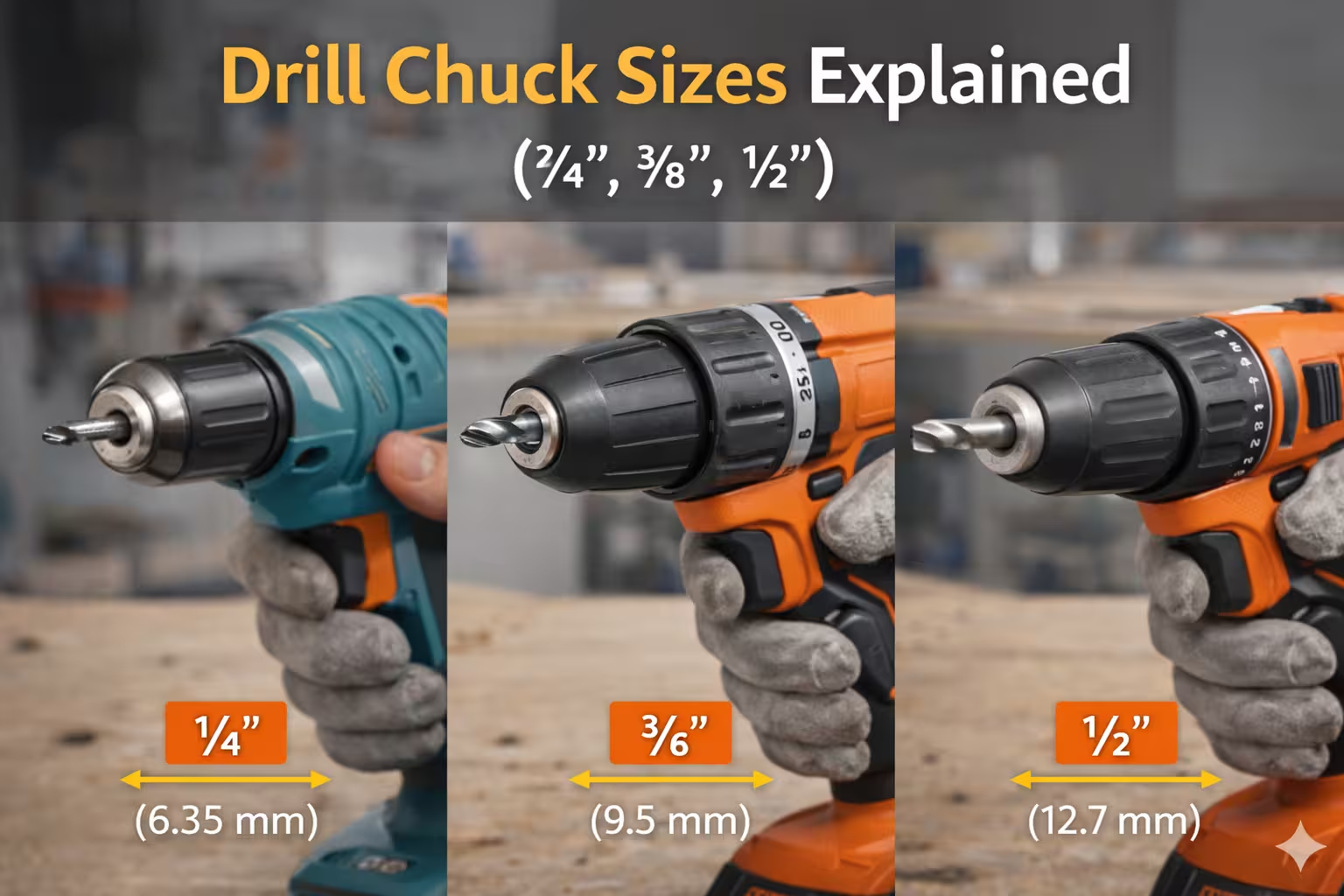
    Most household drills use either 3/8-inch or 1/2-inch chucks.

    If you’re unsure about compatibility, see our guide on (Drill Chuck Sizes Explained).

    Understanding chuck sizes helps ensure your drill bits fit properly and operate safely.


    Final Thoughts

    Choosing the best drill bit for wood depends on the type of project and the size of the hole you need.

    For most woodworking tasks:

    • Brad point bits are best for clean, accurate holes
    • Spade bits are best for fast drilling
    • Auger bits are best for deep holes
    • Hole saws are best for large openings

    Using the right drill bit helps you drill faster, produce cleaner results, and extend the life of your tools.

    If you’re building a complete drill bit collection, make sure to explore our full guide on (Best Drill Bits for Every Material).

    Wood Drill Bit FAQs

    Frequently Asked Questions About Drill Bits for Wood

    What is the best drill bit for wood?

    The best drill bit for wood is usually a brad point drill bit. Brad point bits have a sharp center tip and cutting spurs that create clean, precise holes with minimal splintering in wood.


    Can you drill wood with a regular drill bit?

    Yes. Standard high-speed steel (HSS) drill bits can drill wood, but they are not ideal for clean woodworking results. Specialized wood bits like brad point or spade bits provide faster drilling and cleaner holes.


    What drill bit is best for drilling large holes in wood?

    For large holes in wood, spade bits or hole saws are commonly used. Spade bits are great for fast rough holes, while hole saws create larger and cleaner circular openings.


    What speed should you drill wood at?

    Wood can usually be drilled at medium to high speeds depending on the drill bit size. Larger bits should be used at lower speeds to maintain control and prevent overheating.


    How do you prevent wood from splintering when drilling?

    To prevent splintering:

    • Use brad point drill bits
    • Place a scrap wood backing board behind the material
    • Drill slowly when exiting the wood
    • Use sharp drill bits

    These techniques help produce cleaner holes in wood.


    Why does my drill bit burn the wood?

    Drill bits can burn wood when they are dull, spinning too fast, or when too much pressure is applied. Excessive friction generates heat that scorches the wood surface.


    Can you use masonry drill bits on wood?

    Masonry drill bits can technically drill wood, but they are not designed for wood fibers and usually produce rough holes. Wood-specific bits will always provide better results.


    What drill bit is best for deep holes in wood?

    Auger drill bits are ideal for drilling deep holes in wood. Their threaded tip pulls the bit into the wood while the spiral flutes remove wood chips efficiently.


    What drill should you use for wood drilling?

    Most woodworking tasks can be done with a standard cordless drill. If you’re choosing a drill for home projects, see (Best Drill for DIY Projects at Home) or (Best Drill for Small Home Repairs).

  • Best Drill Bit for Concrete (Masonry & SDS Bits Explained)

    Best Drill Bit for Concrete (Masonry & SDS Bits Explained)

    Drilling into concrete requires the best drill bit for concrete if you want clean holes, faster drilling, and longer tool life. Concrete is extremely dense and abrasive, which means regular drill bits will quickly dull or break.

    Using the correct masonry drill bit makes a huge difference when installing anchors, mounting shelves, or securing fixtures into concrete walls.

    If you want a complete overview of all materials, see our guide on (Best Drill Bits for Every Material (2026 Complete Guide)).

    In this guide, we explain the best drill bits for concrete, how they work, and how to choose the right one for your project.


    Drill Bits for Concrete Comparison Table

    Before diving into details, here is a quick comparison of the most common concrete drill bits.

    Drill Bit TypeBest ForDrill TypeKey Feature
    Carbide Masonry BitLight concrete drillingStandard drill / hammer drillCarbide cutting tip
    SDS Plus BitHeavy concrete drillingRotary hammerQuick-lock SDS shank
    SDS Max BitProfessional constructionRotary hammerLarge diameter drilling
    Multi-Purpose BitBrick and concreteStandard drillVersatile cutting edge

    Most homeowners will use carbide masonry bits, while professionals often use SDS bits with rotary hammers.


    What Makes a Good Concrete Drill Bit

    The best drill bits for concrete share several important design features that allow them to penetrate hard materials.

    Carbide Cutting Tip

    Concrete drill bits usually have a tungsten carbide tip brazed onto the end of the bit. This material is extremely durable and can withstand the impact created by hammer drilling.

    Spiral Flutes

    Concrete bits have deep spiral flutes designed to remove dust and debris from the hole while drilling.

    Impact Resistance

    Unlike metal drill bits, masonry bits are designed to handle the repeated impact created by hammer drills.

    For brick drilling, similar bits are used. You can learn more in (Best Drill Bit for Brick and Masonry).


    Carbide Masonry Drill Bits

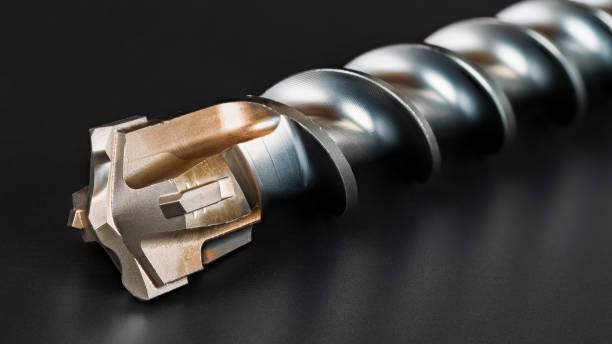
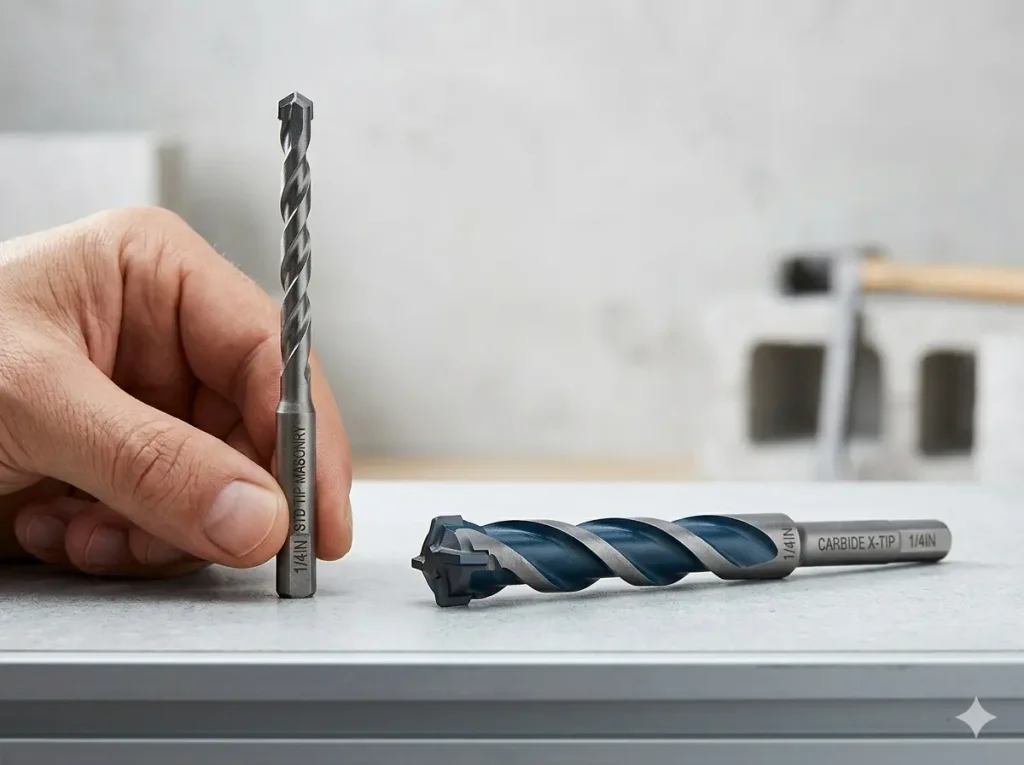
    Close-up of a carbide-tipped masonry drill bit designed for drilling into concrete.

    Carbide masonry drill bits are the most common drill bits for concrete used by homeowners.

    They work well for:

    • installing wall anchors
    • mounting shelving brackets
    • drilling holes for concrete screws
    • light concrete drilling

    These bits are compatible with both standard drills and hammer drills, although hammer mode greatly improves drilling speed.

    Typical sizes range from 3/16 inch to 1/2 inch, which covers most DIY projects.

    When drilling concrete walls regularly, you may also want to read (Best Drill for Concrete Walls (2025 Guide)).


    SDS Drill Bits for Concrete

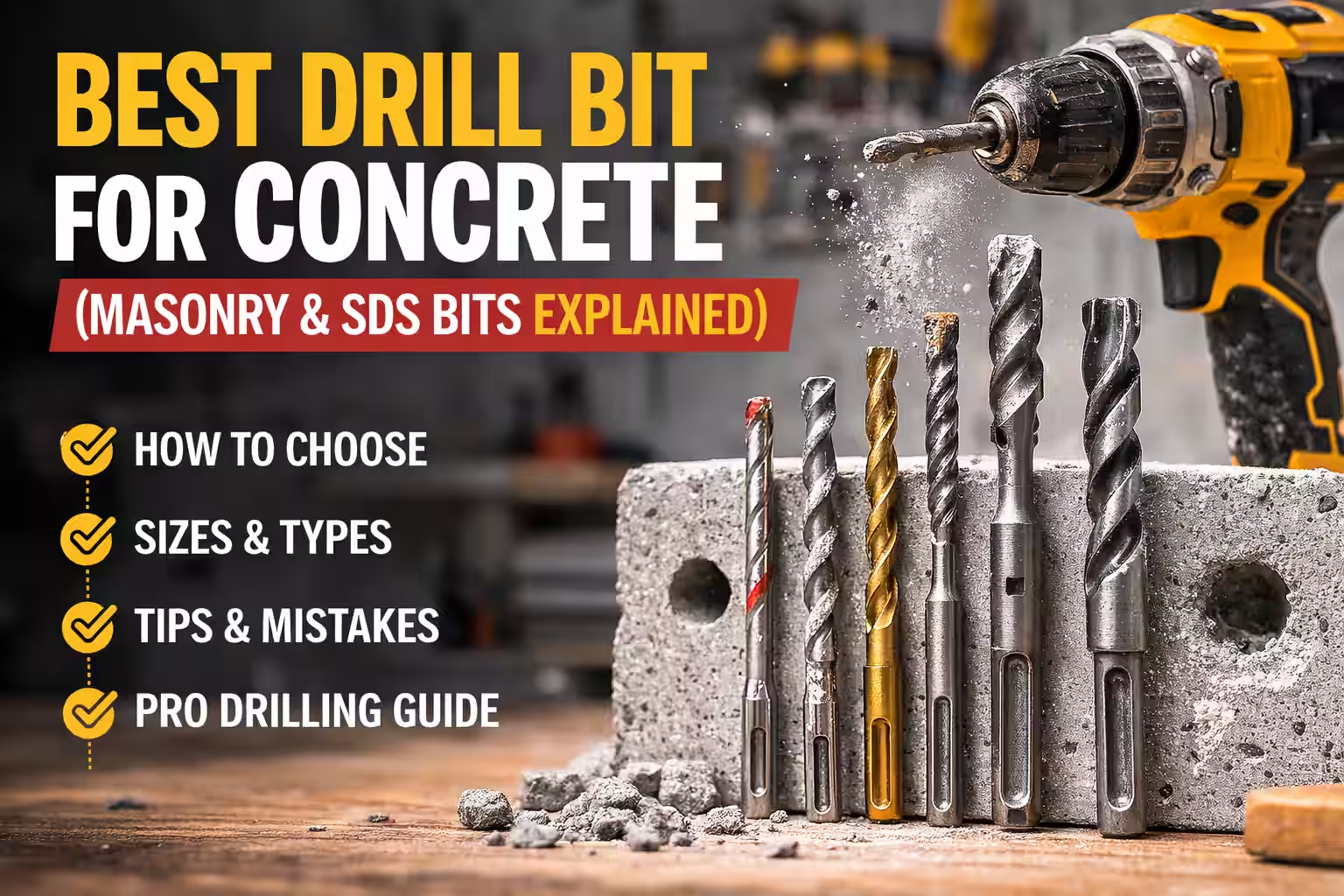
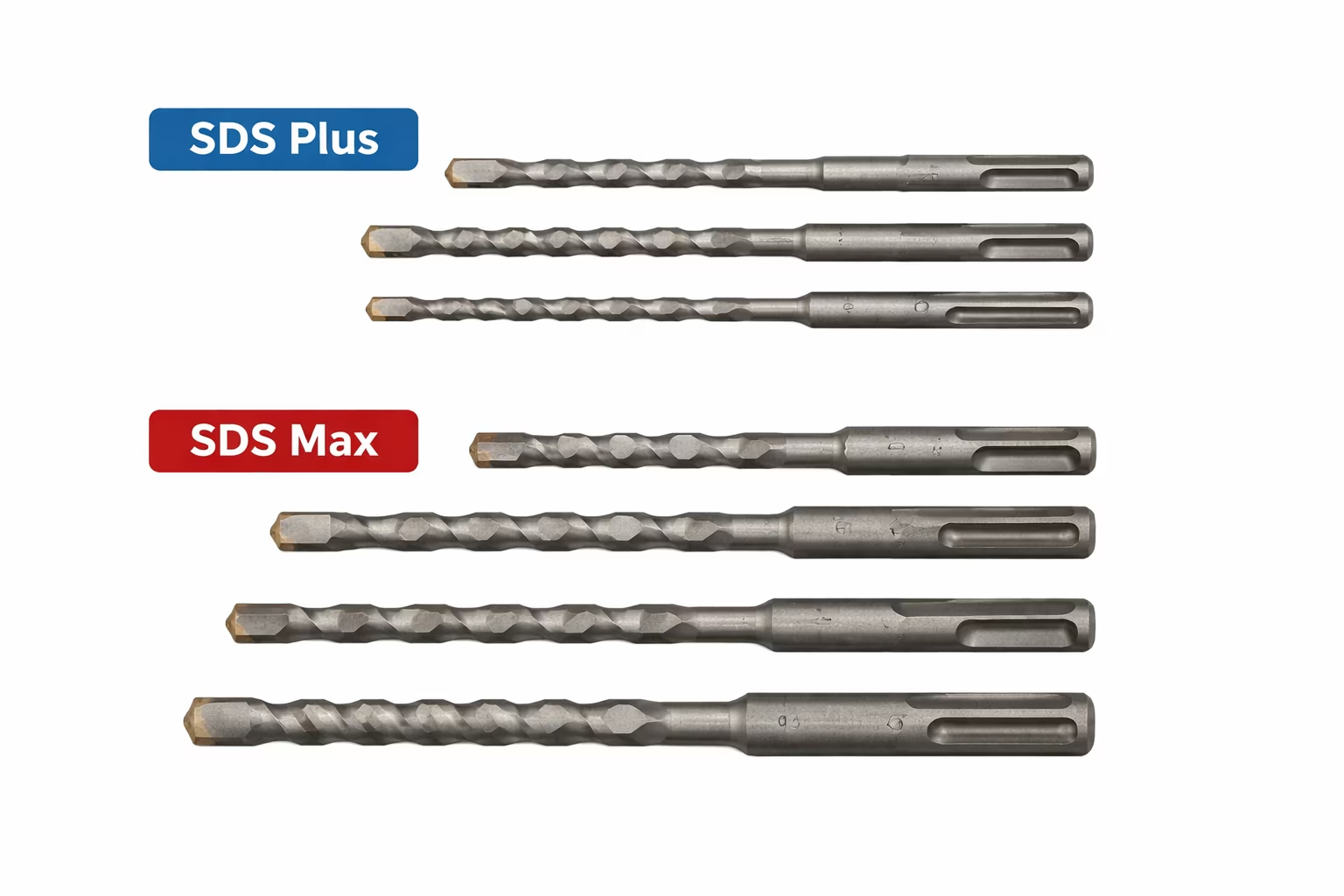
    SDS Plus and SDS Max drill bits used for heavy-duty concrete drilling with rotary hammer drills.

    For tougher drilling tasks, SDS drill bits are a better option.

    SDS stands for Slotted Drive System, which allows the bit to slide inside the drill chuck and transfer more hammering power.

    There are two common types:

    SDS Plus

    SDS Plus bits are widely used in rotary hammer drills for medium-duty concrete drilling.

    They are ideal for:

    • drilling deeper holes
    • drilling larger diameters
    • working with reinforced concrete

    SDS Max

    SDS Max bits are used for heavy-duty construction and professional drilling applications.

    They are typically used for:

    • large anchor holes
    • demolition drilling
    • thick concrete structures

    Most homeowners will not need SDS Max bits, but contractors often rely on them for demanding jobs.

    You can also compare different masonry options in (Masonry Drill Bits vs Concrete Drill Bits).


    Best Drill Type for Concrete Drilling

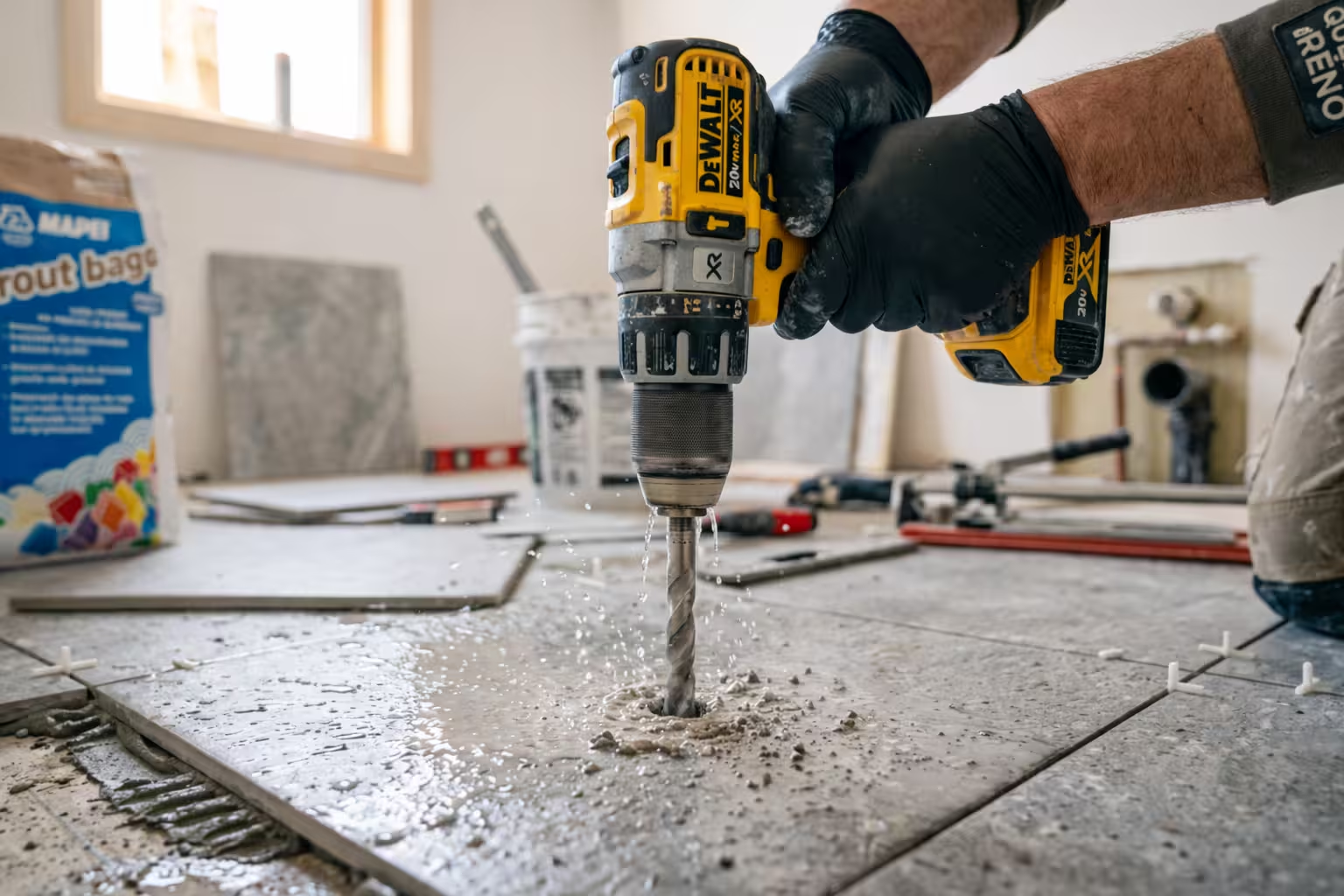
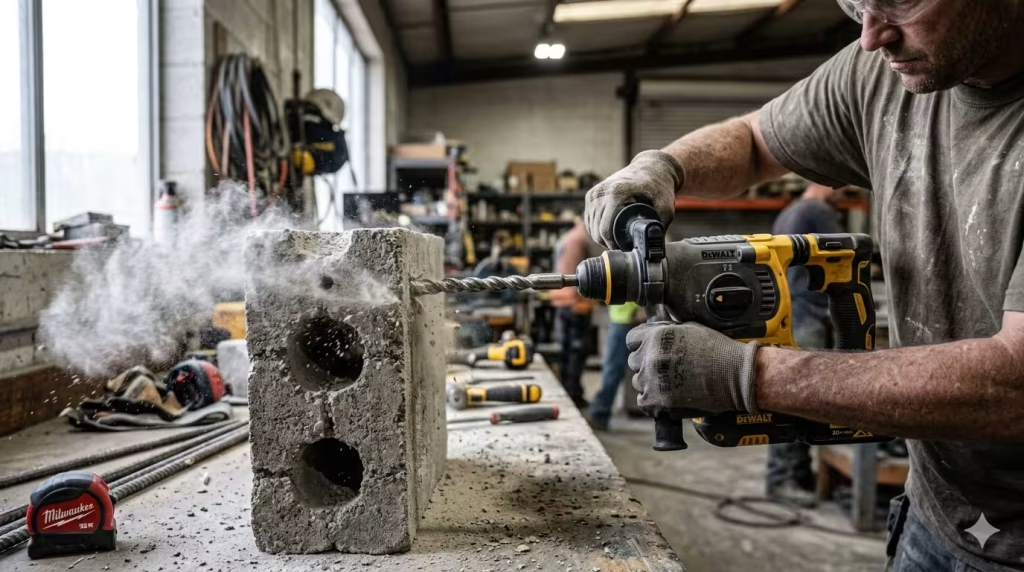
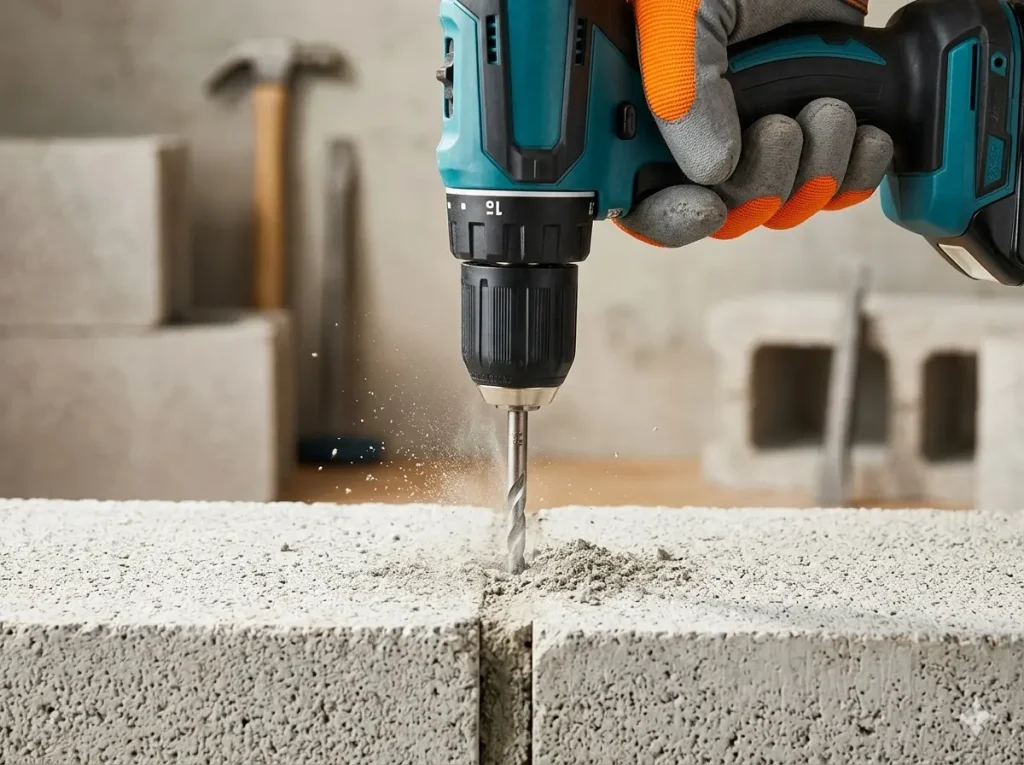
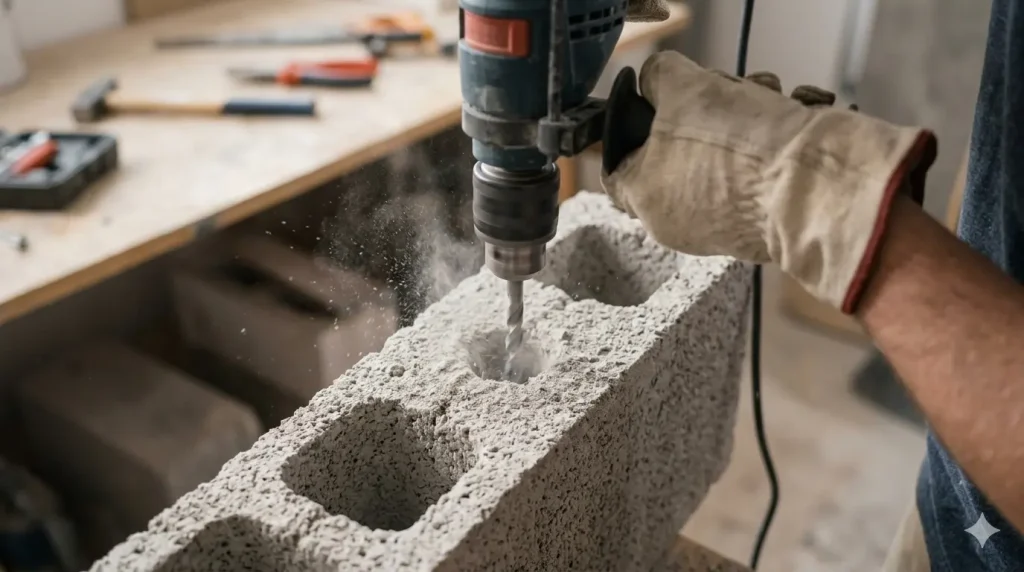
    Hammer drill drilling into a concrete block using a carbide masonry drill bit.

    Even the best drill bit for concrete performs poorly without the right drill.

    Three drill types are commonly used:

    Standard Drill

    A regular drill can work for light concrete drilling, but it will be slower and require more pressure.

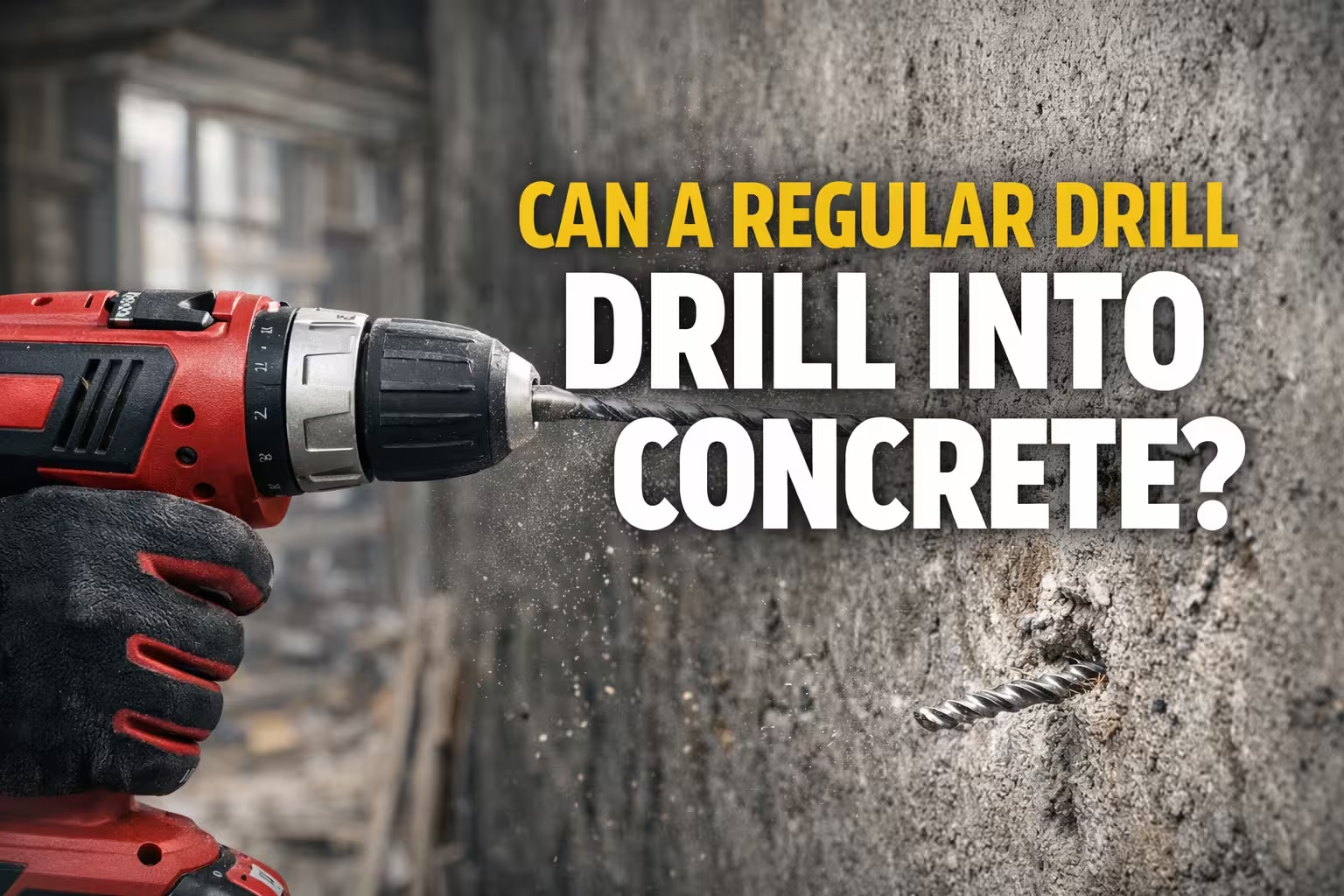
    Some homeowners ask if this is possible, which is explained in (Can a Regular Drill Drill Into Concrete?).

    Hammer Drill

    Hammer drills combine rotation with a hammering motion, making them far more effective for drilling into concrete.

    They are the most common choice for homeowners.

    You can learn more about this in (Hammer Drill vs Rotary Hammer: What’s the Difference?).

    Rotary Hammer

    Rotary hammers are much more powerful and are typically used with SDS drill bits.

    These drills are ideal for heavy-duty drilling or larger holes.

    If you’re considering buying one, see (Best Hammer Drill for Home Use).


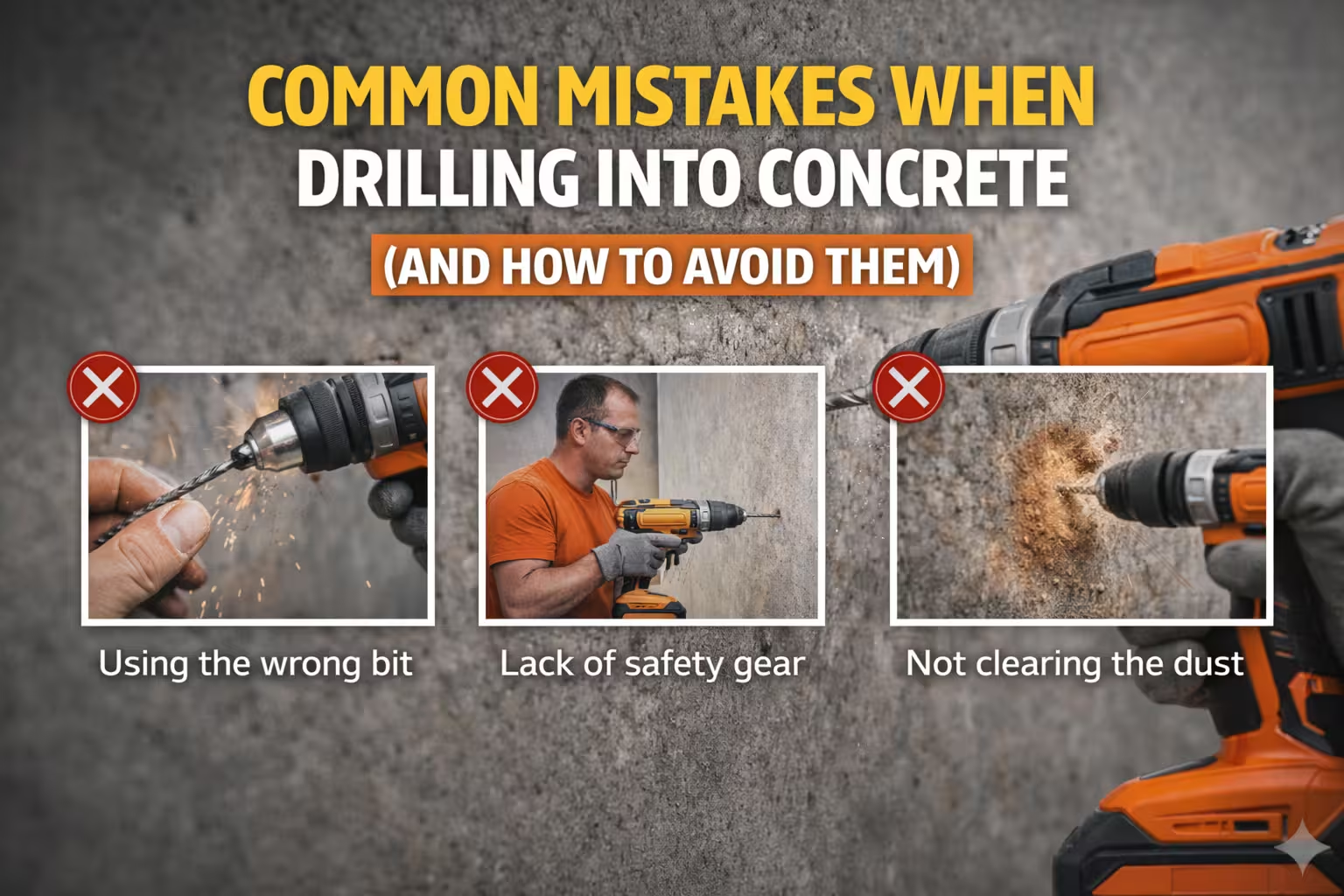
    Common Mistakes When Drilling Concrete

    Concrete drilling can damage drill bits quickly if done incorrectly.

    Common mistakes include:

    Drilling Too Fast

    High speeds create excessive heat and reduce the lifespan of masonry bits.

    Applying Too Much Pressure

    Let the drill and bit do the work. Excess pressure can break the carbide tip.

    Not Clearing Dust

    Concrete dust builds up in the hole and slows drilling. Periodically pull the bit out to clear debris.

    Using the Wrong Drill Bit

    Standard metal or wood drill bits will dull quickly in concrete.

    If you experience overheating or broken bits, see (Why Drill Bits Burn or Break (And How to Prevent It)).


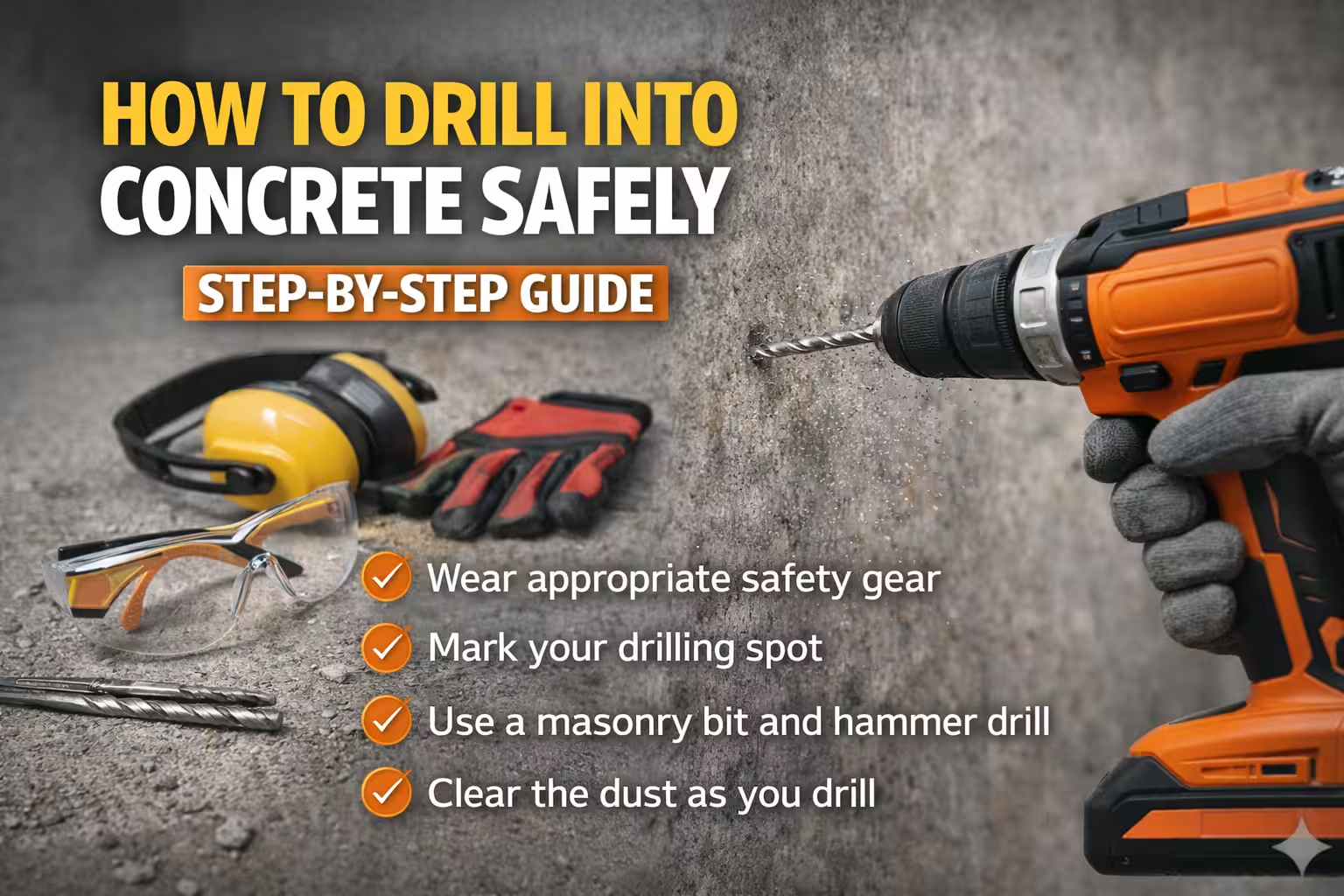
    Tips for Drilling Into Concrete Successfully

    Follow these tips for the best results when drilling into concrete.

    Use Hammer Mode

    Hammer mode significantly improves drilling speed.

    Start With a Pilot Hole

    Small pilot holes help guide larger bits accurately.

    Drill Slowly

    Lower speeds produce cleaner holes and reduce heat buildup.

    Use Proper Anchors

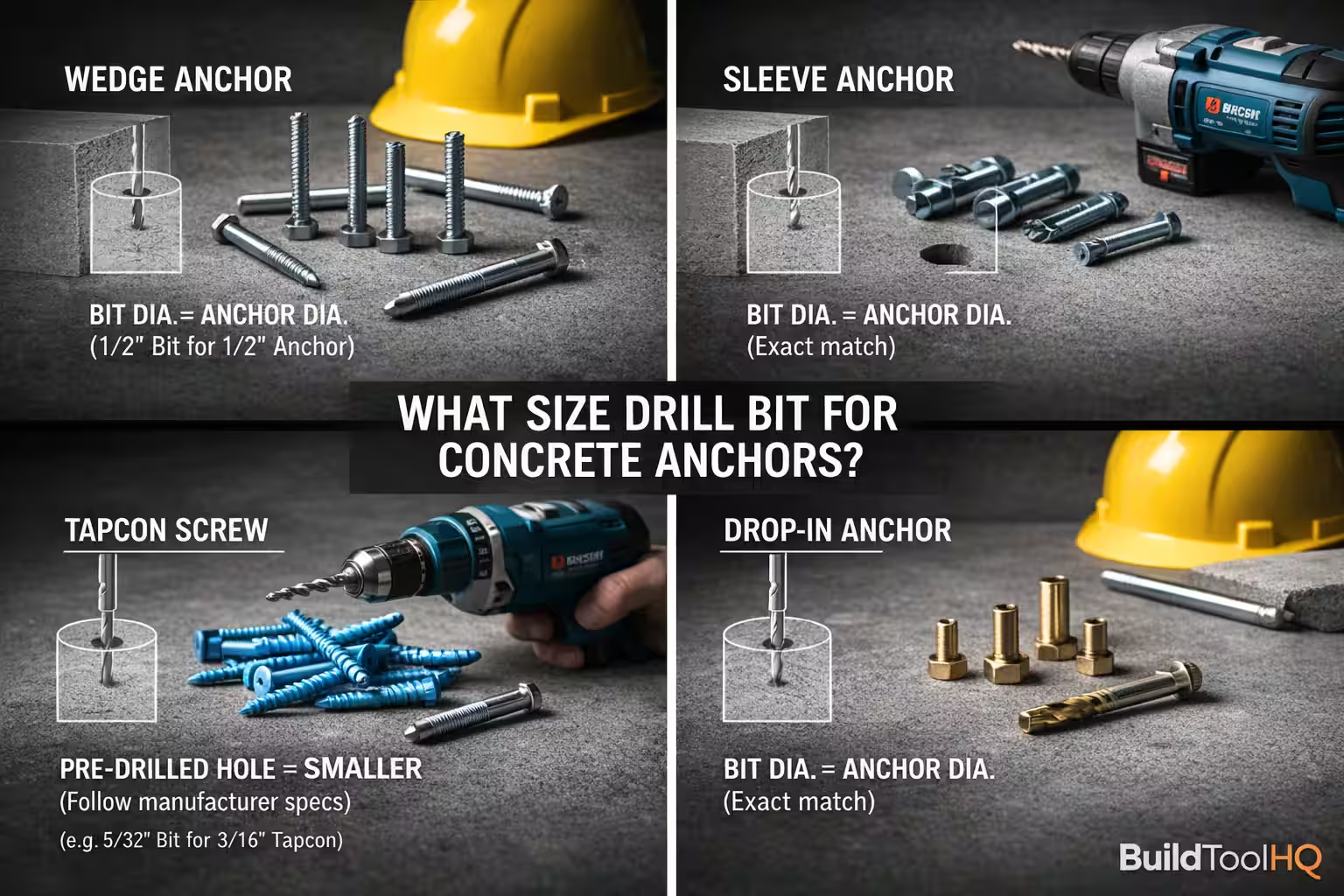
    Make sure the hole size matches the anchor size.

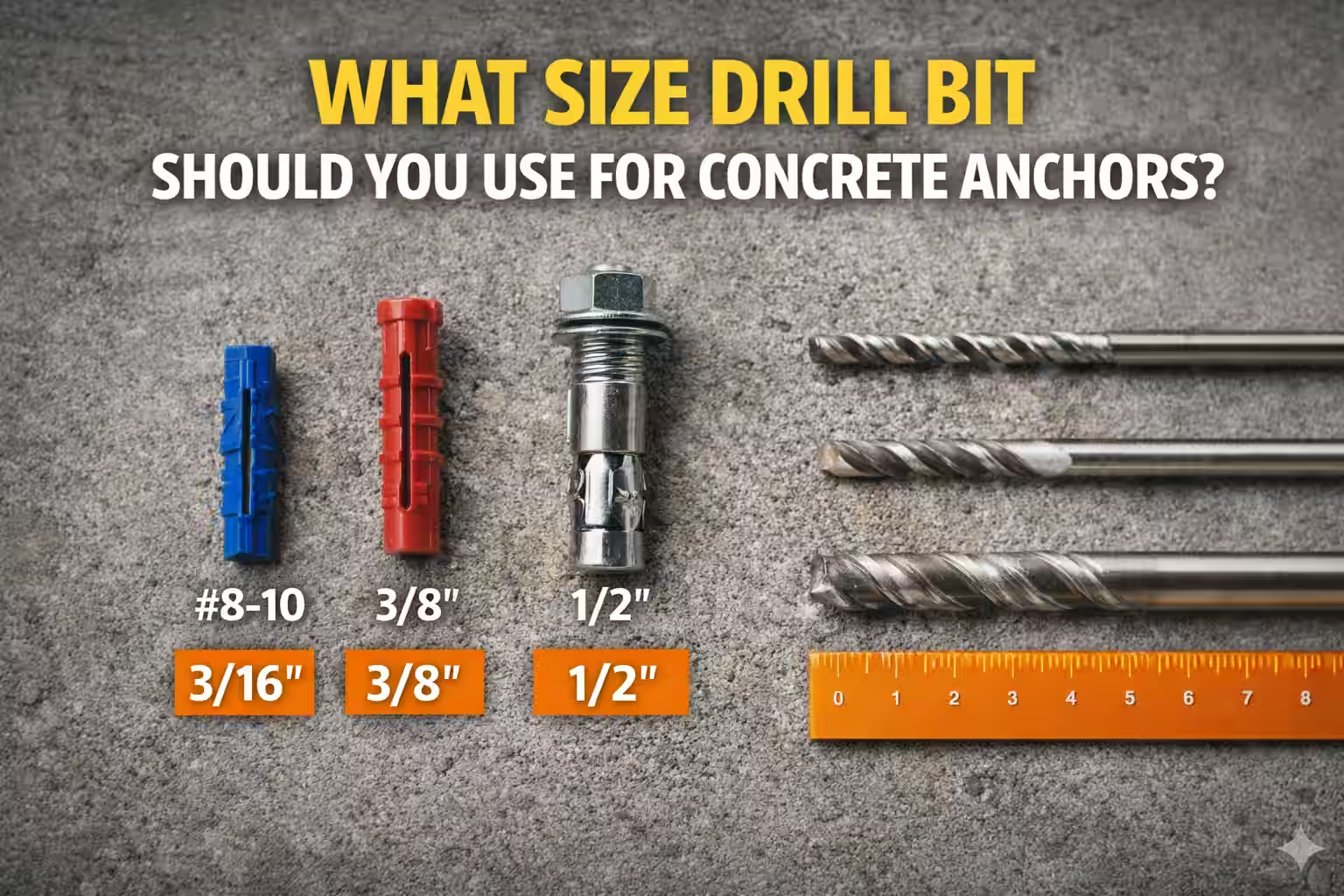
    You can learn more about anchor sizing in (What Size Drill Bit Should You Use for Concrete Anchors?).


    Final Thoughts

    Choosing the best drill bit for concrete is essential for safe and effective drilling.

    Quick recap:

    • Carbide masonry bits are best for most DIY projects
    • SDS Plus bits work well for deeper or larger holes
    • Hammer drills dramatically improve drilling performance
    • Proper technique prevents overheating and broken bits

    For a complete overview of drilling materials and bit types, see our full guide on (Best Drill Bits for Every Material (2026 Complete Guide)).

    Frequently Asked Questions About Drill Bits for Concrete

    What is the best drill bit for concrete?

    The best drill bits for concrete are carbide-tipped masonry drill bits or SDS drill bits. These bits are specifically designed to withstand the impact and hardness of concrete, brick, and stone when used with hammer drills or rotary hammers.


    Can you drill concrete with a regular drill bit?

    No. Standard metal or wood drill bits are not designed for concrete and will dull quickly or break. Concrete requires masonry drill bits with carbide tips that can handle the hardness of the material.


    What is the difference between masonry drill bits and SDS drill bits?

    Masonry drill bits are used with standard hammer drills, while SDS drill bits are designed for rotary hammer drills. SDS bits have a special shank that locks into the drill and allows better impact energy transfer when drilling into concrete.


    Do you need a hammer drill to drill concrete?

    A hammer drill is strongly recommended for drilling concrete. The hammering action helps break up the concrete while the drill bit rotates, making the drilling process much faster and easier.


    What drill speed should you use for concrete?

    Concrete should be drilled at moderate speed with steady pressure. Let the hammering action do most of the work instead of forcing the drill bit into the material.


    Why does my concrete drill bit stop cutting?

    Concrete drill bits may stop cutting because of overheating, dull carbide tips, hitting rebar, or excessive dust buildup in the hole. Removing the bit periodically to clear dust can help maintain drilling efficiency.


    Can you drill through rebar in concrete?

    Standard masonry drill bits cannot easily drill through steel rebar. If you hit rebar, you may need to switch to a metal drill bit or specialized rebar cutter before continuing with the masonry bit.


    What size drill bit should you use for concrete anchors?

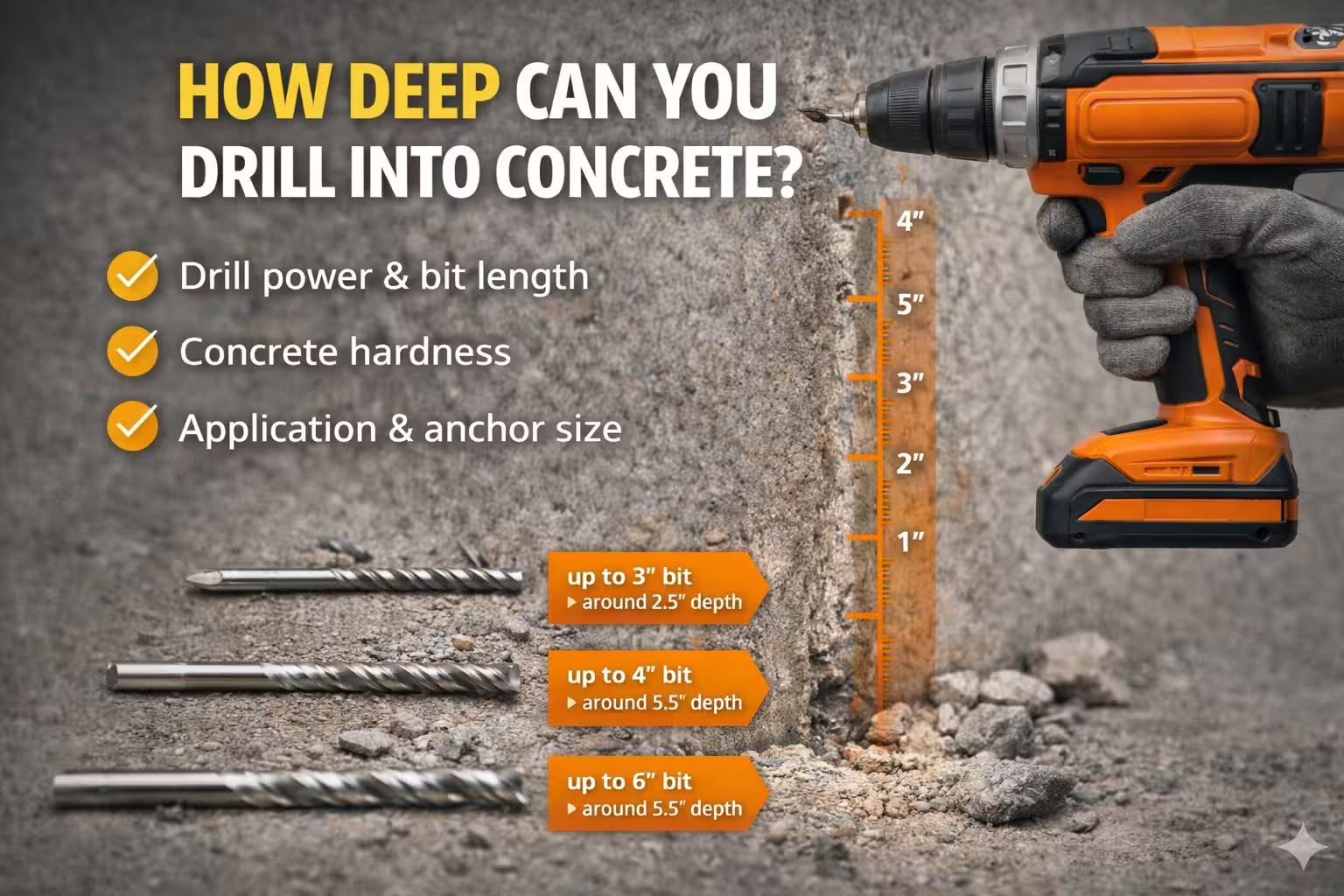
    The drill bit size should match the diameter of the concrete anchor you are installing. For example, a 1/4-inch anchor typically requires a 1/4-inch masonry drill bit.

  • Best Drill Bit for Every Material: Complete Comparison & Selection Guide (2026)

    Best Drill Bit for Every Material: Complete Comparison & Selection Guide (2026)

    Choosing the Best Drill Bit For Every Material isn’t just about making a hole; it’s a high-stakes game of metallurgy, thermal management, and matching the right geometry to your substrate. At BuildToolHQ, we’ve spent thousands of hours testing HSS, Cobalt, and Carbide across every imaginable surface—from soft pine to hardened industrial alloys—to bring you this definitive 2026 guide. 🧬

    Whether you are a professional contractor managing a job site or a weekend DIYer tackling a home renovation, understanding the Best Drill Bit For Every Material will save you a fortune in snapped bits and ruined workpieces. In this expanded guide, we dive deep into the mechanical science of cutting to ensure your toolkit is ready for the most demanding technical challenges. 🚀

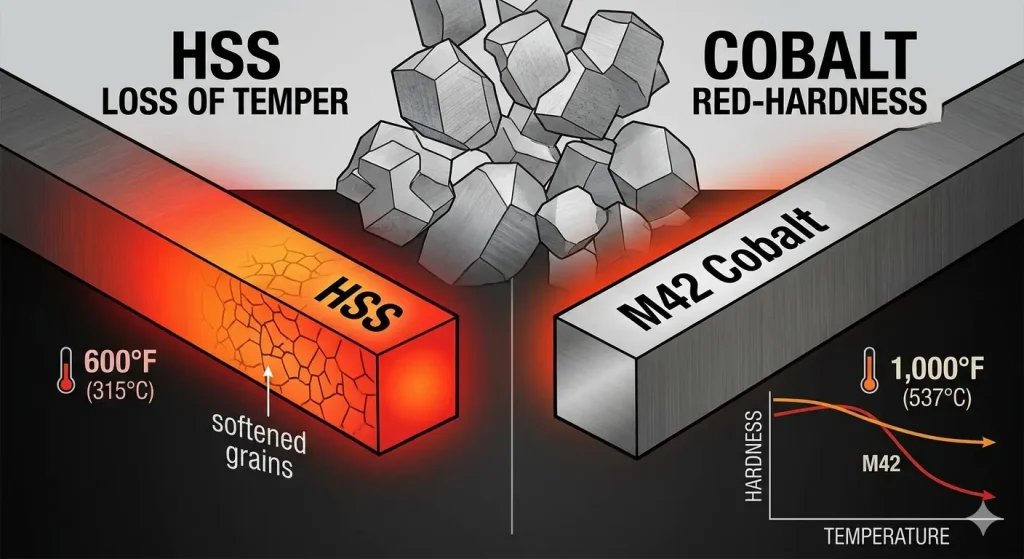
    A technical infographic comparing the heat resistance of High-Speed Steel (HSS) and 8% Cobalt (M42) drill bits. The diagram shows M42 Cobalt remaining stable at 1,000°F, while HSS suffers loss of temper and softening at 600°F.    Best Drill Bit for Every Material
    Scientific comparison of HSS and M42 Cobalt under extreme drilling temperatures. Note how M42 Cobalt maintains structural integrity at 1,000°F, while standard HSS softens and loses its temper at just 600°F.

    🏗️ The Core Hierarchy: Matching Bit to Substrate

    Selecting the Best Drill Bit For Every Material begins with identifying the “Hardness Gap” between your bit and the workpiece. If your bit isn’t significantly harder than the material, you aren’t drilling—you’re just generating friction and smoke. 🔥

    1. Ferrous and Non-Ferrous Metals 🔩

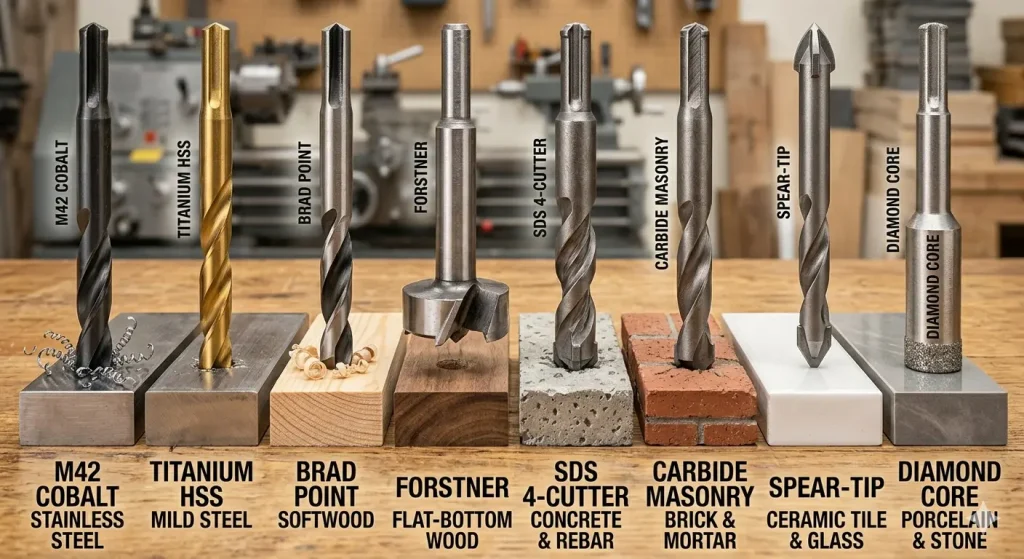
    For general metalworking, High-Speed Steel (HSS) is the baseline. However, as industrial drilling standards have evolved, we now see a massive shift toward Cobalt and Titanium coatings for heat resistance.

    2. Masonry: Concrete, Brick, and Stone 🧱

    These require a percussive “hammering” action. You cannot use a standard twist bit here; you need a tungsten carbide tip that can withstand the impact of a rotary hammer.

    (Read our full guide to the👉 [Best Drill Bit for Brick and Masonry] here).

    3. Specialty Surfaces: Tile, Glass, and Porcelain 💎

    Porcelain and glass are incredibly brittle. They require “Diamond Grit” or “Spear-head” bits designed to grind the material away rather than shave it.

    (Read our full guide to the👉 [Best Drill Bit for Glass] ).


    🧬 Metallurgy 101: Why Your Bit Matters

    A technical infographic comparing the heat resistance of High-Speed Steel (HSS) and 8% Cobalt (M42) drill bits. The diagram shows M42 Cobalt remaining stable at 1,000°F, while HSS suffers loss of temper and softening at 600°F.
    Scientific comparison of High-Speed Steel (HSS) and M42 Cobalt (8% Cobalt) tool steels under load. Standard HSS bits lose their structural temper and soften completely once they reach approximately 600°F (315°C). M42 Cobalt, in contrast, maintains its critical “red-hardness,” remaining stable and capable of cutting even when temperatures surpass 1,000°F (537°C). (Refer to our specialized metallurgy testing methodology).

    To truly find the Best Drill Bit For Every Material, we must look at the atomic level. The material of your bit dictates its “red-hardness”—the ability to maintain a sharp cutting edge while glowing hot in the middle of a deep bore. 🌡️

    HSS vs. Cobalt Performance: The 2026 Standard

    Standard HSS is excellent for plastics and softwoods. However, HSS loses its “temper” and softens at approximately 600°F (315°C). Once this temperature is reached, the bit is effectively dead. 💀

    In contrast, Cobalt bits (M35 or M42) are engineered for superior heat dissipation:

    • M35 Cobalt (5% Cobalt): The gold standard for most home workshop stainless steel applications.
    • M42 Cobalt (8% Cobalt): This is the Best Drill Bit For Every Material involving high-grade industrial alloys or hardened bolts. Cobalt remains stable past 1,000°F (537°C), allowing you to drill through high-friction zones without the edge rounding off.

    (Read our full comparison on👉 [Titanium vs Cobalt Drill Bits: Which Is Better?] here).


    🔥 Thermodynamics: The Friction-Heat-Dull Cycle

    A technical infographic illustrating the thermodynamics of drilling failure. A 2-cutter standard bit is shown glowing red (visualizing intense friction and heat buildup) while failing in concrete. This is contrasted against a cooler, efficient 4-cutter SDS masonry bit that successfully evacuates dust, illustrating stable temperatures and optimized geometry.
    Visualizing the destructive “Friction-Heat-Dull” cycle. A standard bit (top left) traps dust, causing extreme heat (visualized by the red glow) that softens the cutting edge, leading to catastrophic failure. Conversely, a modern 4-cutter SDS geometry (bottom right) optimizes dust evacuation and reduces vibration, maintaining a stable temperature and ensuring efficient material removal.

    The biggest enemy of the Best Drill Bit For Every Material is the Friction-Heat-Dull cycle. As the bit rotates, friction generates heat. If that heat isn’t evacuated via the “flutes” (the spiral grooves), the cutting edge expands and loses its sharpness. 📉

    4-Cutter Geometries in SDS Bits 🛠️

    In heavy masonry work, heat buildup is extreme. Modern 4-cutter geometries in SDS bits reduce vibration and heat buildup compared to the old 2-cutter style. Instead of two cutting faces fighting the aggregate, four faces distribute the load, which:

    1. Prevents the bit from seizing on rebar. 🏗️
    2. Creates a perfectly round hole for better anchor setting.
    3. Extends the life of your rotary tool accessories.

    (Read our full guide to the👉 [Best Drill Bit for Concrete (Masonry & SDS Bits Explained)] here).


    📊 The 2026 RPM & Pressure Reference Table

    A realistic workshop photograph demonstrating three different drill bits engaged with materials. From left to right: a bit in softwood at 1500-2000 RPM, a masonry bit in concrete (Hammer Mode) at 800-1200 RPM, and a Cobalt bit in stainless steel at 200-300 RPM. An "RPM Setting" dial icon is shown in the background for context.
    A “Workshop-First” look at the correlation between material density and drill speed. Notice the aggressive wood chips from the high-speed setting (1500+ RPM) compared to the tight metal “swarf” spirals produced at the much slower, high-torque speed (200-300 RPM) required for stainless steel. 🛠️

    Using the Best Drill Bit For Every Material effectively requires the correct speed. Faster is rarely better when it comes to hard substrates. Use this table to calibrate your drill press or handheld driver. ⏱️

    MaterialBit TypeRecommended RPM (1/4″ Bit)Pressure Level
    Mild SteelHSS/Cobalt400–500 RPMMedium/High 🏋️
    Stainless SteelCobalt (M42)200–300 RPMHigh/Consistent 🔨
    SoftwoodBrad Point1500–2000 RPMLight ☁️
    ConcreteSDS Carbide800–1200 RPM (Hammer)Medium 🏗️
    PorcelainDiamond Grit100–200 RPMVery Light 💧
    Cast IronCarbide Tipped300–400 RPMMedium

    🌲 Woodworking: Precision Over Power

    When seeking the Best Drill Bit For Every Material in a wood shop, you aren’t fighting heat; you’re fighting “tear-out” and grain splintering. 🪚

    • Brad Point Bits: These feature a sharp center spur that prevents “walking” and ensures the hole is exactly where you marked it.
    • Forstner Bits: These are the Best Drill Bit For Every Material involving flat-bottomed holes for hinges or clean-exit holes in cabinetry.(Read our full guide to the👉 [Best Drill Bit for Wood (Clean Holes & Fast Drilling)].

    💎 The Fragile Frontier: Tile, Glass, and Porcelain

    A high-resolution realistic comparison of two specialty drill bits. On the left, a Carbide Spear-Tip bit is positioned over a ceramic tile. On the right, a Diamond Core bit is positioned over a thick porcelain slab. Labels clearly identify each bit and their corresponding recommended materials: Ceramic/Glass for the spear-tip and Porcelain/Stone for the diamond core.
    Matching geometry to fragility. The Carbide Spear-Tip (left) is engineered for the lower density of ceramic and standard glass, while the Diamond Core Bit (right) is a mechanical necessity for grinding through high-density porcelain and stone without causing catastrophic fractures.

    Drilling into a $100 porcelain slab requires the Best Drill Bit For Every Material designed for abrasion. If you use a standard twist bit, the tile will crack instantly. 💔

    • Carbide Spear-Tip: Perfect for basic ceramic tiles and non-tempered glass.
    • Diamond Core Bits: These are essential for modern porcelain. They don’t “cut”; they grind. Pro-Tip: Always use water as a coolant to prevent the diamond bond from melting. 💦(Read our full guide to the👉 [Best Drill Bit for Tile and Porcelain].

    🏗️ Masonry vs. Concrete: Decoding the Substrate

    Many beginners confuse these two, but the Best Drill Bit For Every Material list separates them for a clear reason: Reinforcement.

    • Standard Masonry Bits: Use a “shoveling” action perfect for brick, mortar, and cinder blocks. (Read our full guide to 👉[Masonry Drill Bits vs Concrete Drill Bits] here).
    • SDS Concrete Bits: Designed for the high-impact energy of a rotary hammer, these bits can handle the heavy aggregate and occasional rebar strikes found in structural concrete.

    ⚠️ Why Drill Bits Burn or Break (And How to Prevent It)

    Even the Best Drill Bit For Every Material will fail if you ignore the laws of physics. Understanding the “Why” is just as important as the “How.” 🚩

    1. Excessive RPM: Running a bit too fast for the material creates a “glaze” on the metal, making it impossible to cut further.
    2. Lack of Lubrication: When drilling metal, cutting oil is non-negotiable. It reduces friction and carries heat away.
    3. Side Loading: Drill bits are designed for vertical pressure, not lateral force. Tilting the drill mid-hole is the #1 cause of snapped bits. 🚫

    (Read our full guide on👉 [Why Drill Bits Burn or Break (And How to Prevent It)] .


    🛠️ Specialized Tooling: Beyond the Standard Twist Bit

    🛠️ BuildToolHQ Recommended Watch: To see the science of the ‘Best Drill Bit For Every Material’ in action, check out Haas Automation’s ‘Basics of Drill Selection.’ It’s a masterclass in how industrial standards for coatings and geometries ensure maximum tool life and precision.

    technical training video from Haas Automation titled 'Basics of Drill Selection - Haas University.' The description highlights manufacturing engineering insights into high-speed steel, cobalt, and carbide selection, as well as flute geometry and drill point optimization.
    For those looking to master industrial drilling standards, this resource from Haas Automation provides a deep dive into the engineering behind tool selection. Manufacturing Engineer Andrew Harnett breaks down the specific technical advantages of HSS, Cobalt, and Carbide within a high-precision machining environment. 🛠️

    To be the Best Drill Bit For Every Material expert, you must know when to move beyond the standard spiral.

    • Step Bits (Unibits): The ultimate tool for thin sheet metal and PVC. They allow you to enlarge holes without the bit “grabbing” the material. 🪜
    • Self-Feeding Auger Bits: Best for boring deep, large-diameter holes through thick timber or landscape ties.
    • Countersink Bits: Essential for ensuring screw heads sit flush with the surface for a professional finish.

    🛡️ Pro-Tips for Workshop Success

    🔥 Pro-Tip: The “Peck Drilling” Technique

    When drilling deep holes in metal or wood, use a “pecking” motion. Pull the bit out every 1/4 inch to clear the chips. This prevents the flutes from clogging and keeps the temperature down.

    🛠️ Safety Warning: Eye Protection

    When using the Best Drill Bit For Every Material, especially metal or masonry, high-velocity shards are guaranteed. Always wear ANSI Z87.1 rated safety glasses. 👓


    ❓ Frequently Asked Questions (FAQ)

    Can I use a metal bit to drill through wood? 🪵

    Technically yes, but HSS metal bits often leave “fuzz” or significant tear-out on the backside of the wood. For furniture-grade results, a Brad Point bit is the Best Drill Bit For Every Material involving timber.

    Is Titanium really better than Cobalt? 🧪

    It depends. Titanium bits are HSS bits with a surface coating. They are great for high-speed drilling in soft metals. However, once the coating wears off, it’s just a standard HSS bit. Cobalt is an alloy—the heat resistance goes all the way through the bit, allowing you to resharpen it.

    Why is my masonry bit glowing red and smoking?

    You are likely using too high an RPM or haven’t cleared the dust from the hole. In concrete, dust acts as an insulator, trapping heat. Pull the bit back frequently to “pump” the dust out.

    What is the best bit for hardened steel or Grade 8 bolts?

    Standard bits will fail. You need M42 Cobalt or a solid Tungsten Carbide bit. Use very low RPM and extremely high pressure.

    How do I know if my bit is dull? 🛑

    If the bit produces fine powder instead of “chips” (swarf) in metal, or if you see “blueing” (heat discoloration) on the tip, it is dull. Stop immediately to avoid damaging your drill motor.


    Final Thoughts on Selection 🏆

    Finding the Best Drill Bit For Every Material is a balance of metallurgy, geometry, and patience. By investing in M42 Cobalt for your metals, 4-cutter Carbide for your masonry, and Diamond grit for your fragile porcelain, you ensure that every project meets the “BuildToolHQ” standard of excellence.

    Remember, the Best Drill Bit For Every Material is the one that stays cool, stays sharp, and gets the job done safely. Happy drilling! 🛠️✨

  • Concrete Anchor Selection Chart (Homeowner’s Quick Reference Guide)

    Concrete Anchor Selection Chart (Homeowner’s Quick Reference Guide)

    Choosing the right concrete anchor can feel overwhelming when you’re faced with multiple anchor types, load ratings, base materials, and installation rules. Using the wrong anchor isn’t just inconvenient—it can lead to cracked concrete, loose fixtures, or sudden anchor failure.

    This concrete anchor selection chart is designed as a homeowner-friendly reference that helps you quickly choose the correct anchor for common DIY and home-improvement projects—without guesswork.

    If you’ve worked through the guides in this cluster, this post brings everything together into one practical decision tool you can rely on before drilling your first hole.

    Ready to calculate your specific load limits? Try our free👉 Concrete Anchor Load Calculator.


    Why a Concrete Anchor Selection Chart Matters

    Concrete anchors are not one-size-fits-all fasteners. Each anchor is engineered for specific materials, loads, and installation conditions. When the wrong anchor is used, common problems include:

    • Loose or wobbling fixtures
    • Cracked concrete or masonry
    • Reduced load capacity
    • Anchor pull-out or sudden failure

    Most anchor failures happen not because of poor-quality hardware, but because the anchor chosen wasn’t appropriate for the base material or load. For a deeper understanding of anchor categories, start with (Best Concrete Anchors for Home Use – 2026 Guide).


    Quick Concrete Anchor Selection Chart (Home Use)

    Project TypeBase MaterialRecommended Anchor
    TV mountPoured concreteWedge anchor
    Wall shelvingPoured concreteSleeve anchor
    Light fixturesConcrete / CMUTapcon screws
    Electrical panelSolid blockSleeve anchor
    Overhead pipesConcrete ceilingDrop-in anchor
    Brick wall fixturesBrick mortarMasonry screw
    Heavy equipmentStructural concreteWedge anchor

    ⚠️ Always verify manufacturer load ratings, anchor diameter, and local building code requirements.


    How to Choose the Right Anchor (Simple Decision Process)

    When selecting a concrete anchor, follow this order:

    1. Identify the base material (concrete, brick, block, or masonry)
    2. Determine the load (light, medium, heavy, or overhead)
    3. Check edge distance and spacing requirements
    4. Match the anchor type to both material and load

    Skipping any of these steps significantly increases the risk of anchor failure.


    Anchor Types Explained (Quick Decision Guide)

    Wedge Anchors

    Best for heavy-duty applications in solid, uncracked concrete. Wedge anchors provide the highest holding strength but require proper spacing and edge distance to avoid cracking.

    If spacing is a concern, review (Concrete Anchor Spacing & Edge Distance Guide) before installation.


    Sleeve Anchors

    A versatile option that works well in concrete, brick, and block. Sleeve anchors distribute expansion forces more evenly, making them more forgiving in masonry applications.

    If you’re installing into masonry, read (Can You Use Concrete Anchors in Brick or Block?) before choosing wedge anchors.


    Tapcon Screws

    Ideal for light- to medium-duty projects such as shelves, conduit straps, and light fixtures. Tapcon screws install quickly and are removable, but they have lower load capacity than expansion anchors.

    For a direct comparison, see (Tapcon Screws vs Concrete Anchors: Which Should You Use?).


    Drop-In Anchors

    Designed for flush-mounted and overhead installations. Drop-in anchors require precise drilling depth and thorough hole cleaning to achieve their rated strength.

    To understand their load limits, refer to (How Much Weight Can Concrete Anchors Hold?).


    Load Ratings: What Homeowners Often Miss

    Anchor load ratings depend on far more than anchor size alone. Holding power is influenced by:

    • Concrete strength and condition
    • Hole diameter and embedment depth
    • Edge distance and anchor spacing
    • Installation torque

    Improper installation can reduce anchor capacity by 30–50% or more. Always follow correct procedures outlined in (How to Install Concrete Anchors Correctly – Step-by-Step Guide).


    Common Anchor Selection Mistakes

    Homeowners frequently make these errors:

    • Using concrete anchors in hollow block
    • Installing anchors too close to slab edges
    • Over-tightening anchors
    • Ignoring cracked or deteriorated concrete

    These mistakes—and how to avoid them—are explained in (Common Concrete Anchor Mistakes (And How to Avoid Them)).


    Tool Choice Also Matters

    Using the wrong drill or bit can compromise anchor performance before installation even begins. Proper drilling technique and tool selection reduce the risk of cracking and oversized holes.

    If you’re unsure your drill is suitable, review (Best Drill for Concrete Walls (2025 Guide)) or (Best Drill for Home Use (2026 Guide)) before starting.


    Final Homeowner Recommendation

    If you remember only one rule, remember this:

    Always match the anchor to the base material first—then verify the load.

    When in doubt:

    • Use sleeve anchors for masonry
    • Use wedge anchors for heavy loads in solid concrete
    • Use Tapcon screws for light-duty applications

    Before drilling, double-check bit size using (What Size Drill Bit for Concrete Anchors?).


    Save This Guide for Your Next Project

    This concrete anchor selection chart works best when paired with the full guides in this cluster. Together, they form a complete system for choosing, installing, spacing, and loading concrete anchors safely and confidently.


    Related Concrete Anchor Guides


  • Concrete Anchor Spacing And Edge Distance: How Far Apart Should Anchors Be?

    Concrete Anchor Spacing And Edge Distance: How Far Apart Should Anchors Be?

    When performing professional masonry or DIY installations, concrete anchor spacing and edge distance play a critical role in the safety and structural integrity of your project. Even high-quality fasteners can fail if concrete anchor spacing and edge distance requirements are ignored.

    To achieve professional mastery, follow these 5 essential rules for every masonry mount:

    • 1. The 10x Diameter Rule for Spacing: To ensure 100% load capacity, the minimum distance between two fasteners should be 10 times the diameter of the anchor.
    • 2. The 5x Diameter Rule for Edge Distance: To prevent “edge blowouts,” never install a mechanical anchor closer than 5 times its diameter to the edge of the concrete slab.
    • 3. Avoid the “Cone Failure” Zone: Improper concrete anchor spacing and edge distance can cause overlapping stress zones, leading to the concrete pulling out in a “cone” shape.
    • 4. Material Density Matters: Concrete anchor spacing and edge distance must be increased when working with softer materials like brick or hollow block to prevent structural cracking.
    • 5. Proper Tool Selection: Using a hammer drill and the correct carbide bit is the best secret to ensuring your holes are precise enough to maintain these spacing requirements.

    The Physics of Failure: Why Precision Matters

    5 Best Rules for Concrete Anchor Spacing and Edge Distance Technical Diagram
    Visual guide to concrete anchor spacing and edge distance showing overlapping stress cones and critical minimum dimensions for safe installation.

    Concrete is an engineering paradox: it is incredibly strong in compression but remarkably weak in tension. To ensure a professional installation, you must understand how concrete anchor spacing and edge distance counteract these physical limitations.

    Here are the 5 essential secrets to managing internal stress zones:

    • Structural Integrity Mastery: Adhering to the 5 essential rules prevents spalling and cracking, ensuring that each fastener is surrounded by a dedicated “safety zone” of solid masonry.
    • Outward Bursting Pressure: Every time an anchor is expanded or loaded, it generates a “stress cone” within the material. Proper concrete anchor spacing and edge distance ensure these cones do not overlap.
    • The Overlap Effect: If your concrete anchor spacing and edge distance are too tight, the tension zones from multiple fasteners merge, creating a massive weak point that can lead to “Concrete Cone Failure.”
    • Slab Perimeter Vulnerability: Placing a fastener too close to a perimeter without the correct concrete anchor spacing and edge distance results in an “Edge Blowout,” where the pressure simply shears off the side of the concrete slab.
    • Tension vs. Compression: Because anchors rely on friction (tension), they are essentially “pushing” against the concrete from the inside. Mastery of concrete anchor spacing and edge distance is the only way to balance these forces safely.
    5 Essential Secrets for Concrete Anchor Spacing And Edge Distance Mastery: A detailed 3D technical stress map on a BuildToolHQ concrete block section. The visualization clearly labels overlapping tension zones and destructive concrete cone failure when mechanical wedge anchors are installed with improper spacing (too close). This diagram uses overlaid red graphical cones to illustrate cumulative forces, comparing it directly to a safe zone around a single, correctly placed anchor with independent green stress lines to demonstrate how proper spacing prevents cracking and blowout failure, all maintained within the series workshop context with the orange and black hammer drill.
    A 3D stress map showing how overlapping tension zones (left) create a massive weak point compared to a safe, isolated anchor zone (right).

    Even anchors selected correctly using (Best Concrete Anchors for Home Use – 2026 Guide) will not perform at their rated strength if spacing and edge-distance rules are ignored.


    Minimum Edge Distance (General Guidelines)

    Edge distance is the minimum space required between an anchor and the nearest concrete edge.

    General Rules of Thumb (Non-Structural Use)

    • Wedge anchors
      ➜ Minimum 5–7× anchor diameter
      (Example: ½″ anchor = 2½″–3½″ from edge)
    • Sleeve anchors
      ➜ Minimum 3–5× anchor diameter
    • Drop-in anchors
      ➜ Minimum 4–6× anchor diameter
    • Tapcon concrete screws
      ➜ Minimum 1½″–2″ from edge

    If installation near an edge is unavoidable, Tapcon screws and sleeve anchors are usually safer options than wedge anchors due to lower expansion force.


    Minimum Anchor Spacing (Between Anchors)

    Anchor spacing refers to the distance between two adjacent anchors.

    Typical Spacing Guidelines

    • Wedge anchors
      ➜ Minimum 10× anchor diameter
    • Sleeve anchors
      ➜ Minimum 6–8× anchor diameter
    • Drop-in anchors
      ➜ Minimum 8–10× anchor diameter
    • Tapcon screws
      ➜ Minimum 3–4″ apart

    Example:
    Two ½″ wedge anchors should be spaced at least 5″ apart, and more spacing is recommended for heavier loads.

    To understand how spacing affects holding strength, review (How Much Weight Can Concrete Anchors Hold?).


    Spacing Guidelines for Common Home Projects

    Essential Secrets for Concrete Anchor Spacing And Edge Distance Mastery: A comparative 3D illustration and educational chart, presented in a clean 4:3 aspect ratio, derived from image_20.png on a BuildToolHQ concrete block section. The visualization organizes three real-world concrete fastening scenarios: 'WALL SHELVES & TV MOUNTS' (top-left) with blue concrete screws in a triangular pattern showing 'SPACING: 5"' and 'EDGE DISTANCE: 3"', 'GARAGE STORAGE RACKS' (right) using steel wedge anchors with dimensions of 'SPACING: 7"' and 'EDGE DISTANCE: 4"', and a dedicated 'CEILING-MOUNTED ITEMS' panel (bottom-center) displaying two types of drop-in anchors (flush and flanged) with labels for 'INCREASE SPACING 20-30%' and 'EDGE DISTANCE: ≥ 4"', all set against the standard series workshop context with the out-of-focus orange and black hammer drill.
    Labeled organization of safe spacing and edge distance for three key home projects: TV mounts, garage storage racks, and ceiling items, showing ideal anchor types.

    Wall Shelves & TV Mounts

    • Edge distance: ≥ 2½″
    • Anchor spacing: 4″–6″
    • Best anchors: Sleeve anchors or Tapcon screws

    Garage Storage Racks

    • Edge distance: ≥ 3″
    • Anchor spacing: 6″–8″
    • Best anchors: Wedge anchors or sleeve anchors

    Ceiling-Mounted Items

    • Increase spacing by 20–30%
    • Use drop-in anchors rated for overhead applications

    Proper drilling technique is just as important as spacing. If you’re unsure your drill is suitable, see (Best Drill for Concrete Walls (2025 Guide)) before starting.


    What Happens If Anchors Are Installed Too Close?

    Ignoring spacing and edge-distance rules can lead to:

    • ❌ Cracked or spalled concrete
    • ❌ Reduced holding capacity
    • ❌ Anchor pull-out under load
    • ❌ Premature failure over time

    Even light-duty installations can fail if anchors are clustered too tightly or installed near weak edges.

    Types of concrete anchors and bolts for masonry and concrete including sleeve anchors, wedge anchors, drop-in anchors and concrete screws.
    Different types of concrete anchors used for fixing into concrete including sleeve anchors, wedge anchors, drop-in anchors and concrete screws.

    Brick & Block Spacing Considerations

    Spacing rules change significantly when working with masonry instead of solid concrete.

    • Brick: Install anchors only in mortar joints
    • Concrete block (CMU): Use hollow-wall anchors or chemical anchors
    • Spacing adjustment: Increase spacing by 25–50% compared to solid concrete

    If you’re working with masonry, review (Can You Use Concrete Anchors in Brick or Block?) before drilling.


    Common Spacing Mistakes to Avoid

    lysis: A 4:3 BuildToolHQ diagram. It compares common homeowner installation mistakes, specifically overcrowding (TOO CLOSE SPACING, left) causing concrete blowout with red stress fractures, against diameter confusion (right) on a blueprint, highlighting how manufacturer specs vary for different anchor types. Blurred workshop background features the orange and black hammer drill.
    Technical comparison: Overcrowding anchors (left) causes cumulative tension, while assuming all anchors use the same spacing rules (right) results in critical failure.

    One of the most common homeowner mistakes is placing anchors too close together to compensate for heavy loads. In many cases, fewer anchors installed at proper spacing will outperform multiple anchors installed too close.

    Another frequent error is assuming all anchors of the same diameter have identical spacing requirements. Manufacturer specifications vary by design and material, so always confirm requirements before drilling.

    For a broader overview of installation errors, see (Common Mistakes When Installing Concrete Anchors (And How to Avoid Them)).


    Final Takeaway

    Correct concrete anchor spacing and edge distance are just as important as choosing the right anchor. When in doubt:

    • Stay farther from edges
    • Space anchors wider
    • Use Tapcons or sleeve anchors near edges

    Following these guidelines dramatically improves safety, holding strength, and long-term reliability for DIY and home-improvement projects.

    For anchor selection, installation steps, and load guidance, cross-reference (Best Concrete Anchors for Home Use – 2026 Guide) before starting your project.


    (Best Drill for Home Use – 2026 Guide)

    (How to Install Concrete Anchors Correctly – Step-by-Step Guide)

    (Concrete Anchor Selection Chart – Homeowner’s Quick Reference Guide)

    (Types of Concrete Anchors Explained (Sleeve, Wedge, Drop-In, Tapcon))

    Below are answers to the most common questions about concrete anchor spacing and edge distance.

    FAQ – Concrete Anchor Spacing & Edge Distance

    How far apart should concrete anchors be?

    Most concrete anchors should be spaced at least 8–12 times the anchor diameter apart to maintain proper holding strength. For example, a 3/8-inch anchor typically requires about 3 to 4 inches of spacing between anchors. Proper spacing prevents stress in the concrete and reduces the risk of cracking.

    For heavy loads or structural installations, manufacturers may recommend larger spacing distances, so always verify the anchor specifications before installation.


    How close can a concrete anchor be to the edge?

    Concrete anchors should typically be placed at least 5–10 anchor diameters away from the edge of the concrete.

    For example:

    Anchor DiameterMinimum Edge Distance
    1/4 inch1.5 – 2.5 inches
    3/8 inch2 – 3.5 inches
    1/2 inch3 – 5 inches

    Anchors placed too close to an edge may cause concrete breakout or cracking, especially when under load.


    What happens if anchors are too close together?

    If concrete anchors are installed too close together, several problems can occur:

    • Reduced load capacity
    • Concrete cracking or spalling
    • Anchor pull-out failure
    • Uneven load distribution

    Spacing anchors properly allows the concrete around each anchor to fully develop its holding strength.


    Does anchor type affect spacing requirements?

    Yes. Different anchors require different spacing because they expand or grip the concrete differently.

    For example:

    Anchor TypeTypical Spacing Requirement
    Wedge anchors8–10 diameters
    Sleeve anchors6–10 diameters
    Concrete screws (Tapcon)6–8 diameters
    Drop-in anchors8–12 diameters

    Always consult the manufacturer’s load charts for critical applications.


    Do heavier loads require more anchor spacing?

    Yes. When anchors carry heavier loads, increasing the spacing helps prevent the concrete failure zone of each anchor from overlapping.

    For structural installations such as:

    • railing posts
    • steel brackets
    • heavy equipment mounts

    engineers may specify larger spacing distances than standard guidelines.


    Can anchors be installed closer together in thicker concrete?

    Thicker concrete can sometimes allow slightly reduced spacing, but the minimum recommended spacing should still be followed to maintain safe load capacity.

    Concrete thickness mainly affects:

    • embedment depth
    • load capacity
    • pull-out resistance

    Spacing guidelines are still important to avoid cracking.

  • How to Install Concrete Anchors Correctly (Step-by-Step Guide)

    How to Install Concrete Anchors Correctly (Step-by-Step Guide)

    Installing concrete anchors correctly is critical for safety, strength, and long-term durability. Even the best anchor can fail if it’s installed improperly. This step-by-step guide explains how to install concrete anchors correctly, whether you’re mounting shelves, TVs, electrical panels, or heavy equipment.

    If you haven’t chosen an anchor yet, start with (Best Concrete Anchors for Home Use (2026 Guide)) before drilling.


    Tools and Materials You’ll Need

    Before starting, gather the following:

    • Hammer drill or rotary hammer
    • Correct masonry drill bit
    • Concrete anchors (wedge, sleeve, drop-in, or Tapcon)
    • Vacuum, compressed air, or hole-cleaning brush
    • Wrench or torque wrench
    • Safety glasses and gloves

    If you’re unsure about drill bit sizing, review (What Size Drill Bit for Concrete Anchors?) first.


    Step 1: Mark Anchor Locations Carefully

    Begin by marking your anchor locations with a pencil or marker. Make sure anchors are spaced correctly and not too close to slab edges.

    Incorrect spacing is one of the most common causes of anchor failure. Always follow spacing guidelines in (Concrete Anchor Spacing & Edge Distance Guide) before drilling.


    Step 2: Drill the Hole to the Correct Size and Depth

    Use a hammer drill with the correct masonry bit. Drill straight and perpendicular to the surface.

    Key drilling tips:

    • Drill slightly deeper than the anchor embedment length
    • Do not wobble the drill bit
    • Avoid drilling into cracked or weak concrete

    If you’re unsure whether your drill is suitable, see (Best Drill for Concrete Walls (2025 Guide)).


    Step 3: Clean the Hole Thoroughly (Critical Step)

    Hole cleaning is not optional. Dust left inside the hole prevents anchors from expanding or gripping properly.

    Clean the hole using:

    • Compressed air
    • A vacuum
    • A wire hole-cleaning brush

    Skipping this step can reduce holding power by 30–50%. This mistake is explained in (Common Concrete Anchor Mistakes (And How to Avoid Them)).


    Step 4: Insert the Anchor Correctly

    Insert the anchor according to its type:

    Wedge Anchors

    Tap the anchor into the hole until fully seated, then tighten the nut to expand the wedge.

    Sleeve Anchors

    Insert the anchor through the fixture and into the hole, then tighten gradually.

    Drop-In Anchors

    Insert the anchor flush with the surface and use a setting tool to expand it.

    Tapcon Screws

    Drive the screw directly into the pre-drilled hole without over-tightening.

    For a breakdown of anchor types, see (Types of Concrete Anchors Explained (Wedge, Sleeve, Drop-In, Tapcon)).


    Step 5: Tighten to the Correct Torque

    Over-tightening is one of the fastest ways to damage concrete or strip anchors.

    • Tighten only to manufacturer specifications
    • Use a torque wrench when possible
    • Stop immediately if the anchor spins or cracks appear

    For strength limits, refer to (How Much Weight Can Concrete Anchors Hold?).


    Step 6: Inspect the Installation

    After tightening, check for:

    • No movement or wobble
    • No visible cracks in the concrete
    • Proper seating of the anchor head

    If the anchor spins or feels loose, remove it and install a new anchor in a different location.


    Special Considerations for Brick and Block

    Concrete anchors do not behave the same way in brick or block. Installing into the wrong area can cause bricks to crumble or hollow block to fail.

    If you’re working with masonry, read (Can You Use Concrete Anchors in Brick or Block?) before installing.


    Common Installation Mistakes to Avoid

    Avoid these frequent errors:

    • Using the wrong drill bit size
    • Skipping hole cleaning
    • Installing too close to edges
    • Over-tightening anchors
    • Anchoring into cracked concrete

    Each of these mistakes can significantly reduce holding power or cause sudden failure.


    Final Installation Tips for Homeowners

    If you remember only three rules:

    1. Drill the correct hole size
    2. Clean the hole thoroughly
    3. Do not over-tighten

    Following these steps ensures your anchors perform at their rated strength and remain secure over time.

    For a quick decision overview, bookmark (Concrete Anchor Selection Chart (Homeowner’s Quick Reference Guide)).


    When to Call a Professional

    For structural loads, overhead installations, or safety-critical equipment, consider hiring a licensed professional. Incorrect anchor installation in these cases can result in serious injury or property damage.

  • Can You Use Concrete Anchors in Brick or Block? (What You Need to Know)

    Can You Use Concrete Anchors in Brick or Block? (What You Need to Know)

    Can you use concrete anchors in brick or block the same way you would in solid concrete? Many homeowners assume the answer is yes, but that assumption often leads to cracked masonry, loose fixtures, or complete anchor failure.

    While some concrete anchors can be used in masonry, brick and concrete block behave very differently than poured concrete and require more careful anchor selection.

    This guide explains when concrete anchors are safe to use in brick or block, which anchor types work best, and what mistakes to avoid so your installation remains secure and damage-free.


    Concrete vs Brick vs Concrete Block: Why Material Matters

    Before choosing any anchor, it’s important to understand how these materials differ:

    • Concrete: Dense, solid, and strong in compression
    • Brick: Brittle, may be solid or hollow, prone to cracking
    • Concrete block (CMU): Hollow cores with thinner outer walls

    Anchors rated for solid concrete may not perform safely in brick or block, especially when load forces are involved. Understanding these differences is critical before selecting anchors outlined in (Types of Concrete Anchors Explained (Wedge, Sleeve, Drop-In, Tapcon)).


    Can You Use Concrete Anchors in Brick?

    ⚠️ Sometimes — but only with caution

    Brick cracks easily under expansion pressure. Expansion-style anchors can split brick faces or damage mortar joints if the wrong anchor is used.

    Anchors that MAY work in brick:

    • Sleeve anchors (light to medium loads)
    • Masonry screws (Tapcon-style)
    • Plastic anchors (very light-duty only)

    Anchors to AVOID in brick:

    • Large wedge anchors
    • Heavy expansion anchors

    Improper anchor selection in brick is one of the most common failure causes discussed in (Common Mistakes When Installing Concrete Anchors (And How to Avoid Them)).


    Can You Use Concrete Anchors in Concrete Block?

    ⚠️ Only specific anchors work safely

    Concrete block is hollow, meaning traditional expansion anchors may expand into empty space instead of gripping solid material.

    Best anchor options for concrete block:

    • Sleeve anchors with shallow embedment
    • Masonry screws
    • Toggle or specialty hollow-wall anchors
    • Chemical anchors (for higher loads)

    Before selecting anchors, compare options using (Concrete Anchor Selection Chart (Homeowner’s Quick Reference Guide)) to ensure compatibility with hollow masonry.


    Should You Drill Into Brick or Mortar?

    This decision directly affects strength and repairability.

    Drilling into brick:

    • Stronger hold (if brick is solid)
    • Higher risk of cracking

    Drilling into mortar:

    • Easier to repair
    • Lower holding strength

    For light-duty applications, mortar may be acceptable. For heavier loads, always verify anchor capacity using (How Much Weight Can Concrete Anchors Hold?) before drilling.


    Best Anchor Types for Masonry Applications

    Base MaterialRecommended Anchors
    Solid concreteWedge, sleeve, drop-in
    BrickSleeve anchors, masonry screws
    Concrete blockSleeve anchors, toggles, chemical anchors

    Correct installation is just as important as anchor choice. Always follow procedures outlined in (How to Install Concrete Anchors Correctly – Step-by-Step Guide).


    Installation Tips for Brick and Block

    Masonry requires a gentler approach than solid concrete.

    • Use smaller-diameter anchors
    • Drill slowly to prevent cracking
    • Avoid expansion-heavy anchors
    • Clean holes thoroughly
    • Never overtighten

    Overtightening is especially dangerous in brick and block and is covered in detail in (Common Mistakes When Installing Concrete Anchors (And How to Avoid Them)).


    Tool Selection Matters More Than You Think

    Using the wrong drill or bit increases the risk of cracking brick or damaging block. Hammer drills should be used carefully, and bit size must match the anchor exactly.

    If you’re unsure whether your drill is suitable, review (Best Drill for Concrete Walls (2025 Guide)) before starting.


    When NOT to Use Concrete Anchors in Masonry

    Do not use standard concrete anchors if:

    • Brick is cracked, spalling, or weathered
    • Block cores are thin or damaged
    • Load is structural or overhead
    • Manufacturer does not list masonry compatibility

    In these situations, professional guidance or specialty anchoring systems are strongly recommended.


    Can You Use Concrete Anchors in Brick or Block for Heavy Loads?

    For heavy loads such as wall-mounted TVs, cabinets, or overhead fixtures, using concrete anchors in brick or block requires extra caution. Masonry does not distribute expansion forces the same way solid concrete does, which is why anchor type, placement, and spacing are critical.

    Always confirm load ratings and spacing rules using (Best Concrete Anchors for Home Use – 2026 Guide) before attempting heavier installations.


    Final Thoughts

    While some concrete anchors can be used in brick or block, anchors are not interchangeable across materials. Choosing the wrong anchor can result in cracking, failure, or unsafe installations.

    Always match the anchor type to:

    • The base material
    • The load being supported
    • The installation method

    For anchor comparisons, installation steps, spacing rules, and load guidance, refer back to (How Much Weight Can Concrete Anchors Hold? (Load Ratings Explained)) before starting your project.


    Related Concrete Anchor Guides


  • Common Mistakes When Installing Concrete Anchors (And How to Avoid Them)

    Common Mistakes When Installing Concrete Anchors (And How to Avoid Them)

    Common mistakes when installing concrete anchors can dramatically reduce holding strength or cause anchor failure, even when using high-quality fasteners. In most cases, anchor problems aren’t caused by the anchor itself—but by avoidable installation errors that compromise safety and performance.

    This guide covers the most common mistakes homeowners make when installing concrete anchors and explains how to avoid them using proven best practices.


    Why Installation Mistakes Matter

    Concrete anchors rely on precise drilling, correct embedment, and proper expansion to achieve their rated strength. Even anchors selected using (Best Concrete Anchors for Home Use – 2026 Guide) can fail prematurely if installation steps are skipped or done incorrectly.

    Common consequences of installation mistakes include:

    • Reduced load capacity
    • Anchor spinning or pull-out
    • Cracked or damaged concrete
    • Unsafe overhead installations

    Mistake #1: Using the Wrong Drill Bit Size

    One of the most frequent—and damaging—errors is drilling the wrong hole diameter.

    • Oversized holes prevent proper expansion
    • Undersized holes cause binding or concrete cracking

    Always match the drill bit exactly to the anchor size, as explained in (What Size Drill Bit for Concrete Anchors?).

    ✅ How to avoid it

    Never “eyeball” drill bits. Verify the anchor diameter and use the manufacturer-specified bit.


    Mistake #2: Skipping Hole Cleaning

    Dust and debris left inside the hole reduce friction and prevent anchors from gripping properly. This mistake is especially common with expansion-style anchors.

    This issue is frequently seen with anchors outlined in (Types of Concrete Anchors Explained (Wedge, Sleeve, Drop-In, Tapcon)).

    ✅ How to avoid it

    Vacuum, blow out, or brush the hole thoroughly before inserting the anchor.


    Mistake #3: Drilling Too Shallow or Too Deep

    Incorrect hole depth directly affects anchor performance:

    • Too shallow → anchor won’t seat fully
    • Too deep → anchor may not expand as designed

    This impacts load capacity and long-term reliability.

    ✅ How to avoid it

    Drill slightly deeper than the anchor length (usually about ¼″) and keep the drill straight.


    Mistake #4: Overtightening the Anchor

    Many DIYers assume tighter is stronger—but overtightening can:

    • Strip threads
    • Crack surrounding concrete
    • Reduce holding strength

    This mistake is especially common with Tapcon screws and wedge anchors.

    ✅ How to avoid it

    Tighten until snug and stop when resistance becomes firm. Use hand tools instead of high-torque impact drivers whenever possible.


    Mistake #5: Installing Anchors Too Close to Concrete Edges

    Concrete edges are weaker and more prone to cracking. Anchors placed too close to edges increase the risk of:

    • Concrete spalling
    • Anchor pull-out

    Correct spacing is critical and often overlooked.

    ✅ How to avoid it

    Follow edge distance and spacing rules outlined in (Concrete Anchor Spacing & Edge Distance Guide).


    Mistake #6: Using the Wrong Anchor for the Load

    Not all anchors are designed to handle the same loads. For example:

    • Tapcon screws → light-duty applications
    • Sleeve anchors → medium loads
    • Wedge anchors → heavy structural loads

    Using the wrong anchor can result in failure even if installed correctly.

    ✅ How to avoid it

    Match the anchor type to the application using (Concrete Anchor Selection Chart (Homeowner’s Quick Reference Guide)) and verify load limits before installation.


    Mistake #7: Installing Anchors in Weak or Damaged Concrete

    Cracked, old, or crumbly concrete dramatically reduces anchor performance. Even properly installed anchors may fail if the base material itself is compromised.

    ✅ How to avoid it

    Inspect the surface carefully. If concrete crumbles during drilling, consider relocating the anchor or using alternative mounting methods.


    Mistake #8: Ignoring Manufacturer Instructions

    Anchor specifications vary by:

    • Brand
    • Diameter
    • Material
    • Installation method

    Relying on “experience” instead of instructions is a common cause of failure.

    ✅ How to avoid it

    Always follow manufacturer guidelines and compare them with the step-by-step process in (How to Install Concrete Anchors Correctly – Step-by-Step Guide).


    When Installation Mistakes Become Safety Hazards

    Installation errors are especially dangerous for:

    • Overhead anchors
    • Wall-mounted TVs and furniture
    • Garage storage systems
    • Structural attachments

    These applications require strict adherence to load limits and best practices.


    Final Thoughts

    Most concrete anchor failures are completely preventable. By avoiding common mistakes—wrong drill bit size, poor hole cleaning, overtightening, improper spacing, and incorrect anchor selection—you can achieve the full rated strength of your anchors and ensure long-term safety.

    For anchor selection, installation, spacing, and load guidance, refer back to (Best Concrete Anchors for Home Use – 2026 Guide).


    Related Concrete Anchor Guides

  • How Much Weight Can Concrete Anchors Hold? (Load Ratings Explained)🧱⚙️

    How Much Weight Can Concrete Anchors Hold? (Load Ratings Explained)🧱⚙️

    If you’ve ever asked How Much Weight Can Concrete Anchors Hold, you’re not alone. Homeowners, DIYers, contractors, and installers ask this question every day before mounting shelves, TVs, railings, cabinets, gym equipment, or structural fixtures.

    The truth is that How Much Weight Can Concrete Anchors Hold depends on several scientific factors: anchor type, diameter, embedment depth, concrete strength, spacing, edge distance, installation quality, and the direction of force.

    That means there is no one-size-fits-all answer.

    Ready to calculate your specific load limits? Try our free👉 Concrete Anchor Load Calculator.

    In this complete guide, we’ll explain How Much Weight Can Concrete Anchors Hold using real engineering principles, comparison tables, safety margins, and practical examples.

    For top product picks first, visit 👉 (Best Concrete Anchors for Home Use (2026 Guide)).


    Quick Answer: How Much Weight Can Concrete Anchors Hold 🏆

    A dramatic, vivid close-up photograph of a silver sleeve anchor that has partially failed in a grey concrete wall. The central focus is the massive, star-shaped cracks spiderwebbing dramatically outward from the base of the anchor. A prominent cloud of stark white concrete dust contrasts sharply with the darker grey concrete, emphasizing the fracture and breakout failure. The scene is illuminated by a focused work light. How Much Weight Can Concrete Anchors Hold?
    This is what failure looks like: Exceeding an anchor’s rated load can cause dramatic concrete breakout, ruining your wall and potentially dropping heavy fixtures. Avoid this by understanding proper loading and safety factors.

    Most properly installed concrete anchors can hold anywhere from:

    Anchor TypeApprox Light DutyMedium DutyHeavy Duty
    Plastic Anchor10–30 lbs
    Tapcon Screw50–250 lbs300+ lbsDepends
    Sleeve Anchor100–400 lbs500+ lbsModerate
    Wedge Anchor250–1,000+ lbs2,000+ lbsExcellent
    Drop-In Anchor200–800 lbs1,500+ lbsStrong

    So when asking How Much Weight Can Concrete Anchors Hold, the real answer is: it depends on the anchor system and installation conditions.


    Why There Is No Single Number 🔬

    Many people search How Much Weight Can Concrete Anchors Hold expecting one exact answer. But load ratings are affected by multiple variables:

    Main Variables:

    • Anchor diameter
    • Anchor length
    • Embedment depth
    • Concrete PSI strength
    • Distance from edge
    • Spacing between anchors
    • Static vs dynamic load
    • Shear vs pull-out force
    • Proper torque during install
    • Cracked vs non-cracked concrete

    That’s why two anchors of the same size may hold different loads in different slabs.


    Tensile Load vs Shear Load Explained 📐

    To understand How Much Weight Can Concrete Anchors Hold, you need to know the two main force directions.

    Load TypeMeaningExample
    Tensile LoadPulling straight outHanging shelf
    Shear LoadSideways forceWall bracket
    A high-contrast technical infographic split vertically. The overall background is the grey concrete texture established in image_8.png and image_9.png. The left side, labeled "TENSION LOAD" in bold white text on a bright red header banner, shows a wedge anchor (like image_8.png) installed in a concrete ceiling. A large, thick, vivid scarlet arrow points straight down, pulling directly away from the ceiling, representing tension. A high-quality graphic icon of a heavy overhead projector hangs from the anchor. The right side, labeled "SHEAR LOAD" in bold white text on a bright blue header banner, shows a sleeve anchor (like image_9.png) installed in a vertical concrete wall. A large, thick, vivid royal blue arrow points straight down, parallel to the wall, representing shear. A high-quality graphic icon of a heavy framed mirror hangs from the anchor. Small graphic icons of safety helmets and rulers are subtly integrated into the bottom corners of each panel. The lighting is bright and even, making the colors pop intensely. The diagram is clear, intuitive, and highly eye-catching.
    To understand an anchor’s true capacity, you must know the direction of force. This diagram highlights the critical difference between Tension Load (pulling out) and Shear Load (sliding down).

    Example:

    A wedge anchor may hold:

    • 1,200 lbs tensile
    • 2,000 lbs shear

    This is why How Much Weight Can Concrete Anchors Hold depends on how the force is applied.


    Anchor Type Matters Most ⚙️

    One of the biggest factors in How Much Weight Can Concrete Anchors Hold is anchor type.

    Common Anchor Types:

    Anchor TypeStrength LevelBest Use
    TapconMediumShelves, brackets
    Sleeve AnchorMedium-HighFixtures
    Wedge AnchorHighHeavy loads
    Drop-In AnchorHighMachinery
    Plastic PlugLowVery light duty

    Learn more in 👉 (Types of Concrete Anchors Explained (Wedge, Sleeve, Drop-In, Tapcon))


    How Much Weight Can Concrete Anchors Hold by Diameter 📏

    Larger anchors generally hold more weight.

    DiameterTypical Capacity Range
    1/4″Light to medium
    3/8″Medium to heavy
    1/2″Heavy
    5/8″+Very heavy

    When researching How Much Weight Can Concrete Anchors Hold, diameter is one of the first specifications engineers check.


    Embedment Depth Changes Everything 🧱

    Embedment depth means how deep the anchor sits in solid concrete.

    Shallow embedment = less holding power.
    Deeper embedment = stronger load capacity.

    Example:

    A 3/8″ wedge anchor at 2″ depth may hold far less than the same anchor at 3.5″ embedment.

    That means How Much Weight Can Concrete Anchors Hold is directly tied to drilling depth and proper hole cleaning.

    Need proper drilling specs? Read 👉 (What Size Drill Bit for Concrete Anchors?)


    Concrete Strength (PSI) Matters 🔬

    Concrete is not all the same.

    Concrete PSITypical Strength
    2,500 PSILight residential
    3,000 PSIStandard
    4,000 PSIStrong residential
    5,000+ PSICommercial

    Higher PSI concrete resists breakout forces better.

    So if you ask How Much Weight Can Concrete Anchors Hold, concrete strength is a major part of the answer.


    Edge Distance Can Reduce Strength ⚠️

    An extreme close-up photograph capturing catastrophic concrete edge failure on a rough, grey foundation wall, referencing the specific anchor model and texture from image_16.png. A single polished silver wedge anchor, identical to the style in image_16.png, is installed precariously close to the upper corner of the concrete slab. Instead of just a large crack, this image shows a substantial, complex section of the concrete corner completely sheared away, leaving a jagged, exposed fracture zone of broken aggregate. The wedge anchor, its expanding mechanism fully deployed and biting into the remaining solid material, is now completely exposed and hanging over the new edge. A heavy, prominent cloud of bright white concrete dust, contrasting sharply with the dark grey concrete, is suspended in the air around the fresh fracture. Small concrete chunks are visible below the failure. Dramatic work lighting from the right highlights the raw textures and destructive failure. The background is a softly blurred, dimly lit workshop workbench with tools and boxes.
    Installing an anchor too close to an edge is a recipe for disaster. As this wedge anchor demonstrates, exceeding the safe edge distance causes total catastrophic failure—literally breaking the corner off the concrete slab.

    Anchors placed too close to an edge may crack concrete under load.

    Example:

    An anchor near slab edge may fail long before its rated load.

    This is why professional installers always calculate edge spacing.

    Read 👉(Concrete Anchor Spacing & Edge Distance Guide)

    Whenever people ask How Much Weight Can Concrete Anchors Hold, edge distance is often overlooked.


    Spacing Between Anchors 🧰

    Two anchors installed too close together can weaken each other.

    Instead of doubling capacity, poor spacing may reduce total strength.

    Example:

    4 anchors badly spaced ≠ 4x strength.

    This is another reason How Much Weight Can Concrete Anchors Hold depends on layout, not just anchor size.


    Cracked vs Non-Cracked Concrete 🪨

    Concrete with existing cracks may have lower holding power.

    Examples:

    • Old basement floors
    • Exterior freeze/thaw slabs
    • Expansion crack zones

    A cracked slab may significantly reduce anchor performance.

    So the question How Much Weight Can Concrete Anchors Hold changes if concrete condition is poor.


    Indoor vs Outdoor Anchors 🌧️

    Moisture, corrosion, and freeze cycles matter.

    Outdoor Recommendations:

    • Stainless steel anchors
    • Hot-dip galvanized hardware
    • Corrosion-resistant fasteners

    Rust can weaken anchor systems over time. Long-term durability is part of How Much Weight Can Concrete Anchors Hold.


    Real Homeowner Examples 🏠

    TV Wall Mount

    Load: 70 lbs static
    Recommended: Multiple Tapcons or sleeve anchors

    Garage Shelf

    Load: 200 lbs distributed
    Recommended: Sleeve or wedge anchors

    Stair Rail

    Load: Human impact force
    Recommended: Wedge anchors

    Home Gym Rack

    Load: Dynamic shock load
    Recommended: Heavy wedge anchors

    This shows why How Much Weight Can Concrete Anchors Hold must include real-world usage, not just numbers.


    Dynamic Load vs Static Load ⚡

    Static load = weight sitting still.
    Dynamic load = movement, vibration, shock.

    Examples of dynamic load:

    • Pull-up bars
    • Garage racks with movement
    • Railings
    • Machinery

    Dynamic loads need larger safety margins.

    When asking How Much Weight Can Concrete Anchors Hold, dynamic force is critical.


    Safety Factor Rule 📊

    A responsible approach to load ratings is critical. If you are struggling with the engineering concepts of anchor selection, or want to see a demonstration of safety factors in the real world, the best resource on the internet is Essential Craftsman. In the video below, Scott explains precisely why safety factors matter and how to visualize failure so you can make confident, safe anchor selections.

    Watch Essential Craftsman video: Why Concrete Anchors Fail (and How to Pick the Right One)

    Professionals rarely load anchors to maximum rating.

    Example:

    If an anchor is rated 1,000 lbs ultimate load:

    Recommended working load may be:

    • 250 lbs
    • 333 lbs
    • 500 lbs depending on standard

    That’s why searching How Much Weight Can Concrete Anchors Hold should focus on safe working load—not maximum failure load.


    Tapcon vs Wedge Anchor Comparison 🔩

    FeatureTapconWedge Anchor
    Easy InstallExcellentGood
    RemovableYesNo
    Light LoadsGreatGood
    Heavy LoadsModerateExcellent
    CostLowerMedium

    Read 👉 (Tapcon Screws vs Concrete Anchors: Which Should You Use?)

    This comparison helps answer How Much Weight Can Concrete Anchors Hold for common homeowner projects.


    Common Installation Mistakes ❌

    Even strong anchors fail if installed poorly.

    Mistakes:

    • Wrong hole size
    • Dust left in hole
    • Under-tightening
    • Over-tightening
    • Too close to edge
    • Too shallow embedment
    • Weak concrete zone

    Avoid these with 👉 (How to Install Concrete Anchors Correctly (Step-by-Step Guide))

    Also read 👉 (Common Concrete Anchor Mistakes (And How to Avoid Them))

    Many failures blamed on anchors are actually installation errors affecting How Much Weight Can Concrete Anchors Hold.


    Can Anchors Work in Brick or Block? 🧱

    Yes—but capacities are often lower than solid concrete.

    Hollow block especially changes load ratings.

    Read 👉 (Can You Use Concrete Anchors in Brick or Block?)

    This matters because How Much Weight Can Concrete Anchors Hold in brick is usually different than poured concrete.


    Homeowner Quick Reference Table 🏆

    Weight NeededSuggested Anchor
    Under 50 lbsTapcon / light anchor
    50–150 lbsTapcon / sleeve
    150–400 lbsSleeve / wedge
    400–1,000 lbsWedge anchor
    1,000+ lbsEngineered system
    A professional "hero shot" studio photograph presenting a linear lineup of five common concrete anchor types, ordered from lowest to highest holding strength, referencing the specific models and textures from image_9.png and image_16.png. The lineup is set against a deep navy blue background with subtle orange gradient accents that make the metallic textures pop. From left to right, they are: 1. A small blue plastic plug anchor with a silver screw. 2. A vibrant blue 1/4" diameter Tapcon masonry screw. 3. A 3/8" diameter silver-zinc plated sleeve anchor (identical to the style in image_9.png). 4. A large 1/2" diameter polished silver wedge anchor (identical to the style in image_16.png). 5. A 1/2" diameter silver drop-in anchor with a detailed cross-section graphic overlay revealing its internal expanding plug mechanism. Each anchor is perfectly clean and oriented consistently. The lineup rests on a dark grey, polished concrete slab that matches the aggregate texture from image_16.png. Precise studio lighting emphasizes the contrasting finishes (blue plastic, blue coating, silver plating, polished metal). Below the lineup, a crisp white text banner reads: 'HOMEOWNER QUICK REFERENCE: ANCHOR TYPE LINEUP (LOWEST TO HIGHEST STRENGTH)'. The image is vivid and eye-catching.
    The Anchor Power Lineup: This visual comparison shows the five primary anchors mentioned in our load rating table, ordered from lowest strength (Plastic Plug) to highest strength (Wedge/Drop-In). Use this guide to quickly identify the right system for your project’s weight requirements.

    Need shopping help? See 👉 (Best Concrete Anchor Kits for Homeowners (2026 Review))

    And 👉 (Concrete Anchor Selection Chart (Homeowner’s Quick Reference Guide))


    FAQ: How Much Weight Can Concrete Anchors Hold 🤔

    Can one anchor hold 500 lbs?

    Yes, many wedge anchors can under proper conditions.

    Can Tapcons hold heavy shelves?

    Yes, when properly sized and installed.

    Are four anchors stronger than two?

    Usually yes—but only with proper spacing.

    What causes anchor failure?

    Bad concrete, poor installation, overload, corrosion, edge breakout.

    Is bigger always better?

    Not always. Proper design matters more than size alone.


    Final Verdict: How Much Weight Can Concrete Anchors Hold 🏁

    So, How Much Weight Can Concrete Anchors Hold?

    The honest answer is anywhere from 10 lbs to several thousand pounds, depending on:

    • Anchor type
    • Diameter
    • Depth
    • Concrete PSI
    • Edge distance
    • Spacing
    • Installation quality
    • Load direction
    • Safety factor

    For light home projects, Tapcons or sleeve anchors may be perfect. For serious loads, wedge anchors or engineered systems are often best.

    The smartest way to answer How Much Weight Can Concrete Anchors Hold is not guessing—it’s choosing the right anchor, installing it correctly, and using safe working loads.

  • What Size Drill Bit for Concrete Anchors should you use?

    What Size Drill Bit for Concrete Anchors should you use?

    What size drill bit for concrete anchors you use directly affects holding strength, safety, and whether the anchor installs correctly in concrete, brick, or block. Even a high-quality anchor will fail if the hole is too large, too small, or drilled incorrectly.

    In this guide, you’ll learn what size drill bit to use for concrete anchors, how bit size varies by anchor type, and how to avoid common drilling mistakes that weaken holding strength.


    Why Drill Bit Size Matters for Concrete Anchors

    Concrete anchors rely on precise hole dimensions to grip properly.
    If the hole is oversized, the anchor won’t expand or bite correctly.
    If the hole is undersized, the anchor may not seat fully — or worse, crack the concrete.

    If you’re still choosing which anchor to use, start with (Best Concrete Anchors for Home Use – 2026 Guide) before drilling.


    General Rule: Drill Bit Size = Anchor Diameter

    For most concrete anchors, the rule is simple:

    The drill bit size should match the anchor diameter exactly.

    Examples:

    • 3/8″ anchor → 3/8″ masonry bit
    • 1/2″ anchor → 1/2″ masonry bit

    This applies to most expansion anchors and drop-in anchors.


    Drill Bit Size by Anchor Type

    Different anchor types have slightly different requirements. Here’s how they break down.


    Sleeve Anchors

    Drill bit size: Same diameter as the anchor
    Example:

    • 3/8″ sleeve anchor → 3/8″ masonry bit

    Sleeve anchors rely on even expansion along the sleeve, so hole accuracy is critical.

    Sleeve anchors are commonly discussed in (Types of Concrete Anchors Explained – Sleeve, Wedge, Drop-In, Tapcon).


    Wedge Anchors

    Drill bit size: Same diameter as the anchor
    Hole depth: Slightly deeper than anchor length

    Wedge anchors expand aggressively at the base, so:

    • Hole must be straight
    • Dust must be cleared
    • Depth must allow full expansion

    Incorrect drilling is a common issue covered in (Common Concrete Anchor Installation Mistakes – And How to Avoid Them).


    Drop-In Anchors

    Drill bit size: Exact anchor diameter
    Special note: Requires a setting tool

    Drop-in anchors sit flush with the surface and depend on internal expansion, making precise hole size non-negotiable.

    These anchors are often used for heavier loads discussed in (How Much Weight Can Concrete Anchors Hold? – Load Ratings Explained).


    Tapcon Screws (Concrete Screws)

    Tapcon screws are different.

    Drill bit size:

    • Determined by the screw size, not the head size
    • Always follow manufacturer specs

    Common examples:

    • 3/16″ Tapcon → 5/32″ masonry bit
    • 1/4″ Tapcon → 3/16″ masonry bit

    This difference is why Tapcons are often misinstalled. For a full comparison, see (Tapcon Screws vs Concrete Anchors: Which Should You Use?).


    Plastic Masonry Anchors

    Drill bit size: Matches anchor body diameter

    Plastic anchors are forgiving but not strong, and they should only be used for lightweight projects.

    For anchor selection by surface, see (Best Anchors for Brick vs Concrete vs Block Walls).


    How Deep Should You Drill?

    As a rule:

    • Drill at least 1/4″ deeper than the anchor length
    • This allows space for dust and full expansion

    Failing to drill deep enough is one of the most common DIY mistakes.


    Drill Bit Type Matters Too

    Always use:

    • Carbide-tipped masonry bits
    • Sharp bits only
    • Hammer drill mode for concrete

    Recommended guides:


    Step-by-Step: Drilling the Perfect Anchor Hole

    1. Mark the hole location
    2. Select the correct masonry bit
    3. Drill straight at a steady speed
    4. Drill slightly deeper than anchor length
    5. Clear dust with air or vacuum
    6. Insert anchor or screw

    For a full walkthrough, see (How to Drill Into Concrete Safely – Step-by-Step Guide).


    Common Drill Bit Size Mistakes to Avoid

    Avoid these errors:

    • Guessing bit size instead of measuring
    • Using worn or dull bits
    • Skipping dust removal
    • Using wood or metal bits on concrete

    These mistakes reduce holding strength and are often blamed on the anchor itself.


    Final Recommendation

    If you remember only one thing:

    Use the exact drill bit size recommended for your anchor type — every time.

    Correct drilling improves:

    • Holding power
    • Safety
    • Long-term durability

    For choosing the right fastener overall, return to (Best Concrete Anchors for Home Use – 2026 Guide).


    Continue Learning

    Next guides :

  • Tapcon Screws vs Concrete Anchor Bolts: The 2026 Mastery Guide

    Tapcon Screws vs Concrete Anchor Bolts: The 2026 Mastery Guide

    When fastening into concrete, brick, or block, homeowners often face the same critical question: should you use Tapcon screws vs. concrete anchors for your specific home project? While both options are high-performance masonry fasteners, they serve very different structural purposes. 🏗️

    Choosing the wrong fastener doesn’t just lead to a weak mount—it can cause snapped screw heads, permanently damaged masonry, or total installation failure. To achieve a professional-grade result, you must master the mechanics of Tapcon screws vs. concrete anchors. 🧱

    What You’ll Master in This Guide: 🔍

    • The 5 Essential Secrets: Uncovering the truth about load capacity and material density.
    • Holding Power: A side-by-side comparison of Tapcon screws vs. concrete anchors in solid concrete and hollow block.
    • Installation Speed: Why one option is significantly faster for multi-point mounting.
    • Specialized Tooling: The drill bits and drivers required for Tapcon screws vs. concrete anchors.
    • Failure Prevention: How to avoid “over-torque” and “edge blowout” during installation.

    Whether you are mounting a TV on a basement wall or securing a heavy ledger board to a slab, mastering the nuances of Tapcon screws vs. concrete anchors is the only way to ensure your project stands the test of time. ⏳ This guide provides the definitive breakdown of holding power, removal options, and durability, giving you the mastery needed to choose between Tapcon screws vs. concrete anchors with total confidence. 🛠️

    Pro Tip: Don’t forget that even the best hardware fails if placed incorrectly. Always check our technical guide on ( Concrete Anchor Spacing and Edge Distance ) to ensure your Tapcon screws vs. concrete anchors don’t crack your masonry! 🛡️


    What Are Tapcon Screws?

    Best Secrets for Tapcon Screws vs Concrete Anchors Comparison
    A side-by-side comparison of Tapcon thread-cutting screws and traditional expansion anchors.

    Tapcon screws (also called concrete screws) are hardened fasteners designed to cut threads directly into concrete or masonry. Unlike expansion anchors, Tapcons rely on thread engagement, not outward pressure, to hold in place.

    Tapcon screws are commonly used for:

    • Shelves
    • Light fixtures
    • Electrical boxes
    • Temporary or adjustable mounts

    For a broader overview of fastener options, see (Types of Concrete Anchors Explained – Sleeve, Wedge, Drop-In, Tapcon).


    What Are Concrete Anchors?

    Concrete anchors include expansion and mechanical fasteners such as:

    • Sleeve anchors
    • Wedge anchors
    • Drop-in anchors

    These anchors hold by expanding inside the drilled hole, creating strong outward pressure against the concrete.

    If you’re comparing all anchor options first, start with (Best Concrete Anchors for Home Use – 2026 Guide).


    Tapcon Screws vs Concrete Anchors: Key Differences

    Essential Secrets for Tapcon Screws vs Concrete Anchors Installation.
    A hammer drill with a carbide bit creating a 1/4″ pilot hole next to the Tapcon screw and expansion anchor.

    🔩 Installation Method

    • Tapcon screws thread directly into the hole
    • Concrete anchors expand inside the hole when tightened

    Tapcons are generally faster to install, especially for DIYers.


    🧱 Load Capacity

    Technical visualization comparison of Tapcon Screws vs Concrete Anchors: An analytical overlay on image_9.png showing localized thread engagement force (320 LBF - Light/Medium) on the blue screw versus the massive, conical expansion pressure (1,850 LBF - Medium/Heavy) generated by the traditional wedge anchor in a concrete block, maintaining workshop continuity
    Technical visualization of thread engagement versus powerful conical expansion pressure in solid concrete.
    • Tapcon screws: light to medium loads
    • Concrete anchors: medium to heavy loads

    For exact weight limits, see (How Much Weight Can Concrete Anchors Hold? – Load Ratings Explained).


    🔧 Removability

    • Tapcon screws: removable and reusable (in some cases)
    • Concrete anchors: usually permanent

    If you expect to reposition or remove fixtures later, Tapcons have a clear advantage.


    🛠️ Tools Required

    • Tapcon screws: drill + masonry bit
    • Concrete anchors: drill + masonry bit + wrench or setting tool

    Correct drilling technique matters — review (How to Drill Into Concrete Safely – Step-by-Step Guide) if you’re unsure.


    When to Use Tapcon Screws

    Tapcon screws are best when:

    • Loads are light to medium
    • You want fast installation
    • The mount may need removal later
    • You’re working in brick or block and want minimal expansion stress

    Common Tapcon projects:

    • Mounting shelves
    • Attaching furring strips
    • Installing conduit or brackets

    Make sure your bit size is exact — see (What Size Drill Bit Should You Use for Concrete Anchors?) (Tapcons are very size-sensitive).


    When to Use Concrete Anchors

    Traditional concrete anchors are better when:

    • Loads are heavy
    • Safety is critical (TVs, handrails)
    • Long-term, permanent mounting is required
    • You’re anchoring into solid concrete

    Concrete anchors are commonly recommended for:

    • TV mounts
    • Structural brackets
    • Railings
    • Heavy cabinets

    If you’re mounting into different masonry types, read (Best Anchors for Brick vs Concrete vs Block Walls).


    Tapcon Screws vs Concrete Anchors: Quick Comparison

    FeatureTapcon ScrewsConcrete Anchors
    Load capacityLight–MediumMedium–Heavy
    InstallationEasyModerate
    RemovableYesUsually no
    Expansion stressNoneYes
    Best forDIY projectsHeavy fixtures

    Common Mistakes to Avoid

    Essential Secrets for Tapcon Screws vs Concrete Anchors: A technical failure analysis visualization on a concrete block and red brick. Labeled errors include a blue Tapcon screw with a loose fit from an incorrect drill bit size, a snapped Tapcon head from over-tightening, and a heavy-duty silver wedge anchor causing structural cracks in a brick wall due to excessive expansion pressure, shot in a 4:3 ratio to maintain workshop continuity with the series.
    Labeled examples of concrete fastening failures: over-drilling a Tapcon, a snapped Tapcon head, and a traditional expansion anchor cracking brick.

    Avoid these frequent errors:

    • Using Tapcons for heavy loads
    • Over-tightening Tapcon screws
    • Using expansion anchors in weak brick
    • Drilling incorrect hole sizes

    These issues are covered in detail in (Common Concrete Anchor Installation Mistakes – And How to Avoid Them).


    Best Drill & Bits for Both Options

    Regardless of fastener choice:

    • Use carbide-tipped masonry bits
    • Drill straight and clean out dust
    • Avoid oversized holes

    Recommended guides:


    Final Verdict: Which One Should You Choose?

    Essential Secrets for Tapcon Screws vs Concrete Anchors Tools: A professional 4:3 knolling layout on a concrete block featuring a hammer drill, a dust blow-out bulb, and carbide-tipped masonry bits. Labeled details specify the 3/16 inch bit required for hex-head Tapcons and the 3/8 inch bit needed for silver wedge expansion anchors, maintaining strict workshop continuity with the previous failure analysis and load capacity diagrams.
    Labeled organization of all required tools and bits: the 3/16″ and 3/8″ masonry bits are key differentiators for Tapcon screws vs. traditional wedge anchors.

    Choose Tapcon screws if:

    • You’re mounting lighter items
    • You want easy installation
    • You may remove the fastener later

    Choose concrete anchors if:

    • Loads are heavy
    • Safety matters
    • You want maximum holding power

    For mixed DIY projects, anchor kits can be useful — see (Best Concrete Anchor Kits for Homeowners – 2026 Review).

    If you are trying to decide between Tapcon screws vs concrete anchors, watching the actual installation process can make your choice much clearer. The video below provides a detailed breakdown of how Tapcon screws vs concrete anchors behave during high-torque applications.

    You will see exactly how Tapcon screws are drilled and driven into masonry, along with professional tips for choosing the correct screw length to ensure a secure hold. Understanding the mechanical differences in this Tapcon screws vs concrete anchors demonstration is one of the best secrets to avoiding common installation failures like stripped threads or cracked concrete blocks.


    Continue Learning

    Next, explore:

    These guides will help you fasten into concrete safely and confidently.

    Frequently Asked Questions About Tapcon Screws vs Concrete Anchors

    FAQ: Tapcon Screws vs Concrete Anchors

    Are Tapcon screws as strong as concrete anchors?

    Tapcon screws are strong enough for light to medium-duty applications, but they generally do not match the load capacity of expansion anchors like wedge anchors or sleeve anchors. Concrete anchors create outward pressure inside the hole, which provides stronger holding power for heavy loads such as railings, TV mounts, or structural brackets.

    Can Tapcon screws replace concrete anchors?

    In some cases, yes. Tapcon screws can replace concrete anchors when the load is relatively light and the installation does not require maximum holding strength. For heavier items or safety-critical installations, traditional expansion anchors are usually the better choice.

    Do Tapcon screws work in brick and block?

    Yes. Tapcon screws work well in brick, concrete, and concrete block, as long as the correct drill bit size is used. They are often preferred in brick or hollow block because they do not create expansion pressure that could crack weaker masonry materials.

    Can Tapcon screws be removed and reused?

    Tapcon screws can usually be removed, which makes them useful for temporary mounts or adjustable installations. However, the threads cut into the concrete may wear out after removal, so the same hole may not hold the screw as securely if it is reinstalled.


    What size drill bit do Tapcon screws require?

    Tapcon screws require a precise masonry drill bit size, which depends on the screw diameter. Using the correct bit size is critical because the screw cuts threads directly into the hole. If the hole is too large, the screw may not hold properly.

    When should you use concrete anchors instead of Tapcons?

    oncrete anchors are better when:
    Loads are heavy
    Safety is critical
    A permanent installation is needed
    The fastener must support structural weight
    Examples include mounting TV brackets, railings, heavy cabinets, or structural supports.

    Do Tapcon screws require a hammer drill?

    A hammer drill is recommended when drilling into hard concrete, but Tapcon screws can sometimes be installed using a regular drill with a masonry bit in softer materials like brick or block.

    Are concrete anchors permanent?

    Are concrete anchors permanent?
    Most concrete anchors are considered permanent fasteners. Once installed, they are difficult to remove without damaging the anchor or the surrounding concrete. This makes them ideal for long-term installations that require maximum strength.

  • Types of Concrete Anchors Explained (Sleeve, Wedge, Drop-In, Tapcon)

    Types of Concrete Anchors Explained (Sleeve, Wedge, Drop-In, Tapcon)

    Types of concrete anchors vary by design, strength, and application, and choosing the right one is essential for safe and secure installations in concrete, brick, and block walls. Each anchor type is designed to work in specific materials and load conditions, and using the wrong one can lead to cracked masonry, loose fixtures, or dangerous failures.

    In this guide, we’ll clearly explain the different types of concrete anchors, how they work, and when homeowners should use each one.


    What Are Concrete Anchors?

    Concrete anchors are fasteners designed to secure objects into solid masonry such as concrete, brick, or concrete block. They rely on expansion, threading, or mechanical locking to hold firmly inside drilled holes.

    If you’re new to anchors or deciding what to buy, start with (Best Concrete Anchors for Home Use – 2026 Guide) to understand which types are best for typical household projects.


    The Main Types of Concrete Anchors

    Below are the most common anchor types homeowners will encounter.


    Sleeve Anchors

    Best for: Brick, block, and concrete
    Load rating: Medium to heavy

    Sleeve anchors use a metal sleeve that expands evenly against the walls of the drilled hole when tightened. This even expansion makes them ideal for brick and block, where aggressive expansion could cause cracking.

    Pros:

    • Works in multiple masonry materials
    • Even expansion reduces cracking risk
    • Good for TV mounts, railings, shelves

    Cons:

    • Not removable once installed
    • Requires precise hole depth

    Sleeve anchors are commonly recommended for home installations covered in (Best Anchors for Brick vs Concrete vs Block Walls).


    Wedge Anchors

    Best for: Solid concrete only
    Load rating: Heavy-duty

    Wedge anchors expand aggressively at the base of the anchor when tightened, creating an extremely strong hold. They are commonly used for structural applications.

    Pros:

    • Extremely strong
    • Ideal for heavy loads

    Cons:

    • Concrete only (not brick or block)
    • Permanent installation

    Using wedge anchors incorrectly is one of the issues discussed in (Common Concrete Anchor Installation Mistakes – And How to Avoid Them).


    Drop-In Anchors

    Best for: Flush-mounted applications in concrete
    Load rating: Heavy-duty

    Drop-in anchors sit flush with the surface of the concrete and require a setting tool to expand them internally.

    Pros:

    • Clean, flush finish
    • High load capacity
    • Professional-grade

    Cons:

    • Requires special setting tool
    • Concrete only

    Drop-in anchors are commonly used in commercial settings but can be useful for advanced DIYers installing heavy fixtures.


    Concrete Screws (Tapcon-Style)

    Best for: Light to medium-duty home projects
    Load rating: Light to medium

    Concrete screws thread directly into concrete or masonry without expansion. They are popular because they’re easy to install and removable.

    Pros:

    • Easy installation
    • Removable
    • No expansion stress

    Cons:

    • Lower load capacity
    • Requires precise drilling

    If you’re deciding between screws and anchors, see (Tapcon Screws vs Concrete Anchors: Which Should You Use?).


    Plastic Masonry Anchors

    Best for: Very light-duty projects
    Load rating: Light

    Plastic anchors expand when a screw is driven in. They are best suited for lightweight fixtures.

    Pros:

    • Inexpensive
    • Easy to install

    Cons:

    • Limited strength
    • Not suitable for heavy loads

    For weight considerations, review (How Much Weight Can Concrete Anchors Hold? – Load Ratings Explained).


    Choosing the Right Anchor for Your Project

    Here’s a quick homeowner decision guide:

    • Shelves & light fixtures → Concrete screws
    • TV mounts → Sleeve anchors
    • Structural loads → Wedge anchors
    • Flush installations → Drop-in anchors
    • Lightweight items → Plastic anchors

    Before drilling, make sure your bit size is correct — see (What Size Drill Bit Should You Use for Concrete Anchors?).


    Drill Bits and Hole Preparation Matter

    No anchor will hold properly without a clean, correctly sized hole.

    Best practices:

    • Use carbide-tipped masonry bits
    • Drill straight and to full depth
    • Clean dust from the hole

    For recommended tools, read (Best Drill Bits for Concrete and Masonry) and (Best Drill for Concrete Walls – 2025 Guide).


    Common Mistakes When Choosing Anchor Types

    Avoid these errors:

    • Using wedge anchors in brick
    • Undersizing or oversizing holes
    • Choosing anchors based only on price
    • Ignoring load ratings

    These mistakes are covered in detail in (Common Concrete Anchor Installation Mistakes – And How to Avoid Them).


    Final Thoughts: Which Anchor Type Is Best?

    There’s no single “best” anchor — only the right anchor for the job.

    For most homeowners:

    • Concrete screws handle small projects
    • Sleeve anchors cover most medium-duty needs
    • Wedge anchors are reserved for heavy loads

    For a full buying overview, return to (Best Concrete Anchors for Home Use – 2026 Guide).


    Continue Learning

    Next, you may want to explore:

    These guides will help you choose and install anchors safely and correctly.

  • Best Concrete Anchors for Home Use (2026 Guide)

    Best Concrete Anchors for Home Use (2026 Guide)

    Best concrete anchors for home use are the literal foundation of a safe DIY project. Whether you are mounting a heavy 75-inch TV, installing floating garage shelves, or securing kitchen cabinets into masonry, the difference between a professional result and a structural failure comes down to one thing: selecting the correct fastener. 🧱

    Choosing the wrong concrete anchor doesn’t just lead to a loose mount—it can cause permanent edge blowout, shattered brickwork, or catastrophic equipment damage. This guide breaks down the high-performance hardware you need for concrete, brick, and hollow block walls, ensuring your installations remain rock-solid for years. 🛠️

    What You’ll Master in This Guide:

    • The Top 5 Concrete Anchors: Comparing wedge anchors, sleeve anchors, tapcons, and more.
    • Material Matching: How to pick the right anchor for poured concrete vs. cinder block.
    • Load Ratings: Understanding shear vs. tension strength for heavy home fixtures.
    • Pro Installation: Linking your hardware choice to proper concrete anchor spacing and edge distance and expert drilling techniques.

    Pro Tip: Even the world’s strongest anchor will fail if installed too close to a corner. Always cross-reference your hardware choice with our specialized guide on (Concrete Anchor Spacing and Edge Distance Mastery) to avoid critical masonry blowout.


    What Are Concrete Anchors? (Defining the Mechanics) ⚙️

    Technical diagram of a concrete expansion anchor in a split 4:3 infographic, defining THE MECHANICAL HOLD with radiating blue friction zones and red force arrows, and listing critical data for SUBSTRATE, LOAD, and GEOMETRY. Best Concrete Anchors for Home Use
    diagram visualizing the mechanical hold and internal forces for the best concrete anchors for home use, including static and dynamic load vectors.

    At their core, concrete anchors are specialized masonry fasteners engineered to provide a permanent, high-load attachment point in materials where standard screws would simply strip out. Unlike wood or drywall, masonry is brittle and non-compressive; therefore, the best concrete anchors for home use utilize expansion, keying, or mechanical threading to “bite” directly into the substrate. 🏗️

    When you drive an anchor into a pre-drilled hole, it creates a powerful mechanical hold by converting torque into lateral pressure against the masonry walls. This structural bond is what allows a small piece of steel to support hundreds of pounds of tensile and shear force without budging. 🔩

    3 Critical Factors to Evaluate Before You Drill: 🔍

    Before selecting your hardware, you must analyze these three variables to ensure a safe, long-lasting installation:

    1. The Substrate Material: Are you working with solid poured concrete, clay brick, or hollow cinder block? 🧱 An anchor designed for solid concrete (like a heavy-duty wedge anchor) may shatter a hollow block or fail to grip effectively in soft mortar joints.
    2. The Load Requirement (Static vs. Dynamic): You must calculate the total weight of the item. ⚖️ Are you mounting a static shelf or a dynamic object like a heavy garage door track? Always choose an anchor with a safe working load (SWL) that exceeds your item’s weight by a 4:1 safety factor.
    3. Hole Geometry and Depth: Precision is key to a professional finish. 📏 Every anchor has a specific embedment depth requirement. Drilling too shallow prevents the expansion mechanism from engaging, while drilling too deep can compromise the structural integrity of the masonry unit.

    If you’re not sure how drilling affects anchor strength, start with How Deep Can You Drill Into Concrete? and How to Drill Into Concrete Safely – Step-by-Step Guide


    Types of Concrete Anchors (Quick Overview) 🛠️

    infographic comparison of 5 types of masonry anchors, including Sleeve, Wedge, Drop-In, Tapcon-style, and Plastic Plug. Each visualization shows the internal expansion mechanism, vivid tension cones (blue, orange, yellow, cyan, red), load vectors, and labeled text for substrate matching and load rating, set against a bright technical grid background with natural daylight and BuildToolHQ workshop continuity. Best Concrete Anchors for Home Use
    comparison chart illustrating five distinct types of masonry fasteners—Sleeve, Wedge, Drop-In, Tapcon-style, and Plastic Plug—visualizing their load capacity, substrate matching, and internal mechanical hold.

    There are several common anchor types used by homeowners, but they are not interchangeable. Using a heavy-duty wedge in a hollow brick or a plastic plug for a TV mount is a recipe for disaster. ⚠️ Each fastener has a specific engineering profile designed for different load capacities and masonry substrates.

    For a deep-dive technical analysis of each fastener’s internal mechanics, check out our comprehensive guide: [Types of Concrete Anchors Explained – Sleeve, Wedge, Drop-In, Tapcon].

    Common Masonry Anchor Types: 🔩

    • Sleeve Anchors: The ultimate “all-rounder” for DIYers. These are highly versatile and offer a reliable mechanical hold in both solid concrete, brick, and cinder block. 🏠
    • Wedge Anchors: These are the heavy hitters of the masonry world. Engineered for maximum tensile strength, they are for solid poured concrete only and should never be used in brick or block. 💪
    • Drop-In Anchors: A favorite for overhead or flush-mounted applications. These provide a professional-grade internal thread for bolts, allowing you to remove the fixture while the anchor stays permanent. 🏗️
    • Concrete Screws (Tapcon-style): These high-performance fasteners cut their own threads into the masonry. They are incredibly fast to install and are the only option that is truly removable, making them perfect for light-to-medium duty projects. ⚡
    • Plastic Masonry Anchors: These are for light-duty only (think picture frames or small smoke detectors). Never rely on plastic expansion in concrete for items that carry significant weight or safety risks. 🖼️

    Best Concrete Anchors for Common Home Projects

    🧱 Best for Shelves & Light Fixtures

    Concrete screws (Tapcon-style)

    • Easy installation
    • Removable
    • Ideal for shelves, towel bars, small cabinets

    Make sure your hole size is correct — see (What Size Drill Bit Should You Use for Concrete Anchors?).


    📺 Best for TV Mounts & Heavy Wall Loads

    Sleeve anchors or wedge anchors

    • High load capacity
    • Strong expansion grip

    If you’re comparing tools, (Hammer Drill vs Regular Drill: Which One Do You Need?) explains why hammer drills are often required for these anchors.


    🧰 Best for Brick or Block Walls

    Sleeve anchors

    • Even expansion prevents cracking
    • Works well in hollow materials

    Avoid wedge anchors in brick — this mistake is covered in (Common Mistakes When Drilling Into Concrete – And How to Avoid Them).


    🔩 Best for DIY Homeowners

    Concrete anchor kits

    • Multiple sizes included
    • Ideal for mixed projects

    We review the best options in (Best Concrete Anchor Kits for Homeowners – 2026 Review).


    How Much Weight Can Concrete Anchors Hold?

    Anchor strength depends on:

    • Anchor type
    • Diameter and embedment depth
    • Concrete quality
    • Installation accuracy

    For real-world numbers and safety margins, read (How Much Weight Can Concrete Anchors Hold? – Load Ratings Explained).

    ⚠️ Tip: Always derate manufacturer ratings by 25–30% for home projects.


    Concrete Anchors vs. Wall Plugs (The Golden Rule) 📏

    A common mistake that leads to failed DIY projects is confusing a standard plastic wall plug with a high-performance mechanical concrete anchor. While they might look similar in a toolbox, their engineering profiles and weight capacities are worlds apart. 🌍 Understanding this distinction is vital for ensuring your heavy home fixtures don’t end up on the floor. 💥

    The Load-Bearing Rule of Thumb: ⚖️

    • Plastic Wall Plugs (Light-Duty): These rely on simple friction and are designed for lightweight masonry or brick applications. 🖼️ Use these exclusively for items like picture frames, light mirrors, or smoke detectors. They lack the tensile strength required to hold structural weight or dynamic loads.
    • Concrete Anchors (Medium to Heavy-Duty): These are engineered for high-stakes projects like mounting TVs, water heaters, or structural shelving. 📺 Unlike plugs, these fasteners create a high-pressure mechanical hold by expanding steel against the masonry, making them the best concrete anchors for home use when safety is the top priority.

    ⚠️ Warning: Never substitute a wall plug for a concrete anchor when the item weighs more than a few pounds. Overloading a plastic plug in concrete will eventually lead to “creep,” where the plug slowly slides out of the hole, resulting in a sudden and dangerous failure. 🛡️

    We break this down clearly in (Types of Concrete Anchors Explained (Sleeve, Wedge, Drop-In, Tapcon).


    Drill Bits Matter More Than You Think

    The anchor is only as strong as the hole it’s installed in.

    Always use:

    • Carbide-tipped masonry bits
    • Correct diameter (never oversize)
    • Clean holes (dust reduces grip)

    If you’re unsure which bit to buy, see (Best Drill Bits for Concrete and Masonry).


    How to Install Concrete Anchors Correctly (Summary) 🛠️

    Even when you purchase the best concrete anchors for home use, simple installation errors can lead to total fastener failure, property damage, or safety hazards. Avoiding these frequent masonry anchor mistakes is critical to maintaining the structural integrity of your project and ensuring the best concrete anchors for home use provide a permanent mechanical hold. 📉

    Top 4 Critical Installation Errors: 🚫

    1. Selecting the Wrong Type for the Substrate: A major risk is choosing the best concrete anchors for home use based on price rather than engineering. For example, using a wedge anchor in hollow cinder block—even if it is rated as one of the best concrete anchors for home use—will result in immediate pull-out. ❌ You must match the hardware to your specific masonry surface.
    2. Improper Embedment Depth: Drilling too shallow prevents the expansion sleeve of the best concrete anchors for home use from fully engaging. Conversely, drilling too deep can cause the bolt to “bottom out.” 📏 Always follow the manufacturer’s minimum embedment depth to ensure the best concrete anchors for home use reach their maximum shear strength.
    3. Overtightening the Anchor Bolt: Excessive torque can crush the concrete internally or snap the bolt of even the best concrete anchors for home use. ⚙️ This compromises the structural bond and creates a hidden weakness, meaning the best concrete anchors for home use may fail unexpectedly under a heavy load.
    4. Ignoring Spacing and Edge Distance: Installing the best concrete anchors for home use too close to the edge of a slab or too close to each other creates cumulative tension. 🧱 This leads to edge blowout, even with the best concrete anchors for home use. Always consult our technical layout guide for safe concrete anchor spacing and edge distance.

    Pro Tip: Most failures involving the best concrete anchors for home use aren’t caused by the hardware itself, but by poor hole preparation. 🌬️ Never skip the dust clean-out step, as residual grit acts as a lubricant against the expansion mechanisms of the best concrete anchors for home use.

    For a full walkthrough, follow (How to Install Concrete Anchors Correctly – Step-by-Step Guide).


    Common Concrete Anchor Mistakes to Avoid (and How to Prevent Failure) ⚠️

    Avoid these frequent errors:

    • Using the wrong anchor type
    • Drilling too shallow or too deep
    • Overtightening
    • Installing anchors too close to edges

    We cover these in detail in (Common Concrete Anchor Installation Mistakes – And How to Avoid Them).


    Best Tools for Installing Concrete Anchors

    For most home projects:

    • Hammer drill for concrete
    • Standard drill for light masonry
    • Cordless drills for small anchors

    Compare your options in:


    Final Recommendation: Which Concrete Anchor Should You Choose?

    Quick decision guide:

    • Shelves / fixtures → Concrete screws
    • TV mounts → Sleeve anchors
    • Structural loads → Wedge anchors
    • Mixed DIY jobs → Anchor kits

    If you’re still deciding between fastening methods, see (Tapcon Screws vs Concrete Anchors: Which Should You Use?).


    Next Steps

    Now that you understand concrete anchors, continue with:

    These guides will ensure your installations are safe, strong, and long-lasting.

    Frequently Asked Questions About Concrete Anchors :


    What are the best concrete anchors for home use?

    The best concrete anchors for home use are usually concrete screws (Tapcon-style), sleeve anchors, or wedge anchors, depending on the weight of the item being installed. Concrete screws are ideal for light fixtures and shelves, while sleeve or wedge anchors are better for heavy loads such as TV mounts or cabinets.

    Can you use regular screws in concrete?

    No. Regular wood or drywall screws will not hold properly in concrete. Concrete requires specialized anchors or concrete screws designed to grip masonry surfaces and provide a secure hold.

    What drill bit should you use for concrete anchors?

    Concrete anchors require carbide-tipped masonry drill bits that match the diameter recommended by the anchor manufacturer. Using the wrong drill bit size can reduce the anchor’s holding strength.

    Do you need a hammer drill for concrete anchors?

    A hammer drill is strongly recommended when drilling into solid concrete. The hammering action helps break the concrete while the drill rotates, making drilling faster and more accurate.

    How deep should you drill for concrete anchors?

    The hole should usually be drilled slightly deeper than the anchor length to allow dust and debris to settle at the bottom. This helps the anchor seat fully and achieve maximum holding strength.

    How much weight can concrete anchors hold?

    Concrete anchor strength depends on:
    Anchor type
    Diameter and embedment depth
    Concrete quality
    Installation accuracy

    Heavy-duty anchors like wedge anchors or sleeve anchors can support hundreds of pounds when properly installed.

    Can you install concrete anchors in brick or block walls?

    Yes. Many concrete anchors can be installed in brick, mortar joints, or concrete block walls, but some anchors—such as wedge anchors—are designed specifically for solid concrete.

    Why do concrete anchors fail?

    Concrete anchors may fail due to:
    Incorrect hole size
    Dust left in the hole
    Overtightening
    Installing too close to edges
    Using the wrong anchor type for the material
    Proper drilling and installation techniques are essential for a secure hold.

    Are concrete screws removable?

    Yes. Concrete screws (Tapcon-style anchors) can usually be removed and reinstalled, making them a popular option for DIY homeowners who may need to adjust or relocate fixtures.

  • Drill Maintenance and Care for Homeowners (Keep Your Drill Working Longer)

    Drill Maintenance and Care for Homeowners (Keep Your Drill Working Longer)

    Proper drill maintenance and care is often overlooked by homeowners. Many drills fail early not because they are low quality, but because they are poorly maintained. Dust buildup, dull bits, neglected batteries, and improper storage can dramatically shorten a drill’s lifespan.

    This guide explains how homeowners can maintain and care for their drills correctly, so tools last longer, perform better, and remain safe to use for DIY projects.


    Why Drill Maintenance Matters

    Regular maintenance helps:

    • Extend the life of your drill
    • Improve drilling performance
    • Reduce overheating and motor strain
    • Prevent safety issues

    A well-maintained drill delivers consistent power and better control, especially during repeated home projects.

    Before maintaining your drill, make sure you’re using the right tool for your needs. See
    (Best Drill for Home Use (2026 Guide)).


    Clean Your Drill After Use

    Dust and debris are the biggest enemies of power tools.

    After each use:

    • Wipe down the drill body
    • Remove dust from vents
    • Clean the chuck area

    Concrete and masonry dust can clog ventilation openings and cause overheating if not removed.

    If you drill into masonry often, proper bit and drill choice matters. Review
    (Hammer Drill vs Regular Drill: Which One Do You Need?).


    Inspect Drill Bits Regularly

    Dull or damaged drill bits reduce performance and increase strain on the drill.

    Check bits for:

    • Worn cutting edges
    • Chipped carbide tips
    • Bent shanks

    Replace bits when they no longer cut cleanly. Continuing to use worn bits causes excessive pressure and motor stress.

    For proper bit selection, see
    (Best Drill Bits for Concrete and Masonry).


    Maintain the Chuck

    The drill chuck holds the bit securely. Poor chuck condition leads to slipping bits and unsafe operation.

    Chuck care tips:

    • Tighten evenly
    • Remove debris inside the jaws
    • Lightly lubricate if recommended by the manufacturer

    If you’re unsure about chuck types, review
    (Drill Chuck Sizes Explained (¼”, ⅜”, ½”)).


    Battery Care for Cordless Drills

    Batteries are one of the most expensive components of cordless drills.

    Best battery practices:

    • Avoid fully draining batteries frequently
    • Store batteries at room temperature
    • Remove batteries when not in use
    • Use the correct charger

    Proper battery care preserves capacity and reduces replacement costs.

    If you’re deciding between drill types, see
    (Cordless vs Corded Drill: 7 Key Differences for Home Use (2026 Guide)


    Cord and Plug Care for Corded Drills

    For corded drills:

    • Inspect cords for cuts or cracks
    • Avoid pulling the drill by the cord
    • Store cords loosely to prevent damage

    Damaged cords should be repaired or replaced immediately to avoid electrical hazards.


    Store Your Drill Correctly

    Improper storage leads to moisture damage, dust buildup, and accidental drops.

    Best storage practices:

    • Keep drills in a dry location
    • Use a case or shelf
    • Avoid leaving drills on the floor

    Proper storage improves safety and tool longevity.


    Avoid Common Maintenance Mistakes

    Homeowners often:

    • Ignore dust buildup
    • Continue using dull bits
    • Store batteries improperly
    • Skip routine inspections

    Many of these habits lead to poor performance and early tool failure. More mistakes are explained in
    (Common Drill Mistakes Homeowners Make (And How to Avoid Them)


    Safety and Maintenance Go Together

    Maintenance improves safety. Clean tools, sharp bits, and functioning chucks reduce:

    • Kickback
    • Bit slippage
    • Overheating

    For safe operation guidance, review
    (How to Use a Drill Safely at Home (2026 Guide)).


    Frequently Asked Questions

    How often should I clean my drill?

    Light cleaning after each use and deeper inspection every few months is ideal.

    Do drills need lubrication?

    Only specific parts like chucks may need light lubrication. Follow manufacturer guidance.

    Can poor maintenance affect drilling quality?

    Yes. Poorly maintained drills produce uneven holes and reduce accuracy.


    Conclusion: Drill Care Saves Time and Money

    Drill maintenance and care are simple but essential. Cleaning after use, inspecting bits, caring for batteries, and storing drills properly can extend tool life significantly.

    For homeowners, a few minutes of maintenance prevents frustration, improves performance, and protects your investment.

  • How to Use a Drill Safely at Home (2026 Guide)

    How to Use a Drill Safely at Home (2026 Guide)

    Knowing how to use a drill safely at home is just as important as choosing the right drill. Many homeowner injuries and damaged projects happen not because of bad tools, but because of unsafe drilling habits and skipped precautions.

    This guide explains essential drill safety practices for home use, including preparation, proper technique, and common hazards to avoid—so you can complete DIY projects confidently and safely.


    Why Drill Safety Matters for Homeowners

    Drills are powerful tools capable of causing:

    • Hand and eye injuries
    • Damaged walls and materials
    • Broken drill bits
    • Loss of control or kickback

    Even small DIY projects require basic safety awareness to prevent accidents.

    For help choosing the right drill before starting, see
    (Best Drill for Home Use (2026 Guide)


    Wear Proper Safety Gear

    Before drilling, always protect yourself.

    Essential safety equipment:

    • Safety glasses to protect eyes from debris
    • Gloves for grip (avoid loose-fitting gloves)
    • Hearing protection for extended drilling sessions

    Concrete and masonry drilling produces fine dust that can irritate eyes and lungs, so protection is especially important.


    Check the Surface Before Drilling

    One of the most important safety steps is inspecting the surface.

    Before drilling:

    • Check for electrical wiring
    • Locate plumbing pipes
    • Use a stud finder for walls

    Drilling blindly can lead to serious damage and costly repairs.

    If your project involves wall mounting or anchors, review
    (Best Drill for DIY Projects at Home (Shelves, TVs, Anchors)).


    Choose the Right Drill for the Job

    Using the wrong drill increases the risk of injury and tool damage.

    Examples:

    • Regular drills struggle in concrete
    • Hammer drills are unnecessary for wood
    • Heavy drills cause fatigue during overhead work

    Understanding drill types improves safety and results. Learn the differences in
    (Hammer Drill vs Regular Drill: Which One Do You Need?).


    Use the Correct Drill Bits

    Always match the drill bit to the material:

    • Wood bits for lumber
    • Masonry bits for concrete or brick
    • Metal bits for steel

    Using the wrong bit increases slippage and overheating.

    For masonry work, see
    (Best Drill Bits for Concrete and Masonry).


    Set the Correct Speed and Torque

    Incorrect settings are a common cause of accidents.

    Safe drilling tips:

    • Start at low speed
    • Increase speed gradually
    • Use torque settings for screw driving

    High speed and excessive force reduce control and increase the chance of bit breakage.

    To better understand drill settings, review
    (What Drill Power Do You Really Need? (RPM, Torque & Voltage Explained)


    Maintain Proper Body Position

    Your stance matters when drilling.

    Best practices:

    • Keep both feet firmly planted
    • Hold the drill with both hands when possible
    • Keep the drill perpendicular to the surface

    Avoid awkward positions that can cause slips or strain.


    Control Pressure and Let the Drill Work

    Pressing too hard does not improve performance.

    Excessive pressure causes:

    • Bit overheating
    • Loss of control
    • Crooked holes

    Apply steady pressure and allow the drill to do the cutting.


    Avoid Common Safety Mistakes

    Homeowners often:

    • Drill without eye protection
    • Use dull or damaged bits
    • Ignore torque settings
    • Drill at full speed immediately

    Many of these mistakes are covered in more detail in
    (Common Drill Mistakes Homeowners Make (And How to Avoid Them)


    Extra Safety Tips for Cordless and Corded Drills

    Cordless drill safety:

    • Keep batteries charged
    • Avoid damaged batteries
    • Store batteries properly

    Corded drill safety:

    • Inspect cords for damage
    • Avoid wet conditions
    • Use grounded outlets

    For help choosing between corded and cordless tools, see
    (Cordless vs Corded Drill: 7 Key Differences for Home Use (2026 Guide)).


    Frequently Asked Questions

    Is drilling dangerous for beginners?

    Drilling is safe when basic precautions are followed and the right drill is used.

    Should I unplug or remove the battery when changing bits?

    Yes. Always disconnect power before changing drill bits.

    Can drill safety improve project quality?

    Yes. Proper technique results in cleaner holes, better accuracy, and less damage.


    Conclusion: Safe Drilling Leads to Better Results

    Learning how to use a drill safely at home protects you, your tools, and your property. Simple habits like wearing eye protection, choosing the correct drill and bit, and controlling speed make a significant difference.

    Safe drilling leads to cleaner results, fewer mistakes, and more confidence in every DIY project.

  • Drill Chuck Sizes Explained (¼”, ⅜”, ½”)

    Drill Chuck Sizes Explained (¼”, ⅜”, ½”)

    Understanding drill chuck sizes is essential when choosing a drill for home use. Many homeowners focus on power, voltage, or brand, but overlook chuck size—even though it directly affects what drill bits you can use and what projects your drill can handle.

    This guide explains ¼”, ⅜”, and ½” drill chuck sizes, what they mean, when each size is best, and how to choose the right chuck size for DIY projects at home.


    What Is a Drill Chuck?

    The drill chuck is the part at the front of the drill that holds the drill bit in place. Chuck size refers to the maximum diameter of the bit shank the drill can accept.

    Choosing the right chuck size ensures:

    • Compatibility with common drill bits
    • Better grip on the bit
    • Safer and more accurate drilling

    For a general overview of choosing a drill, see
    (Best Drill for Home Use (2026 Guide)).


    ¼-Inch Chuck Explained

    A ¼-inch chuck is the smallest common chuck size.

    Best uses:

    • Light-duty DIY
    • Small screws
    • Furniture assembly
    • Precision work

    Advantages:

    • Lightweight
    • Easy to control
    • Ideal for beginners

    Limitations:

    • Cannot accept larger drill bits
    • Not suitable for masonry or heavy drilling

    ¼-inch chucks are most often found on compact cordless drills and impact drivers.


    ⅜-Inch Chuck Explained

    A ⅜-inch chuck is the most common size for homeowner drills.

    Best uses:

    • General DIY projects
    • Shelves and wall mounts
    • Light to medium drilling
    • Screw driving

    Advantages:

    • Accepts a wide range of drill bits
    • Good balance of size and power
    • Suitable for most home tasks

    Limitations:

    • Not ideal for large masonry bits
    • Limited for heavy-duty drilling

    Most cordless drills designed for home use feature a ⅜-inch chuck.


    ½-Inch Chuck Explained

    A ½-inch chuck is found on more powerful drills.

    Best uses:

    • Large drill bits
    • Masonry and concrete drilling
    • Heavy-duty DIY projects

    Advantages:

    • Maximum bit compatibility
    • Stronger grip on larger bits
    • Better for tough materials

    Limitations:

    • Heavier drill
    • Less comfortable for small tasks
    • Overkill for light DIY work

    ½-inch chucks are common on hammer drills and corded drills.

    If you’re drilling into masonry, this chuck size often pairs well with hammer mode. Learn more in
    (Hammer Drill vs Regular Drill: Which One Do You Need?).


    Which Drill Chuck Size Do Homeowners Really Need?

    Most homeowners are best served by a ⅜-inch chuck.

    It offers:

    • Enough capacity for common drill bits
    • Compatibility with anchors and screws
    • Comfortable handling for everyday tasks

    Choose a ½-inch chuck only if you:

    • Drill into concrete frequently
    • Use large drill bits
    • Work on heavier projects

    For most DIY tasks, larger chuck sizes add weight without real benefit.


    Chuck Size vs Drill Power

    Chuck size and drill power are closely related.

    • Small chuck + low torque = light-duty use
    • Larger chuck + higher torque = heavy-duty use

    A drill with a large chuck but insufficient torque won’t perform well. To understand power requirements, see
    (What Drill Power Do You Really Need? (RPM, Torque & Voltage Explained)


    Chuck Size and DIY Projects

    Shelves and Furniture

    ⅜-inch chuck is ideal.

    TV Mounts and Anchors

    ⅜-inch works for drywall; ½-inch is better for masonry anchors.

    Concrete and Brick

    ½-inch chuck with hammer mode performs best.

    If your DIY work includes anchors and masonry, review
    (Best Drill for DIY Projects at Home (Shelves, TVs, Anchors)).


    Common Chuck Size Mistakes

    Homeowners often:

    • Buy a large chuck unnecessarily
    • Ignore bit compatibility
    • Use oversized drills for small jobs

    These mistakes lead to fatigue and poor control. More mistakes are covered in
    (Common Drill Mistakes Homeowners Make (And How to Avoid Them)


    Frequently Asked Questions

    Can a drill with a ⅜-inch chuck use small bits?

    Yes. A ⅜-inch chuck can hold smaller bits securely.

    Is a ½-inch chuck always better?

    No. Bigger chucks add weight and are unnecessary for most DIY work.

    Do chuck sizes affect safety?

    Yes. Proper chuck size improves bit grip and reduces slippage.


    Conclusion: Choosing the Right Drill Chuck Size

    Understanding drill chuck sizes helps homeowners choose a drill that fits their projects without unnecessary weight or cost. For most home use, a ⅜-inch chuck provides the best balance of versatility and comfort.

    Larger chuck sizes are useful for heavy-duty tasks but are rarely required for everyday DIY projects.

  • Common Drill Mistakes Homeowners Make (And How to Avoid Them)

    Common Drill Mistakes Homeowners Make (And How to Avoid Them)

    Many problems homeowners experience when using a drill don’t come from bad tools—they come from common drill mistakes. Stripped screws, crooked holes, damaged walls, and broken bits are usually caused by poor technique or choosing the wrong settings.

    This guide explains the most common drill mistakes homeowners make, why they happen, and how to avoid them so your DIY projects are safer, cleaner, and more successful.


    Using the Wrong Type of Drill

    One of the biggest mistakes is using the wrong drill for the job.

    Examples include:

    • Using a regular drill on concrete or brick
    • Using a heavy hammer drill for light DIY work
    • Choosing corded tools when portability is needed

    Each drill type is designed for specific tasks. For a full overview, see
    (Best Drill for Home Use (2026 Guide)

    If you’re unsure whether a hammer drill is necessary, review
    (Hammer Drill vs Regular Drill: Which One Do You Need?).


    Ignoring Drill Power and Settings

    Many homeowners leave their drill on one setting for every task.

    Common errors:

    • Using high speed for all drilling
    • Ignoring torque settings
    • Applying maximum power unnecessarily

    Different materials require different power levels. Using the wrong settings leads to poor control and damaged materials.

    To understand power properly, see
    (What Drill Power Do You Really Need? (RPM, Torque & Voltage Explained)


    Applying Too Much Pressure

    Pressing harder does not make drilling faster. In fact, it often causes:

    • Bit overheating
    • Loss of control
    • Crooked holes
    • Reduced tool lifespan

    A drill should do the work. Apply steady pressure and let the bit cut naturally.


    Using the Wrong Drill Bits

    Using incorrect drill bits is a very common mistake.

    Examples:

    • Wood bits on masonry
    • Dull bits on hard materials
    • Incorrect bit size for anchors

    Wrong bits reduce efficiency and increase the risk of cracking or slipping.

    If your projects involve concrete or brick, see
    (Best Drill Bits for Concrete and Masonry).


    Skipping Pilot Holes

    Skipping pilot holes often leads to:

    • Split wood
    • Stripped screws
    • Crooked fasteners

    Pilot holes help guide screws and reduce resistance, especially in hardwood or dense materials.

    This mistake is common during furniture assembly and shelving projects. For drill recommendations, see
    (Best Drill for DIY Projects at Home (Shelves, TVs, Anchors)


    Choosing the Wrong Drill Size or Weight

    Heavier drills are not always better.

    Common issues:

    • Fatigue during overhead work
    • Poor control
    • Increased risk of mistakes

    Most homeowners benefit from lighter drills with balanced power rather than oversized tools.


    Not Checking the Surface Before Drilling

    Drilling blindly can cause serious problems.

    Mistakes include:

    • Hitting electrical wiring
    • Drilling into plumbing
    • Damaging hidden studs

    Always inspect walls, use stud finders, and confirm anchor locations before drilling.


    Ignoring Basic Safety Practices

    Skipping safety steps can lead to injury.

    Common oversights:

    • No eye protection
    • Loose clothing
    • Poor footing
    • Unsafe ladder positioning

    For a complete safety overview, see
    (How to Use a Drill Safely at Home (2026 Guide)).


    Frequently Asked Questions

    What is the most common drill mistake?

    Using the wrong drill type or wrong settings for the material.

    Can drill mistakes damage walls permanently?

    Yes. Incorrect drilling can crack masonry, strip drywall, or weaken anchors.

    Are cordless drills easier for beginners?

    Yes. Cordless drills are generally easier to control and safer for beginners.


    Conclusion: Avoiding Common Drill Mistakes

    Most drill problems are preventable. Using the right drill, correct settings, proper bits, and safe technique dramatically improves results.

    By avoiding these common drill mistakes, homeowners can complete DIY projects more efficiently, protect their tools, and achieve cleaner, more professional-looking results.

  • What Drill Power Do You Really Need? (RPM, Torque & Voltage Explained)

    What Drill Power Do You Really Need? (RPM, Torque & Voltage Explained)

    Understanding drill power (RPM, torque, and voltage) is one of the most confusing parts of choosing a drill for home use. Tool specifications often list these numbers without explaining what they actually mean or how they affect real-world performance.

    This guide breaks down drill power in simple terms so homeowners can confidently choose a drill that’s strong enough for their projects—without buying an oversized, expensive, or uncomfortable tool.


    What Does Drill Power Really Mean?

    Drill power is not a single measurement. It’s a combination of three key factors:

    • RPM (speed)
    • Torque (twisting force)
    • Voltage (battery output for cordless drills)

    These elements work together. A drill with high RPM but low torque may spin fast but struggle with tougher materials. A drill with high torque but poor speed control may feel powerful but lack precision.

    For a full overview of drill types before diving deeper into power specs, see (Best Drill for Home Use (2026 Guide)


    RPM Explained: Drill Speed

    RPM (revolutions per minute) measures how fast the drill bit spins.

    High RPM is best for:

    • Drilling small holes
    • Wood and drywall
    • Plastic and thin metal
    • Fast, clean drilling

    Low RPM is better for:

    • Drilling larger holes
    • Driving screws
    • Hard materials
    • Preventing bit slippage

    Most modern drills feature variable speed triggers, allowing you to control RPM by how hard you press the trigger. This flexibility is essential for DIY work.

    Using high RPM when drilling large holes or driving screws often causes:

    • Stripped screw heads
    • Overheating
    • Loss of control

    Torque Explained: Twisting Force

    Torque is the force that turns the drill bit or screw.

    High torque is needed for:

    • Driving long screws
    • Dense materials
    • Larger drill bits
    • Masonry drilling (with hammer mode)

    Low torque works best for:

    • Small screws
    • Precision work
    • Light materials

    Many drills include a clutch with adjustable torque settings, which helps prevent overdriving screws and damaging materials.

    If you’re unsure how torque differs between drill types, compare them in (Hammer Drill vs Regular Drill: Which One Do You Need?).


    Voltage Explained: Cordless Drill Power

    Voltage applies primarily to cordless drills and reflects battery output.

    Common voltage ranges:

    • 12V: Light-duty tasks, compact size
    • 18V–20V: Ideal for most homeowners
    • 24V+: Heavy-duty or professional use

    Higher voltage generally means more power, but it also increases:

    • Tool weight
    • Battery size
    • Cost

    For most homeowners, 18V–20V cordless drills offer the best balance of power, comfort, and versatility.

    To compare cordless and corded options more clearly, see (Cordless vs Corded Drill: 7 Key Differences for Home Use (2026 Guide)


    How Much Drill Power Do Homeowners Really Need?

    Most homeowners do not need maximum power.

    A drill with:

    • Variable speed
    • Adjustable torque
    • Mid-range voltage
    • Optional hammer mode

    can handle:

    • Furniture assembly
    • Shelves and cabinets
    • Wall anchors
    • Light masonry drilling
    • General home repairs

    Choosing more power than necessary often results in a drill that feels heavy, awkward, and tiring to use.


    When More Drill Power Actually Matters

    Higher drill power becomes important when you:

    • Drill into concrete or brick frequently
    • Use large hole saws
    • Drive long structural screws
    • Work with dense materials

    In these cases, a hammer drill or a higher-torque model makes sense. Learn more in (Best Hammer Drill for Home Use (2026 Guide)


    Common Drill Power Mistakes Homeowners Make

    Many DIY users run into problems because of these mistakes:

    • Choosing the highest voltage without considering weight
    • Ignoring torque settings
    • Using high RPM for all tasks
    • Buying professional-grade tools unnecessarily

    These mistakes often lead to fatigue, poor results, or wasted money. More examples are covered in (Common Drill Mistakes Homeowners Make (And How to Avoid Them)


    Frequently Asked Questions

    Is higher voltage always better?

    No. Higher voltage adds power and weight. Most homeowners are best served by 18V–20V drills.

    Does RPM matter more than torque?

    Both matter. RPM controls speed, torque controls force. Balanced performance is more important than extreme numbers.

    Can low-power drills still handle DIY projects?

    Yes. Many home projects require control and precision rather than raw power.


    Conclusion: Choosing the Right Drill Power

    You don’t need the most powerful drill to succeed with home projects. Understanding RPM, torque, and voltage helps you choose a drill that’s strong enough without being bulky, expensive, or difficult to control.

    For homeowners, balanced power and comfort matter far more than maximum specifications.

  • Cordless vs Corded Drill: 7 Key Differences for Home Use (2026 Guide)

    Cordless vs Corded Drill: 7 Key Differences for Home Use (2026 Guide)

    Choosing between a cordless vs corded drill is one of the most common decisions homeowners face when buying a power tool. Both options can handle everyday tasks, but they excel in very different situations.

    This guide explains the real differences between cordless and corded drills, which one is better for home use, and how to choose the right option based on your projects—not marketing hype.


    1. Power and Performance

    Corded drills deliver consistent power because they draw electricity directly from an outlet. This makes them ideal for long drilling sessions or tougher materials.

    Cordless drills rely on battery output, which can drop as the battery drains. Modern lithium-ion batteries are powerful, but they still can’t match unlimited corded power for extended use.

    Best choice:

    • Heavy or continuous drilling → Corded drill
    • Light to moderate tasks → Cordless drill

    2. Portability and Convenience

    Cordless drills clearly win in portability. You can use them anywhere—garage, backyard, ladder, or job site—without worrying about extension cords.

    Corded drills limit your movement and require a nearby power source, which can be frustrating for quick jobs.

    Winner: Cordless drill


    3. Ease of Use for Homeowners

    For most homeowners, cordless drills are easier to handle:

    • Lighter
    • No cable management
    • Faster setup

    Corded drills can feel bulky and are better suited for workshop environments.

    If you’re still deciding between drill types in general, see (Hammer Drill vs Regular Drill: Which One Do You Need?).


    4. Runtime and Downtime

    Corded drills run non-stop as long as power is available.

    Cordless drills depend on battery life. While spare batteries help, charging downtime is still a factor—especially for longer projects.

    Best choice:

    • Long sessions → Corded
    • Short DIY tasks → Cordless

    5. Maintenance and Longevity

    Corded drills tend to last longer because they don’t rely on batteries that degrade over time.

    Cordless drills may require battery replacement after a few years, which adds cost.

    Long-term durability: Corded drill


    6. Cost and Value

    Corded drills are usually cheaper upfront.

    Cordless drills cost more because of batteries and chargers—but offer greater flexibility.

    Budget-focused buyers: Corded
    Convenience-focused buyers: Cordless


    7. Best Use Cases for Each

    Cordless Drill Is Best For:

    • Hanging shelves
    • Furniture assembly
    • Light drilling and driving
    • General home maintenance

    Corded Drill Is Best For:

    • Workshop use
    • Long drilling sessions
    • Consistent heavy loads

    For a complete recommendation based on all home projects, see (Best Drill for Home Use – 2026 Master Guide).


    Frequently Asked Questions

    Is a cordless drill powerful enough for home use?

    Yes. Modern cordless drills handle most homeowner tasks easily.

    Should beginners choose cordless or corded?

    Most beginners prefer cordless drills due to ease of use and portability.

    Do professionals still use corded drills?

    Yes—especially for continuous or high-load work.


    Final Verdict: Cordless vs Corded Drill

    For most homeowners, a cordless drill is the best all-around choice due to convenience and versatility. A corded drill still makes sense if you work primarily in a garage or need nonstop power.

    If you want a single drill that covers the widest range of tasks, your answer will usually be cordless—but choosing the right type still matters.

  • Hammer Drill vs Regular Drill: Which One Do You Need?

    Hammer Drill vs Regular Drill: Which One Do You Need?

    Hammer drill vs regular drill is a common comparison homeowners face when choosing the right tool for DIY and home improvement projects. While both drills look similar, they work very differently and are designed for different materials.

    This guide explains the key differences between hammer drills and regular drills, when each one makes sense, and how to choose the right option for your home projects—without overspending or buying tools you don’t need.


    What Is a Regular Drill?

    A regular drill provides rotational force only. It spins the drill bit to create holes and drive screws but does not deliver any hammering action.

    Best uses for a regular drill

    • Wood
    • Drywall
    • Plastic
    • Thin metal
    • Light household repairs

    Regular drills are lightweight, easy to control, and ideal for most basic DIY tasks around the home.

    Limitations

    Regular drills struggle with hard materials like concrete and brick. They rely entirely on rotation, which makes drilling into masonry slow and inefficient.

    If you’re wondering whether a standard drill can handle concrete at all, see
    (Can a Regular Drill Drill Into Concrete?)


    What Is a Hammer Drill?

    A hammer drill combines rotation with a rapid hammering motion. This hammering action helps break up hard materials like concrete and masonry while the bit spins.

    Best uses for a hammer drill

    • Concrete walls
    • Brick and block
    • Masonry anchors
    • Wall mounts and fixtures

    Hammer drills are the preferred choice for homeowners who occasionally need to drill into concrete without stepping up to professional-grade tools.

    For a broader overview of drill types, see
    (Best Drill for Home Use (2026 Guide))


    Hammer Drill vs Regular Drill: Key Differences

    Drilling Mechanism

    • Regular drill: Rotational force only
    • Hammer drill: Rotation + hammering action

    Material Capability

    • Regular drill: Soft materials
    • Hammer drill: Soft materials + masonry

    Speed and Efficiency

    • Regular drill: Slow in concrete
    • Hammer drill: Faster and more controlled in concrete

    Versatility

    • Regular drill: Great for basic DIY
    • Hammer drill: Handles both DIY and light masonry work

    Which One Do You Need for Home Use?

    Choose a regular drill if:

    • You only drill into wood, drywall, or metal
    • You don’t install concrete anchors
    • You want a lighter, simpler tool

    Choose a hammer drill if:

    • You drill into concrete or brick occasionally
    • You install wall anchors or mounts
    • You want one drill that handles most home projects

    For homeowners who want a single do-it-all tool, a hammer drill offers much more flexibility.

    The video below explains the key differences between a hammer drill and a regular drill, including speed, power, and best use cases.


    What About Rotary Hammers?

    Some people confuse hammer drills with rotary hammers.

    A rotary hammer is a more powerful tool designed for:

    • Thick concrete
    • Structural drilling
    • Large-diameter holes

    For most homeowners, rotary hammers are unnecessary. To understand the difference clearly, read
    (Hammer Drill vs Rotary Hammer: What’s the Difference?)


    Drill Bits Matter More Than You Think

    Even the best drill won’t perform well without the correct drill bit.

    Concrete drilling requires masonry drill bits with carbide tips. Using wood or metal bits leads to poor results and damaged tools.

    Learn more here:
    (Best Drill Bits for Concrete and Masonry)


    Safety Considerations

    Both drill types require safe handling:

    • Wear eye protection
    • Keep the drill straight
    • Avoid excessive pressure
    • Let the drill do the work

    If you’re drilling into hard surfaces, follow proper safety steps outlined in
    (How to Drill Into Concrete Safely (Step-by-Step Guide))


    Common Mistakes to Avoid

    Homeowners often make these mistakes:

    • Using a regular drill on concrete
    • Applying too much pressure
    • Drilling at high speed from the start
    • Using the wrong drill bits

    More mistakes and solutions are covered in
    (Common Drill Mistakes Homeowners Make (And How to Avoid Them)


    Frequently Asked Questions

    Can a hammer drill replace a regular drill?

    Yes. A hammer drill can function like a regular drill when hammer mode is turned off.

    Is a hammer drill harder to use?

    No. Modern hammer drills are easy to control and suitable for DIY users.

    Do all homeowners need a hammer drill?

    Not all, but many benefit from the added versatility.


    Conclusion: Hammer Drill vs Regular Drill

    Choosing between a hammer drill vs regular drill depends on the materials you work with. For basic DIY tasks, a regular drill is sufficient. For drilling into concrete, brick, or masonry, a hammer drill is the better and safer choice.

    For most homeowners, a hammer drill provides the best balance of power, versatility, and long-term value.

  • How Deep Can You Drill Into Concrete?

    How Deep Can You Drill Into Concrete?

    How deep can you drill into concrete depends on the type of drill, drill bit length, concrete hardness, and the purpose of the hole. For anchors, fasteners, or mounting hardware, drilling too shallow or too deep can weaken holding strength and cause installation problems.

    This guide explains how drilling depth works in concrete, what limits you should expect, and how to drill safely and accurately for reliable results.


    What Determines How Deep You Can Drill Into Concrete?

    Several factors affect how deep you can drill into concrete:

    Drill Type

    • Hammer drills are suitable for most anchor-depth holes in concrete walls
    • Rotary hammers can drill much deeper into thick or reinforced concrete

    If you’re still choosing a drill, start with
    Best Drill for Concrete Walls (2025 Guide)


    Drill Bit Length

    The maximum drilling depth is limited by the usable length of the drill bit.

    • Short masonry bits → shallow anchor holes
    • Long masonry or SDS bits → deeper drilling

    Always leave extra space at the bottom of the hole for dust buildup.


    Concrete Hardness and Composition

    Not all concrete is the same.

    • Older or softer concrete drills more easily
    • Reinforced concrete and high-density mixes resist drilling and reduce effective depth

    Hitting rebar or aggregate can stop progress entirely.


    Typical Drilling Depths for Common Applications

    Concrete Anchors

    Most wall anchors require relatively shallow holes.

    • Plastic anchors: usually 1–2 inches
    • Sleeve anchors: typically 2–3 inches
    • Wedge anchors: often 2½–4 inches

    Exact depth depends on anchor type and manufacturer instructions.

    For proper sizing, see
    What Size Drill Bit Should You Use for Concrete Anchors?


    Mounting and Wall Fixtures

    TV mounts, shelves, and brackets generally require drilling deep enough to fully seat anchors while leaving room for dust.

    Drilling too deep weakens the anchor’s grip.


    Heavy-Duty and Structural Drilling

    For structural applications or thick slabs, deeper drilling may be required.

    This is where rotary hammers with long SDS bits are used.

    If you’re unsure which tool fits your job, compare options in
    Hammer Drill vs Rotary Hammer: What’s the Difference?


    How to Drill to the Correct Depth

    Accuracy matters more than maximum depth.

    Use a Depth Guide

    • Many drills include adjustable depth stops
    • Tape wrapped around the bit also works as a visual guide

    Drill Slightly Deeper Than Needed

    Drill the hole about ¼–½ inch deeper than the anchor length to allow space for dust.

    Clear Dust Frequently

    Pull the bit out occasionally to remove dust and maintain drilling efficiency.

    For safe technique, follow
    How to Drill Into Concrete Safely (Step-by-Step Guide)


    What Happens If You Drill Too Deep?

    Drilling deeper than required can cause problems:

    • Reduced anchor holding strength
    • Excess dust preventing proper seating
    • Increased risk of hitting rebar or utilities

    Precision matters more than force when drilling concrete.


    Common Mistakes When Drilling Concrete Too Deep

    Avoid these common errors:

    • Drilling without measuring anchor length
    • Ignoring depth markings
    • Applying excessive pressure
    • Using the wrong drill or bit

    More mistakes and fixes are covered in
    Common Mistakes When Drilling Into Concrete (And How to Avoid Them)

    Frequently Asked Questions

    Can you drill all the way through a concrete wall?

    Yes, but only with the proper drill, long masonry or SDS bits, and careful planning.

    Does deeper drilling weaken concrete?

    Unnecessary depth can weaken anchor performance but usually doesn’t damage structural integrity when done correctly.

    Can a regular drill reach full anchor depth?

    Only in soft masonry and shallow holes. For concrete walls, a hammer drill is recommended.

    Can a Regular Drill Drill Into Concrete?


    Conclusion: How Deep Should You Drill Into Concrete?

    How deep you can drill into concrete depends on the job—not just the tool. For most homeowners, drilling only as deep as needed for anchors or fasteners provides the strongest and safest results.

    Measure carefully, drill precisely, and always match depth to anchor requirements. Concrete doesn’t forgive mistakes—but proper preparation makes drilling straightforward and reliable.

  • What Size Drill Bit Should You Use for Concrete Anchors?

    What Size Drill Bit Should You Use for Concrete Anchors?

    What size drill bit should you use for concrete anchors is one of the most common questions homeowners ask when mounting shelves, brackets, TVs, or fixtures to concrete walls. Choosing the wrong bit size can lead to loose anchors, weak holding power, or damaged concrete.

    This guide explains how to choose the correct drill bit size for concrete anchors, how depth affects strength, and which mistakes to avoid for safe, reliable installations.


    Why Drill Bit Size Matters for Concrete Anchors

    Concrete anchors rely on friction, expansion, or bonding to hold securely inside the hole. If the hole size is incorrect, the anchor cannot perform as designed.

    • Hole too small → anchor won’t fit or may crack concrete
    • Hole too large → anchor won’t grip and may pull out
    • Incorrect depth → reduced holding strength

    Using the correct drill bit size ensures the anchor seats properly and supports the intended load.


    General Rule: Match the Drill Bit to the Anchor Size

    In most cases, the drill bit size should match the diameter of the anchor, not the screw.

    For example:

    • 1/4-inch anchor → 1/4-inch drill bit
    • 3/8-inch anchor → 3/8-inch drill bit

    Always follow the anchor manufacturer’s instructions when available.

    For an overview of tools suitable for anchor installation, see
    Best Drill for Concrete Walls (2025 Guide)


    Common Types of Concrete Anchors and Bit Size Requirements

    Plastic Expansion Anchors

    • Drill bit size = anchor diameter
    • Suitable for light-duty applications

    Sleeve Anchors

    • Drill bit size = anchor diameter
    • Used for medium to heavy loads

    Wedge Anchors

    • Drill bit size = anchor diameter
    • Designed for heavy-duty concrete fastening

    Drop-In Anchors

    • Drill bit size = anchor diameter
    • Requires precise depth and clean holes

    No matter the anchor type, accuracy matters.


    How Deep Should You Drill for Concrete Anchors?

    Drilling depth is just as important as diameter.

    As a general rule:

    • Drill the hole slightly deeper than the anchor length
    • Extra depth allows room for dust and debris

    Drilling too shallow prevents proper seating, while drilling excessively deep weakens the surrounding concrete.

    For a detailed explanation, see
    How Deep Can You Drill Into Concrete?


    Using the Correct Drill and Bit for Anchor Holes

    Concrete anchor holes should be drilled using:

    • A hammer drill for most wall applications
    • A rotary hammer for thick or reinforced concrete

    Use masonry drill bits with carbide tips to handle concrete abrasion.

    For bit selection guidance, read
    Best Drill Bits for Concrete and Masonry


    Common Mistakes When Drilling Anchor Holes

    Many anchor failures happen because of simple mistakes:

    • Using the wrong drill bit size
    • Not drilling deep enough
    • Failing to clear dust from the hole
    • Using a regular drill instead of a hammer drill
    • Applying excessive pressure

    Avoid these issues by following proper drilling technique.

    Common Mistakes When Drilling Into Concrete (And How to Avoid Them)


    Safety Tips When Drilling Anchor Holes

    Concrete drilling produces dust and vibration.

    Always:

    • Wear eye protection
    • Use hearing protection for extended drilling
    • Drill straight and steady
    • Clear dust before inserting anchors

    For a full safety walkthrough, follow
    How to Drill Into Concrete Safely (Step-by-Step Guide)


    Frequently Asked Questions

    Should the drill bit be the same size as the anchor?

    Yes. In most cases, the drill bit should match the anchor diameter exactly.

    Can I use a regular drill for anchor holes?

    Only for very soft masonry. For concrete walls, a hammer drill is recommended.

    Can a Regular Drill Drill Into Concrete?

    What happens if the hole is too big?

    The anchor may spin, loosen, or fail to hold weight securely.


    Conclusion: Choosing the Right Drill Bit Size for Concrete Anchors

    Choosing the correct drill bit size for concrete anchors is essential for safe, secure installations. Matching the bit size to the anchor, drilling to the proper depth, and using the right tools ensures strong holding power and long-lasting results.

    When in doubt, measure carefully and drill precisely—concrete offers no second chances.

  • Common Mistakes When Drilling Into Concrete (And How to Avoid Them)

    Common Mistakes When Drilling Into Concrete (And How to Avoid Them)

    Common mistakes when drilling into concrete are one of the main reasons DIY projects fail. Cracked walls, broken drill bits, loose anchors, and damaged tools usually come from small errors made before or during drilling.

    Concrete is dense, abrasive, and unforgiving. Without the right tools and technique, even simple tasks like installing anchors or mounting shelves can become frustrating or unsafe.

    This guide explains the most common mistakes people make when drilling into concrete—and how to avoid them for cleaner, safer, and more reliable results.


    Using the Wrong Type of Drill

    One of the most common mistakes is using a regular drill instead of a drill designed for concrete.

    A standard drill lacks the hammering action needed to break up concrete efficiently. This leads to slow progress, overheating, and excessive pressure on the tool.
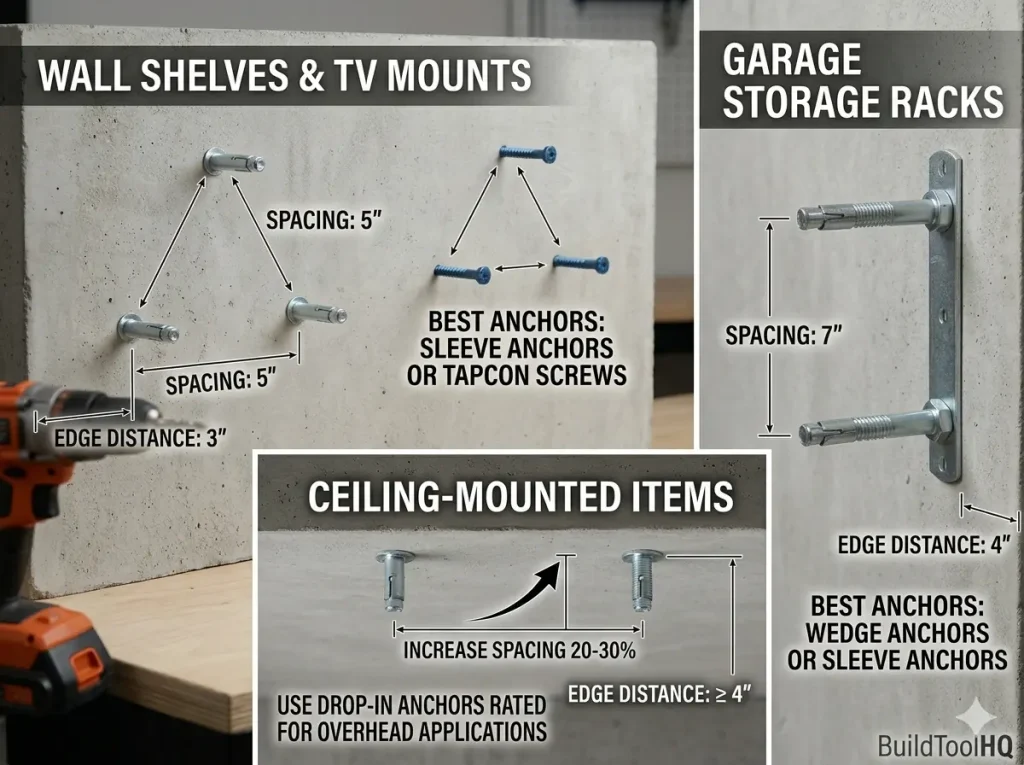
    How to avoid it:

    • Use a hammer drill for most concrete wall applications
    • Use a rotary hammer for thick or reinforced concrete

    If you’re unsure whether your drill is suitable, see
    Can a Regular Drill Drill Into Concrete?
    and
    Hammer Drill vs Rotary Hammer: What’s the Difference?


    Using the Wrong Drill Bit

    Concrete requires masonry drill bits with carbide tips. Using wood or metal bits is a guaranteed way to dull or snap them.

    Common errors include:

    • Using standard twist bits
    • Drilling with worn or damaged masonry bits
    • Using multi-material bits for hard concrete

    How to avoid it:
    Always choose drill bits designed specifically for concrete and masonry.

    For a full breakdown, read
    Best Drill Bits for Concrete and Masonry


    Applying Too Much Pressure

    Many people assume that pushing harder will drill faster. In concrete, this does the opposite.

    Excessive pressure:

    • Overheats the drill bit
    • Strains the drill motor
    • Causes uneven or crooked holes

    How to avoid it:

    • Let the drill and bit do the work
    • Apply steady, moderate pressure
    • Drill at a controlled speed

    Drilling at High Speed Too Soon

    Starting at full speed is another frequent mistake.

    High speed:

    • Causes bit wandering
    • Increases heat buildup
    • Reduces accuracy

    How to avoid it:

    • Start drilling slowly
    • Increase speed only after the bit has seated
    • Use hammer mode once the hole is established

    For proper technique, follow
    How to Drill Into Concrete Safely (Step-by-Step Guide)


    Skipping Surface Preparation

    Failing to prepare the drilling area can lead to inaccurate holes and damaged surfaces.

    Common preparation mistakes:

    • Not marking the hole location
    • Drilling at an angle
    • Ignoring hidden wiring or plumbing

    How to avoid it:

    • Mark drilling points clearly
    • Use a level to ensure straight alignment
    • Check behind walls before drilling

    Ignoring Proper Drill Depth

    Drilling too shallow or too deep can weaken anchors and reduce holding strength.

    Common depth issues:

    • Anchor not fully seated
    • Excess dust preventing proper fit
    • Over-drilling beyond anchor length

    How to avoid it:

    • Match drill depth to anchor requirements
    • Clear dust from the hole

    Learn more here:
    How Deep Can You Drill Into Concrete?
    What Size Drill Bit Should You Use for Concrete Anchors?


    Skipping Safety Gear

    Concrete drilling produces fine dust, vibration, and noise.

    Skipping safety gear increases the risk of:

    • Eye injuries
    • Hearing damage
    • Respiratory irritation

    How to avoid it:
    Always wear:

    • Safety glasses
    • Hearing protection for longer jobs
    • Gloves for grip and vibration control
    • A dust mask when drilling indoors

    Using the Wrong Power Source

    Some users struggle because their drill lacks consistent power.

    Common issues:

    • Cordless drill with insufficient battery power
    • Underpowered drill for hard concrete

    How to avoid it:
    Choose the right power option for your project.

    For guidance, see
    Cordless vs Corded Hammer Drill for Concrete: Which Is Better?


    Frequently Asked Questions

    Why do drill bits break when drilling concrete?

    Usually due to excessive pressure, high speed, or using the wrong type of bit.

    Is it safe to drill concrete indoors?

    Yes, but proper ventilation and dust control are important.

    Can mistakes be fixed after drilling?

    Some issues can be corrected, but many require re-drilling or patching. Prevention is far easier than repair.


    Conclusion: Avoiding Concrete Drilling Mistakes

    Most problems drilling into concrete come from using the wrong tools, rushing the process, or skipping preparation.

    By avoiding these common mistakes when drilling into concrete, homeowners and DIY users can achieve cleaner holes, stronger anchors, and safer results—without damaging tools or walls.

    For a complete overview of tools and techniques, start with
    Best Drill for Concrete Walls (2025 Guide)

  • How to Drill Into Concrete Safely (Step-by-Step Guide)

    How to Drill Into Concrete Safely (Step-by-Step Guide)

    How to drill into concrete safely is one of the most common concerns for homeowners and DIY users working with masonry walls. Concrete is extremely hard, produces fine dust, and places stress on both tools and users if done incorrectly.

    This step-by-step guide explains how to drill into concrete safely, which tools and drill bits to use, and how to avoid common mistakes that cause cracked walls, broken bits, or injuries.


    Step 1: Choose the Right Drill for Concrete

    Using the correct drill is the most important safety decision.

    For most homeowners, a hammer drill is the safest and most effective option for drilling into concrete walls. It combines rotation with a light hammering action that helps break up concrete as the bit spins.

    • For standard anchors and wall mounting → Hammer drill
    • For thick slabs or repeated heavy drilling → Rotary hammer
    • For light, occasional jobs only → Regular drill (not ideal)

    If you’re unsure whether your drill is suitable, see Can a Regular Drill Drill Into Concrete? and Hammer Drill vs Rotary Hammer: What’s the Difference?


    Step 2: Use the Correct Drill Bit

    Safety and performance depend heavily on using the right bit.

    Concrete requires masonry drill bits, which are designed to withstand high friction and impact. Using wood or metal bits will cause overheating, dulling, or snapping.

    For a detailed breakdown of bit types and materials, see Best Drill Bits for Concrete and Masonry

    Never drill concrete with:

    • Wood bits
    • Metal bits
    • Dull or damaged bits

    Step 3: Mark and Prepare the Drilling Spot

    Before drilling:

    1. Mark the hole location clearly
    2. Check for hidden electrical wires or plumbing
    3. Make sure the drill bit is seated straight in the chuck
    4. Hold the drill perpendicular to the wall

    Starting crooked increases the risk of bit slipping or wall damage.


    Step 4: Wear Proper Safety Gear

    Concrete drilling produces dust, vibration, and noise.

    Always wear:

    • Safety glasses (concrete dust can damage eyes)
    • Hearing protection for longer jobs
    • Gloves for grip and vibration control
    • A dust mask when drilling multiple holes

    Concrete dust can be harmful if inhaled, especially indoors.


    Step 5: Start Drilling Slowly

    Safety comes from control, not force.

    • Start at a low speed
    • Apply steady, moderate pressure
    • Let the drill and bit do the work

    Do not force the drill. Excess pressure causes overheating and increases the chance of bit failure.


    Step 6: Use Hammer Mode Correctly

    Once the bit has started cleanly:

    • Switch to hammer mode (if using a hammer drill)
    • Maintain consistent pressure
    • Pause occasionally to clear dust from the hole

    Brick and mortar respond well to hammer mode, but fragile surfaces require a gentle start.


    Step 7: Drill to the Correct Depth

    Drilling deeper than necessary weakens anchors and creates excess dust.

    Anchor depth depends on:

    • Bit size
    • Anchor type
    • Concrete hardness

    For detailed depth guidance, see How Deep Can You Drill Into Concrete? and What Size Drill Bit Should You Use for Concrete Anchors?


    Step 8: Let the Drill Cool Down

    Concrete drilling creates heat.

    • Stop periodically
    • Allow the bit and drill to cool
    • Clear dust from the hole before continuing

    Overheating shortens tool life and increases injury risk.


    Common Safety Mistakes to Avoid

    Many concrete drilling accidents come from avoidable mistakes:

    • Using the wrong drill or bit
    • Drilling at high speed from the start
    • Applying excessive pressure
    • Skipping safety gear
    • Ignoring dust buildup

    For a full breakdown, see Common Mistakes When Drilling Into Concrete (And How to Avoid Them)


    Frequently Asked Questions

    Is drilling into concrete dangerous?

    It can be if done incorrectly. Using proper tools, safety gear, and technique greatly reduces risk.

    Can I drill concrete indoors?

    Yes, but ensure proper ventilation and dust control.

    Should I use hammer mode on brick?

    Yes, but start slowly to avoid cracking softer brick or mortar.


    Conclusion

    Learning how to drill into concrete safely comes down to preparation, proper tools, and patience. A hammer drill, masonry bits, controlled speed, and basic safety gear make concrete drilling safe and manageable for most homeowners.

    Following these steps protects your tools, your walls, and most importantly—you.

    A step-by-step guide explaining how to drill into concrete safely using the correct tools, drill bits, and techniques.

    Total Time: 15 minutes

    Choose the right drill for concrete

    Use a hammer drill for most concrete walls or a rotary hammer for heavier jobs.

    Use the correct drill bit

    Select a masonry drill bit designed for concrete and avoid wood or metal bits.

    Mark and prepare the drilling spot

    Mark the hole location and ensure the drill is held straight and perpendicular.

    Wear proper safety gear

    Wear safety glasses, hearing protection, gloves, and a dust mask.

    Start drilling slowly

    Begin drilling at a low speed with steady pressure and avoid forcing the drill.

    Use hammer mode correctly

    Switch to hammer mode after the hole starts cleanly and clear dust periodically.

    Drill to the correct depth

    Drill only as deep as required for the anchor or fastener.

    Let the drill cool down

    Pause to let the drill and bit cool and remove dust buildup.

    Tools:

    • Hammer drill
    • Masonry drill bit
    • Safety glasses
    • Hearing protection
    • Dust mask

  • The Truth: Can a Regular Drill Drill Into Concrete? (2026 Guide)

    The Truth: Can a Regular Drill Drill Into Concrete? (2026 Guide)

    Many homeowners ask a very valid question: Can a Regular Drill Drill Into Concrete, especially when faced with small household projects? Whether you want to hang heavy floating shelves in the basement, install anchors for outdoor security lighting, or mount a new fixture in a utility room, the demand for masonry drilling is real.

    When you look at the specialized (and expensive) hammer drills available, it’s natural to wonder if you can simply use the standard driver drill sitting in your toolbox. The short answer is: yes, you can, but only in extremely specific situations, and it is usually not the best tool for the job.

    In this definitive guide, we will deep dive into the engineering reasons why standard drills struggle, explain exactly when a regular drill can work on concrete, and detail when you must switch to a hammer drill to avoid ruining your tools or your wall.


    The Engineering Challenge: Why Concrete Defeats Rotation-Only Drills

    To answer the central question, Can a Regular Drill Drill Into Concrete, we first need to understand the material. Concrete is a dense composite, a mixture of strong aggregate (like small rocks and gravel), binding cement, and sand. It is incredibly tough.

    When you use a regular drill on wood or drywall, the tool uses high speed and pure rotation to shave away material, allowing the bit to twist its way forward. This doesn’t work on concrete. A regular drill:

    • Relies solely on rotation: The bit only spins.
    • Cannot fracture aggregate: A rotating bit will hit a piece of rock and immediately stall. It has no mechanism to break the stone, so it just spins and creates immense heat.
    • Demands extreme user pressure: Because the drill isn’t helping, the user must apply immense, tiring physical pressure to try and “push” the bit into the surface.

    This is exactly why so many DIY users try the project and conclude that concrete is “impossible” to drill. The material isn’t impossible; the issue is using the wrong tool. Attempting to answer “Can a Regular Drill Drill Into Concrete” by testing it on a modern foundation wall is a recipe for a burnt-out motor. For most residential masonry tasks, you should consult a proper guide on the 🔗 Best Drill for Concrete Walls (2026 Guide).
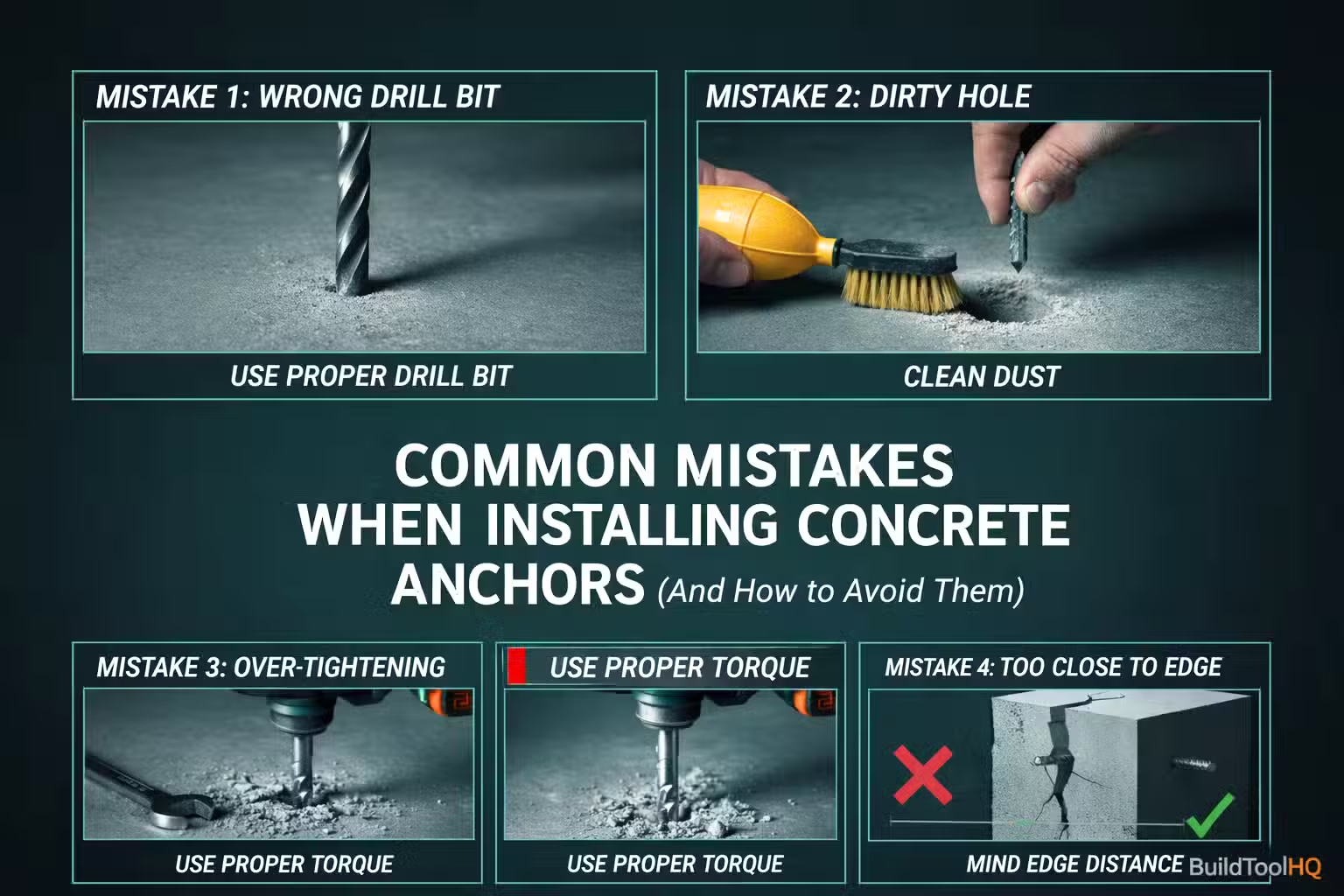

    Can a Regular Drill Drill Into Concrete? A Conditional Checklist

    We need to address the nuance. The short answer was “yes,” but only under specific, careful conditions. If your project ticks all of these boxes, you may be able to proceed using your current equipment.

    Can a Regular Drill Drill Into Concrete : A close-up photograph capturing a standard, rotation-only driver drill (not a hammer drill) successfully sinking a masonry bit into the mortar joint of a grey cinder block, illustrating the specific conditions under which a regular drill can work on concrete.
    Don’t have a hammer drill? In limited cases, a regular drill can succeed on soft masonry like cinder block mortar. This visual proves that with the right carbide-tipped bit and very slow speeds, a shallow hole is possible without ruining your tool. 🧱
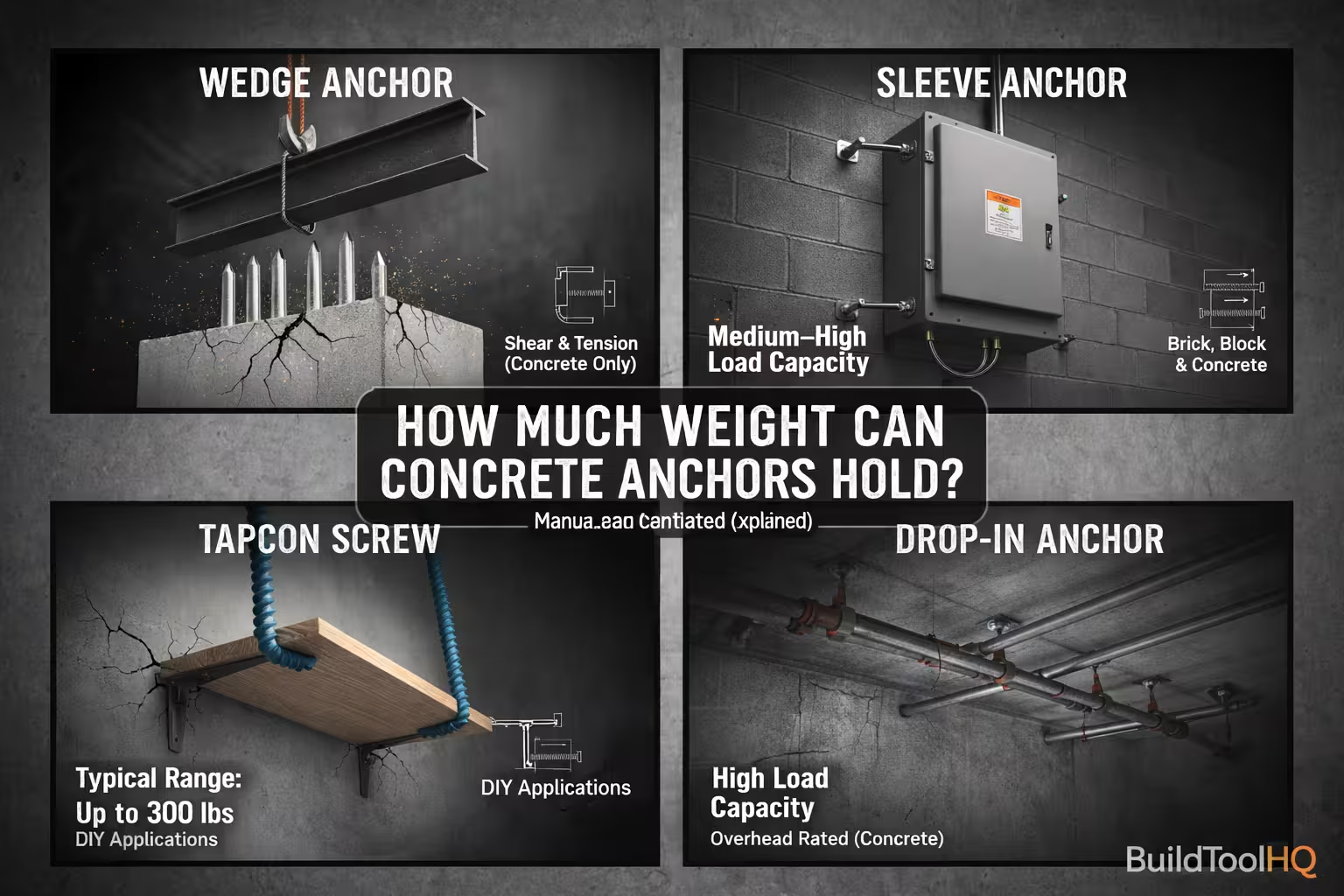
    A Regular Drill CAN Drill Into Concrete IF:

    1. The Concrete is “Soft” Masonry or Mortar

    Some forms of concrete are less dense than others. If you are drilling into very old, weathered concrete (such as an aged outdoor patio) or mortar joints (the cement holding brick walls together), it is possible to make progress. These materials are much softer than a modern, high-PSI poured foundation wall. Can a Regular Drill Drill Into Concrete made of cinder block? Yes, that is usually possible because of the material’s lower density and hollow structure.

    2. The Hole is Small, Shallow, and Accurate

    We are talking about very specific hole requirements. Can a Regular Drill Drill Into Concrete for a 1/2-inch wedge anchor? Absolutely not. But if you only need a 3/16-inch or 1/4-inch hole for a light-duty plastic anchor, a regular drill might succeed. Crucially, the hole cannot be deep. Every millimeter you drill deeper, the friction and heat increase. If you are trying to find the answer to 🔗 How Deep Can You Drill Into Concrete?, you won’t find it using a standard drill.

    3. You MUST Use a Specialized Masonry Bit

    A detailed macro comparison photograph showing a regular, standard-tipped masonry drill bit used on cinder block in image_17.png, labeled "STD TIP MASONRY" (left), alongside a premium, multi-cutter head "CARBIDE X-TIP" masonry bit (right) necessary for efficient hammer drilling into hard concrete walls.
    The secret to masonry drilling is the bit, not just the drill. Can a Regular Drill Drill Into Concrete? Only if you use the specialized carbide-tipped bit on the right. The standard bit on the left, used in our previous visual, works for cinder block, but it will melt instantly on hard concrete. 💡

    This is non-negotiable. You cannot use wood or metal bits. They will be dull within three seconds. Concrete drilling requires masonry bits with hardened carbide tips. These bits are designed to smash concrete, not cut it. The flutes are also specifically designed to lift massive amounts of concrete dust out of the hole. Can a Regular Drill Drill Into Concrete if I skip this bit? No, not even for soft masonry. To find the right tools, check 🔗 Best Drill Bits for Concrete and Masonry.

    4. You Drill Slowly and Use Controlled Pressure

    This is a technical challenge. Regular drills operate best at high speeds for driving screws. When drilling concrete, you must do the opposite. High speed creates friction heat, which will quickly melt the bond holding the carbide tip on your bit. You must drill slowly, at low RPM, but apply a significant, steady force—but not enough to bind the motor.


    Why You Should Avoid Using a Regular Drill on Concrete

    Even if your project fits the checklist above, just because you can doesn’t mean you should. We strongly recommend homeowners avoid using a regular drill on masonry. Here is a performance breakdown and the risks involved.

    FeatureRegular DrillHammer DrillRotary Hammer
    Primary ActionRotation onlyRotation + High-Speed HammerPneumatic Piston Hammer
    MaterialWood, Drywall, Light MetalBrick, Concrete Walls, MasonryRebar, Poured Structural Concrete
    User EffortExtremely High Pressure RequiredLow to Moderate PressureVery Low Pressure
    Bit Damage RiskVery High (Overheating)Low (If used properly)Low
    Motor Burn RiskModerate to High (Stalling)LowVery Low
    Verdict for ConcreteNot RecommendedBest for HomeownersOverkill for DIY

    The engineering differences are profound. When you ask Can a Regular Drill Drill Into Concrete, you are looking at a tool designed for torque (twisting), not percussive impact (crushing). For a comprehensive breakdown of the power, check out: 🔗 Hammer Drill vs Regular Drill vs Rotary Hammer: What’s the Difference?

    Risk #1: Total Tool Damage (Bit and Motor)

    The #1 outcome when people try to answer “Can a Regular Drill Drill Into Concrete” is a smoking drill motor and a melted bit. The tool has to work so hard against dense stone that the internal temperature can exceed safe limits, ruining the windings of the motor. You might “save money” by not buying a new drill, but you will spend that money replacing your regular one and the bits you destroyed.

    Risk #2: Poor Results and cracked Masonry

    Because you are forced to apply so much uneven physical pressure, the hole you drill will rarely be clean or straight. A hole that is angled or too wide will prevent your anchors from holding correctly, making your shelf or mount unsafe. Even worse, the erratic pressure can cause “blowouts” or cracks in the surrounding masonry, turning a simple task into a major wall repair. You can learn more about how to avoid these disastrous mistakes here: 🔗 Common Mistakes When Drilling Into Concrete (And How to Avoid Them).


    🔗 How to Drill Into Concrete Safely (Step-by-Step Guide)

    A close-up photograph looking down at a user's gloved hands stabilizing a standard, rotation-only driver drill (not a hammer drill) as the simple masonry bit sinks about one inch deep into a light grey cinder block mortar joint. Fine concrete dust is visibly kicking up and collecting around the hole. The texture of the porous cinder block and the metal drill chuck are in sharp focus.
    Can a regular drill drill into concrete? Only if it’s soft masonry like a cinder block mortar joint. This close-up shows the required safety gear and the fine grey dust that requires constant venting.

    If you have read the warnings and decided that your one-time, soft-masonry project must proceed with a regular drill, you must follow this safety protocol. This isn’t a recommendation; it is essential to prevent injury or significant property damage.
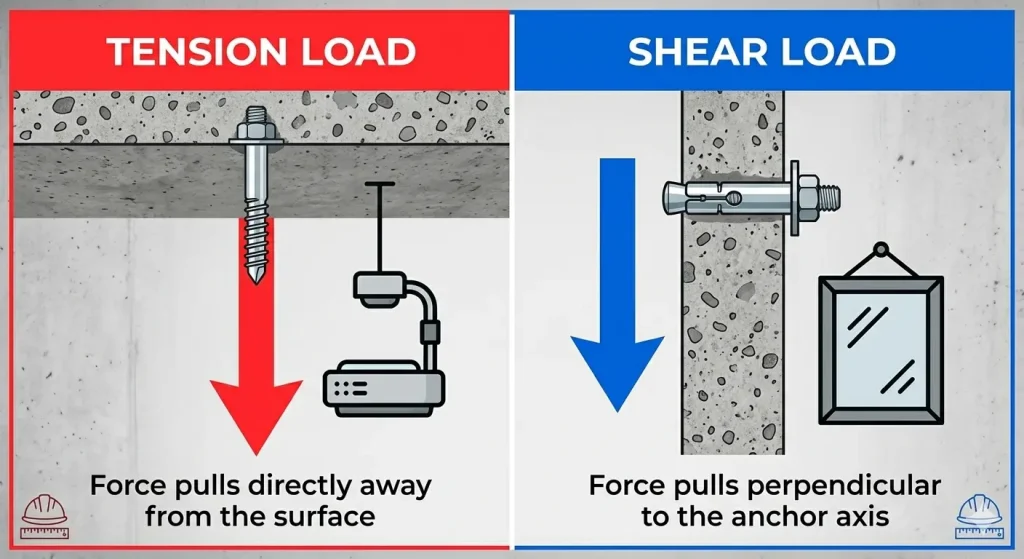
    1. Mark the Spot and Wear Protection: Start by marking your hole’s position. Put on safety glasses and hearing protection. Can a Regular Drill Drill Into Concrete without these? Not safely. 🛡️
    2. Clear the Holes Frequency: When drilling into concrete, a regular drill creates powder. This powder acts like sand inside the drill’s motor vents. Blow out the drill with compressed air after every single hole.
    3. Use “Rotation Mode”: Ensure your drill is set to “Drill” mode, not “Driver/Clutch” mode. You want all the motor’s power going purely to the bit’s spin.
    4. Start at Low RPM: Place the bit against the wall and pull the trigger gently. The absolute biggest risk to both your tool and your accuracy is overheating. Start drilling slowly to establish the initial divot, preventing the bit from wandering across the wall.
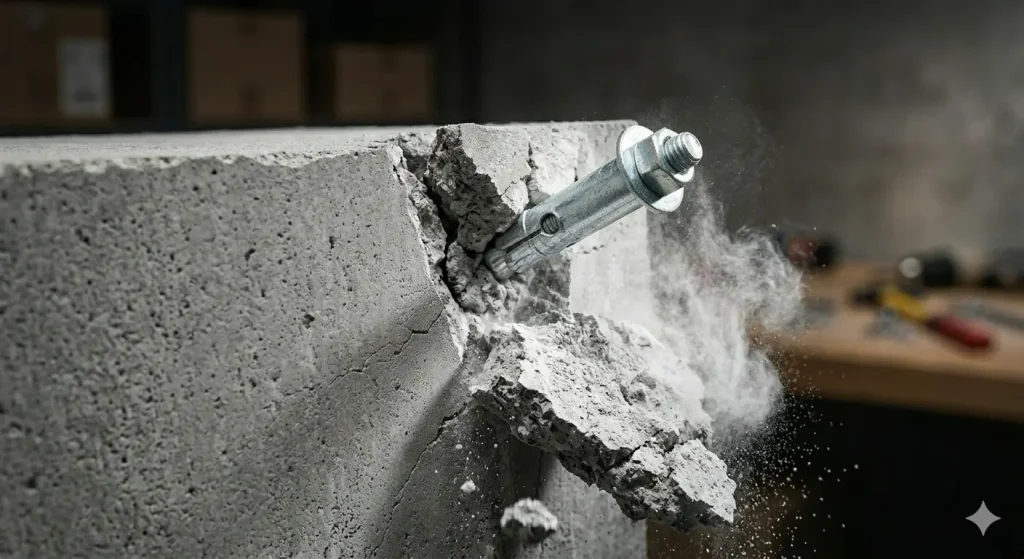
    5. Steady, Controlled Pressure: Apply heavy, linear force directly into the back of the drill. Do not wobble or lean. Keep the bit perfectly perpendicular to the concrete.
    6. Take Frequent “Cooling Breaks”: Drill for 30 seconds, then stop for 60 seconds. Let the bit and the drill motor cool down. Can a Regular Drill Drill Into Concrete continuously? No. Continuous use will result in failure. Dip the carbide bit shank in water if it becomes scalding, but never the carbide tip, which can crack.
    7. Watch the Color: If you see the tip of your masonry bit begin to glow red, you are going too fast and have already dulled the bit. Replace it immediately.
    8. Depth Rod Check: Use a depth rod or wrap masking tape around the bit to ensure you don’t drill deeper than your anchor requires. Over-drilling reduces holding power. If you need to establish anchor depth, see 🔗 What Size Drill Bit Should You Use for Concrete Anchors?.

    FAQ: Your Top Questions Answered on Regular Drills vs. Masonry

    Can a Regular Drill Drill Into Concrete to set a Tapcon screw?

    No, we do not recommend it. Tapcon screws require incredibly precise pilot holes. If the hole is 1/16″ too wide, the screw threads won’t bite and will strip. Can a Regular Drill Drill Into Concrete with the precision required for this fastening? No, you need a hammer drill.

    Can a Regular Drill Drill Into Concrete walls without a masonry bit?

    Absolutely not. Wood bits will melt, and metal bits will dull and snap. Can a Regular Drill Drill Into Concrete is irrelevant; without the correct carbide-tipped masonry bit, the project will fail instantly.

    Why is my regular drill vibrating so much in concrete?

    That is likely not vibration but binding. Can a Regular Drill Drill Into Concrete efficiently? No, the binding you feel is the bit hitting aggregate and stalling the motor. This is why you must drill slowly and periodically lift the bit to clear dust.

    Can a regular drill sink anchors like wedge anchors or sleeve anchors?

    Only for the absolute smallest sizes in soft masonry. For anchors that demand high-torque expansion, you must use a hammer drill. To understand anchor depth versus bit size, consult 🔗 How Deep Can You Drill Into Concrete?.

    Can a Regular Drill Drill Into Concrete faster if it is corded?

    Generally, yes. Can a Regular Drill Drill Into Concrete without overheating better? A corded drill often provides better consistent power, reducing the risk of stalling the motor under heavy pressure. However, it still lacks the necessary hammering action and the motor will still be under excessive strain. If you are debating power options, see: 🔗 Cordless vs Corded Hammer Drill for Concrete: Which Is Better?

    Can a Regular Drill Drill Into Concrete ceiling walls?

    No, this is extremely dangerous. Drilling overhead requires all the physical force and stamina you can muster, even with the right tools. Attempting to use a regular drill, which demands even more force, will lead to muscle fatigue and significantly increases the risk of the drill slipping and falling.


    Final Verdict: Can a Regular Drill Drill Into Concrete (And Should You)?

    To summarize the definitive answer to the user’s question, Can a Regular Drill Drill Into Concrete, the short answer is yes, technically you can, but it is almost never the right decision.

    A standard, rotation-only drill can succeed only on very old, soft concrete, mortar joints, and cinder blocks for small (under 1/4″), shallow holes, and only if you use a carbide masonry bit. However, even in these ideal scenarios, the process is slow, frustrating, and puts your tool at significant risk of total failure.

    For 99% of homeowners and DIY users, the balanced power, speed, and safety of a quality hammer drill is always the best choice. Can a Regular Drill Drill Into Concrete? Yes, you can, but investing in the correct equipment will save you massive amounts of time, protect your tools, and provide a much safer, cleaner finish to your masonry project. For homeowners frequently facing these projects, a solid cordless model is a fantastic resource, as discussed in 🔗 Best Hammer Drill for Home Use (2026 Guide).