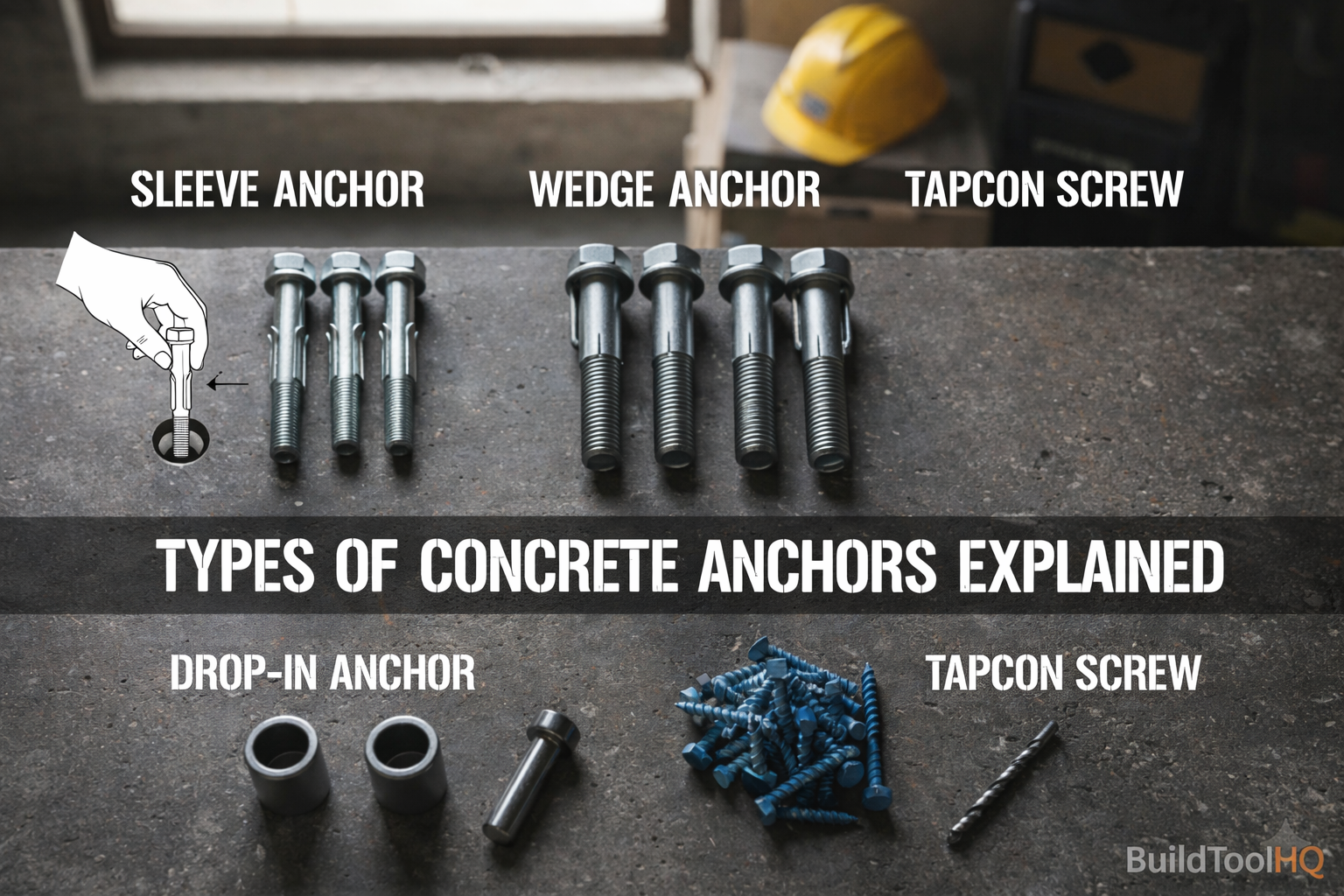
Types of concrete anchors vary by design, strength, and application, and choosing the right one is essential for safe and secure installations in concrete, brick, and block walls. Each anchor type is designed to work in specific materials and load conditions, and using the wrong one can lead to cracked masonry, loose fixtures, or dangerous failures.
In this guide, we’ll clearly explain the different types of concrete anchors, how they work, and when homeowners should use each one.
What Are Concrete Anchors?
Concrete anchors are fasteners designed to secure objects into solid masonry such as concrete, brick, or concrete block. They rely on expansion, threading, or mechanical locking to hold firmly inside drilled holes.
If you’re new to anchors or deciding what to buy, start with (Best Concrete Anchors for Home Use – 2026 Guide) to understand which types are best for typical household projects.
The Main Types of Concrete Anchors
Below are the most common anchor types homeowners will encounter.
Sleeve Anchors
Best for: Brick, block, and concrete
Load rating: Medium to heavy
Sleeve anchors use a metal sleeve that expands evenly against the walls of the drilled hole when tightened. This even expansion makes them ideal for brick and block, where aggressive expansion could cause cracking.
Pros:
- Works in multiple masonry materials
- Even expansion reduces cracking risk
- Good for TV mounts, railings, shelves
Cons:
- Not removable once installed
- Requires precise hole depth
Sleeve anchors are commonly recommended for home installations covered in (Best Anchors for Brick vs Concrete vs Block Walls).
Wedge Anchors
Best for: Solid concrete only
Load rating: Heavy-duty
Wedge anchors expand aggressively at the base of the anchor when tightened, creating an extremely strong hold. They are commonly used for structural applications.
Pros:
- Extremely strong
- Ideal for heavy loads
Cons:
- Concrete only (not brick or block)
- Permanent installation
Using wedge anchors incorrectly is one of the issues discussed in (Common Concrete Anchor Installation Mistakes – And How to Avoid Them).
Drop-In Anchors
Best for: Flush-mounted applications in concrete
Load rating: Heavy-duty
Drop-in anchors sit flush with the surface of the concrete and require a setting tool to expand them internally.
Pros:
- Clean, flush finish
- High load capacity
- Professional-grade
Cons:
- Requires special setting tool
- Concrete only
Drop-in anchors are commonly used in commercial settings but can be useful for advanced DIYers installing heavy fixtures.
Concrete Screws (Tapcon-Style)
Best for: Light to medium-duty home projects
Load rating: Light to medium
Concrete screws thread directly into concrete or masonry without expansion. They are popular because they’re easy to install and removable.
Pros:
- Easy installation
- Removable
- No expansion stress
Cons:
- Lower load capacity
- Requires precise drilling
If you’re deciding between screws and anchors, see (Tapcon Screws vs Concrete Anchors: Which Should You Use?).
Plastic Masonry Anchors
Best for: Very light-duty projects
Load rating: Light
Plastic anchors expand when a screw is driven in. They are best suited for lightweight fixtures.
Pros:
- Inexpensive
- Easy to install
Cons:
- Limited strength
- Not suitable for heavy loads
For weight considerations, review (How Much Weight Can Concrete Anchors Hold? – Load Ratings Explained).
Choosing the Right Anchor for Your Project
Here’s a quick homeowner decision guide:
- Shelves & light fixtures → Concrete screws
- TV mounts → Sleeve anchors
- Structural loads → Wedge anchors
- Flush installations → Drop-in anchors
- Lightweight items → Plastic anchors
Before drilling, make sure your bit size is correct — see (What Size Drill Bit Should You Use for Concrete Anchors?).
Drill Bits and Hole Preparation Matter
No anchor will hold properly without a clean, correctly sized hole.
Best practices:
- Use carbide-tipped masonry bits
- Drill straight and to full depth
- Clean dust from the hole
For recommended tools, read (Best Drill Bits for Concrete and Masonry) and (Best Drill for Concrete Walls – 2025 Guide).
Common Mistakes When Choosing Anchor Types
Avoid these errors:
- Using wedge anchors in brick
- Undersizing or oversizing holes
- Choosing anchors based only on price
- Ignoring load ratings
These mistakes are covered in detail in (Common Concrete Anchor Installation Mistakes – And How to Avoid Them).
Final Thoughts: Which Anchor Type Is Best?
There’s no single “best” anchor — only the right anchor for the job.
For most homeowners:
- Concrete screws handle small projects
- Sleeve anchors cover most medium-duty needs
- Wedge anchors are reserved for heavy loads
For a full buying overview, return to (Best Concrete Anchors for Home Use – 2026 Guide).
Continue Learning
Next, you may want to explore:
- (Tapcon Screws vs Concrete Anchors: Which Should You Use?)
- (How to Install Concrete Anchors Correctly – Step-by-Step Guide)
- (Best Concrete Anchor Kits for Homeowners – 2026 Review)
These guides will help you choose and install anchors safely and correctly.
Leave a Reply