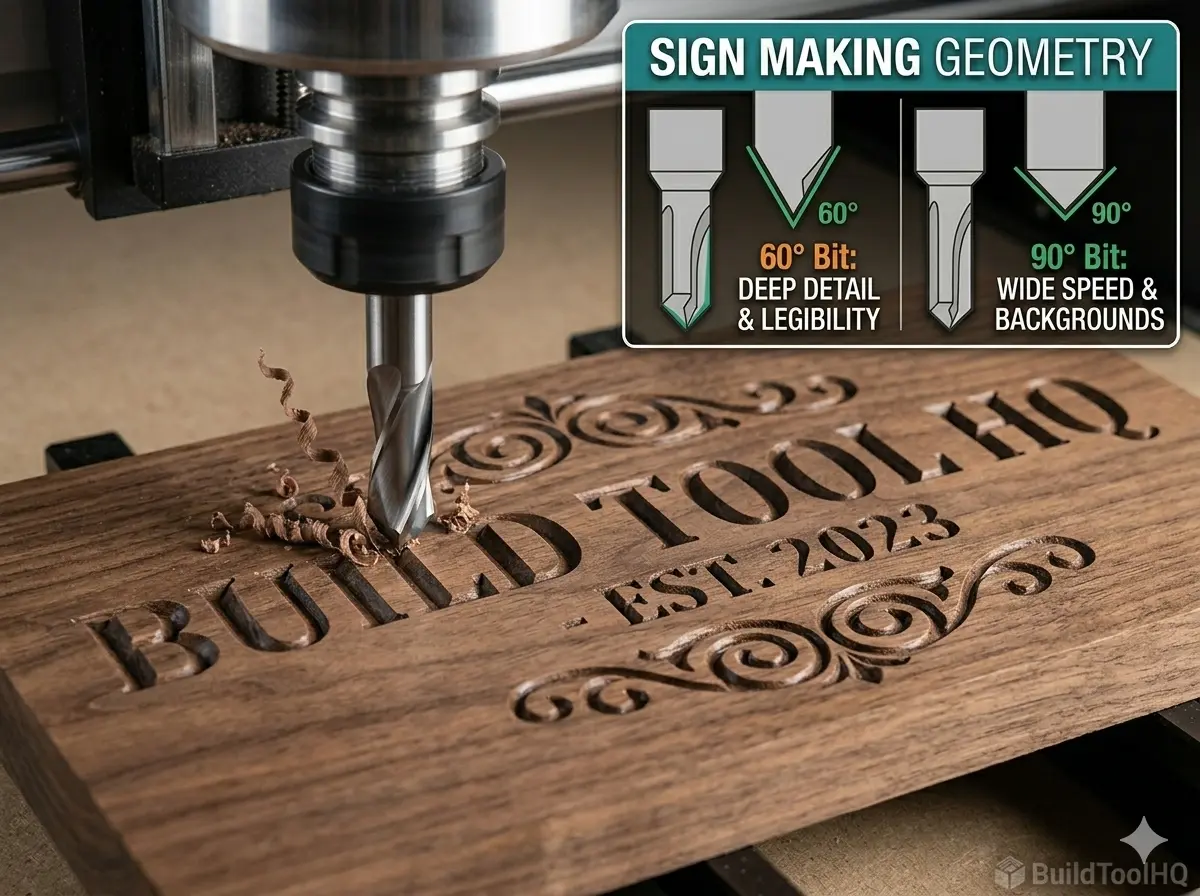
V-carving is the soul of classic sign making. When a CNC machine cuts a standard 2D profile, the result is often flat and mechanical. But when that same machine drives a pointed V-bit simultaneously in the X, Y, and Z axes, it produces deep, “chiseled” lines that capture light and create dramatic shadow. This 2.5D technique transforms simple text into professional, dimensional art.
To achieve a sand-free, professional result, you must choose the best CNC v-carve bits for signs. This selection is a core component of your overarching strategy, as detailed in [The Ultimate Guide to CNC Router Bits: Selection, Speeds, and Materials]. Selecting the right tools, especially the best CNC v-carve bits for signs, can significantly affect the outcome of your project.
1. What is V-Carving? (The Prismatic and Corner Lift Concepts)
By leveraging the best CNC v-carve bits for signs, you will be able to create high-quality signage with ease.
Choosing the right tools, such as the best CNC v-carve bits for signs, will enhance your overall sign-making experience.
Learning about the best CNC v-carve bits for signs can help you understand how to get the best results from your CNC machine.
Standard router bits (like upcut spirals) remove a predictable width of material based on their diameter. V-carve bits are different. They do not remove a set diameter; instead, they cut based on their point.
Investing in the best CNC v-carve bits for signs will lead to better outcomes and greater satisfaction with your projects.
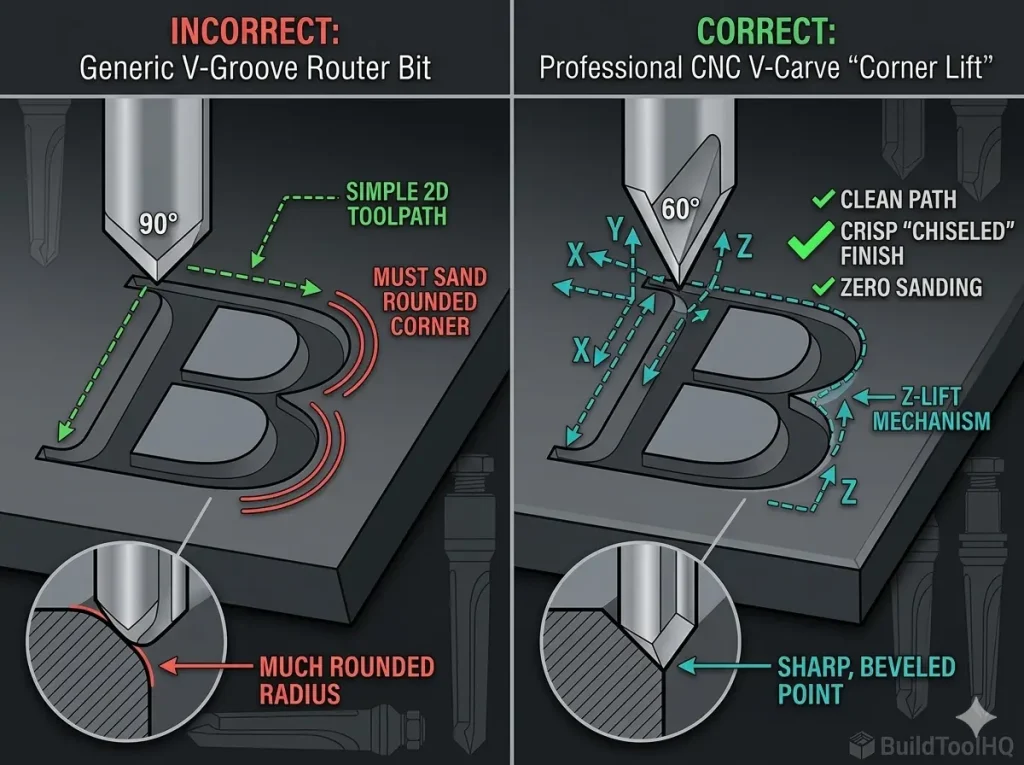
In a V-carve toolpath, the CNC software calculates a fluctuating Z-depth to match the varying width between the letters on your design. Where a font stroke is thin, the bit runs shallow. Where the stroke is wide, the bit dives deep. This automatic Z-depth change means the V-groove router bit creates a perfect beveled edge along every curve of your sign, culminating in a crisp point.
By focusing on the best CNC v-carve bits for signs, you can create intricate designs that capture attention and admiration.
The Magic of “Corner Lifting”
The main reason to choose the best CNC v-carve bits for signs is “corner lifting.” When a V-bit reaches the end of a stroke, the Z-axis physically lifts the point of the bit, creating a perfectly defined, sharp corner. A flat-bottom bit (like those discussed in [Ball Nose vs. Tapered Ball Nose: The nuances of 3D carving and finishing passes]) will always leave a radius in a corner; only a pointed V-bit can achieve that precise, “chiselled” finish that defines professional sign making.
When you opt for the best CNC v-carve bits for signs, you ensure that your text stands out with clarity and depth, making your signs truly eye-catching.
2. The 60 vs 90 Degree V-Bit Debate (Choosing Your Weapon)
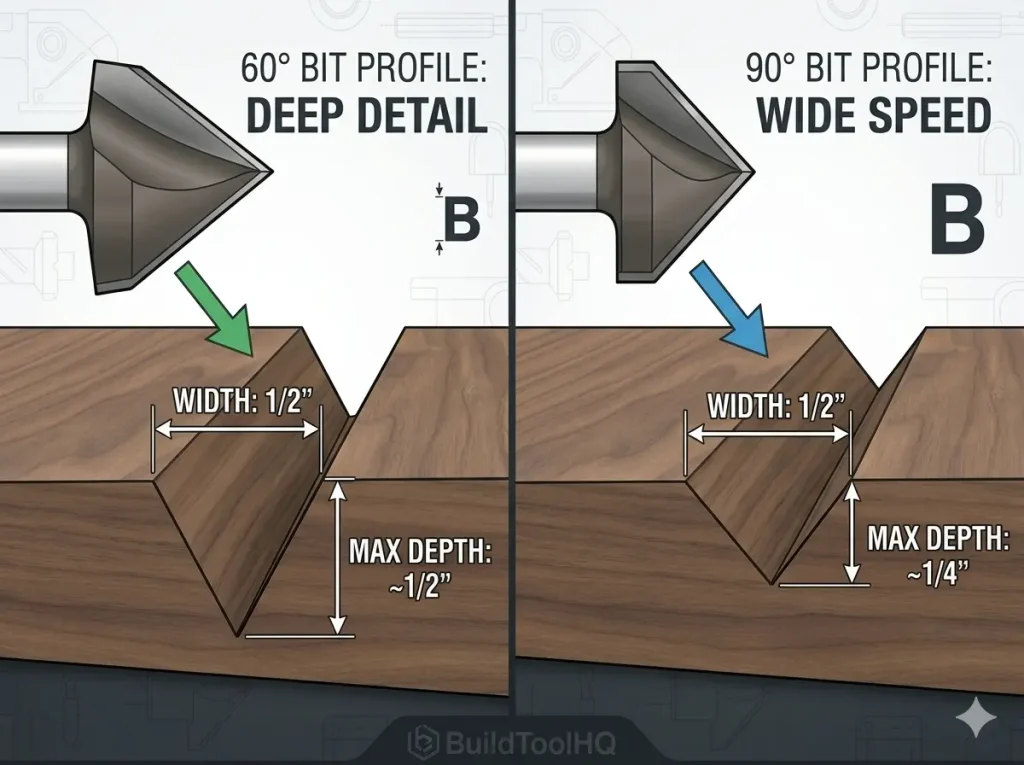
V-bits are primarily defined by their “included angle.” For 90% of sign-making projects, you will choose between a 60-degree V-bit or a 90-degree V-bit.
Thus, the best CNC v-carve bits for signs are more than just tools; they are the key to unlocking your creative potential.
- 60-Degree V-Bits: These have a narrower point and must dive deeper to reach the same width. This creates dramatic shadows and superior legibility for small, delicate text (under 1 inch). If your sign must be readable from a distance, the 60-degree geometry is superior.
- 90-Degree V-Bits: These have a wide, stout geometry. They create wide cuts at shallow depths. Because the bit doesn’t dive as deep, it can often complete a toolpath in fewer passes, which is great for large, bold text (over 2 inches) or creating wide borders.
If you are V-carving over a laminated background, refer to our guide on [Best CNC Bits for Plywood and Hardwoods: A deep dive into wood-specific geometry] to understand how to manage grain tear-out before you begin.
With the right knowledge, you can choose the best CNC v-carve bits for signs that match your project needs perfectly.
3. Specialized V-Bits (Moving Beyond the Basics)
Incorporating the best CNC v-carve bits for signs into your setup will significantly enhance your sign-making capabilities.
When considering your options, remember that the best CNC v-carve bits for signs are those that fit your specific project needs, ensuring both precision and aesthetic appeal.
While 60 and 90-degree bits are your standard “workhorses,” you should consider specialized geometry for specific sign-making challenges.
30-Degree “Engraving” Bits
For ultra-fine, microscopic detail—such as isolation routing on PCBs or carving highly detailed crests—a 30-degree V-bit is essential. These tools often feature a small flat-point “tip” (e.g., $0.1mm$) to increase durability.
Indexable/Insert V-Bits
The most professional sign-making shops use indexable V-bits. Much like replacing the standard inserts on a [Surfacing and Slab Leveling Bits: Mastering large-area clearing] ensures a flat table, rotating your indexable V-bit insert ensures a mathematically perfect point, which is the secret to avoiding frustrating “rounded” corners.
4. Pro-Tips for Sharp Corners and Crisp Detail
Utilizing the best CNC v-carve bits for signs ensures that every project you undertake is both efficient and aesthetically pleasing.
In conclusion, understanding the best CNC v-carve bits for signs is crucial for anyone looking to succeed in this craft.
Ultimately, the best CNC v-carve bits for signs are fundamental to achieving the precise and beautiful results you desire.
The best CNC v-carve bits for signs are only as good as your material choice and machine setup.
For optimal results, always choose the best CNC v-carve bits for signs, tailored to your specific materials and design requirements.
When you prioritize the best CNC v-carve bits for signs, you can elevate your projects to a whole new level, impressing clients and customers alike.
Each time you work with the best CNC v-carve bits for signs, you’ll discover new techniques and possibilities for enhancing your craft.
- Minimize Flex: When a V-carve toolpath performs the simultaneous “corner lift” (moving X, Y, and Z at once), the machine is under significant strain. If your gantry has any “flex,” the point will “wobble,” resulting in “mushy” corners. This rigidity is as critical here as it is when [Aluminum Cutting with CNC: Single-flute secrets and lubrication].
- Material Selection: Hardwoods like Walnut, Maple, and Oak provide clean “shavings.” Softwoods like Pine tend to “fuzz” or tear out, which takes hours to sand and often ruins the crisp beveled edge.
The best CNC v-carve bits for signs not only enhance the beauty of your designs but also improve the efficiency of your cutting process.
Frequently Asked Questions (FAQ)
Choosing the best CNC v-carve bits for signs can make all the difference when it comes to achieving a professional finish.
What is the best material for V-carve signs?
Hard, dense hardwoods like Walnut, Maple, and Oak are the best choices, providing clean “shavings” and excellent edge detail. Softwoods like Pine and many plywoods tend to “fuzz” or tear out. If you are V-carving text over a laminated background, refer to our guide on (CNC bits for plywood) to minimize tear-out on the top surface.
What is the best CNC v-carve bit for small text on a sign?
For small, delicate text (under 1/2″ tall), a 60-degree V-bit is the professional choice. This narrower geometry allows the bit to dive deep, providing significant legibility and drama even when the stroke width of the letters is very thin. For ultra-fine details, a 30-degree engraving bit is better.
Why are my V-carve corners rounded and not sharp?
Rounded corners are a result of a “tip mismatch.” Either your software is calculating for a mathematically perfect point but your bit is actually slightly flat (dull), or your CNC gantry is flexing during the simultaneous X, Y, and Z “Corner Lift” move. As shown in our (corner lift mechanism diagram), a perfect point requires both precise software data and a rigid machine setup.
Do I need to run a roughing pass before V-carving?
If your V-carve design is wide (e.g., 1-inch letters), a standard V-carve toolpath will take multiple slow passes. It is often more efficient to run a “V-Carve with Flat Area Clearance,” using a small (upcut spiral bit) to remove the bulk material, followed by the pointed V-bit just to clean up the beveled edges and “corner lift.”
Why does the depth of my V-carve vary across the sign?
Precision depth is vital for consistent V-carving. If your machine is cutting too deep or too shallow in different areas, your spoilboard is not level. You must refer to our guide on (surfacing bit for CNC router) and level your spoilboard before attempting precision V-carving.
Leave a Reply to 10 Best CNC Router Bits: The Ultimate Guide To Selection & Speeds Cancel reply