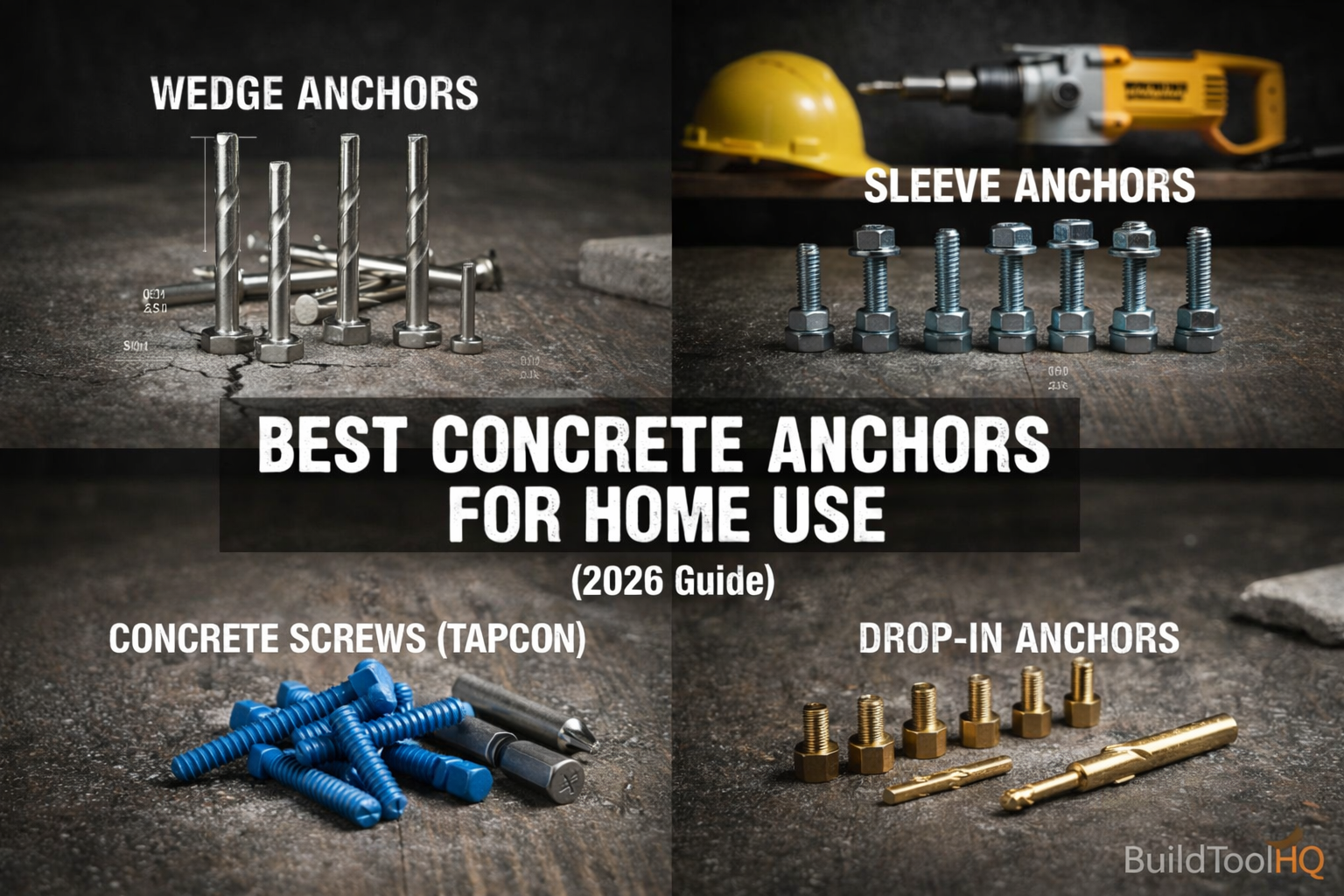
Best concrete anchors for home use are essential when mounting shelves, TVs, cabinets, and heavy fixtures into concrete, brick, or block walls. Choosing the wrong anchor can lead to loose mounts, cracked masonry, or unsafe installations — which is why selecting the right anchor type matters for every home project.
In this guide, you’ll learn which concrete anchors are best for home use, how to choose the right type for your project, and how they connect with proper drilling techniques covered in our other guides.
What Are Concrete Anchors?
Concrete anchors are fasteners designed to secure objects into hard masonry surfaces such as concrete, brick, or concrete block. Unlike wood screws or drywall anchors, concrete anchors expand, grip, or thread directly into masonry to create a strong mechanical hold.
Before choosing an anchor, it’s important to understand:
- The type of wall (solid concrete, brick, block)
- The weight of the item
- The hole size and depth required
If you’re not sure how drilling affects anchor strength, start with How Deep Can You Drill Into Concrete? and How to Drill Into Concrete Safely – Step-by-Step Guide
Types of Concrete Anchors (Quick Overview)
There are several common anchor types used by homeowners. Each has a specific use case.
For a full breakdown, see (Types of Concrete Anchors Explained – Sleeve, Wedge, Drop-In, Tapcon).
Common anchor types:
- Sleeve anchors – versatile, good for brick and block
- Wedge anchors – extremely strong, concrete only
- Drop-in anchors – flush-mounted, professional-grade
- Concrete screws (Tapcon-style) – removable and easy to install
- Plastic masonry anchors – light-duty only
Best Concrete Anchors for Common Home Projects
🧱 Best for Shelves & Light Fixtures
Concrete screws (Tapcon-style)
- Easy installation
- Removable
- Ideal for shelves, towel bars, small cabinets
Make sure your hole size is correct — see (What Size Drill Bit Should You Use for Concrete Anchors?).
📺 Best for TV Mounts & Heavy Wall Loads
Sleeve anchors or wedge anchors
- High load capacity
- Strong expansion grip
If you’re comparing tools, (Hammer Drill vs Regular Drill: Which One Do You Need?) explains why hammer drills are often required for these anchors.
🧰 Best for Brick or Block Walls
Sleeve anchors
- Even expansion prevents cracking
- Works well in hollow materials
Avoid wedge anchors in brick — this mistake is covered in (Common Mistakes When Drilling Into Concrete – And How to Avoid Them).
🔩 Best for DIY Homeowners
Concrete anchor kits
- Multiple sizes included
- Ideal for mixed projects
We review the best options in (Best Concrete Anchor Kits for Homeowners – 2026 Review).
How Much Weight Can Concrete Anchors Hold?
Anchor strength depends on:
- Anchor type
- Diameter and embedment depth
- Concrete quality
- Installation accuracy
For real-world numbers and safety margins, read (How Much Weight Can Concrete Anchors Hold? – Load Ratings Explained).
⚠️ Tip: Always derate manufacturer ratings by 25–30% for home projects.
Concrete Anchors vs Wall Plugs
Many homeowners confuse concrete anchors with plastic wall plugs.
Here’s the rule:
- Wall plugs → light-duty, masonry or brick
- Concrete anchors → medium to heavy-duty loads
We break this down clearly in (Types of Concrete Anchors Explained (Sleeve, Wedge, Drop-In, Tapcon).
Drill Bits Matter More Than You Think
The anchor is only as strong as the hole it’s installed in.
Always use:
- Carbide-tipped masonry bits
- Correct diameter (never oversize)
- Clean holes (dust reduces grip)
If you’re unsure which bit to buy, see (Best Drill Bits for Concrete and Masonry).
How to Install Concrete Anchors Correctly (Summary)
Correct installation prevents anchor failure.
Basic steps:
- Mark and level
- Drill to correct depth
- Clean out dust
- Insert anchor
- Tighten gradually
For a full walkthrough, follow (How to Install Concrete Anchors Correctly – Step-by-Step Guide).
Common Concrete Anchor Mistakes to Avoid
Avoid these frequent errors:
- Using the wrong anchor type
- Drilling too shallow or too deep
- Overtightening
- Installing anchors too close to edges
We cover these in detail in (Common Concrete Anchor Installation Mistakes – And How to Avoid Them).
Best Tools for Installing Concrete Anchors
For most home projects:
- Hammer drill for concrete
- Standard drill for light masonry
- Cordless drills for small anchors
Compare your options in:
- (Best Drill for Concrete Walls – 2025 Guide)
- (Best Hammer Drill for Home Use – 2025 Guide)
- (Cordless vs Corded Hammer Drill for Concrete: Which Is Better?)
Final Recommendation: Which Concrete Anchor Should You Choose?
Quick decision guide:
- Shelves / fixtures → Concrete screws
- TV mounts → Sleeve anchors
- Structural loads → Wedge anchors
- Mixed DIY jobs → Anchor kits
If you’re still deciding between fastening methods, see (Tapcon Screws vs Concrete Anchors: Which Should You Use?).
Next Steps
Now that you understand concrete anchors, continue with:
- (Types of Concrete Anchors Explained – Sleeve, Wedge, Drop-In, Tapcon)
- (What Size Drill Bit Should You Use for Concrete Anchors?)
- (How Much Weight Can Concrete Anchors Hold?)
These guides will ensure your installations are safe, strong, and long-lasting.
Leave a Reply