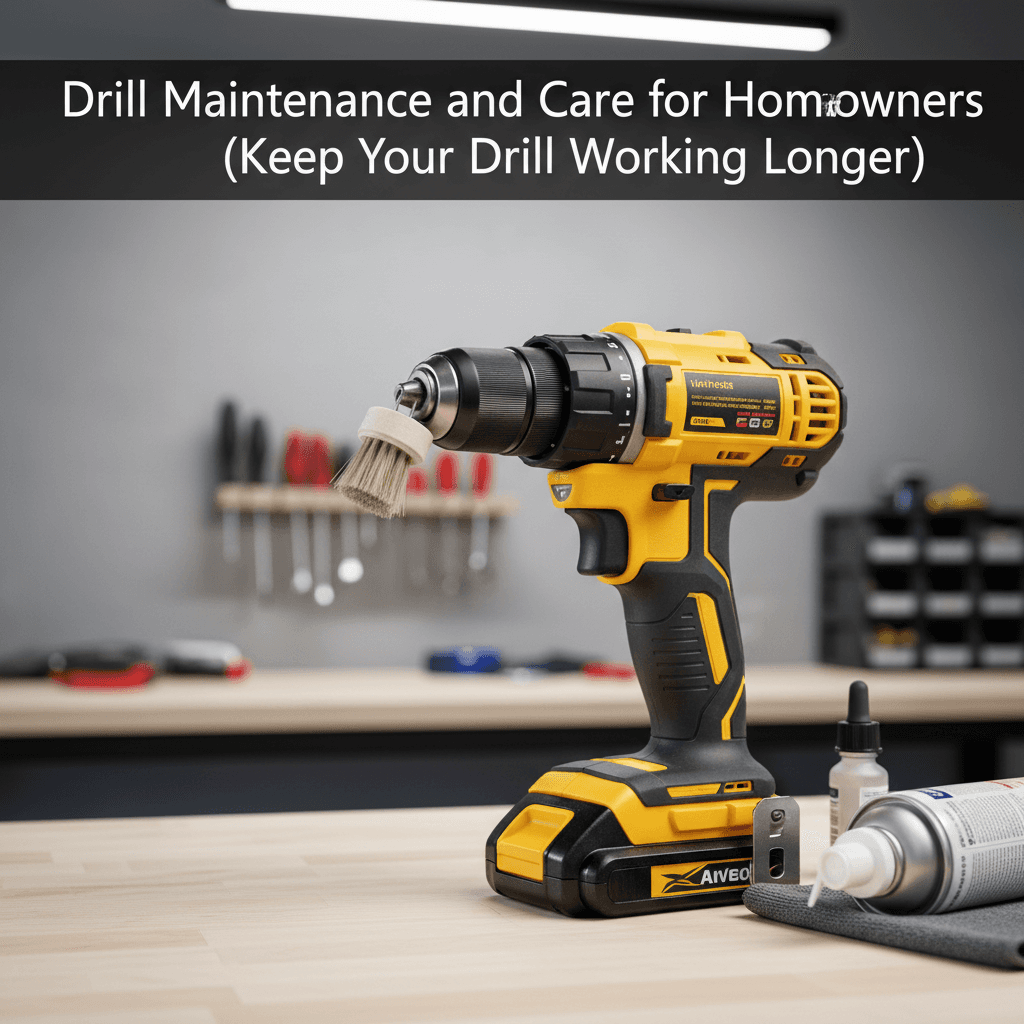
Drill Maintenance and Care for Homeowners (Keep Your Drill Working Longer)
A high-quality drill is an investment, not a disposable commodity. Yet, on jobsites and in residential garages alike, drills are routinely subjected to brutal conditions and zero maintenance. Many homeowners assume that when a drill starts smoking, losing power, or dropping bits, it is simply at the end of its life cycle. In reality, premature tool failure is almost always the result of neglect. Drywall dust, neglected lithium-ion batteries, unlubricated chucks, and dull tooling will destroy a $200 pro-sumer drill just as quickly as a cheap budget model.
This guide breaks down exactly how to maintain your drill to maximize its lifespan, retain peak torque, and prevent catastrophic motor failure.
Overview: What Drill Maintenance Actually Means
Drill maintenance involves servicing three primary zones of the tool: the motor and housing, the chuck mechanism, and the power source (typically a lithium-ion battery). Each of these components is vulnerable to different environmental hazards.
The motor requires clean airflow to prevent overheating. The chuck, which is full of precision-machined mechanical jaws and springs, requires a dust-free, lubricated environment to grip bits securely. Batteries require thermal management and proper charging cycles to prevent cell degradation. A properly maintained drill will deliver its maximum rated RPM and torque consistently, whereas a neglected drill will suffer from voltage drop, overheating, and mechanical slipping.
When to Maintain Your Drill
Do not wait for your drill to sound like a grinding garbage disposal before you service it. Adopt a routine maintenance schedule based on usage frequency.
- After Every Use: Wipe down the exterior housing with a dry or slightly damp cloth. Remove the battery before storing the tool.
- After Heavy Dust Exposure: If you have been drilling into drywall, masonry, or MDF, blow out the motor vents using an air compressor set to 30-40 PSI. Do this while the drill is running unloaded to cycle the debris out of the internal fan.
- Monthly (or Every 10-15 Hours of Use): Inspect the chuck for grit. Fully open and close the jaws to ensure smooth operation. Apply a dry lubricant if the mechanism feels stiff.
- Annually: If you own a brushed drill, inspect the carbon brushes for wear. Check all exterior Torx or Phillips screws on the drill housing and tighten them, as heavy vibration causes them to back out over time.
Key Differences: Maintenance Based on Drill Type
Not all drills require the exact same care routine. Understanding the internal mechanics of your specific model dictates how you should maintain it.
Brushed vs. Brushless Motors
Traditional brushed motors use spring-loaded carbon blocks (brushes) that physically rub against the motor's commutator to transfer electricity. This friction generates high heat and slowly wears the brushes down. If a brush wears out completely, the metal spring will gouge the commutator, destroying the tool. If your brushed drill is sparking excessively or losing power, unscrew the rear housing caps, pull the brushes out, and measure them. If they are shorter than 1/4 inch, replace them immediately.
Brushless motors, found in premium lines like DeWalt 20V XR or Milwaukee M18 Fuel, use electronic circuit boards to coordinate power delivery via electromagnets. Because there is no physical friction, there are no brushes to replace. However, the internal electronics are highly sensitive to metallic dust. Blowing out a brushless motor with compressed air is non-negotiable if you work around metal shavings.
Corded vs. Cordless Maintenance
When choosing between cordless and corded models, users often forget that corded drills require cable maintenance. Always inspect the power cord for fraying, especially near the strain relief at the base of the handle. Never carry or unplug a corded drill by pulling the cable. For cordless drills, maintenance is entirely battery-centric. Lithium-ion batteries degrade rapidly if left in freezing garages or baking in a hot truck bed.
Pro Tips for Extending Drill Lifespan
Contractors keep their tools running for years under extreme abuse by following a few strict operational rules.
- Use Dry PTFE Lubricant on the Chuck: Never use a wet lubricant on your drill chuck. Wet oils attract sawdust and drywall dust, turning the lubricant into a grinding paste that will strip the chuck jaws. Instead, open the jaws fully, spray a dry Teflon (PTFE) lubricant or graphite powder inside, open and close the chuck three times, and wipe away the excess.
- Keep Your Bits Sharp: Forcing a dull drill bit through wood or steel forces the motor to draw excess amperage. This creates intense heat, which melts the resin coating on the motor windings. Ensuring you use sharp, high-quality bits reduces the mechanical load. For more insight on this, read our guide on preventing drill bits from burning or breaking.
- Manage Battery Storage States: Lithium-ion batteries hate being stored at 100% capacity or 0% capacity for long periods. If you are putting your drill away for the winter, store the batteries indoors at room temperature with a 40% to 50% charge (usually 2 bars on the battery indicator).
Common Drill Maintenance Mistakes Homeowners Make
Avoid these catastrophic errors that routinely send drills to the scrapyard.
Mistake 1: Using the drill as a hammer. Do not use the back of your drill housing to tap wall anchors into drywall. The internal plastic fan blades and the magnetic stator are fragile. Impact shocks will shatter the fan or misalign the motor casing.
Mistake 2: Ignoring the gear selector switch. Most modern drills have a 2-speed or 3-speed gearbox. Setting 1 is for high torque and low speed (driving heavy lags or drilling large holes). Setting 2 is for high speed and low torque (drilling small pilot holes). Driving heavy screws in speed 2 forces the motor to stall and burn out. This is one of the most destructive errors average users commit.
Mistake 3: Blocking the air vents. When pushing hard into a piece of material, many users naturally wrap their hands around the back of the motor housing, covering the ventilation slots. This immediately chokes the motor of cooling air. Always hold the drill by the ergonomic pistol grip.
Buying Advice: Investing in Maintainable Tools
If you are in the market for a new drill, look for features that make long-term maintenance easier and extend the baseline durability of the tool.
First, opt for a drill with a metal ratcheting chuck rather than a plastic one. Plastic chuck sleeves crack when dropped and warp under high heat, whereas heavy-duty all-metal chucks (like those manufactured by Röhm for premium tool brands) can be easily cleaned and lubricated for decades. Knowing your tooling requirements and understanding drill chuck capacities (usually 3/8-inch or 1/2-inch) will help you select a robust front end.
Second, if your budget allows, step up to a brushless motor. The initial cost is $30 to $50 higher, but you eliminate the need for carbon brush replacements and gain a motor that runs significantly cooler. Finally, look for drills with encapsulated or conformal-coated electronic boards. These coatings protect the vital brain of the drill from moisture, humidity, and conductive dust.
Conclusion
Your drill is the hardest working tool in your home arsenal. By taking five minutes after a project to blow out the dust, lubricate the metal chuck jaws with dry PTFE spray, and store the lithium-ion batteries at a comfortable room temperature, you can easily double or triple the tool's lifespan. Stop treating power tools like throwaway items; respect the machinery, keep your bits sharp, and your drill will deliver peak performance for years to come.