How to Attach Wood to Concrete Floor: 4 Methods That Hold

Attaching a wood bottom plate to a concrete slab is one of the most common framing tasks in residential construction — and one of the most consistently done wrong by homeowners. Regular wood screws won’t bite concrete. Construction adhesive alone can’t handle lateral loads from a framed wall. And a standard drill set to rotation-only mode will spin for five minutes without making a usable hole in a 3,000 PSI slab.
In 15 years of residential construction and renovation — basement walls, subfloors, garage slabs — I’ve used the attachment methods in this guide. This guide covers all four, with a comparison table, the exact drill bit sizes for every application, and a complete step-by-step for the most common scenario: a pressure-treated 2x4 bottom plate anchored flat to a concrete floor. Use the Anchor Spec Engine to get the exact anchor type, diameter, embedment depth, and pilot hole size for your specific load.
Quick answer: Tapcon concrete screws are the best choice for most bottom plates and sleepers — removable, no special tools, strong enough for standard framing (400-500 lbs shear). Use split drive anchors or powder-actuated fasteners for permanent, high-volume production framing instead. Always use a hammer drill, and always add a sill gasket moisture barrier under any wood touching concrete.
| Method | Holding | Removable | Tools |
|---|---|---|---|
| Tapcon screws | 400–500 lb shear | Yes | Hammer drill |
| Split drive anchors | High | No | Hammer drill + hammer |
| Powder-actuated | High | No | PAT tool + loads |
| Construction adhesive | Supplement only | No | Caulk gun |
For a 2x4 plate on slab: 1/4″ × 2-3/4″ Tapcon, 5/32″ bit, 16″ spacing. Full sizing chart further down.
Do I need a hammer drill?
Yes. A regular drill will not make a clean hole in cured concrete — it polishes rather than cuts, and burns the bit doing it.
Can I use regular screws?
No. Wood and drywall screws have no concrete thread profile. They spin in the hole or snap under shear load.
Do I really need a sill gasket?
On any wood touching a slab, yes. Concrete wicks moisture upward and will rot untreated lumber from underneath.
Why Concrete-to-Wood Is Different From Every Other Fastening Job
Wood-to-wood fastening works because screws and nails grip fibres — the fastener threads physically interlock with the material. Concrete has no fibres to grip. Instead, mechanical anchors work by expanding against the sides of a drilled hole (wedge and sleeve anchors), cutting threads directly into concrete (Tapcon screws), or compressing concrete around a shank driven at high velocity (powder-actuated fasteners).
Three things every DIYer needs to understand before starting:
- Hole diameter is critical. Unlike wood where slightly oversized holes are forgiving, concrete anchors require the exact pilot hole size specified by the manufacturer. A 1/32" difference can mean the anchor won’t expand properly or won’t engage threads at all.
- Hole cleaning is not optional. Concrete dust in the hole acts like a lubricant and reduces holding strength by 30 to 50 percent. Every hole must be blown clean before setting an anchor.
- A hammer drill is required. A standard drill will overheat and fail trying to drill concrete. Hammer mode uses a percussive action that breaks concrete as it rotates. For holes larger than 1/2" or very hard concrete, an SDS rotary hammer is the professional standard.
The 4 Methods for Attaching Wood to Concrete
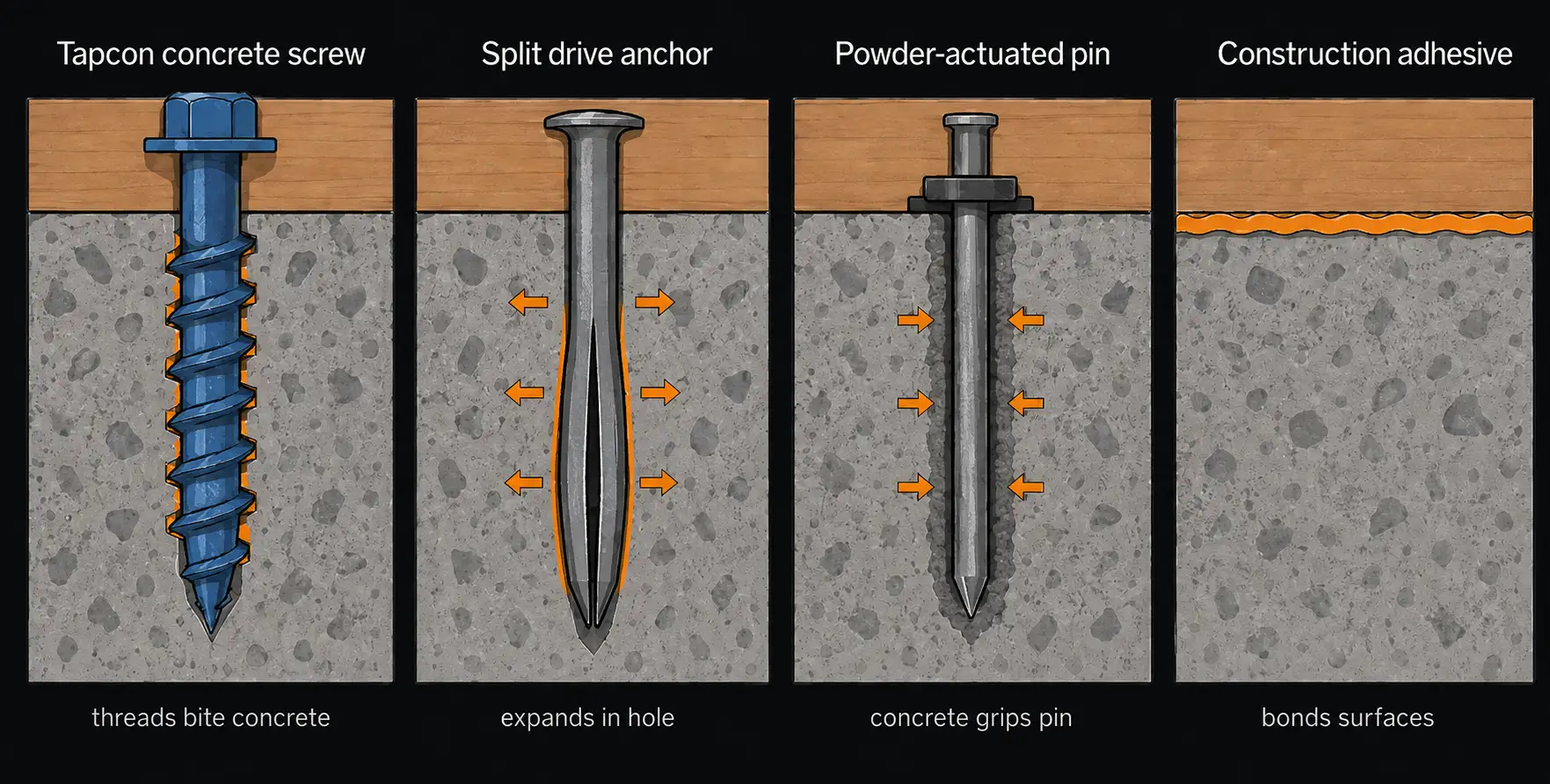
Each method has a specific set of applications where it performs best. Using the wrong method for the situation is the most common source of failures.
| Method | Best For | Strength | Removable | Tools Needed |
|---|---|---|---|---|
| Tapcon concrete screws | Bottom plates, sleepers, furring strips | Medium (400–500 lbs shear) | Yes | Hammer drill, carbide masonry bit |
| Split drive anchors | Permanent bottom plates, sill plates | High (600–800 lbs shear) | No | Hammer drill, carbide bit, hammer |
| Powder-actuated (Ramset) | Production framing, high volume sill plates | High (similar to split drive) | No | Powder-actuated tool, cartridges, pins |
| Construction adhesive | Sleepers, subfloor panels, non-structural | Medium (tension only) | No | Caulk gun only |
Tapcon Concrete Screws
Tapcon is the best choice for most DIYers attaching wood to concrete. They cut their own threads directly into the concrete, require no special setting tools, and — critically — they’re removable if you need to reposition. The 3/16" diameter Tapcon with 1-3/4" embedment handles every standard bottom plate application. The 1/4" diameter is for heavier loads or thicker lumber.
The only catch: the pilot hole must be exactly 5/32" for a 3/16" Tapcon and 3/16" for a 1/4" Tapcon. No substitutions. The hole must also be drilled at least 1/4" deeper than the anchor embedment to give the tip clearance to engage threads properly.
Split Drive Anchors
Split drive anchors are driven through the wood and into a pre-drilled concrete hole with a hammer. The split tip expands as it’s driven, locking the anchor permanently. They’re faster than Tapcon for production work but are not removable — once driven, they stay. Use them when layout is final and you don’t need adjustability.
Powder-Actuated Fasteners (Ramset)
A powder-actuated tool fires a hardened steel pin through wood directly into concrete using a gunpowder cartridge — no pre-drilling required. This is how professional framers work on slab construction because it’s fast: one shot per fastener in seconds. The tool rents for under $30/day at most home improvement stores. The limitation: powder-actuated tools don’t work reliably in very hard concrete above 5,000 PSI and require proper training — they are essentially controlled firearms and must be operated with full awareness of the hazards. Never fire near slab edges or in slabs thinner than 3 inches.
Construction Adhesive
Construction adhesive alone should never be used to attach structural framing to concrete — it provides no lateral load resistance and relies entirely on bond strength that degrades with moisture and temperature cycling. Where adhesive earns its place is as a supplement to mechanical fasteners: a bead of adhesive under a bottom plate before driving Tapcons eliminates squeaking, improves air sealing, and reduces the mechanical fastener count needed. For non-structural applications like subfloor sleepers on grade-level slabs, adhesive plus Tapcons at 16" spacing is a professional standard method. People often ask whether you can simply glue wood to concrete and skip the drilling entirely. For a plate that carries any load, or anything that will be pushed, leaned on, or built upon, the answer is no — glue resists being pulled apart far better than it resists being pushed sideways, and a bonded joint that fails gives no warning first. Glue is genuinely the right answer for one job only: holding something light and non-structural in place where drilling is impossible or would damage the slab.
Which Method Should You Use?
For most homeowners attaching a bottom plate, sleeper, or furring strip to a concrete floor: use 3/16" Tapcon concrete screws at 16" spacing, driven with a hammer drill using a 5/32" carbide masonry bit. This covers basement framing, garage wall framing, subfloor sleepers, and most fixture anchoring situations.
Use split drive anchors when layout is final and you need extra holding strength without a screw head above the wood surface. Use powder-actuated for production framing where you’re setting more than 20 plates. Use adhesive as a supplement — never as the only fastener for any structural application.
Want the exact fastener spec for your plate? The Anchor Spec Engine gives you size, embedment depth, and spacing per ACI 318-19 — free, instant.
Attaching Wood to a Cinder Block Wall Is a Different Job
Everything above assumes a solid poured slab or wall. Concrete masonry unit (CMU) block behaves differently enough that the same fastener gives you a fraction of the strength, and the numbers are not close.
A 3/16" Tapcon carries roughly 600 lbs of ultimate pull-out in 2,000 PSI concrete. The identical screw in medium-weight block carries about 340 lbs, and in lightweight block about 220 lbs. Apply the industry 4:1 safety factor and the safe working load drops from about 150 lbs to 85 lbs, and then to 55 lbs. That is a third of the capacity for the same screw, same bit, same technique.
Three things change when the wall is block rather than a slab:
Full detail on the block-specific options in how to anchor into a cinder block wall.
Step-by-Step: Attaching a 2x4 Bottom Plate to a Concrete Slab
What You’ll Need
- Pressure-treated 2x4 lumber (UC3B or UC4A rating minimum for concrete contact)
- 3/16" Tapcon concrete screws, 2-3/4" length
- 5/32" carbide-tipped masonry bit (Tapcon carbide pilot bit recommended)
- Hammer drill (18V or 20V cordless with hammer mode, or corded)
- Compressed air or bulb blower for hole cleaning
- Sill gasket or closed-cell foam tape for moisture barrier
- Chalk line and tape measure for layout
Step 1: Snap a Layout Line
Mark your wall location on the concrete slab with a chalk line. Measure twice — once the plate is anchored with Tapcons, repositioning means patching and re-drilling in new locations. If you’re framing a basement wall, account for any planned insulation between the framing and the foundation wall before snapping the line — the rigid foam goes on the concrete first, so the plate line moves in by its thickness. Full detail in the basement wall framing guide.
Step 2: Apply a Sill Gasket
Before placing the plate, apply a sill gasket — a strip of closed-cell foam tape — to the bottom of the pressure-treated 2x4. This is a moisture barrier that keeps the wood from wicking ground moisture directly from the slab. It’s also a code requirement in most jurisdictions. Skip this and you’ll be replacing a rotted bottom plate within 5 to 10 years even with pressure-treated lumber.
Step 3: Position the Plate and Mark Hole Locations
Place the plate on the chalk line. Mark fastener locations at 16" on center, starting 2 to 4 inches from each end. Keep fasteners at least 1-3/4" from the edge of the slab to avoid edge blowout in the concrete. Add an intermediate fastener in the middle of any unsupported span over 8 feet.
Step 4: Drill Through Wood Into Concrete
Chuck the 5/32" carbide masonry bit in your hammer drill and engage hammer mode. Drill through the wood and into the concrete to at least 2 inches depth — 1/4" deeper than the 1-3/4" embedment. Use firm, steady pressure and let the hammer action do the work. Pull the bit out every 20 to 30 seconds on deep holes to clear dust and prevent overheating the carbide tip.
Step 5: Clean Every Hole
Remove the plate and blow out every drilled hole with compressed air or a bulb blower. This step is skipped constantly and it is the single most common reason Tapcon anchors strip or fail. Concrete dust in the hole prevents proper thread engagement and reduces holding strength by 30 to 50 percent. Blow out twice per hole — once right after drilling and once before driving the screw.
Step 6: Drive the Tapcons
Replace the plate on the sill gasket, aligning holes with the drilled concrete. Drive each Tapcon with a drill/driver until the head is snug against the wood — not over-tightened. The head should compress the wood slightly but not strip the threads. If a Tapcon strips while driving, stop immediately. A stripped hole cannot be reused with the same size — move to the next size up (1/4") or shift to a new location.
Step 7: Check the Plate Is Flat
Run your hand along the plate after all fasteners are driven. There should be no gap between the plate and the slab. Any rocking or lifting indicates either a high spot in the concrete that needs grinding, or a fastener driven at an angle. Fix this before framing up — a plate that rocks transfers that movement into every stud above it.
Drill Bit Size Chart by Anchor and Application
| Anchor Type | Anchor Size | Pilot Hole Size | Common Application |
|---|---|---|---|
| Tapcon | 3/16" | 5/32" | 2x4 bottom plate, furring strips, light fixtures |
| Tapcon | 1/4" | 3/16" | 2x6 plate, heavy fixtures, ledger boards |
| Split drive anchor | 1/4" | 1/4" | Permanent bottom plates, sill plates |
| Split drive anchor | 3/8" | 3/8" | Heavy structural plates, tall wall framing |
| Sleeve anchor | 1/4" | 1/4" | Thicker wood members, adjustable position |
| Sleeve anchor | 3/8" | 3/8" | Heavy wood members, structural ledgers |
Moisture Barrier and Treated Lumber: Don’t Skip This
Any wood in direct contact with concrete must be pressure-treated and separated from the concrete by a moisture barrier. This is building code in most jurisdictions and a practical requirement everywhere.
Concrete is porous and wicks moisture continuously. An untreated 2x4 sitting directly on a concrete slab will begin showing rot and mold within 2 to 3 years in most climates — even in a heated, conditioned basement. Pressure-treated lumber rated UC3B (above-grade contact) or UC4A (ground and concrete contact) resists this moisture exposure. Check the tag stapled to the end of every board before buying — not all pressure-treated lumber is rated for concrete contact.
The sill gasket — a thin strip of closed-cell foam installed between the plate and the concrete — does two jobs: it acts as a capillary break preventing direct moisture transmission into the wood end grain, and it seals the air gap between plate and slab that would otherwise allow cold air infiltration in winter. In cold climates like Quebec and Ontario, that air seal has a meaningful impact on comfort and energy efficiency in finished basements.
Pro Tips From the Field
Common Mistakes When Attaching Wood to Concrete
Frequently Asked Questions
Can I use regular screws to attach wood to concrete?
Do I need a hammer drill to attach wood to concrete?
What size Tapcon do I need for a 2x4 bottom plate?
Should I use construction adhesive as well as Tapcons?
How far apart should Tapcons be spaced on a bottom plate?
Can I attach wood to concrete without drilling?
Related Guides and Tools
- Anchor Spec Engine — get the exact anchor type, size, embedment depth, and bit size for your project
- Drill Bit Selector — find the right masonry bit for your anchor and drill type
- AI Foreman — get a complete framing or concrete project plan
- Drill Bit Size for Anchors: Complete Chart
- Masonry Anchors Explained: Types, Uses, and Load Ratings
- How to Install a Ledger Board on Concrete
- How Thick Should a Concrete Slab Be? Complete Guide by Application (2026)
- How to Drill Into Concrete Safely Without Cracking It (Step-by-Step Guide)
Free Tool · Built on ACI 318-19
Get exact anchor specs for your project
Answer 6 questions and get the exact anchor type, diameter, embedment depth, pilot hole size, and torque value — calculated to ACI 318-19.
Try the Anchor Spec Engine →
Thomas Leroy
Founder of BuildToolHQ, drawing on years of hands-on building, fabrication, and technical work, plus deep product and manufacturer research. Every guide is built on real documentation and real product research — not recycled advice — so tradespeople and serious DIYers get the same technical knowledge professionals use every day.
More about Thomas