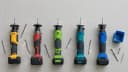
Best SDS-Plus Rotary Hammers 2026: 4 Brands Tested

Quick answer: For most buyers, the right SDS-Plus rotary hammer is whichever one matches your existing battery platform — Bosch, DeWalt, Milwaukee, and Metabo HPT all perform within a comparable class (2.0–2.6 joules of impact energy), and all four are rated for the same 1" maximum hole diameter, so your existing battery platform usually matters more than the spread between them. The one genuine exception is Makita's XRH06ZB, a different, lighter-duty tool built for overhead work rather than general drilling.
| Pick | Impact Energy | Best For |
|---|---|---|
| Bosch GBH18V-26DN | 2.6 J | Starting fresh, no existing battery platform |
| DeWalt DCH273B | 2.1 J | DeWalt 20V MAX users, best value entry point |
| Milwaukee 2912-20 | 2.0 J | M18 users, largest cordless ecosystem |
| Makita XRH06ZB | 0.9 J | Overhead work, high-volume small anchors, half the weight |
| Metabo HPT DH18DBLQ4 | 2.6 J | MultiVolt platform users, competitive alternative |
Which Job, Which Hammer
| Job | Best Pick |
|---|---|
| Standard 1/2"-3/4" anchor work, full-day use | Bosch, DeWalt, or Milwaukee |
| Overhead work, high-volume small anchors | Makita XRH06ZB |
| Regular contact with rebar | Any pick + Diablo rebar-rated bit |
| Already on a specific battery platform | Stay on it — the gap is small |
| Holes larger than 1" diameter, core drilling | None of these — need SDS-Max instead |
See the mechanism diagram and full comparison: jump down ↓
✓ Impact energy figures verified directly against manufacturer specifications and independent buying-guide data.
What's your main job?
I've run every one of these five rotary hammers on real jobs over the years — anchor installs, ledger bolts, conduit mounting. This rotary hammer comparison focuses specifically on cordless SDS-Plus models, the right choice for standard concrete and masonry drilling; if you need SDS-Max for heavy demolition or large-diameter core work, that's a genuinely different tool (SDS-Plus vs. SDS-Max, explained below). Real rotary hammer reviews should tell you which one to buy for your actual job, not just which one wins on a spec sheet — here's what actually separates these five once you've put real hours on them.
SDS-Plus vs SDS-Max: Which Do You Need?
Before buying, confirm which format fits your work:
| SDS-Plus | SDS-Max | |
|---|---|---|
| Shank | 10mm | 18mm |
| Hole range | 1/4"–1-1/8" | 1"+ |
| Weight class | Lighter, one-handed | Heavier, two-handed |
| Best for | Anchor installation, most contractors | Core drilling, large-diameter anchors, demolition |
All 5 picks below are SDS-Plus — the right format for nearly all anchor and concrete work. See our SDS-Max Rotary Hammer guide for larger-diameter and demolition work.
Stroke mechanism per manufacturer technical documentation.
What to Look For in a Rotary Hammer
Impact energy, not voltage, is the number that matters. For SDS-Plus, 1.7–2.6 J (Bosch and Metabo HPT publish the same figure in ft-lbs — multiply by 1.356 to compare: 1.9 ft-lbs is 2.6 J, not 1.9) covers anchor holes up to 1" for most standard work; past 1" diameter you're in SDS-Max territory. BPM (blows per minute) multiplied by impact energy determines real drilling speed — a high-BPM, low-joule tool feels fast but stalls in hard aggregate.
Weight matters more than specs for overhead work. Anything over 7 lbs becomes genuinely tiring drilling ceiling anchors all day — this is exactly why Makita's sub-compact XRH06ZB exists as a deliberate tradeoff rather than a lesser tool. Vibration control (Bosch's system, DeWalt's SHOCKS, Milwaukee's AVS) is worth paying for if you drill more than a few holes a week; hand fatigue is cumulative. And stay on your battery platform — the performance gap between these brands is smaller than the cost of starting a second battery ecosystem.
Real Specs Compared
| Model | Impact Energy | Weight | Best For |
|---|---|---|---|
| Bosch GBH18V-26DN | 2.6 J | 5.8 lbs | Best overall, starting fresh |
| DeWalt DCH273B | 2.1 J | 6.8 lbs | DeWalt 20V MAX users |
| Milwaukee 2912-20 | 2.0 J | 6.8 lbs | M18 ecosystem, largest cordless platform |
| Makita XRH06ZB | 0.9 J | 3.3 lbs | Overhead work, light anchors only |
| Metabo HPT DH18DBLQ4 | 2.6 J | Not disclosed | MultiVolt platform, competitive alternative |
Impact energy and weight figures verified directly against dewalt.com, milwaukeetool.com, boschtools.com, makitatools.com, and Metabo HPT's own listings. Note Makita's XRH06ZB is a genuinely different class of tool — less than half the impact energy of the other four, in exchange for roughly half the weight.
Recommended Hammers
All five are genuine SDS-Plus tools, matched for a fair comparison — stay on your existing battery ecosystem if you have one, since the performance gap between the big four is smaller than the cost of starting a second platform.
Bosch GBH18V-26DN — Best for Starting Fresh
The benchmark SDS-Plus rotary hammer for professional use. At 2.6 J of impact energy (published as 1.9 ft-lbs EPTA), it handles anchor holes up to 1" efficiently, and the three-mode operation (drill, hammer-drill, chisel) covers all standard concrete work. Bosch's 18V ProCORE battery ecosystem is one of the strongest in the industry — fast charging, long runtime, compatible across the entire Bosch professional line. If you're starting fresh without an existing battery platform, this is the default pick.
DeWalt DCH273B — Best for DeWalt Users
At 2.1 joules the DCH273B sits just below the Bosch, which publishes 1.9 ft-lb — 2.6 joules once converted — at a comparable weight. It accepts the same 20V MAX batteries as your drill, impact driver, and circular saw, eliminating the need for a separate charger and battery set. Active vibration control (SHOCKS) matches the Bosch's feature set, and it's OSHA Table 1 compliant when paired with the DWH303DH onboard dust extractor.
Milwaukee 2912-20 — Best for Milwaukee Users
Milwaukee's M18 FUEL SDS-Plus rotary hammer delivers 2.0 J of impact energy — the lowest of the four standard-duty picks, though the gap to the 2.6 J Bosch is small in practice and adds the POWERSTATE brushless motor and REDLINK PLUS intelligence Milwaukee users expect. Sold as a bare tool — use your existing M18 batteries. Milwaukee's M18 ecosystem is the largest cordless platform available, a real consideration if you're already invested in it.

Overhead, light-duty work (left) versus standard-duty ground-level drilling (right) — the real distinction that actually separates Makita's XRH06ZB from the other four hammers in this comparison.
Makita XRH06ZB — Lightest Option (Different Class)
Worth understanding clearly before buying: the XRH06ZB isn't a lighter version of the same tool as the other three — it's a genuinely different class. At 0.9 joules, it delivers less than half the impact energy of the Bosch, DeWalt, or Milwaukee, in exchange for a 3.3 lb sub-compact body, roughly half the weight of the others. That tradeoff is the whole point: for high-volume overhead anchor work or repetitive small-anchor placement where every ounce matters over a full day, the weight savings are real money in reduced fatigue. It is not the right tool for 3/4" holes in reinforced concrete — that's what the DCH273B or 2912-20 are built for.
Metabo HPT DH18DBLQ4 — Competitive Alternative
Matching the Bosch's 2.6 J impact energy (1.9 ft-lbs EPTA) in the same 18V weight class, the DH18DBLQ4 is a genuine, capable alternative for anyone on Metabo HPT's MultiVolt platform, or comparison-shopping outside the four dominant brands. It drills 1" holes in concrete and 1/2" holes in steel, putting it squarely in the same standard-duty class as the Bosch, DeWalt, and Milwaukee picks above.
Prices and availability change — links go to current Amazon listings. As an Amazon Associate, BuildToolHQ earns from qualifying purchases.
Budget Corded Option
If the five picks above are more tool than your actual use case needs — a handful of anchors a year, not daily jobsite work — a budget corded rotary hammer is worth knowing about. Two real options worth naming: Eneacro's ENRH3201 and Berserker's 32MB, both genuine SDS-Plus tools with real Amazon listings and real reviews, not knockoff junk.
One honest caveat: these brands' stated impact energy figures aren't EPTA-standardized the way Bosch, DeWalt, Milwaukee, and Metabo HPT's numbers are — treat the raw numbers as a rough guide, not a precise apples-to-apples comparison with the premium picks above. Corded tools also deliver power differently than battery-limited cordless tools, which is part of why these numbers can look competitive on paper.
Prices and availability change — links go to current Amazon listings. As an Amazon Associate, BuildToolHQ earns from qualifying purchases.
What SDS Bits Do You Need?
Every SDS rotary hammer requires SDS-Plus bits — standard round-shank masonry bits cannot be used. The most important sizes for anchor installation:
- 5/32" — for 3/16" Tapcon screws
- 3/16" — for 1/4" Tapcon screws
- 3/8" — for 3/8" wedge and sleeve anchors
- 1/2" — for 1/2" wedge and sleeve anchors (most common structural size)
See our complete Concrete Anchor Drill Bit Size Chart for all anchor types and sizes, and our Best Masonry Drill Bits guide for the full technical breakdown on cutter geometry and bit selection.
Rebar-Rated Bit for These Hammers
All five hammers above are rated to 1" SDS-Plus capacity, and four different manufacturers make a genuine 4-cutter, rebar-rated bit to match. Diablo's Rebar Demon claims up to 1,800°F heat tolerance versus roughly 800°F for standard bits, and up to 7x longer life — manufacturer figures, not independently verified, but specific and plausible rather than vague marketing language. Milwaukee's MX4 uses the same 4-cutter architecture confirmed directly from Milwaukee's own product line. Hilti's TE-CX uses an X-shaped gradient-carbide tip engineered specifically to absorb rebar impact. Bosch's HC4C2293 Bulldog Tough claims 2x life versus 2-cutter bits, though real reviews show some batch variance worth knowing about before committing one to a big job.
Prices and availability change — links go to current Amazon listings. As an Amazon Associate, BuildToolHQ earns from qualifying purchases.
Common Mistakes
Want this as a printable reference?
Download the free PDF quick reference — impact energy specs, SDS-Plus vs. SDS-Max, battery platform guide, bit sizing, and rebar-rated bit options, all on one printable sheet.
Download Free PDF ↓Frequently Asked Questions
What is the difference between SDS-Plus and SDS-Max?
SDS-Plus has a 10mm shank with two open and two closed slots — the standard format for most contractors handling holes up to 1-1/8". SDS-Max has an 18mm shank for larger hammers used in commercial construction and core drilling. The shanks are not interchangeable. For most anchor installation and residential concrete work, SDS-Plus is the correct choice.
Can I use SDS bits in a regular hammer drill?
No — SDS bits require an SDS chuck. You can buy an SDS-to-standard chuck adapter, but it absorbs impact energy and significantly reduces performance, since SDS bits are designed to float axially in the chuck to take the full strike. Always use the correct bit format for your tool.
How much does an SDS rotary hammer cost?
Quality cordless SDS-Plus rotary hammers (bare tool, no battery) generally range from $200 to $350. Kits including batteries and charger typically run $250 to $550. For homeowners who drill concrete occasionally, a mid-range cordless SDS hammer in the $200-300 range delivers professional results.
Is a corded or cordless SDS hammer better?
Modern 18V/20V brushless SDS hammers match corded performance for anchor installation and typical concrete drilling. The gap only shows in sustained heavy use — extended core drilling or continuous chiseling where battery depletion becomes a factor. For most users, cordless is the right choice for mobility and convenience.
Why is the Makita XRH06ZB so much less powerful than the others?
It's a deliberate design tradeoff, not a weaker version of the same tool. At 3.3 lbs, it's roughly half the weight of the Bosch, DeWalt, or Milwaukee picks, built specifically for overhead work and high-volume small-anchor placement where weight matters more than raw impact energy. It's genuinely underpowered for larger holes in hard concrete.
Related Guides
- Best SDS-Max Rotary Hammer 2026 — The right tool for larger diameters and core drilling
- Best Masonry Drill Bits (2026 Guide) — Cutter geometry, RPM guide, and bit selection in depth
- Drill Bit Size for Concrete Anchors — Matching bit diameter to anchor type and size
Free Tool · AI-Powered
Plan your whole project in 2 minutes
Tell our AI Foreman what you are building and get a complete tool list, materials shopping list, step-by-step plan, and mistakes to avoid.
Try the AI Foreman →
Thomas Leroy
Founder of BuildToolHQ, drawing on years of hands-on building, fabrication, and technical work, plus deep product and manufacturer research. Every guide is built on real documentation and real product research — not recycled advice — so tradespeople and serious DIYers get the same technical knowledge professionals use every day.
More about Thomas