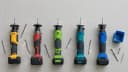
Best SDS-Max Rotary Hammer 2026: DeWalt vs Milwaukee vs Bosch vs Makita

SDS-Max is the format contractors reach for once a job outgrows SDS-Plus — larger anchors, rebar doweling, core drilling, and sustained chipping work. All four cordless options below are matched in the same 1-9/16" chuck class so the comparison is apples-to-apples, with every spec cross-verified against the manufacturer or an independent hands-on test.
Quick answer: if you are buying today, buy corded. Cordless SDS-Max is barely stocked on Amazon — one of the four cordless tools here is delisted and the others are out of stock — and the cordless models cost roughly double. Corded gives you the same chuck, unlimited runtime and no battery to buy.
Full impact energy, weight and vibration figures in the spec comparison below. Specs verified against dewalt.com, boschtools.com, an authorized Milwaukee retailer, and Pro Tool Reviews’ independent hands-on testing.
Author: Thomas Leroy, Construction & Renovation Specialist
Fifteen years of hands-on residential construction and renovation, using most of the power tools on the market across a wide range of brands. New models ship constantly, so we pair that hands-on background with current manufacturer data — cross-checked spec by spec — to compare each tool with as much precision and impartiality as we can.
SDS-Max vs SDS-Plus — Do You Actually Need It?
Move up to SDS-Max if any of these apply to your work:
- Anchor or rebar dowel diameter exceeds 1" — SDS-Plus tops out at 1-1/8" total hole diameter and struggles above roughly 3/4" in dense or reinforced concrete Get that hole wrong — a rebar strike, or dust left in the bottom — and it is one of the main reasons anchors pull out later.
- You’re coring holes larger than 1-1/8" — SDS-Max tools here handle core bits up to 4"+ depending on the model
- You do sustained chipping or light demolition, not just drilling — SDS-Max motors and hammering mechanisms are built for continuous duty cycles that would overheat an SDS-Plus tool
- You’re setting rebar dowels (#5–#9 bar) for structural connections, which need larger, deeper holes than SDS-Plus is rated for
Stay on SDS-Plus if you’re drilling anchors 1/4"–1" for wedge, sleeve, or Tapcon anchors — that covers the vast majority of residential and light-commercial work. See our SDS-Plus rotary hammer guide for that comparison.
Anchor and rebar diameters are typical ranges, not exact for every product — verify your specific anchor spec before drilling.
Real Specs by Brand
| Feature | DeWalt DCH481 | Milwaukee 2717-20 | Bosch GBH18V-36CN | Makita XRH07 |
|---|---|---|---|---|
| Chuck size | 1-9/16" | 1-9/16" | 1-9/16" | 1-9/16" |
| Impact energy | 6.1 J | ~6.8 J (5 ft-lbs) | 7.0 J (5.2 ft-lbs EPTA) | 11.4 J (8.4 ft-lbs) |
| Battery platform | 60V FLEXVOLT | M18 | 18V CORE18V PROFACTOR | 18V X2 LXT (36V, 2 batteries) |
| Weight (bare tool) | 11.9 lbs (5.4 kg) | 12.15 lbs | 11.3–13.4 lbs (varies by kit) | 16.8 lbs |
Why the Makita reads 11.4 J. Three of these four sit between 6.1 and 7.0 joules. The Makita is nearly double at 11.4 — and also the heaviest at 16.8 lbs against 11.3 to 13.4 for the rest. It hits harder because there is more mass behind the blow. That is an advantage for sustained demolition and a real cost overhead or on a ladder, which is why impact energy on its own never settles the choice.
Sizes verified against manufacturer specifications and independent hands-on testing.
Recommended Tools by Brand
All four are matched in the same 1-9/16" chuck class for a fair comparison — stay on your existing battery ecosystem if you have one.
These three are corded, and all three are in stock on Amazon as of this update. A corded SDS-Max gives you unlimited runtime and costs roughly half what the cordless equivalent does — the tradeoff is the cord.


A caveat on the three unbranded tools. The VEVOR, ENEACRO and Berserker impact-energy figures are manufacturer claims, not EPTA-standardised numbers like the DeWalt and Bosch figures. That is why the $130 tool appears to hit twice as hard as the $500 one — the two numbers were not measured the same way. Treat the claimed figures as a rough guide, not an apples-to-apples comparison. All three are genuine SDS-Max tools, not knockoffs — they just have no dealer network behind them.
Demolition hammers — chipping, not drilling
These two chip and break. They do not drill, so they are not substitutes for the rotary hammers above — but if breaking concrete is the whole job, they do it for less.


Cordless, and what it really costs
Only one cordless SDS-Max is stocked on Amazon — the DeWalt DCH614X2, which costs more than double the corded DeWalt for the same 1-9/16" capacity. The other three below are sold at Home Depot rather than Amazon, so those links earn us nothing; they are here because they are what actually exists. Cordless is worth the premium if you are already on the battery platform and working where a cord will not reach, and hard to justify otherwise.

Need more power than any of these four offer? Hilti’s Nuron TE 60-22 is the professional benchmark this category gets measured against, at a significantly higher price point — worth considering for daily structural anchor and rebar dowel work.
Prices and availability change — links go to current Amazon listings. As an Amazon Associate, BuildToolHQ earns from qualifying purchases.
Vibration Exposure: A Real Difference Between These Four
Manufacturers publish a vibration emission value (ah, measured to EN60745/ISO 28927) for most rotary hammers — and for three of these four, the numbers are public. The gap between them is large enough to matter for anyone running one of these tools through extended chipping or drilling sessions.

Sustained chiseling is where vibration exposure actually adds up — the real reason this section exists.
| Tool | Published Vibration (drilling) |
|---|---|
| DeWalt DCH481 | 9.4 m/s² |
| Milwaukee 2717-20 | 10 m/s² |
| Bosch GBH18V-36CN | 11.4 m/s² (EU spec sheet, equivalent model)* |
| Makita XRH07 | 5 m/s² |
*Bosch does not publish a vibration value on GBH18V-36CN's U.S. product pages. This figure is from Bosch's official EU technical data sheet for the equivalent international model (GBH 18V-36 C, same 7.0J impact energy and weight class), which discloses hammer-drilling vibration under EU regulatory requirements the U.S. listing doesn't require.
The EU/UK Control of Vibration at Work Regulations use an 8-hour energy-equivalent exposure value, A(8): an Exposure Action Value of 2.5 m/s² A(8), where exposure is expected to start being actively managed, and an Exposure Limit Value of 5.0 m/s² A(8), which should not be exceeded. Applying the standard formula — A(8) = ah × √(T/8) — to each tool’s published value gives a rough sense of how much actual trigger time it takes to reach those thresholds:
| Tool | Reaches Action Value (2.5 m/s²) | Reaches Limit Value (5.0 m/s²) |
|---|---|---|
| DeWalt DCH481 | ~34 min | ~2h 16m |
| Milwaukee 2717-20 | ~30 min | ~2h |
| Bosch GBH18V-36CN | ~23 min | ~1h 32m |
| Makita XRH07 | ~2h | ~8h (a full shift) |
These figures use each manufacturer’s own published test data and the EU exposure formula as a reference point, not a literal safety limit for any individual — real jobsite vibration varies with material hardness, bit condition, and technique. The U.S. does not currently set an enforceable OSHA permissible exposure limit for hand-arm vibration the way the EU does; NIOSH publishes exposure guidance rather than a binding standard. Bosch does not publish a vibration figure for the GBH18V-36CN on its U.S. product pages.
Hand-Arm Vibration Syndrome: What the Numbers Don’t Tell You
Two things worth knowing beyond the exposure-time table above. First, HAVS damage is irreversible once it sets in — early symptoms may stabilize if exposure stops promptly, but the underlying nerve and blood-vessel damage does not reverse. That’s the whole argument for prevention over cure.
Second, gloves marketed as “anti-vibration” offer real but limited protection, especially at the low frequencies these tools produce. Even ISO 10819-certified gloves are tested primarily against higher-frequency vibration, and independent user reports on certified gloves are genuinely mixed. There’s also a counter-intuitive risk worth knowing: overly thick, stiff gloves can increase vibration transmission by forcing a tighter grip to maintain control, and a tense grip transmits vibration more efficiently than a relaxed one.
The US has no OSHA-enforced numeric vibration exposure limit — unlike the EU figures above, which are legally binding in the EU/UK. ACGIH publishes a non-binding threshold limit value, and OSHA relies on its General Duty Clause rather than a specific standard.
Wet vs Dry Core Drilling
Core bits for these hammers fall into two types, and they behave differently:
- Carbide-segment core bits run in hammer + rotate mode, the same as a standard SDS bit — they work dry, generate real silica dust, and are the simpler option if you already own the rotary hammer and nothing else.
- Diamond core bits cut by grinding rather than pounding, and need rotation-only mode for a clean cut and reasonable bit life — running one in hammer mode wears it out fast. Every SDS-Plus tool supports rotation-only mode; not every SDS-Max tool does. Confirm the specific model supports it before buying a diamond bit.
For deep holes, reinforced concrete, or repeated use, wet diamond coring is the better method — water cools the bit, controls dust and slurry, and meaningfully extends bit life. It needs a water supply and containment (a water swivel or dam ring), which isn’t always practical. Dry coring skips the water — better for occasional holes, indoor work without water access, or jobs near live electrical wiring — but it generates significant respirable crystalline silica dust. OSHA’s Table 1 (1926.1153) requires effective engineering controls for dry drilling and coring in concrete; in practice that means a HEPA vacuum dust collection system with a shroud around the bit, not just a dust mask. (Dust collection accessories are covered in the OSHA compliance section below.)
Hitting Rebar While Drilling
Drilling into existing concrete, you will eventually hit rebar — it’s less a question of if than when. What happens next depends heavily on the bit.
A standard 2-cutter bit tends to jam or chip when it contacts rebar, stopping the hole and often requiring the bit to be backed out with locking pliers. A 4-cutter bit is built differently: four symmetrical cutting edges share the load as they meet the rebar instead of one edge catching on it, letting the bit shear through cleanly rather than jamming. Full-carbide 4-cutter bits can, in some cases, drill through rebar entirely — though that should be done deliberately, not as a surprise.
The real danger isn’t the rebar itself, it’s what happens if the bit binds: the motor keeps driving rotation while the bit is stuck, and the entire tool body can twist violently in your hands. This is exactly what DeWalt’s anti-rotation system and Bosch’s KickBack Control (both covered in the brand sections below) are built to catch — cutting power the instant they detect the bit binding, before the twist reaches you.
If a bit does jam on rebar: disengage the tool and battery before touching the bit, then work it free with locking pliers rather than forcing the trigger again.
If your work regularly hits rebar, a genuine 4-cutter SDS-Max bit is worth stepping up to regardless of which hammer you buy. Diablo’s Rebar Demon line is purpose-built for it — Dura-Carbide rated to withstand up to 1800°F versus roughly 800°F for standard bits, with up to 7x longer life in rebar-heavy concrete. Milwaukee’s MX4 uses the same 4-cutter architecture the brand markets explicitly for rebar contact. Bosch’s Speed-X 4-cutter bit is manufactured to ANSI B212.14 and is confirmed cross-compatible with Hilti hammers using TE-Y/TE-FY shanks, not just Bosch’s own line. And Hilti’s own TE-YX is the direct match for anyone already on a Hilti-shank tool. None of these four brands are exclusive to the core hammer comparison above — all are genuine, real options worth knowing about specifically for rebar-heavy work.
Prices and availability change — links go to current Amazon listings. As an Amazon Associate, BuildToolHQ earns from qualifying purchases.
OSHA Compliance: Drilling vs. Chipping Have Different Rules
The Table 1 note in the coring section above covers drilling specifically — but SDS-Max tools are dual-mode, and chipping or demolition work falls under a different part of the same regulation with genuinely different requirements.
- Drilling (OSHA 1926.1153 Table 1, item vii): with a shroud and dust collection system meeting the airflow and filter requirements, no respirator is required — regardless of shift length or indoor/outdoor use.
- Chipping and demolition (item x): with a water delivery system, or a shroud and dust collection system, outdoor use under 4 hours needs no respirator — but indoor or enclosed use requires an APF 10 respirator regardless of duration, and outdoor use past 4 hours requires one too.
That means the exact same rotary hammer can be respirator-free in drilling mode and require a respirator the moment you switch to chiseling indoors. Confirm which mode you’ll actually be running before assuming your dust control setup covers you. Milwaukee makes mode-specific dust extraction accessories for exactly this distinction — a drilling attachment (5317-DE) and a separate SDS-Max Chisel Boot (5318-DE) purpose-built for bull point and flat chisels.
DeWalt DCH481
The DCH481 runs on DeWalt’s 60V FLEXVOLT platform, which shares batteries with DeWalt’s larger corded-replacement tools. At 6.1 joules of impact energy in the 1-9/16" class, it’s a straightforward step up for anyone already invested in the FLEXVOLT ecosystem — no separate charger or battery set needed if you already own a FLEXVOLT tool. It also includes an anti-rotation system that cuts power the instant it detects the tool binding or losing control — a real safety feature if the bit ever catches on rebar.
Not currently buyable on Amazon. Home Depot carries the DCH614B instead — same FLEXVOLT 60V platform, but a 1-3/4 in. chuck rather than the DCH481’s 1-9/16 in.
Check the DCH614B at Home Depot →
Milwaukee 2717-20
Part of Milwaukee’s M18 FUEL lineup, the 2717-20 runs on one of the broadest professional cordless ecosystems on the market. At 12.15 lbs bare, it’s in the same light-tool cluster as DeWalt and Bosch — all three sit under 13 lbs, with Makita the clear outlier at 16.8 lbs. Sold as a bare tool, it’s the obvious pick for contractors already carrying M18 batteries for drills, impact drivers, and other jobsite tools. It also runs Milwaukee’s REDLINK PLUS Intelligence, which actively manages tool and battery temperature to prevent overload damage during extended chipping sessions.
Delisted from Amazon. Home Depot carries the same 2717-20 as a bare tool.
Bosch GBH18V-36CN
Part of Bosch’s PROFACTOR line, the GBH18V-36CN pairs BITURBO brushless technology with the CORE18V High Power battery platform to target corded-tool performance from an 18V cordless package. At 11.3–13.4 lbs depending on configuration, it has the best power-to-weight ratio of the four — a real advantage for overhead anchor and dowel work. Bosch’s KickBack Control also cuts power automatically if the bit binds in the hole, reducing the risk of the tool twisting out of your hands.
Not currently buyable on Amazon — unavailable on Amazon.
Makita XRH07
Makita’s entry into cordless SDS-Max is recent — the category itself only gained real cordless options in the past few years. Independent hands-on testing found the XRH07’s Advanced AVT vibration control noticeably better than competing brands, which matters directly for extended drilling or chipping sessions. At 16.8 lbs it’s the heaviest of the four, a real tradeoff for that vibration control. That control comes from a genuinely different mechanism, not just padding — an internal counterbalance uses air pressure to drive counterweight pistons in the opposite direction of the hammering action, actively canceling vibration rather than just absorbing it.
Not currently stocked on Amazon. What Home Depot carries is the GRH05M1, which is Makita’s 40V XGT platform — not the 18V X2 LXT described above. XGT and LXT batteries are not interchangeable, so this is a different system, not a different kit.
SDS-Max Bits & Chisels
None of these hammers do anything without a bit. All four brands make genuine SDS-Max solid drill bits and chisels — here’s a verified option from each, all confirmed real Amazon listings.
Drill Bits
Chisels
Milwaukee’s listing above is a scaling chisel (for surface material removal); the other three are bull point chisels (for general chipping and breaking) — both are genuine chisel types, not directly interchangeable in function.
Prices and availability change — links go to current Amazon listings. As an Amazon Associate, BuildToolHQ earns from qualifying purchases.
Who Should Actually Buy Which
- Already own batteries on one of these platforms? Buy that brand. The performance gap between all four is smaller than the cost of starting a second battery ecosystem — true regardless of which specific tool you're comparing.
- Solo tradesperson carrying tools between jobs? Bosch’s 11.3 lb low-end weight and best power-to-weight ratio matter more than raw impact energy when you’re the one hauling it up a ladder or across a site all day.
- Sustained chipping or demo work across full shifts? Makita’s vibration control is the real differentiator — nearly 4x longer trigger time before reaching the EU exposure limit than DeWalt or Milwaukee, based on published test data.
- Coring is a regular part of the job? Check core bit compatibility and rotation-only mode support before choosing — not every SDS-Max tool handles diamond core bits equally well (see the coring section above).
- Buying your first SDS-Max tool with no existing platform? Buy corded. You are not tied to a battery system yet, cordless SDS-Max is barely stocked and costs roughly double, and a corded tool gives you the same chuck with unlimited runtime. If you are certain you want cordless anyway, Milwaukee’s M18 spans one of the broadest tool ranges of any single platform, which matters if you plan to keep adding to it.
Common Mistakes
Frequently Asked Questions
Do I need SDS-Max or is SDS-Plus enough?
SDS-Plus handles the vast majority of residential and light-commercial anchor work — wedge, sleeve, and Tapcon anchors from 1/4" to 1-1/8". Move up to SDS-Max if you’re setting anchors or rebar dowels over 1", coring holes larger than 1-1/8", or doing sustained chipping and light demolition, which SDS-Plus motors aren’t built for.
What is the difference between SDS-Plus and SDS-Max?
The shanks are a different size and not interchangeable — SDS-Plus uses a 10mm shank and tops out around 1-1/8" bit diameter, while SDS-Max uses an 18mm shank and handles bits up to 2" or larger with a core bit. SDS-Max tools are also built with heavier motors and hammering mechanisms rated for continuous chipping and demolition duty cycles.
Is Milwaukee or DeWalt better for SDS-Max?
Both are close on impact energy in the 1-9/16" class. The real deciding factor is almost always your existing battery platform — the DCH481 runs on DeWalt’s 60V FLEXVOLT system, the 2717-20 on Milwaukee’s M18, which spans one of the broadest tool ranges of any single platform. Buy on whatever platform you already own; the performance gap between the two is smaller than the cost of starting a second battery system.
Can I use SDS-Max bits in an SDS-Plus rotary hammer?
No. SDS-Max bits have an 18mm shank and physically will not fit an SDS-Plus chuck, which is sized for a 10mm shank. The two systems are not interchangeable in either direction — buy bits that match your specific tool.
How much impact energy do I need for core drilling?
Core drilling capacity depends more on the tool’s core-bit rating than raw joules alone — the Makita XRH07 is rated for core bits up to 4-1/8", for example. For holes larger than about 2" in reinforced concrete, check the specific model’s core-bit capacity rather than comparing impact energy figures alone.
Related Guides
- Best SDS-Plus Rotary Hammers 2026 — The right choice for most anchor work
- Hammer Drill vs Rotary Hammer — When to upgrade from a hammer drill
- Drill Bit Size for Concrete Anchors — Right bit for every anchor
- Anchor Specification Engine — Instant anchor sizing built on ACI 318-19
- Best Masonry Drill Bits (2026 Guide) — 2-cutter vs 4-cutter geometry, and which bit for which job
- Best Concrete Cut-Off Saw 2026: DeWalt vs Milwaukee vs Bosch vs Makita
Free Tool · AI-Powered
Plan your whole project in 2 minutes
Tell our AI Foreman what you are building and get a complete tool list, materials shopping list, step-by-step plan, and mistakes to avoid.
Try the AI Foreman →
Thomas Leroy
Founder of BuildToolHQ, drawing on years of hands-on building, fabrication, and technical work, plus deep product and manufacturer research. Every guide is built on real documentation and real product research — not recycled advice — so tradespeople and serious DIYers get the same technical knowledge professionals use every day.
More about Thomas