Best Cordless Cut-Off Tool 2026: DeWalt, Milwaukee, Ryobi & More Compared


Thomas Leroy
Founder of BuildToolHQ, drawing on years of hands-on building, fabrication, and technical work, plus deep product and manufacturer research. Every guide is built on real documentation and real product research — not recycled advice — so tradespeople and serious DIYers get the same technical knowledge professionals use every day.
More about ThomasA cordless cut-off tool is a one-handed, 3-inch-class cutter built for metal, tile, PVC, and tight-space work — it is not a full-size angle grinder, and it is not a replacement for a 9-inch concrete cut-off saw. We checked eight real cordless models against their own manufacturer spec sheets and operator's manuals, not just marketing copy, to find where the real differences in cutting depth, actual RPM, and price actually sit.
Quick answer: A 3-inch cordless cut-off tool is for one-handed cuts in metal, tile, PVC, and tight spaces — not concrete, and not a substitute for a full-size grinder or a 9-inch concrete saw. DeWalt cuts deepest at 0.8", well ahead of the rest of the field. Already own batteries on one of these eight platforms? Start there — the performance gap between them is smaller than the cost of a second battery ecosystem.
| Brand | Best If |
|---|---|
| DeWalt DCS438B | Already on 20V MAX, want the deepest single-pass cut of the group |
| Milwaukee 2522-20 | Already on M12, want the lightest bare tool of the group |
| Bosch GWS12V-30N | Already on Bosch 12V, want a tool sold and shipped directly by Amazon |
| Makita XCM01Z | Already on 18V LXT, want tool-less depth adjustment up to 5/8" |
| RIDGID R87547B | Want the lowest price with a Lifetime Service Agreement included |
| Ryobi PSBCS02B | Starting from zero, want the most-reviewed budget-tier pick |
| Craftsman CMCM300B | Already on Craftsman V20, need a straightforward second tool |
| WORX WX801L | Want the lowest price of the eight and don't own any of these platforms yet |
Specs verified against each manufacturer's official product page and operator's manual — not marketing copy alone. Availability checked September 2026; links go to current listings.
What a Cordless Cut-Off Tool Actually Is
A compact cut-off tool is a small, one-handed spinning-wheel cutter — mechanically closer to a miniature angle grinder than a saw. It accepts 3-inch wheels (metal, diamond tile, or carbide abrasive) and is built for jobs where a full-size 4½-inch angle grinder is too big, too heavy, or won't fit: cutting bolts flush, trimming EMT conduit, notching metal studs, scoring tile, or making a clean cut on PVC in a tight space. Every one of the eight tools here runs on an existing battery platform — none of them are sold with a dedicated battery system of their own.
Real Specs by Brand
| Brand | Cut Depth | No-Load Speed | Bare Weight | Platform |
|---|---|---|---|---|
| DeWalt DCS438B | 0.8" | 20,000 RPM | 2.07 lbs | 20V MAX |
| Milwaukee 2522-20 | 0.64" | 20,000 RPM | 1.52 lbs | M12 |
| Bosch GWS12V-30N | Not published | 19,500 RPM | Not published | Bosch 12V |
| Makita XCM01Z | Up to 5/8" with guard | 20,000 RPM | 2.6 lbs (w/ battery) | 18V LXT |
| RIDGID R87547B | 0.64" | 19,000 RPM* | 1.55 lbs | RIDGID 18V |
| Ryobi PSBCS02B | 0.62" | 19,500 RPM* | ~1.5 lbs | RYOBI ONE+ |
| Craftsman CMCM300B | 0.75" | 20,000 RPM | 2.1 lbs | Craftsman V20 |
| WORX WX801L | 0.57" | 19,000 RPM | 2.4 lbs (w/ battery) | WORX Power Share |
Specs verified against manufacturer product pages and operator's manuals where published. Makita and WORX weights include their battery, since neither publishes a separate bare-tool figure; the other six are bare-tool weights — not a fully apples-to-apples comparison, but the real weight you'd hold in each case. *RIDGID and Ryobi's own marketing lists 19,000 and 19,500 RPM respectively, but each brand's own operator's manual specifies a 20,000 RPM rated speed — we've flagged both figures rather than pick one.
The RPM Number That Doesn't Match the Manual
Check the spec sheet on a RIDGID or Ryobi retail listing and you'll see 19,000 RPM and 19,500 RPM. Open either brand's own printed operator's manual and the "rated speed" listed is 20,000 RPM on both — the same figure DeWalt, Makita, and Craftsman advertise up front. It's a small gap, and it doesn't change which tool is faster in practice, but it's a real example of retail marketing copy and the manufacturer's own technical documentation disagreeing on the same tool. If you're comparing RPM numbers across a shopping page, you're not always comparing the number the manufacturer actually engineered to.
RPM isn't the same as cutting power, either. Independent testing from Torque Test Channel on this exact tool class found DeWalt pulling ahead on real measured output despite similar RPM claims across the board, with Milwaukee's compact tool notably behind — a pattern several owners report directly as the tool bogging down or cutting out under sustained load. High RPM on a spec sheet tells you how fast the wheel spins with nothing touching it, not how it behaves cutting through 1/8" steel.
Some links are affiliate links, and BuildToolHQ earns a commission if you buy through them, at no extra cost to you. It does not change what gets recommended. Every product here was checked against its live listing for current rating, price, and availability, and anything discontinued or a poor fit was left out. Where a brand's own marketing and its official spec sheet disagreed, we've noted both rather than pick the more flattering number. As an Amazon Associate, BuildToolHQ earns from qualifying purchases.
Recommended Cordless Cut-Off Tools




DeWalt DCS438B
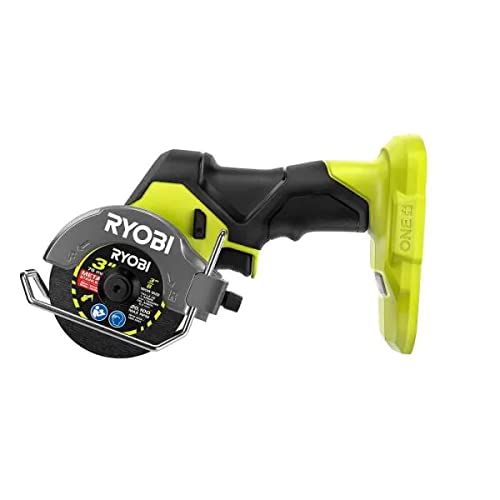
The DCS438B is the deepest-cutting tool of the eight at 0.8" — a real, verified edge that comes down to a design choice most competitors skip: DeWalt offsets the blade spindle from the motor housing rather than mounting it in-line, which physically allows more of the wheel to reach the material. It runs on the 20V MAX platform at 20,000 RPM with a 550 MWO brushless motor, forward/reverse operation, and a spindle lock for quick wheel changes. The dust shroud has a tool-free depth adjustment with an AirLock connection, so it's the only tool here that connects directly to a DeWalt dust extractor without an adapter. It's also Tool Connect chip-ready for asset tracking on a job site that already uses the system.
The tradeoff is weight: at 2.07 lbs bare, it's the heaviest tool in this comparison by a real margin — noticeably more than Milwaukee's 1.52 lbs or RIDGID's 1.55 lbs. For a tool built around one-handed use in tight spaces, that's worth knowing before you buy, not after.
Milwaukee 2522-20
Part of the M12 FUEL lineup, the 2522-20 is the lightest bare tool here at 1.52 lbs, with a reversible blade rotation feature that lets you choose which direction material gets thrown — genuinely useful control that none of the other seven tools offer in quite the same way. REDLINK PLUS intelligence adds overload protection, and it ships with three wheels (metal, diamond tile, carbide abrasive) plus a 7/16" flange adapter that also fits Dremel Saw-Max accessories, extending what you can run on it beyond Milwaukee's own catalog.
One thing worth knowing before you buy: independent horsepower testing on this exact tool class (Torque Test Channel) measured Milwaukee's real cutting power well behind DeWalt and RIDGID despite a similar 20,000 RPM spec, and it's a pattern multiple owners report directly — the tool bogging down or cutting out under sustained load in tougher material. RPM tells you how fast the wheel spins with nothing touching it, not how it behaves cutting steel.
Bosch GWS12V-30N
Bosch doesn't sell a tool under the "cut-off tool" name the way the other seven brands do — the GWS12V-30N is catalogued as a 3" angle grinder, but Bosch's own product copy markets it for exactly this job: quick cuts through threaded rod, strut, conduit, and tile in spaces other tools can't reach. It spins at 19,500 RPM with restart protection, a real safety feature that prevents the tool from firing back up automatically if you swap batteries mid-task without releasing the trigger first, plus overload protection and a spindle-lock design for fast wheel changes.
The honest gap: Bosch doesn't publish a cutting depth or bare-tool weight spec the way the other seven do, so it's the one tool here you can't directly compare on those two numbers. What it does have going for it operationally is that it's sold and shipped by Amazon.com directly, not a third-party seller — true of only two other tools on this list.
Makita XCM01Z
The XCM01Z runs on Makita's 18V LXT platform at 20,000 RPM, and its standout feature is a tool-less dust collection guard that installs without a wrench and allows cuts up to 5/8" deep once fitted — deeper than its own unguarded spec and deeper than most of the field. Star Protection Computer Controls lets the tool and a Star Protection-equipped battery exchange data in real time to guard against overloading, over-discharging, and overheating. An electric brake stops the wheel in under 2 seconds.
Worth knowing plainly: it's the most expensive tool in this comparison, and it also carries the fewest Amazon reviews by a wide margin — 138, against 3,000+ for the DeWalt and Milwaukee picks. That's not a knock on the tool itself, which Makita builds to the same LXT standard as the rest of its line, but it does mean less real-world purchase history to draw on than its closest competitors.
RIDGID R87547B
RIDGID calls this a "Multi-Material Saw," not a cut-off tool, and it's the lowest-priced tool here that still comes from a major brand — backed by RIDGID's Lifetime Service Agreement, free parts and service for life with registration, a warranty structure none of the other seven brands match. It includes three wheels (metal, diamond tile, carbide abrasive), a tool-free rotating guard, and an adjustable wire depth guide for repeatable cuts. One real discrepancy worth flagging: RIDGID's retail listings advertise 19,000 RPM, but RIDGID's own operator's manual states a 20,000 RPM rated speed — the same figure DeWalt and Makita advertise up front.
The honest limitation, echoed by hands-on reviewers: cutting depth (0.64") and the non-standard blade thickness are real constraints for anything beyond light-duty cuts. It's a genuinely good value pick for occasional use, not a replacement for a heavier-duty tool if you're cutting all day.
Ryobi PSBCS02B
The most-reviewed tool in this comparison at 880 ratings, the PSBCS02B runs on the 18V ONE+ platform with dual LEDs that light up both the forward and reverse cutting direction, and a wire base with an adjustable fence for controlling cut depth by feel rather than guesswork. The tool body rotates roughly 15° relative to the cutting head, letting it sit lower or longer depending on the space you're working in — a small feature that shows up repeatedly in hands-on reviews as genuinely useful, not a marketing add-on. Like RIDGID, Ryobi's own operator's manual lists a 20,000 RPM rated speed, a step above the 19,500 RPM the retail listing advertises.
Tool Box Buzz, who has hands-on time with the Milwaukee and RIDGID tools in this same comparison, called the Ryobi as good as both and preferred several of its details outright — a genuinely credible, non-Ryobi-affiliated endorsement for the platform most homeowners are already invested in.
Craftsman CMCM300B
The CMCM300B runs on Craftsman's V20 platform at a claimed 20,000 RPM with a genuinely deep 0.75" cut — second only to DeWalt in this comparison and ahead of both Milwaukee and RIDGID. It has a variable-speed trigger, an electric brake, a spindle lock, and is compatible with Craftsman's VERSATRACK storage system if you're already organized around it.
The one real difference worth naming plainly: every other tool in this comparison changes wheels tool-free, using a spindle lock and a quick-release mechanism. The Craftsman uses a keyed, wrench-required blade change instead — a small but genuine step back in convenience if you're swapping wheels between materials mid-job. It's still a reasonable value if you're already on the V20 platform and don't mind keeping the hex key handy.
WORX WX801L
The WX801L is the least expensive tool in this comparison by a clear margin. It runs on WORX's Power Share battery system, which is genuinely the broadest platform here: the same battery powers over 75 tools spanning WORX's 20V, 40V, and 80V power tool, garden, and lifestyle lines, not just cutting tools. It's also one of only two tools in this comparison explicitly built to accept any standard 3" x 3/8" wheel, not just WORX-branded ones, so wheel sourcing isn't locked to one brand.
The honest tradeoff for the price: at 0.57" it has the shallowest cutting depth of the eight, and its 2.4 lb weight is measured with the battery attached, since WORX doesn't publish a separate bare-tool figure. For light cutting jobs and a first tool on a platform you don't already own, it's a real value; for anything approaching the depth DeWalt or Craftsman can manage, it isn't the right pick.
Which Wheel Do You Need?
The tool is bought once. Wheels are the recurring cost, and fitting the wrong one is how a cut goes badly. Every tool on this page takes a 3-inch wheel with a 3/8" arbor, and several include a 7/16" adapter ring, so the wheel market is open to you whichever brand you bought.
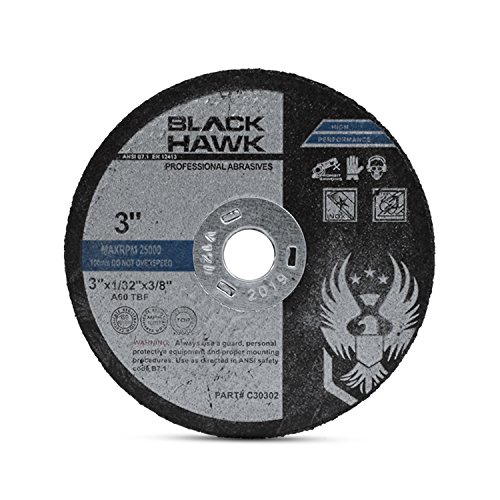


Every wheel here is rated at or above 20,000 RPM, the no-load speed of five of the eight tools on this page. A wheel rated below your tool’s speed is a real failure risk, not a spec quibble.
Compact Cut-Off Tool vs Angle Grinder
These get confused constantly because they're mechanically similar — both spin a wheel at high RPM. The real difference is what each one is actually built to do.
| 3" Cut-Off Tool | 4½" Angle Grinder | |
|---|---|---|
| One-handed use | Built for it | Usually needs two hands |
| Tight-space access | Excellent | Fair — larger guard and body |
| Cutting depth | 0.57–0.8" (3" wheel) | Deeper — larger wheel diameter |
| Grinding, sanding, polishing | No — cutting only | Yes, with the right disc |
| Weight | 1.5–2.6 lbs | Typically 4–6+ lbs |
| Best for | Quick, precise cuts in confined spots | Heavier cutting, grinding, and multi-purpose work |
If you're doing more grinding, deburring, or paint/rust removal than precision cutting, a full-size angle grinder is the right tool — see our cordless angle grinder comparison. If tight-space cutting is genuinely most of the job, the compact tool wins on control and fatigue over a full shift.
Cut-Off Tool vs Die Grinder
A die grinder spins much faster (often 20,000–25,000+ RPM) but uses small rotary bits and mounted points, not 3" wheels — it's built for shaping, deburring, and porting, not straight-line cuts. If your job is cutting a bolt or a piece of conduit cleanly in half, a cut-off tool is the right shape for it; a die grinder isn't built for that cut at all.
Cut-Off Tool vs Oscillating Tool
An oscillating multi-tool moves its blade back and forth a few degrees rather than spinning continuously, which makes it better for plunge cuts into drywall, flush trim cuts against a wall or floor, and delicate work where a spinning wheel would grab or tear the material. A cut-off tool cuts faster in metal and tile but can't plunge-cut or flush-trim the way an oscillating tool can. See our oscillating multi-tool comparison if flush and plunge cuts are the bigger part of your work.
Do You Actually Need a Compact Cut-Off Tool?
This tool earns its place in a bag if you regularly cut bolts, EMT conduit, metal studs, or tile in spots where a 4½-inch grinder is too big to fit — behind cabinets, inside stud bays, under fixtures. If you're grinding welds, removing rust, or shaping metal more than you're making clean straight cuts, a full-size angle grinder is the better first purchase. If you need to cut concrete, brick, or rebar, none of these eight tools are rated for it at any real depth — see our 9-inch cordless concrete cut-off saw guide instead.
Common Mistakes
Pro Tips
Frequently Asked Questions
What can a cordless cut-off tool actually cut?
Metal (bolts, studs, conduit, pipe), tile, PVC, and drywall or cement board, depending on which wheel is mounted. It's not built for concrete, masonry, or thick lumber - those need a different tool class entirely.
How deep can a 3-inch cut-off tool cut?
Between 0.57" and 0.8" depending on the model, verified against each manufacturer's own spec sheet. DeWalt's DCS438B cuts deepest at 0.8"; WORX's WX801L is shallowest at 0.57".
Is a compact cut-off tool the same as an angle grinder?
No. Both spin a wheel at high RPM, but a cut-off tool is built only for cutting with a 3" wheel, while an angle grinder can also grind, sand, and polish depending on the disc, usually with a larger 4-1/2" wheel and more depth.
Which cordless cut-off tool has the highest RPM?
DeWalt, Makita, and Craftsman all publish 20,000 RPM directly. RIDGID and Ryobi advertise 19,000 and 19,500 RPM on their retail listings, but both brands' own operator's manuals list a 20,000 RPM rated speed - the retail copy and the technical manual don't agree on either tool.
Can I use a compact cut-off tool on concrete?
Not at any meaningful depth. These tools top out under 1" of cut, which isn't enough for concrete or masonry work. For that, see a 9-inch cordless concrete cut-off saw instead.
Final Decision
Already own batteries on one of these eight platforms? Buy that brand. The performance differences here are real but smaller than the cost of a second battery and charger.
Starting from zero and want the deepest cut? DeWalt's DCS438B, at 0.8", with the tradeoff of being the heaviest bare tool in the group.
Want the lowest price from a name brand with a real warranty? RIDGID's R87547B, backed by a Lifetime Service Agreement.
Want the cheapest tool here, period, and don't own any of these platforms yet? WORX's WX801L — with the shallowest cut depth as the honest tradeoff.
Need to cut concrete, or need grinding capability too? Neither job belongs to this tool class — see the concrete saw or angle grinder guides below instead.
Related Guides
- Best Cordless Concrete Cut-Off Saw 2026 — For concrete, masonry, and rebar cutting these tools can't handle
- Best Cordless Angle Grinder 2026 — For grinding, sanding, and heavier cutting
- Best Cordless Oscillating Multi-Tool 2026 — For flush and plunge cuts a spinning wheel can't make
Free Tool · AI-Powered
Plan your whole project in 2 minutes
Tell our AI Foreman what you are building and get a complete tool list, materials shopping list, step-by-step plan, and mistakes to avoid.
Try the AI Foreman →