Drywall Cut-Out Tool: Cut Direction, Bits, and Which One to Buy
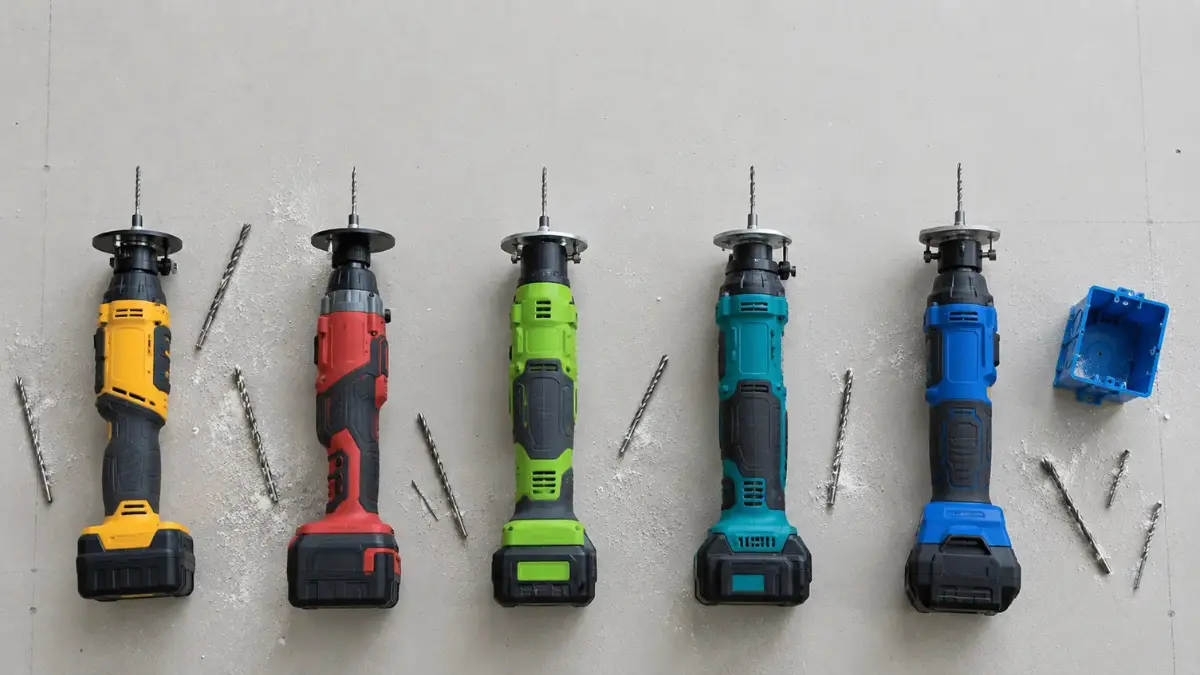
Quick answer: Before the tool, the technique. The bit spins clockwise, so cutting counter-clockwise around the outside of a box makes that rotation pull the tool into the box edge. Cut clockwise and it pushes away and wanders. That one thing separates a clean fifteen-second cut from a repair.
On the tools themselves, the RPM spread is 26,000 to 32,000 — narrow enough that it decides nothing. What does decide it is the collet, which limits which bits you can ever run, and whether you need a dust answer.
| If you want | Tool | Why |
|---|---|---|
| Every bit option open | DeWalt DCE555B | Takes 5/32 in bits; ships fewer collets than the Bosch |
| A published runtime figure | Milwaukee 2627-20 | About 120 outlet boxes on a 3.0Ah pack |
| Double-layer board | Makita XOC02Z | 32,000 RPM, rated for two sheets |
| Working in a finished house | Makita XOC02Z | Only tool with extraction and wireless vacuum start |
| A tool that survives the dust | Bosch GCU18V-30N | IP5X sealed switch, and ships all three collets |
| The lowest price | Ryobi PCL540B | $52.95 with both collets and a bit included |
All five are bare tools. The Bosch is the only one that arrives with all three collets, two bits and a dust hood in the box.
Author: Thomas Leroy, Construction & Renovation Specialist
Fifteen years of hands-on residential construction and renovation, using most of the power tools on the market across a wide range of brands. Most of what goes wrong with a cut-out tool is not the tool — it is cutting in the direction that fights the bit instead of the one that helps it. That is a physics problem with a one-sentence answer, and almost nobody writing about these tools mentions it. Every spec below is from the manufacturer’s own published data, and where a maker does not publish a figure, this page says so instead of borrowing one.
Four Different Tools Answer to This Name
“Drywall cutting tool” is used for at least four things that are not interchangeable. Worth being clear before you buy, because two of them look similar in a listing photo.
| Tool | How it cuts | Use it for |
|---|---|---|
| Rotary cut-out tool | Spinning bit, ~30,000 RPM | Boxes and openings in board already hung. This page. |
| Jab saw | Hand blade, push cut | One or two openings, no power needed |
| Oscillating multi-tool | Blade sweeping through a small arc | Cutting against a finished surface, flush cuts |
| Reciprocating cut-out saw | Short blade, in-out stroke | A different powered tool entirely |
Cut Direction: Why the Tool Wanders
This is the whole thing. If you take one point from this page, take this one.
The bit spins clockwise, seen with the tool base flat against the board. That rotation pushes sideways, and which way it pushes depends entirely on which way you are travelling.
| Cutting | Travel | What the bit does |
|---|---|---|
| Outside of a box | Counter-clockwise | Rotation pulls the tool into the box edge. It hugs the box with almost no pressure from you. |
| Outside of a box | Clockwise | Rotation pushes the tool away from the box. It wanders off across the sheet. |
| Inside cuts — windows, doors | Clockwise | Reversed, for the same reason. The rotation holds the bit against the inside edge. |
Fine Homebuilding put it plainly: counter-clockwise is critical for accurate cuts. A contractor on GreenBuildingAdvisor who cut seventy-five boxes in one go said the most common mistake he saw was moving the tool the wrong way round.
The sequence for an outlet box
| Step | Why |
|---|---|
| 1. Tack the sheet, but not near the box | Screws close to the box put the board under pressure. It blows out as you finish the cut. |
| 2. Mark the box centre on the board | You are plunging blind. |
| 3. Set depth so the flute just penetrates | The smooth pilot tip should project past the cutting edge. Any deeper and you are cutting whatever is behind the box. |
| 4. Plunge in the centre of the box | Not the edge. The centre is the safe hole. |
| 5. Slide sideways to find the edge, then lift slightly to jump over it | You need the pilot on the outside of the box, not inside it. |
| 6. Travel counter-clockwise, pressing lightly toward your centre mark | The rotation does the rest. |
The Five Tools, Compared
How the product picks on this page work. Some links are affiliate links, and BuildToolHQ earns a commission if you buy through them, at no extra cost to you. It does not change what gets recommended. Every product here was checked against its live listing for current rating, price and availability, and anything discontinued or wrong for the job was left out. Where no product genuinely fits, we say so instead of linking something close enough. As an Amazon Associate, BuildToolHQ earns from qualifying purchases. Editorial policy · Full disclosure


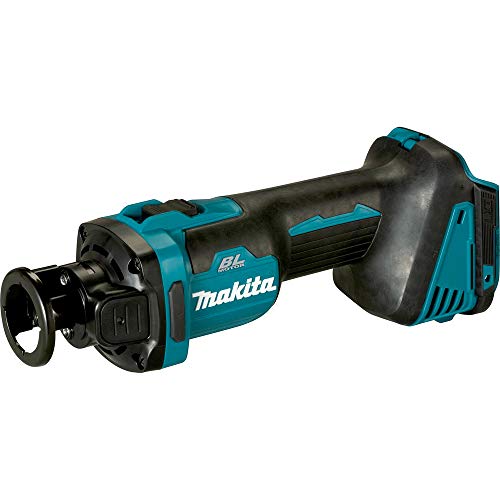

A cut-out tool spins a small bit at around 30,000 RPM and lets you cut an opening through drywall that is already screwed to the wall. Outlet boxes, switch boxes, can lights, HVAC registers — you hang the sheet over the top of them and cut them out afterwards.
Done right, one box takes about fifteen seconds and comes out clean enough that the cover plate hides the edge. Done wrong, the bit wanders off across the sheet, tears the face paper, and leaves the taper a repair. The difference between those two outcomes is mostly one thing, and it is not which tool you bought.
Bits, and the Collet That Limits Them
Bits are the consumable here. They snap, they dull, and a dull one wanders, burns and tears face paper — which is why they sell in packs of eight, sixteen and fifty.
| Type | Shank | Use for |
|---|---|---|
| Guide point | 1/8 in | Boxes, can lights, receptacles. The smooth tip rides the box edge |
| Standard point / zip bit | 1/8 in | Straight cut-outs where there is nothing to trace |
| X-Bit | 5/32 in | Guide point, faster cut, longer life — needs a 5/32 collet |
| Pilot point | 1/4 in | Windows and doors. Bigger, faster, and you burn through fewer of them |
The collet on your tool decides which of those you can ever run. The professional habit is a 1/8 guide point for boxes and a 1/4 for window and door openings — often on two tools, because stopping to swap bits mid-hang is not viable.
| Tool | Collets | Runs 5/32 X-Bit? |
|---|---|---|
| DeWalt DCE555B | 1/8, 5/32, 1/4 in | Yes |
| Milwaukee 2627-20 | 1/8, 1/4 in | No |
| Makita XOC02Z | 1/8, 1/4 in | No |
| Ryobi PCL540B | 1/8, 1/4 in (both in the box) | No |
| Bosch GCU18V-30N | 1/8, 5/32, 1/4 in (all three included) | Yes |
Every figure here is from the manufacturer. Milwaukee’s comes from their own service parts list, which shows exactly two collets — 48-66-0320 and 48-66-0325. Makita state plainly that the XOC02Z accepts 1/8″ and 1/4″ bits, and their parts diagram shows two collet cones. Bosch’s comes from boschtools.com and their 2022 product announcement; their Amazon listing does not mention collets at all, which is why most roundups miss that it ships with all three.
Three bits that cover the job


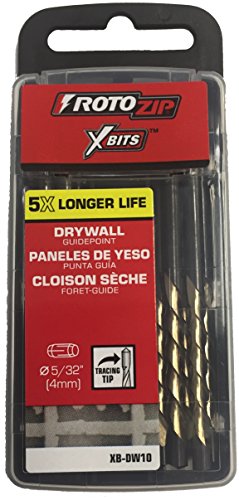
The X-Bit needs a 5/32″ collet, which only the DeWalt and the Bosch have. Worth the arithmetic before you buy it: $1.87 a bit for standard 1/8″ against $4.20 for the 5/32″ X-Bit is a 2.2× premium, against a claimed 5× life. RotoZip’s claim, not a tested figure — but if it holds even halfway it pays.
Which bit fits which tool
| Bit | DeWalt | Milwaukee | Makita | Ryobi | Bosch |
|---|---|---|---|---|---|
| GP8 — 1/8″ | ✓ | ✓ | ✓ | ✓ | ✓ |
| Pilot point — 1/4″ | ✓ | ✓ | ✓ | ✓ | ✓ |
| X-Bit — 5/32″ | ✓ | — | — | — | ✓ |
Every tool here takes 1/8″ and 1/4″. Only the DeWalt and the Bosch have a 5/32″ collet — and only the Bosch includes all three in the box.
Which raises a separate question worth asking before you buy: what actually arrives in the box. Accepting a collet size and supplying one are different things, and the gap is wider here than in most categories.
| Tool | In the box |
|---|---|
| Bosch GCU18V-30N | All three collets, 2 bits, dust hood, wrench, footplate |
| Milwaukee 2627-20 | Both collets, 2 bits, wrench, belt clip |
| Ryobi P225 / PCL540B | Both collets, 1 bit |
| Makita XOC02Z | 1/8″ collet only, 1 bit, wrench — the 1/4″ collet is part 763676-1, sold separately |
| DeWalt DCE555B | Not stated by DeWalt |
The Makita is the one to watch. It ships the fewest accessories of the five, and its dust attachment, circular guide and 1/4″ collet are all separate purchases — so the tool that looks mid-priced is among the dearest to fully equip.
Real Specs by Brand
From each manufacturer’s published data.
| Spec | DeWalt DCE555B | Milwaukee 2627-20 | Ryobi PCL540B | Makita XOC02Z | Bosch GCU18V-30N |
|---|---|---|---|---|---|
| Speed | 26,000 RPM | 28,000 RPM | not published | 32,000 RPM | 30,000 RPM |
| Collets | 1/8, 5/32, 1/4 | 1/8, 1/4 | 1/8, 1/4 | 1/8, 1/4 | 1/8, 5/32, 1/4 |
| Collets included | not stated | Both, + 2 bits | Both, + 1 bit | 1/8 only | All three, + 2 bits + dust hood |
| Motor | Brushless | 4-pole | — | Brushless | Brushless |
| Cut depth | — | 1 in | — | 2 layers of board | — |
| Runtime claim | — | ~120 boxes / 3.0Ah | — | — | — |
| Dust handling | — | Top vent | — | Extraction attachment + AWS | IP5X sealed switch |
| Brake | — | — | — | Electric | Electric |
| Price | $109.99 | $109 | $52.95 | see listing | $119 |
Empty cells are figures the manufacturer does not publish. The RPM spread across the four that do publish is 26,000 to 32,000 — narrow enough that it is not what separates these tools.
Dust Is the Real Problem
A bit spinning at 30,000 RPM through gypsum throws a fine white cloud that goes everywhere and settles on everything. In an occupied house it is the difference between a tidy job and a week of complaints.
Nothing eliminates it. What helps, in order:
- A second person holding a vacuum nozzle at the bit. Crude, and still the most effective thing on this list.
- A dedicated extraction attachment. Makita is the only tool here with one, plus AWS wireless auto-start that spins up a connected vacuum when you pull the trigger. Both sold separately.
- Bosch’s included dust hood, which attaches to a vacuum and comes in the box rather than costing extra. Their IP5X switch rating is a separate thing — about the tool surviving the dust rather than reducing it, and the switch is where these tools usually die.
- Cutting from the centre outward, so the offcut stays supported and does not drop and shatter.
Who Should Buy Which
- You already own a battery platform. Buy that brand’s tool. The spread on this page is genuinely small.
- You want every bit option open. DeWalt, for the 5/32 collet. It is the only one here that runs an X-Bit.
- You are hanging for a living. Milwaukee, for the only published runtime figure in the category — about 120 boxes on a 3.0Ah pack.
- Double-layer or fire-rated assemblies. Makita, rated to cut through two sheets.
- Working in a finished house. Makita again, for the extraction attachment and wireless vacuum start.
- You want everything in one box. Bosch ships all three collets, two bits and a dust hood, and has the IP5X sealed switch for a tool that lives in a dusty van.
- One room, once. Ryobi. Half the price, both collets in the box, and it does the same job.
Common Mistakes
Pro Tips
Related Guides
- Drywall Screw Gun — the other half of hanging board, and why depth control matters
- Drywall Screw Size Chart — length by board thickness, spacing, and ASTM C1002 types
- Best Cordless Oscillating Multi-Tool — the other tool for cutting board already on the wall, and when it is the better choice
- Screw Size Chart — gauge, diameter and pilot holes across every screw type
- Impact Driver vs Drill — the two tools people reach for that are wrong for drywall
Frequently Asked Questions
Which direction should I cut around an electrical box?
Why does my cut-out tool keep wandering off the box?
How deep should the bit be set?
Is the guide point on the bit a safety feature?
What size bits do cut-out tools take?
Can I use a cut-out tool instead of an oscillating multi-tool?
Why did the drywall blow out when I finished the cut?
How do I control the dust?
Free Tool · AI-Powered
Plan your whole project in 2 minutes
Tell our AI Foreman what you are building and get a complete tool list, materials shopping list, step-by-step plan, and mistakes to avoid.
Try the AI Foreman →
Thomas Leroy
Founder of BuildToolHQ, drawing on years of hands-on building, fabrication, and technical work, plus deep product and manufacturer research. Every guide is built on real documentation and real product research — not recycled advice — so tradespeople and serious DIYers get the same technical knowledge professionals use every day.
More about Thomas