Best Cordless Oscillating Multi-Tool 2026: DeWalt, Milwaukee, Bosch, Makita
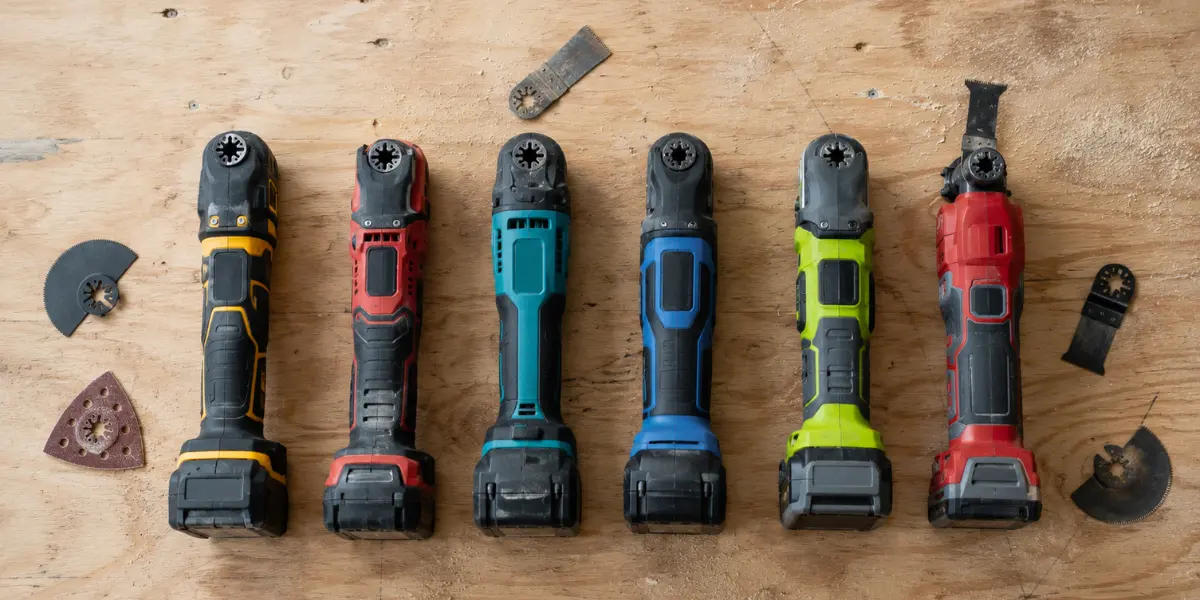
Quick answer: If you already own a battery platform, buy that brand’s tool — the differences below are real but smaller than a spare charger and battery. Starting fresh, the choice comes down to two numbers. Oscillation arc decides how fast it cuts: Milwaukee is widest at 4.2°, Craftsman narrowest at 2.8°. The blade mount decides what every accessory costs you afterwards, and these six use four incompatible systems.
| If you want | Tool | Why |
|---|---|---|
| The fastest cut | Milwaukee 2836-20 | 4.2° arc, widest here |
| Least hand fatigue | Makita XMT04ZB | AVT counterbalance, up to 85% less vibration |
| Speed control on delicate work | DeWalt DCS356B | Three preset speeds plus trigger |
| The fastest blade changes | Bosch GOP18V-34N | Starlock lever, no tool needed |
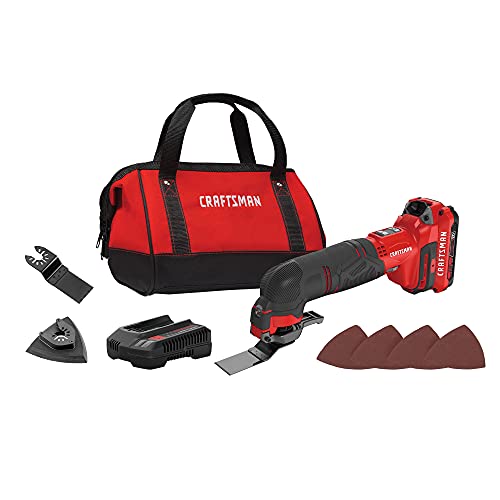
| Everything in one box | Craftsman CMCE501D1 | Battery, charger, blades and bag |
| The lowest price | Ryobi P343 | Cheapest here, takes universal blades |
Five of the six are bare tools. The Craftsman is a kit, so its price is not comparable with the rest — a bare tool plus a battery and charger costs more than that whole box.
Author: Thomas Leroy, Construction & Renovation Specialist
Fifteen years of hands-on residential construction and renovation, using most of the power tools on the market across a wide range of brands. An oscillating multi-tool earns its place on a remodel for one reason: it cuts things already fixed in place, where nothing else fits. Every figure below is taken from the manufacturer’s own published specification, and where a maker does not publish a number — Ryobi does not publish an oscillation angle for any of its tools — this says so instead of borrowing one from a review site. Independent test results are credited to whoever actually ran them.
What an Oscillating Multi-Tool Actually Does
The head does not spin. It sweeps side to side through a few degrees of arc, up to 20,000 times a minute — which is why an oscillating saw cuts nothing like a circular or reciprocating one. Because the blade is barely moving at any instant, you can rest it against a finished surface and cut the thing next to it without the tool wandering — which is the entire reason it exists.
That same property sets its limits. It is not a demolition tool: a reciprocating saw will cut a stud in a fraction of the time. It is not a sander for flat panels either, because the pad is small and the motion is not orbital. Reach for it when access is the problem, not when volume is.
The Blade Mount Is the Real Buying Decision
Every review compares cutting speed. Almost none explains that these six tools use four incompatible blade interfaces, and that the one you pick determines what accessories cost you for as long as you own the tool. Blades are consumables. The tool is bought once.

| Blade mount | Fits | Which of the six |
|---|---|---|
| Universal / OIS | 4 of 6 | Ryobi, Craftsman, DeWalt*, Milwaukee* |
| Starlock | 6 of 6 | All six — adds Bosch and Makita |
| StarlockPlus | 2 of 6 | Bosch, Makita |
| StarlockMax | 1 of 6 | Makita only |
*DeWalt and Milwaukee take OIS blades through an adapter, not natively. Higher Starlock tiers accept lower blades, never the reverse.
| System | Used by | What it means for blades |
|---|---|---|
| OIS / universal | Ryobi, Craftsman | Cheapest and most widely stocked. Bosch’s 2010 open pattern became the default, and it is what generic blades target. |
| Starlock tiers | Bosch, Makita | Tool-free, three duty levels. Higher tools take lower blades, never the reverse. |
| OPEN-LOK | Milwaukee | Milwaukee’s own. Their accessory line, or adapter plates. |
| Quick-Change | DeWalt | Proprietary, but ships with a universal adapter so OIS blades fit out of the box. |
The compatibility rules only run one direction, and that catches people out:
Practically: if you already own a drawer of universal blades, the Ryobi or Craftsman keeps them useful. If you are starting fresh and expect to buy a lot of accessories, the Makita has the widest access of the six. If you buy the Milwaukee, accept that you are on OPEN-LOK or adapters permanently.
The Six Tools, Compared
How the product picks on this page work. Some links are affiliate links, and BuildToolHQ earns a commission if you buy through them, at no extra cost to you. It does not change what gets recommended. Every product here was checked against its live listing for current rating, price and availability, and anything discontinued or wrong for the job was left out. Where no product genuinely fits, we say so instead of linking something close enough. As an Amazon Associate, BuildToolHQ earns from qualifying purchases. Editorial policy · Full disclosure



An oscillating multi-tool is the one you reach for when the cut has to happen where the material already is. Undercutting a door casing so flooring slides beneath it. Opening a rectangle in fitted drywall for an outlet box. Grinding grout out of a joint without touching the tile either side. A saw cannot get in there and a grinder would wreck everything around it.
The six tools below span 2.8° to 4.2° of oscillation arc, four incompatible blade mounts, and a real spread in what they cost to keep fed. The arc figure decides how fast it cuts. The mount decides what every blade costs you for the rest of the tool’s life, and it is the part almost nobody explains before you have already bought.
Oscillation Angle, and Why the Published Numbers Disagree
Arc is the number that decides cutting speed. Wider removes more material per sweep; narrower gives more control and less vibration. The useful range across the whole category is roughly 2° to 5°, so the spread on this page — 2.8° to 4.2° — covers most of it.
There is a measurement trap here. Some makers publish the total sweep and some publish the deflection to one side, which is half the number. Pro Tool Reviews state the convention plainly: 3.6° means 1.8° to either side. DeWalt publishes 1.6° for the DCS356B, which is the one-sided figure — in the same terms as everyone else, it is 3.2°. Most sites republish the 1.6 and make the tool look half as aggressive as it is.
Every figure in this comparison is stated as total arc.
Real Specs by Brand
Every figure below comes from the manufacturer’s own published specification, not a retailer listing or a review roundup. Arc is total sweep throughout.
| Spec | DeWalt | Milwaukee | Makita | Bosch | Ryobi | Craftsman |
|---|---|---|---|---|---|---|
| Oscillation arc | 3.2° | 4.2° | 3.6° | 3.4° | not published | 2.8° |
| Speed (OPM) | 0–20,000 | 10–20,000 | 10–20,000 | 10–20,000 | up to 20,000 | 8–18,000 |
| Speed control | 3-speed + trigger | Dial | Dial + soft start | Dial | Dial + trigger | Dial |
| Weight | 2.33 lb bare | 3.1 lb bare | 3.7 lb w/ batt | 2.6 lb bare | not published | 1.9 lb bare |
| Motor | Brushless | Brushless | Brushless | Brushless | Brushed | Brushed |
| Blade mount | Quick-Change | OPEN-LOK | StarlockMax | StarlockPlus | Universal | Universal |
| Blade change | Tool-free | Wrench on bolt | Tool-free | Tool-free | Hex key | Tool-free |
| Vibration control | — | Dampening | AVT, up to 85% | Up to 80% vs prev gen | — | — |
Ryobi publishes no oscillation angle or bare weight for the P343. Rather than borrow a figure from a review site, those cells are left empty.
DeWalt DCS356B: The One Most People Buy
Fourteen thousand four hundred ratings is not a small lead. The next brushless tool on this page has 780, and that gap says something about how many people walk into this category, look for the safest option, and take it. It is not a bad instinct.
What justifies it in use is the three-speed selector. Most tools here give you a dial and a trigger, which means holding a steady finger position for the length of a cut. The DCS356B lets you set a ceiling first and then use the full trigger travel under it. On grout removal or sanding, where too much speed burns the surface you are trying to save, that is a genuinely better control scheme rather than a spec-sheet feature.
The limit is the arc. At 3.2° total sweep it is the narrowest of the four brushless tools, and against Milwaukee's 4.2° you will feel it on thick stock. Worth being precise here because most of the internet is not: DeWalt publishes 1.6°, which is the deflection to one side. Doubling it gives the figure everyone else quotes. The tool is not half as aggressive as its own spec sheet implies, but it is still the least aggressive brushless option here.
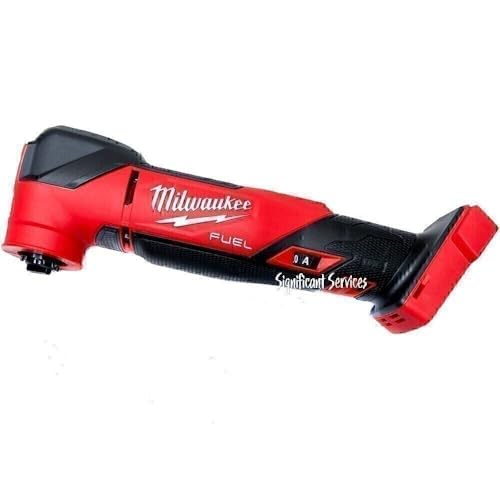
Milwaukee 2836-20: Fastest, With a Catch at the Head
Every head-to-head test I could find puts Milwaukee first on cutting speed, and the 4.2° arc explains it without needing to invoke anything else. A full degree of extra sweep against DeWalt means measurably more material removed per stroke, and on nail-embedded wood or a thick jamb the difference stops being academic.
Auto-Load is the feature worth knowing about. The tool starts gently and ramps to full speed once the blade is actually loaded, which means plunge cuts start where you put them instead of skating across the surface. Combined with the 180-degree LED rather than a single forward spot, it is clearly designed by people who have used one in a dark cabinet.
Then there is the blade bolt. Changing accessories needs a wrench, not a lever, and on a tool whose entire purpose is switching between a plunge blade, a scraper and a sanding pad, that is a tax you pay several times an hour. Pro Tool Reviews are blunt that their team will not use a tool requiring a wrench for accessory changes. If you cut hard and change blades rarely, buy it. If you switch constantly, the fastest-cutting tool here may still be the slowest to work with.
Makita XMT04ZB: The One You Can Use All Day
AVT is not marketing. It is an internal counterbalance - a second mass moving against the oscillating head - and it is a different thing from wrapping a handle in rubber. Makita rate it at up to 85 percent reduction, and Pro Tool Reviews name Makita the current low-vibration leader, a position Fein held for years before this.
The accessory story is the other reason to take it seriously. It accepts StarlockMax, StarlockPlus and Starlock blades - all three tiers - where Bosch's own StarlockPlus tool cannot take StarlockMax accessories at all. If you expect to spend more on blades than you did on the tool, which most people eventually do, that is worth more than a fraction of a degree of arc.
The cost is weight. At 3.7 lb with a battery it is the heaviest tool here, and that pushes against the fatigue argument the moment you are working overhead. Vibration reduction helps a wrist; it does not help a shoulder holding three and a half pounds above head height. For floor-level and bench work the trade is clearly worth it. For ceiling work, less so.
Bosch GOP18V-34N: Lightest Brushless, and It Finished Everything
Bosch and Fein invented the Starlock interface between them, and it shows in the one place you touch most often. The no-touch change is the fastest here - fold the lever, press the blade in, done - and Bosch put it at eight times quicker than their own older OIS system.
The rotated battery is the detail that gives it away as a tool designed by people who do this work. The pack sits turned 90 degrees from where you would expect, which sounds like nothing until you are flush-cutting against a wall and the battery is not the thing stopping you getting closer. At 2.6 lb bare it is also the lightest brushless option, which matters more than the numbers suggest on long overhead runs.
It is not the fast one. At 3.4° it cut slower than the wider-arc tools in testing, and Bosch made a deliberate choice there - the StarlockPlus interface trades some accessory range for a mount that stays rigid. Set against that: in Pro Tool Reviews' round it completed all seven tests, where DeWalt, Hilti and Ryobi did not. A tool that finishes everything asked of it is telling you something different from one that wins a single speed run.
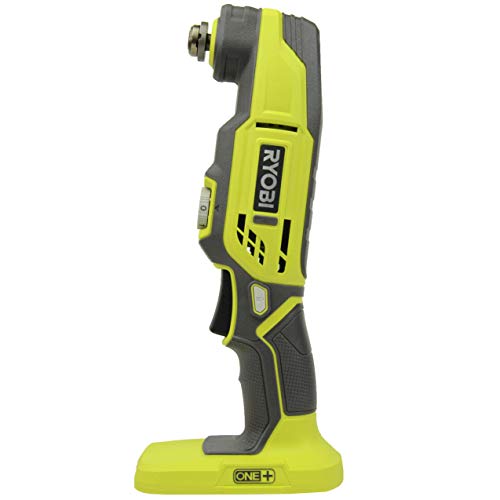
Ryobi P343: Cheapest Way to Own One
Second most-reviewed tool on this page after the DeWalt, which is worth pausing on. A lot of people buy an oscillating tool once, for one job, and never need a second. For that buyer the P343 is a reasonable answer - it takes universal accessories, so blades cost a fraction of Starlock equivalents and every hardware store stocks them.
Two things to know before you buy. Blade changes need the supplied hex key, which is the same objection as the Milwaukee but on a tool costing a third as much, so it stings less. And Ryobi publishes no oscillation angle - not for this tool, not for any of them. Every other maker here states it. That means there is no honest way to place the P343 against the others on the single spec that determines cutting speed, and this page will not invent a figure to fill the gap.
What it does have is the ONE+ platform, which is over 175 tools on one battery. If you are buying your first cordless tool rather than your fifth, that matters more than anything in the spec table.
Craftsman CMCE501D1: Everything in One Box
The only kit here, and that changes the comparison entirely. Every other tool on this page is a bare body - no battery, no charger. If you do not already own a platform, a bare DeWalt plus a battery and charger costs more than this whole box, which comes with a 2.0Ah battery, charger, two blades, a sanding platen, four sheets of paper and a bag.
At 1.9 lb it is also the lightest tool here by a clear margin, and that is not nothing. Overhead work, inside a cabinet, up a ladder - the weight in your hand is often the thing that ends the session, not the battery.
Read the specs before you decide, though, because they are the weakest here on both axes that matter. The 2.8° arc is the narrowest of the six, and it tops out at 18,000 OPM where every other tool reaches 20,000. The motor is brushed. You are buying completeness and low weight, not cutting performance, and it is worth being clear-eyed about which of those you actually need.
Blades: What Fits, and What Actually Cuts
The tool is bought once. Blades are the recurring cost, and two things decide what you can buy: the mount, and the cutting edge.
Mount compatibility
Starlock blades fit Starlock and OIS tools. OIS blades do not fit Starlock tools. The compatibility is one-directional and there is no workaround short of an adapter plate.
On this page: the Bosch GOP18V-34N and Makita XMT04ZB are Starlock. The three universal sets below will not mount on either. The three Starlock sets fit all six tools.
Read compatibility bullets carefully. Listings routinely name Bosch and Makita, then exclude Starlock separately — both true, since those brands also made pre-Starlock tools.
Starlock — fits all six tools


Entry pricing is line-ball with the cheapest universal set. The Starlock premium survives only in high-count variety sets.
Universal / OIS — DeWalt, Milwaukee, Ryobi, Craftsman only
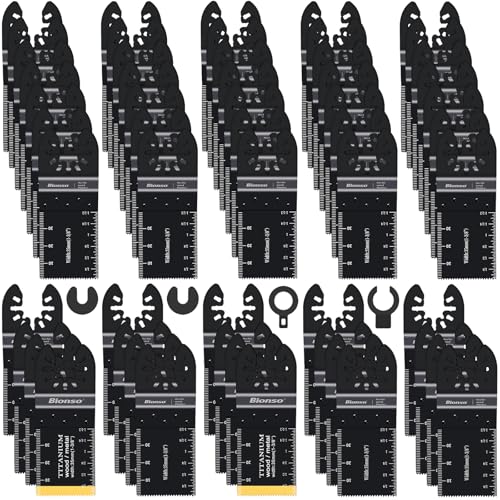


The DeWalt and Milwaukee accept adapter plates, so these mount on four of the six. If you already own universal blades and a Starlock tool, an adapter plate ($8–15) will mount them — it costs rigidity and it is not how the 3D interface was meant to work, but against a drawer of blades you already paid for it is an easy call. Buying a Starlock tool and then adapting every blade you ever own is a different decision.
Cutting edge
| Type | Construction | Use for | Fails on |
|---|---|---|---|
| HCS | High carbon steel, teeth ground in | Softwood, drywall, plastic | Any metal |
| Bi-metal | HSS edge welded to spring steel | Hardwood, occasional nails | Shears teeth on hardened steel |
| Carbide | Teeth brazed on individually | Nail-embedded wood, bolts, screws | Overkill and slower in clean timber |
| Titanium-coated | Nitride layer over HCS or bi-metal | Same as the base blade, slightly longer | Coating does not change the steel |
| Diamond grit | Grit bonded to the edge, no teeth | Grout, tile, cement board, plaster | Wood and metal — it abrades, it does not cut |
Bosch rate carbide at 30x bi-metal life in nail-embedded work. The failure modes differ: carbide dulls, bi-metal shears.
Shape and pitch
- Straight plunge — cuts in from the face. Undercutting, outlet boxes.
- Segmented half-moon — long straight cuts, reaches corners a plunge blade cannot.
- Triangular pad — detail sanding.
- Coarse pitch — clears chips, cuts wood fast, strips instantly on metal.
- Rigid scraper — stiff flat blade for old adhesive, thinset and paint. Push into the joint, let the oscillation break the bond.
- Flexible scraper — thinner and springy, for caulk and sealant beads where a rigid blade would gouge the substrate.
Most variety sets are wood-weighted. Count the metal blades, not the pieces.
A dull blade reads as a weak tool. Oscillating blades abrade rather than bite, so they dull gradually and you compensate without noticing. Change the blade before diagnosing the motor.
What an Oscillating Multi-Tool Is Actually Used For
The spec sheet tells you arc and speed. It does not tell you that this is the only tool that will cut a door jamb off at floor level without lifting the casing, or take a bead of silicone out of a bath surround without scarring the acrylic. These are the jobs people buy one for, and each has a blade that suits it.
| Job | Blade | What to watch |
|---|---|---|
| Undercutting door jambs | Segmented or wide bi-metal | Lay a offcut of the new flooring down as a height guide and cut on top of it |
| Removing grout | Diamond grit segment | Silica dust. Extraction or a mask, and keep the blade moving or it glazes |
| Cutting out old caulk | Flexible scraper | Low speed. High speed melts silicone into a smear instead of lifting it |
| Trimming baseboard in place | Straight plunge, fine pitch | Finish nails. A bi-metal blade survives them; HCS will not |
| Lifting tile and thinset | Rigid scraper, or diamond for the bed | Slow work. A floor scraper or chisel clears area far faster |
| Cutting openings in drywall | HCS plunge | Check for cable and pipe first. The blade will cut both without resistance |
| Detail sanding | Triangular pad | Corners and spindles only. The motion is not orbital and it will not flatten a panel |
Two of these deserve a caveat the listings never give. Grout removal is the job most often shown in marketing photos and it is genuinely slow — a diamond segment clears a joint at a few inches a minute, and a full bathroom floor is an afternoon. Tile and thinset removal is slower still; the tool earns its place on the last few tiles against a wall where nothing else fits, not on the open floor.
Dust extraction matters more here than on most tools. Grout, thinset and plaster all release respirable silica, and the extraction port on these tools connects to a shop vac on every model in this comparison.
Who Should Buy Which
- You already own a battery platform. Buy the bare tool from that brand and stop reading. The differences here are real but smaller than the cost of a second charger and battery.
- You cut hard and often — nail-embedded wood, thick stock. Milwaukee, for the 4.2° arc. Accept the wrench on the blade bolt.
- You use it for long stretches. Makita. The AVT counterbalance is the difference between a twenty-minute job and a twenty-minute job that leaves your hands buzzing.
- You switch accessories constantly. Bosch or DeWalt. Both change blades without a tool, and Bosch’s Starlock lever is the fastest here.
- You are working overhead or in a cabinet. The lightest tools are the Craftsman at 1.9 lb and the DeWalt at 2.33 lb.
- You own no batteries and want one box. The Craftsman kit, understanding it is the slowest tool here on both arc and speed.
- You want it to cost as little as possible. Ryobi, and buy generic universal blades.
Common Mistakes
Pro Tips
Related Guides
- Drywall Cut-Out Tool — faster than an oscillating tool for openings in board already hung, and why they are not the same job
- Reciprocating Saw vs Jigsaw — the two tools people reach for when a multi-tool is the wrong answer
- Impact Driver vs Drill — the other cordless tool most people buy alongside this one, and what each one is actually for
- Best Cordless Brad Nailer 2026 — same four brands compared on trim work
- Best Cordless Ratchet 2026 — the same format applied to automotive work
- Bolt and Wrench Size Chart — SAE against metric, with thread pitch and torque figures
Frequently Asked Questions
Can an oscillating multi-tool replace a reciprocating saw?
What does oscillation angle actually mean?
Will any oscillating blade fit any tool?
Are adapters a good solution for blade compatibility?
Is brushless worth paying for on a multi-tool?
Why does my multi-tool feel like it has lost power?
What blade should I use for wood that might contain nails?
Which oscillating multi-tool has the least vibration?
Free Tool · AI-Powered
Plan your whole project in 2 minutes
Tell our AI Foreman what you are building and get a complete tool list, materials shopping list, step-by-step plan, and mistakes to avoid.
Try the AI Foreman →
Thomas Leroy
Founder of BuildToolHQ, drawing on years of hands-on building, fabrication, and technical work, plus deep product and manufacturer research. Every guide is built on real documentation and real product research — not recycled advice — so tradespeople and serious DIYers get the same technical knowledge professionals use every day.
More about Thomas