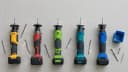
Best Cordless Brad Nailer 2026: DeWalt vs Milwaukee vs Metabo vs Makita

Five cordless 18-gauge brad nailers, every spec checked against the manufacturer rather than the retailer listing. Two of the differences that matter most — how long each one really runs, and what happens when the magazine gets low — are published in ways that make them look comparable when they are not.
Quick answer: All five drive 18-gauge brads and all five offer sequential and bump firing. They split on reach — only DeWalt and Milwaukee take a 2-1/8" brad, the other three stop at 2". Metabo HPT is the only one here with no dry-fire lockout at all, and the only one that arrives with a battery.
| If you want | Tool | Why |
|---|---|---|
| The most proven | DeWalt DCN680B | 3,729 ratings — four times any other tool here |
| No spin-up delay | Milwaukee 2746-20 | Nitrogen air spring fires the instant you pull |
| Lightest, ready to work | Metabo HPT NT1850DFT | 4.4 lb bare, and the only kit with a battery |
| Longest runtime | Makita XNB04Z | 1,700 nails on a 2.0Ah — most on an equal battery |
| Lowest price | Craftsman CMCN618B | Least expensive, but the least documented |
Specs verified against dewalt.com, milwaukeetool.com, metabo-hpt.com, makitatools.com and the Craftsman CMCN618 instruction manual. Runtime figures are normalized to a 2.0Ah battery further down, because no two makers publish them the same way.
What an 18-Gauge Brad Nailer Actually Does
An 18-gauge brad nailer drives thin, small-headed nails for finish carpentry — casing, baseboard, crown, cabinet face frames, shoe molding. The wire is thin enough that the hole disappears under filler and paint, which is the whole point of the gauge.
It is not a structural tool. An 18-gauge brad has very little holding power compared with a 16- or 15-gauge finish nail, and almost none in shear. For anything carrying weight — heavy trim, hardwood flooring, stair parts — you want a heavier gauge or a screw. A brad nailer holds trim in place while glue cures and keeps a reveal tight. That is its job, and it is very good at it.
Cordless changed the category more than any spec on this page. No compressor, no hose dragged through a finished room, no gas cartridge. The trade is weight in your hand and a battery to keep charged.
Dry-Fire Lockout Is Not a Yes or No Spec
Every spec sheet treats dry-fire lockout as a checkbox. It is not. What the feature actually does — and how easily it can be defeated — differs enough between these tools to change which one you should buy, and no manufacturer describes it in a way that lets you compare.
A blank strike is not harmless. The driver blade hits the workpiece with nothing between it and the wood, and on a painted or prefinished surface that is a dent you have to fill and touch up on trim you had already finished.
| Tool | What it actually does |
|---|---|
| DeWalt DCN680B | Low nail lockout — DeWalt’s own wording. Stops the tool before it can strike a blank. |
| Milwaukee 2746-20 | Locks out at empty, but see below — the last few nails are a real gap. |
| Metabo HPT NT1850DFT | None. A yellow window shows when you are low. That is the entire system. |
| Makita XNB04Z | Anti-dry fire mechanism, described by Makita as preventing driving blanks. |
| Craftsman CMCN618B | Not published. No dry-fire feature appears in the CMCN618 manual’s component list or in any Craftsman copy. |
Metabo HPT is the outlier, and it is a deliberate one. Metabo fits dry-fire lockout to plenty of their other nailers — their pin nailer catalog entry lists it explicitly — and left it off this model. Two independent hands-on reviews confirm the tool simply will not stop you. You get a yellow reload window and your own attention. On a tool that is otherwise the lightest and best-value option here, that is the trade being made.
The Runtime Number Everyone Misreads
Nails per charge is the headline runtime spec, and it is close to meaningless as published, because every manufacturer states it on a different battery. Put the marketing figures side by side and the spread looks enormous:
| Tool | Published figure | On which battery |
|---|---|---|
| Makita XNB04Z | 4,250 nails | 5.0Ah |
| Metabo HPT NT1850DFT | 1,300 nails | 2.0Ah (the one in the box) |
| DeWalt DCN680B | 850 nails | 20V MAX 2.0Ah |
| Craftsman CMCN618B | 420 nails | Not stated — Craftsman footnotes it |
| Milwaukee 2746-20 | None published | Milwaukee states no runtime figure |
Two of the five manufacturers will not tell you how long their tool runs. Milwaukee publishes no nails-per-charge figure at all, and Craftsman’s 420 carries a footnote that never names the battery it was measured on. That silence is worth weighing against the three that do publish.
Read that column and Makita looks like it runs five times as long as DeWalt. It does not. Makita publishes a second figure that almost nobody quotes: 1,700 nails on a 2.0Ah battery. Put every tool on the same size battery and the real picture is this:
| Tool | Nails per charge on a 2.0Ah | vs DeWalt |
|---|---|---|
| Makita XNB04Z | 1,700 | 2.0x |
| Metabo HPT NT1850DFT | 1,300 | 1.5x |
| DeWalt DCN680B | 850 | baseline |
| Craftsman CMCN618B | Not comparable | Craftsman never states the battery |
| Milwaukee 2746-20 | None published | No figure on any battery |
Twice the runtime is still a real advantage for the Makita. But it is twice, not five times, and the difference between those two readings is the difference between a fair comparison and a marketing number. Note also what is missing: Milwaukee publishes no nails-per-charge figure at all, and Craftsman’s 420 carries a footnote that never names the battery it was measured on.
Running list of unit traps on this site: Bosch publishes impact energy in ft-lbs where others use joules; DeWalt publishes UWO instead of in-lbs; oscillating tool angle is quoted one-sided by some makers and as total sweep by others. Same pattern every time — check the basis before you compare the number.
The Five Tools
Ordered by platform and role rather than by rank. Prices and availability move; every tool below had a live, in-stock, new-condition listing when this page was last checked.


Real Specs by Brand
Manufacturer figures only. Empty cells mean the manufacturer does not publish that number — not that it was hard to find.
| Tool | Nail range | Magazine | Weight | Dry-fire | Motor | Firing modes |
|---|---|---|---|---|---|---|
| DeWalt DCN680B | 5/8"–2-1/8" | 110 nails | 5.3 lb (bare tool) | Yes | Brushless | Sequential + contact |
| Milwaukee 2746-20 | 5/8"–2-1/8" | 110 nails | 5.35 lb (bare tool) | Yes | Brushless (POWERSTATE) | Sequential + contact |
| Metabo HPT NT1850DFT | 5/8"–2" | 100 nails | 4.4 lb (bare tool) | No | Brushless | Sequential + bump (selective actuation) |
| Makita XNB04Z | 9/16"–2" | 110 nails | 6.1 lb (WITH battery) | Yes | Brushless | Sequential + bump (2-mode selector) |
| Craftsman CMCN618B | 5/8"–2" | Not published | Not published by Craftsman | Not published by Craftsman | Not stated — never called brushless | Sequential + contact |
Makita states 6.1 lb with a battery, which is how that platform lists net weight; DeWalt, Milwaukee and Metabo HPT figures are bare tool. Craftsman publishes no weight, no motor type and no dry-fire specification for the CMCN618B. That is not a gap in this research — it was checked against Craftsman’s own product pages, the CMCN618 instruction manual and five retailers. Craftsman markets brushless motors on other V20 tools and does not here, which is worth weighing on a tool bought partly on price.
DeWalt DCN680Bview on Amazon →
The DCN680B is the one most people already own, and 3,729 ratings against the next-highest 885 is not a small gap. That matters more than it sounds: a tool with this much field history has no undiscovered failure modes left.
It drives 5/8" to 2-1/8" brads through a brushless motor spinning a flywheel, and that mechanism is the tool’s one real character trait. The flywheel has to reach speed before the blade fires, so there is a short delay between pulling the trigger and the nail landing. It is slight, and most people stop noticing within an hour. Next to the Milwaukee’s nitrogen spring it is unmistakable.
DeWalt publishes 850 nails per charge on a 2.0Ah battery, the lowest real figure here on a stated basis. Set against that: low nail lockout in DeWalt’s own words, a micro nose that genuinely helps placement, and the deepest accessory and service network of any platform on this page.
Milwaukee 2746-20view on Amazon →
The 2746-20 uses a sealed nitrogen air spring recompressed by a POWERSTATE brushless motor, and the practical result is that it fires the instant you pull. No spin-up, no wait. Running casing or shoe molding at pace, that difference is the most noticeable thing about this tool.
It is also the most expensive here and Milwaukee publishes no runtime figure at all, which is a strange omission on a flagship tool. What they do publish is a 110-nail magazine, a 5/8" to 2-1/8" range, and three interchangeable no-mar tips in the box.
The dry-fire behaviour covered above is the honest caveat. It locks out at empty, but the partial lock at roughly five nails is defeatable with a firm push, and past that point you are firing blanks into finished trim. Watch the magazine on the last few and it is a non-issue. Do not, and it will cost you a filler-and-touch-up cycle.
Metabo HPT NT1850DFTview on Amazon →
At 4.4 lb bare the NT1850DFT is close to a pound lighter than the DeWalt and Milwaukee, and roughly a pound and a half under the Makita once you account for Makita quoting weight with a battery fitted. Overhead, on ladders, or through a long day of crown, that is the spec you feel.
It is also the only tool here that arrives ready to work — 2.0Ah battery, charger and bag in the box — while every other pick on this page is a bare tool. Compared like for like against a bare tool plus a battery and charger, the gap is wider than the sticker price suggests. The air spring drive gives it the same zero ramp-up feel as the Milwaukee, and it is backed by a lifetime tool warranty.
The cost is the dry-fire lockout it does not have, and a 100-nail magazine that is the smallest here. For a homeowner or trim carpenter who watches the reload window, neither is disqualifying. For someone who runs a magazine dry without looking, the Milwaukee or DeWalt is the safer tool.
Makita XNB04Zview on Amazon →
The XNB04Z is the runtime winner on any fair comparison — 1,700 nails on a 2.0Ah battery, twice the DeWalt, and 4,250 if you feed it a 5.0Ah. It pairs that with a 110-nail magazine, an anti-dry fire mechanism, and a slim nose that genuinely helps in corners.
It also takes a 9/16" brad, shorter than anything else on this page, which is useful on thin stock and delicate profiles where a 5/8" would be too much nail.
Two things to weigh. It is the most expensive tool here, and it has 18 ratings — the thinnest review history on the page by a wide margin. Makita’s reputation is not in question, but if you prefer to buy tools other people have already stress-tested, the DeWalt has two hundred times the feedback.
Craftsman CMCN618Bview on Amazon →
The CMCN618B is roughly half the price of the DeWalt and Milwaukee, and it is not a no-name tool — 885 ratings at 4.6 stars and an Amazon’s Choice badge put it second only to the DeWalt in field feedback on this page.
What it does not have is documentation. Craftsman publishes no weight, no motor type, and no dry-fire specification for this model. Their own copy calls it a “powerful motor” and never says brushless — and Craftsman does market brushless on other V20 tools, so the omission is more likely a description of the tool than a gap in the copywriting. The 420-nails-per-charge figure carries a footnote that never names the battery.
None of that makes it a bad buy for occasional trim work, and the manual confirms the fundamentals: 5/8" to 2" brads, sequential and contact modes, tool-free depth, jam and stall release, trigger lock-off. It does mean you are buying with less information than any other tool here.
Brads and Consumables
The tool is bought once. Brads are the recurring cost, and the only compatibility rule that matters is length: every tool here takes standard 18-gauge brads, but three of them stop at 2". Buy 2-1/8" brads for a Metabo, Makita or Craftsman and the box is useless.
| Length | Typical use | Fits |
|---|---|---|
| 5/8" – 1" | Thin trim, small boxes, cabinet backs | All five |
| 1-1/4" – 1-1/2" | Casing, shoe, most interior trim | All five |
| 2" | Baseboard, thicker casing, jamb work | All five |
| 2-1/8" | Heavier trim into studs | DeWalt and Milwaukee only |
Galvanized is the sensible default for interior work. Stainless is worth it only where moisture is genuinely in play — bathrooms, exterior-adjacent trim — because a plain brad will bleed rust through paint eventually.
Prices and availability change — links go to current Amazon listings.
Who Should Actually Buy Which
Already on a battery platform? Buy that brand. The performance gap between these five is smaller than the cost of starting a second battery ecosystem, and that is true even where the specs differ on paper.
| If this is you | Buy |
|---|---|
| Starting from nothing and want the cheapest complete setup | Metabo HPT — battery, charger and bag included, lightest tool here |
| Running trim all day, overhead or on ladders | Metabo HPT at 4.4 lb, or DeWalt at 5.3 lb if you want the lockout |
| You need 2-1/8" brads | DeWalt or Milwaukee — the only two that reach it |
| You hate waiting on a tool between shots | Milwaukee — nitrogen spring, no spin-up |
| Reloading is the thing that annoys you | Makita — 1,700 nails on a 2.0Ah, 110-nail magazine |
| Occasional weekend trim, tight budget | Craftsman — accept that Craftsman documents it poorly |
| You run magazines dry without looking | DeWalt or Makita — not the Metabo |
Common Mistakes
Pro Tips
Cordless vs. Pneumatic
If you already own a compressor, pneumatic is still genuinely competitive: lighter without a battery, no ramp-up, and meaningfully cheaper up front. A good pneumatic 18-gauge runs a fraction of what any tool on this page costs.
Cordless wins on setup and mobility. No hose through a finished room, nothing to drag between floors, no compressor cycling while someone is on a call in the next room. For a finish carpenter moving room to room, or a homeowner doing one room at a time, that is the whole argument — and it is usually enough.
Prices and availability change — links go to current Amazon listings.
Related Guides
- Nail Size Chart and Penny Sizing Explained — why an 8d common and an 8d box are different diameters
- Best Cordless Ratchet — same four-platform comparison, for mechanics work
- Impact Driver vs Drill — if you are still choosing a first cordless platform
- Drywall Screw Size Chart — for the wall behind the trim
Frequently Asked Questions
What is a brad nailer used for?
An 18-gauge brad nailer drives thin brad nails for finish carpentry - door and window casing, baseboards, crown molding, cabinet face frames, and light trim work. The thin wire leaves a small hole that is easy to fill and nearly invisible after painting. For heavier structural work, use a 15- or 16-gauge finish nailer; for very light delicate work, a 23-gauge pin nailer.
What is the difference between sequential and contact firing?
Sequential mode fires one nail per trigger pull - safer and more controlled, and required on most commercial job sites. Contact (bump) actuation fires as you hold the trigger and bump the nose against the material - faster for production work, but less precise and often not allowed on commercial sites. All five nailers compared here offer both modes.
Which cordless brad nailers have dry-fire lockout?
DeWalt, Milwaukee and Makita all have it. Metabo HPT's NT1850DFT does not - it has a yellow reload window instead, confirmed by two independent hands-on reviews. Craftsman does not publish a dry-fire specification for the CMCN618B and no such feature appears in the tool's manual. Note that Milwaukee's lockout has a documented gap: at roughly five nails remaining the contact tip only partially locks and can be pushed past, at which point the tool fires blanks.
How many nails per charge do cordless brad nailers really get?
It depends entirely on the battery, and manufacturers publish the figure on different ones. On a 2.0Ah battery, Makita states 1,700 nails, Metabo HPT 1,300 and DeWalt 850. Makita's widely quoted 4,250 figure is measured on a 5.0Ah battery. Milwaukee publishes no figure at all, and Craftsman's 420 does not state which battery it used.
Which brad nailers take 2-1/8 inch brads?
Only the DeWalt DCN680B and the Milwaukee 2746-20. The Metabo HPT NT1850DFT, Makita XNB04Z and Craftsman CMCN618B all stop at 2 inches. The Makita is the only one here that goes down to 9/16 inch at the short end.
Is a cordless brad nailer worth it over pneumatic?
For most finish carpentry, yes. Drive consistency on brushless cordless models is good, and eliminating the compressor and hose is a real practical upgrade for trim work. Pneumatics keep an edge in very dense hardwood at maximum nail length, are lighter without a battery, and cost meaningfully less up front - so if you already own a compressor the case is closer.
How much more likely is a nail gun injury with contact firing?
OSHA-cited research found the risk of injury is roughly twice as high using a contact (bump-fire) trigger compared to a single-shot sequential trigger. Sequential requires a deliberate trigger pull for every nail; contact fires continuously as you hold the trigger and bump the nose against material, which makes accidental double-fires and misfires more likely.
Which cordless brad nailer is the lightest?
The Metabo HPT NT1850DFT at 4.4 pounds bare tool, followed by DeWalt at 5.3 and Milwaukee at 5.35. Makita states 6.1 pounds but that figure includes a battery, which is how that platform lists net weight. Craftsman does not publish a weight for the CMCN618B.
Free Tool · AI-Powered
Plan your whole project in 2 minutes
Tell our AI Foreman what you are building and get a complete tool list, materials shopping list, step-by-step plan, and mistakes to avoid.
Try the AI Foreman →
Thomas Leroy
Founder of BuildToolHQ, drawing on years of hands-on building, fabrication, and technical work, plus deep product and manufacturer research. Every guide is built on real documentation and real product research — not recycled advice — so tradespeople and serious DIYers get the same technical knowledge professionals use every day.
More about Thomas