Best Cordless Ratchet 2026: DeWalt vs Milwaukee vs Bosch vs Makita

Author: Thomas Leroy, Construction & Renovation Specialist
Fifteen years of hands-on residential construction and renovation has been spent on job sites rather than under a car, so this comparison leans on documentation instead of war stories. Torque is the number that decides these tools and it is the one most easily misread — a ratchet rated at 35 ft-lbs will not break loose a lug nut torqued to 90, no matter how fresh the battery is, and no amount of RPM changes that. Every figure here is taken from the manufacturer’s own published specifications, with independent test results credited to whoever actually ran them.
Cordless ratchets look like a novelty until you're ten bolts into a lower control arm change with a manual ratchet, wrist aching, and realize a battery-powered version would've saved twenty minutes. All four major brands compared here field genuinely capable cordless ratchets — but they've made very different tradeoffs between torque and speed, and picking the wrong one for your work means fighting the tool instead of the fastener. Every product here, including sockets and a genuine budget alternative, is verified against manufacturer specifications, not assumed from marketing copy.
Quick answer: All four are 3/8" drive cordless ratchets, matched for a fair comparison. DeWalt has by far the highest torque (75 ft-lbs, nearly double the others); Makita has by far the highest speed (800 RPM, nearly double the others). Neither wins outright — which one you need depends on whether your work is mostly breaking bolts loose or mostly spinning them down fast.
| Brand | Best If |
|---|---|
| DeWalt DCF510B | Breaking loose stuck or corroded fasteners is your main job |
| Milwaukee 2457-20 | Already on M12, want the most compact head for tight engine bays |
| Bosch GRC18V-60N | Already on Bosch 18V, want 3-speed selectable control |
| Makita RW01Z | Running down lots of loose fasteners fast is your main job |
At a Glance
| Brand | Torque | Speed | Drive |
|---|---|---|---|
| DeWalt DCF510B | 75 ft-lbs | 0-300 RPM | 3/8"+1/2" interchangeable |
| Milwaukee 2457-20 | 35 ft-lbs | 250 RPM | 3/8" |
| Bosch GRC18V-60N | 45 ft-lbs | 0-400 RPM | 3/8" |
| Makita RW01Z | 35 ft-lbs | 0-800 RPM | 3/8"+1/4" interchangeable |
Torque Compared
Manufacturer-advertised max torque figures.
Independent Testing At a Glance
| Category | Winner | Why |
|---|---|---|
| Highest Torque | DeWalt | 75 ft-lbs, nearly double the field |
| Highest RPM | Makita | 800 RPM — Bob Vila's independent testing winner |
| Best Grip / Ergonomics | DeWalt | Independently confirmed in hands-on testing |
| Most Compact Head | Milwaukee | 3/4" head profile, tightest of the four |
| Most Balanced Spec | Bosch | 45 ft-lbs / 400 RPM, 3 selectable speed modes |
Best For Your Job
| Job | Best Pick |
|---|---|
| Breaking loose a stuck or corroded bolt | DeWalt |
| Running down a dozen already-loose fasteners fast | Makita |
| Working deep in a cramped engine bay | Milwaukee |
| A mixed job with both stuck and loose fasteners | Bosch |
| Occasional DIY use on the tightest budget | AOBEN |
Source: Bob Vila independent head-to-head testing — see the Independent Testing section below for full details.
Independent testing referenced above covered Milwaukee’s M12 FUEL ratchet and Makita’s 18V RW01Z. Both are hard to source at present, so the products linked here are the current in-stock equivalents on the same platforms with matching published specifications — Milwaukee’s 2457-20 (same 3/4" head) and Makita’s RW01Z (same 35 ft-lbs and 800 RPM).
What a Cordless Ratchet Is (And Isn’t)
A cordless ratchet is a compact, battery-powered version of a hand ratchet — it spins a socket to run fasteners down or break them loose, without the arc-swing limitation of a manual ratchet in a tight space. It is not a substitute for an impact wrench: independent testers are explicit on this point, and the physics back it up. Impact wrenches deliver hundreds of foot-pounds through a hammering mechanism specifically built to shock a seized fastener loose. These ratchets top out at 35–75 ft-lbs through continuous rotation with no hammering action at all. If a bolt is genuinely rusted or over-torqued, a ratchet will stall the motor before it breaks the fastener free — that’s an impact wrench’s job. See our Impact Wrench comparison if that’s the tool you actually need.
What a ratchet does better than either a manual ratchet or an impact wrench is speed and precision on fasteners that are already loose or only moderately tight: running down a dozen oil pan bolts, spinning off wheel lug studs after the lugs are cracked loose, assembling brackets, or working through any repetitive fastening job where a hand ratchet's swing arc costs real time in a cramped space.
Mechanically, a cordless ratchet's motor drives a small gear reduction that spins the anvil continuously in one direction while a pawl-and-gear ratcheting head (the same basic mechanism as a hand ratchet) allows the handle body to be repositioned without backing the socket off the fastener. This is different from an impact wrench's hammer-and-anvil mechanism, which delivers torque in rapid rotational strikes rather than continuous rotation — the reason impact wrenches can deliver dramatically higher peak torque from a similarly-sized motor, at the cost of the smooth, controllable feel a ratchet provides.
Real Specs by Brand
| Feature | DeWalt DCF510B | Milwaukee 2457-20 | Bosch GRC18V-60N | Makita RW01Z |
|---|---|---|---|---|
| Max torque | 75 ft-lbs | 35 ft-lbs | 45 ft-lbs (60 Nm) | 35 ft-lbs |
| No-load speed | 0-300 RPM | 250 RPM | 0-400 RPM (3-speed) | 0-800 RPM |
| Drive size | 3/8" + 1/2" (interchangeable anvils) | 3/8" only | 3/8" only | 3/8" + 1/4" (interchangeable anvils) |
| Motor type | Brushless | Brushed | Brushless | Brushless |
| Battery platform | 20V MAX | M12 | 18V | 12V max CXT |
| Head design | Sealed head (auto oil/solvent resistant) | 3/4" head, 10-3/4" long, 1.9 lbs | Standard open head | Low-profile, electric brake |
Specs verified against dewalt.com, milwaukeetool.com, boschtools.com, and makitatools.com. The VEVOR figures below come from VEVOR itself, which is both the manufacturer and the seller, so they carry no independent source.
Recommended Tools by Brand
All four are 3/8" drive cordless ratchets — stay on your existing battery ecosystem if you have one.
How these picks are chosen. Every specification above was read from the manufacturer’s own documentation, not from a press release or a retailer listing, and no brand pays for placement here or sees this before it publishes. BuildToolHQ earns a commission if you buy through these links, at no cost to you — and it changes nothing about the order. DeWalt leads because it puts out 75 ft-lbs against 35 for two of the others, a figure anyone can check against dewalt.com in about a minute. Where a tool is weak, this post says so.



Prices and availability change — links go to current Amazon listings. As an Amazon Associate, BuildToolHQ earns from qualifying purchases. Some links on this page go to retailers other than Amazon, including VEVOR, through separate affiliate programmes on the same terms.
Torque vs. RPM: The Real Tradeoff
Every cordless ratchet on the market makes the same fundamental engineering tradeoff, and these four brands sit at genuinely different points on that spectrum. Torque is the twisting force available to break a fastener loose or drive it home against resistance. RPM is how fast the tool spins once resistance is low. A motor and gearbox tuned to deliver more of one delivers less of the other — there's no way around it in a tool this size, which is exactly why DeWalt's 75 ft-lbs and Makita's 800 RPM sit at opposite ends of this comparison rather than either brand simply building "the best" ratchet outright.
In practice: high torque matters most for the first turn on a stuck or corroded fastener, or driving into resistance the whole way (a long bolt into a blind-tapped hole, for instance). High RPM matters most once a fastener is already loose and you're just spinning it the rest of the way off or on — a dozen oil pan bolts, a valve cover, an accessory bracket. Most real jobs are a mix of both phases, which is why Bosch's middle-ground spec (45 ft-lbs, 400 RPM, with 3 selectable speed modes) and the general "40-60 ft-lbs is the sweet spot for mid-range automotive work" guidance from independent buying guides both point toward the same conclusion: unless your work skews heavily toward one phase or the other, a balanced tool serves most jobs better than either extreme.
What Independent Testing Found
Bob Vila's hands-on 2024 comparison test is the most directly relevant independent data available across these specific brands, and their findings add real nuance beyond the spec sheet.
Makita won their overall pick specifically for RPM — their testers called it the highest RPM they'd seen in this tool category, and it's a genuine standout even against the other three brands compared here, which top out at less than half Makita's speed.
Milwaukee earned runner-up, though their testers noted a real tradeoff: the Milwaukee unit "felt heavier than the others" in hand despite Milwaukee's reputation for compact tools, while its extended-reach neck and recessed head design made it genuinely easier to position deep in an engine bay — a real, honest tradeoff between reach and hand-feel that a spec sheet alone wouldn't reveal.
DeWalt earned "Best Grip" in the same test — independent confirmation that DeWalt's ergonomics hold up in hands-on use, not just on paper. Separately, Pro Tool Reviews has stated plainly that DeWalt's cordless ratchet line represents the highest torque available in a cordless ratchet they'd tested at the time of release — a claim that still holds up against Milwaukee, Bosch, and Makita's current flagships, none of which come close to DeWalt's 75 ft-lbs.
One consistent, honest critical data point worth knowing: multiple verified purchaser reviews of Milwaukee's compact ratchet line describe the torque as noticeably lower than expected in hand, even though the advertised spec is accurate. This tracks with the real physics — 35 ft-lbs is genuinely the lowest torque figure in this comparison, tied with Makita, and users coming from pneumatic ratchets or expecting impact-wrench-like force are the ones most likely to be surprised by it.
Sockets & Accessories
A cordless ratchet is only as useful as the sockets you have to run on it, and getting the wrong type costs real performance or risks real damage. Drive size has to match exactly — a 3/8" ratchet needs 3/8" sockets, and while adapters exist to step down to 1/4" or up to 1/2", each adapter adds a failure point and reduces torque transfer slightly. Socket type matters more than most buyers realize: chrome sockets are fine for hand-ratchet or light-duty use, but for anything approaching a cordless ratchet's rated torque, use impact-rated sockets — they're built from a softer, more flex-tolerant steel designed to absorb shock loading, where chrome sockets are harder and more brittle and can crack under repeated torque spikes. Deep sockets reach recessed fasteners but sacrifice a small amount of torque efficiency versus a shallow socket on the same fastener; use shallow whenever the fastener is accessible.
The ball detent — the small spring-loaded ball inside the ratchet's anvil that holds a socket in place — deserves real attention. A worn or damaged detent lets a socket separate from the drive under load, which is a genuine safety hazard, not just an inconvenience: a socket coming off mid-torque can become a real projectile risk. Inspect it periodically, especially on a ratchet used daily.
Extension bars and universal swivels round out a genuinely useful kit beyond sockets themselves. A 3" extension reaches recessed fasteners without needing a deep socket; a 6" extension goes further but sacrifices some rigidity and control, especially at higher torque. A universal swivel adapter lets you approach a fastener at an angle rather than dead-on, useful when a straight approach is physically blocked — but like any adapter, it adds a failure point and reduces precise torque control, so it's a convenience tool for loosening and running-down work, not for final torque on anything critical.
Socket Size Chart — Can You Actually Swap It?
Every conversion chart lists the nearest SAE size. Almost none tell you whether you can use it, which is the only part that matters. A socket a few thousandths oversize grips the corners of the hex instead of the flats, and the corners are what shear off. These are the ten sizes you actually reach for, grouped by whether the swap is safe — and if you need the same treatment for bolt heads and wrench openings, the bolt and wrench size chart covers those — bars drawn to a fixed 0.020″ scale, so a long bar means the same thing everywhere on this page.
* 15/32″ and 19/32″ are uncommon sizes missing from most socket sets — the nearest size you actually own is further away than the bar suggests. Fastener sizes vary by vehicle; the notes are what these sizes usually turn up on, not a rule.
Socket Sets for a 3/8″ Ratchet
All three are 3/8″ drive, which is what every ratchet in this comparison takes. Prices and availability change — links go to current Amazon listings. As an Amazon Associate, BuildToolHQ earns from qualifying purchases.
1/2″ Impact Sockets for What the Ratchet Cannot Turn
The chart above ends on two sizes no ratchet in this comparison can break loose. Lug and hub nuts live at 80–100 ft-lbs and beyond; the strongest tool here stops at 75. That work belongs to a breaker bar or an impact wrench, and both of those are 1/2″ drive — a different set of sockets entirely. Impact-rated is not optional here either: chrome sockets are harder and more brittle, and a chrome socket on an impact wrench is how you get shrapnel.
These will not fit the ratchets above without an adapter, and an adapter on a 1/2″ socket defeats the point. Buy these for the breaker bar. Prices and availability change — links go to current Amazon listings. As an Amazon Associate, BuildToolHQ earns from qualifying purchases.
Bridging the Two: Adapters and Extensions
Two drive sizes means two sets of sockets, and the obvious question is whether an adapter lets one ratchet do both. It does, with a real cost attached: every adapter is another joint between the tool and the fastener, another place for the drive to flex, and a measurable loss of torque transfer. On a tool that only makes 35 to 75 ft-lbs to begin with, that loss matters more than it would on an impact wrench.
So the honest answer is that adapters are for reach, not for stepping up drive size. Running a 1/2″ socket off a 3/8″ ratchet to break a lug nut is asking a small tool to do a job it cannot do anyway. But getting a 3/8″ socket eight inches deeper into an engine bay, or angling it round an obstruction with a swivel, is exactly what these are for — and it is the difference between reaching a bolt and pulling half the intake off to get at it.
Impact-rated, so it is safe behind a powered tool as well as a hand ratchet. Prices and availability change — links go to current Amazon listings. As an Amazon Associate, BuildToolHQ earns from qualifying purchases.
Safety & Technique
Cordless ratchets are lower-risk than impact wrenches or grinders, but real technique still matters, especially for anything safety-critical.
- Never use a cordless ratchet to set final torque on a safety-critical fastener — lug nuts, suspension bolts, cylinder head bolts, or anything with a published torque spec. Use the ratchet to run the fastener down quickly, then finish with a calibrated torque wrench to the exact spec. The same principle applies to impact wrenches, and it applies here for the same reason: a power tool's "feel" for tightness is not a substitute for a measured value.
- Check the ball detent before use, especially on a ratchet used daily — a socket that separates from the drive under load is a real, if uncommon, safety hazard.
- Match drive size exactly rather than relying on adapters for routine work; adapters add a failure point and reduce torque transfer.
- Don't force a ratchet past a stall — if the motor bogs down and stops turning a fastener, that's the tool telling you it's at the edge of its torque rating, not a signal to hold the trigger down harder. Switch to a breaker bar or impact wrench instead.
- Keep the head clear of your other hand when working in tight spaces — the same crush-point awareness that applies to any rotating power tool applies here, particularly in cramped engine bays where hand position is easy to lose track of.
- Let the tool cool between heavy-use sessions if it feels warm to the touch — brushless motors run efficiently, but sustained stall conditions (repeatedly hitting the torque limit on stuck fasteners) generate real heat that shortens motor and battery life over time.
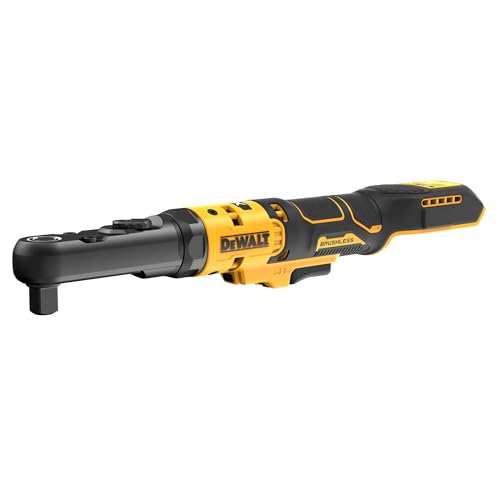
DeWalt DCF510B
The DCF510B runs on DeWalt's 20V MAX platform, and it's the clear torque leader of this comparison at 75 ft-lbs — nearly double Milwaukee's or Makita's figure, and well ahead of Bosch's. It's also the only tool here with genuinely interchangeable drive anvils, swapping between 3/8" and 1/2" without a separate adapter, which real-world reviewers note gives it more versatility across job types than a single fixed drive size. The sealed head design and glass-filled nylon housing are built specifically to resist automotive oils and solvents, a detail that matters if this tool lives in a shop rather than a general tool bag. Independent testing recognized it for "Best Grip" specifically, confirming the ergonomics hold up in hands-on use.
Milwaukee 2457-20
The 2457-20 is the sub-compact of this group and the cheapest by a wide margin. Milwaukee puts the head at 3/4", the body at 10-3/4" and the weight at 1.9 lbs, which is what makes it the one that actually fits where the others do not — head clearance in a cramped engine bay is the limiting factor far more often than torque is. The forward/reverse switch is recessed into the back of the head so you cannot knock it mid-job, and there is an onboard fuel gauge and an LED on the body.
Two honest limits. At 250 RPM it is the slowest of the four by a clear margin — Makita spins more than three times faster — so this is not the tool for running down a long row of loose fasteners. And while 35 ft-lbs covers most automotive work, independent reviewers are consistent that it does not fully replace an air ratchet: anything torqued down hard still needs breaking loose by hand first, and the tool will briefly shut itself down if you push it past its rated torque rather than letting you damage the fastener. With over 8,000 ratings it is also by far the most reviewed tool in this comparison, which is worth something on its own.
Bosch GRC18V-60N
Bosch's first-ever cordless ratchet, launched December 2025, sits deliberately in the middle of this comparison on both torque (45 ft-lbs) and speed (400 RPM) — a genuine "balanced" pick rather than a specialist tool. Three selectable HMI speed modes let you dial in torque-vs-speed on the fly rather than committing to one fixed character, useful when a job mixes stuck fasteners with a run of loose ones. It's also the newest entrant here by a wide margin — the other three brands' ratchets have years of established market history, while Bosch's is genuinely new to the category, which is a real, if unavoidable, position to be in for anyone comparing long-term reliability data.
Makita RW01Z
The RW01Z is the speed specialist of this comparison by a wide margin — 800 RPM, more than three times Milwaukee’s 250 and more than double DeWalt’s 300. Like DeWalt, it offers interchangeable drive anvils (3/8" and 1/4" here, rather than DeWalt’s 3/8"+1/2"), and it includes an electric brake that stops the anvil the instant you release the trigger — a real precision advantage when spinning down a fastener fast and needing to stop exactly on target rather than coasting past it. It can also be turned by hand as a manual ratchet when the motor is not engaged. The tradeoff for that speed is torque: at 35 ft-lbs it is tied with Milwaukee for the lowest figure here, and it will stall well before DeWalt or Bosch on a genuinely stuck fastener.
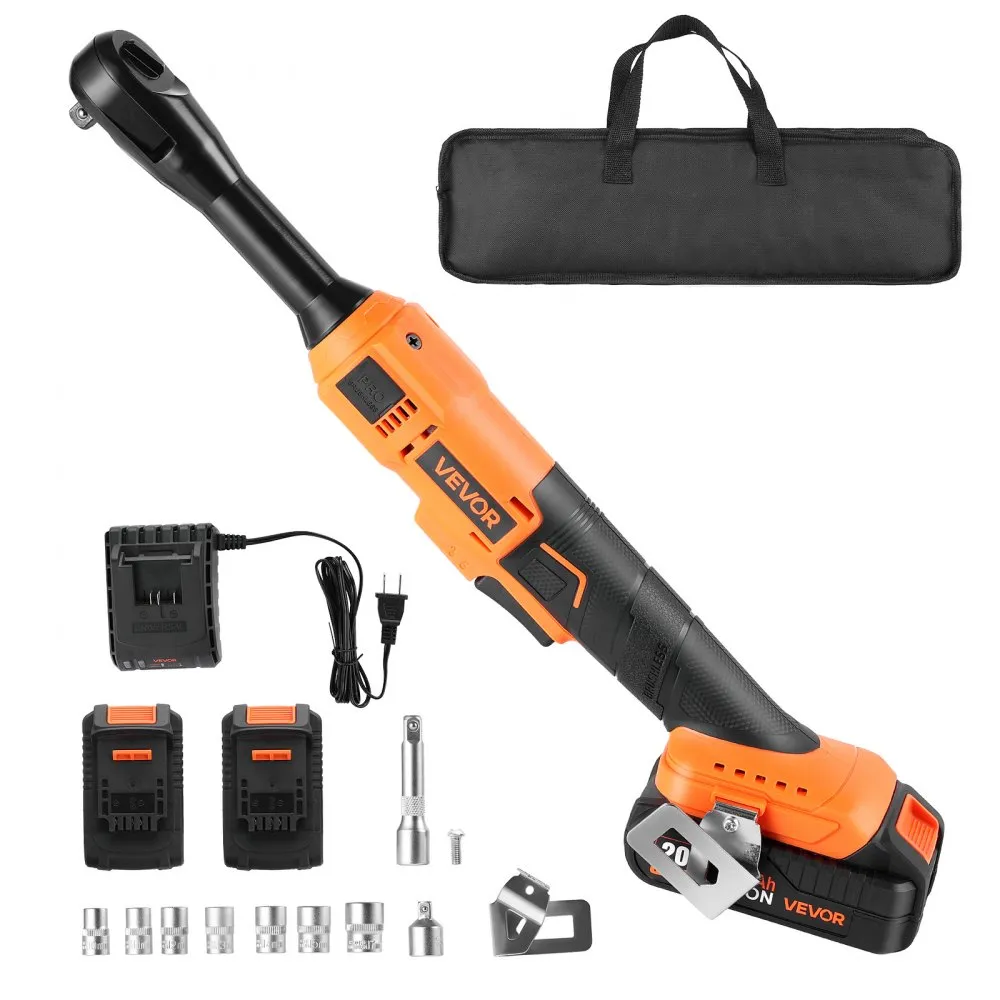
Budget Pick: The One Most People Buy
Every tool above is sold bare. You supply the battery, which is fine if you already own the platform and expensive if you do not — a battery and charger alone runs more than this entire kit. The AOBEN is the answer to that problem: tool, two 2000mAh batteries, charger, a starter set of sockets and a case, for less than the price of a bare-tool Bosch. At 35 ft-lbs it matches the Milwaukee and Makita on torque, and it is the single most-bought cordless ratchet on Amazon — #1 in its category with over 10,900 ratings.
Be clear-eyed about the trade, though. This is an off-brand tool, not a Ryobi or a Craftsman, and the 12V pack it runs on fits nothing else — there is no platform here to grow into, and when the batteries eventually die you are buying AOBEN cells or buying a new tool. It is sold by the manufacturer rather than by Amazon, though Amazon fulfils it. If you expect to own three or four cordless tools eventually, the money is better spent buying into a real platform. If you want a working ratchet in a case for under a hundred dollars and nothing more, this is the one people actually buy.
Sold as a complete kit, unlike the bare-tool basis used for the four picks above. The listing carries several configurations at different prices — the link goes to the two-battery kit. Prices and availability change — links go to current Amazon listings. As an Amazon Associate, BuildToolHQ earns from qualifying purchases.
Who Should Buy Which
- Already own batteries on one of these four platforms? Buy that brand — the performance differences here are real, but the cost of starting a second battery ecosystem usually outweighs them.
- Working mostly on stuck, corroded, or heavily-torqued fasteners? DeWalt's 75 ft-lbs gives you real headroom the other three don't have.
- Running down lots of already-loose fasteners fast? Makita's 800 RPM is the clear speed leader, with an electric brake for precise stopping.
- Working in genuinely tight engine bays? Milwaukee's 0.75" head profile is the most compact of the four.
- Want flexibility without committing to one character? Bosch's 3-speed selectable modes and balanced 45 ft-lbs/400 RPM spec split the difference deliberately.
- New to the category and don't want to commit to a full-price tool yet? the AOBEN kit is the cheapest way to own one, batteries and charger included — just know its battery fits nothing else.
Common Mistakes
Frequently Asked Questions
Can a cordless ratchet replace an impact wrench?
No. Cordless ratchets deliver 35-75 ft-lbs through continuous rotation with no hammering mechanism, while impact wrenches deliver hundreds of foot-pounds through a hammer-and-anvil action specifically built to shock stuck fasteners loose. A genuinely seized bolt will stall a ratchet's motor rather than break free. See our Impact Wrench comparison if that's the tool you need.
Is DeWalt or Makita better for a cordless ratchet?
They're built for opposite priorities. DeWalt's DCF510B has by far the highest torque of this comparison (75 ft-lbs), ideal for breaking loose stuck or resistant fasteners. Makita's RW01Z has by far the highest speed (800 RPM), ideal for quickly running down fasteners that are already loose. Most real jobs involve some of both; pick based on which phase dominates your actual work.
What torque do I need for automotive work?
Independent buying guides consistently point to 40-60 ft-lbs as the sweet spot for typical automotive fastener work, which is why Bosch's 45 ft-lbs, balanced spec is a genuinely reasonable middle-ground pick. Heavier work — suspension components, engine mounts — benefits from DeWalt's 75 ft-lbs headroom.
Do I need impact-rated sockets for a cordless ratchet?
For anything approaching the ratchet's rated torque, yes. Chrome hand-tool sockets are harder and more brittle, and can crack under the repeated torque spikes of powered use. Impact-rated sockets are built from more flex-tolerant steel designed to absorb that shock loading.
Can I use a cordless ratchet to set final torque on lug nuts?
Use it to run the lug nut down quickly, but always finish with a calibrated torque wrench to the vehicle's specified torque value. A power tool's feel for tightness isn't a substitute for a measured spec, especially on safety-critical fasteners.
What's the difference between 3/8" and 1/4" drive ratchets?
3/8" drive is the standard for most automotive and general mechanical work, handling the majority of common fastener sizes. 1/4" drive is for smaller precision fasteners — electronics, small appliance work, delicate assembly. DeWalt and Makita both offer interchangeable anvils that let one tool cover two drive sizes without buying a second ratchet.
Why is Milwaukee’s torque lower than DeWalt’s?
Size, mostly. The 2457-20 is a sub-compact M12 tool built around a 3/4" head and a 1.9 lb body, and there is only so much motor and gear reduction you can fit behind a head that small. DeWalt’s DCF510B is a 20V tool with a larger body and gets 75 ft-lbs out of it. This is a genuine engineering tradeoff rather than a difference in build quality — you can have the compact head or the torque, not both in a tool this size.
How does a cordless ratchet mechanism actually work?
A small brushless motor drives a gear reduction that spins the anvil continuously in one direction, while a pawl-and-gear ratcheting head — the same basic mechanism found in a hand ratchet — lets you reposition the tool body without backing the socket off the fastener. This continuous-rotation design is fundamentally different from an impact wrench's hammer-and-anvil mechanism, which is why ratchets feel smoother but top out at much lower torque.
Is a 12V or 18V/20V cordless ratchet better?
Milwaukee’s M12 and Makita’s 12V max CXT platforms prioritise compact size and light weight in the tool itself, which is a real advantage in tight spaces. DeWalt’s 20V MAX and Bosch’s 18V platforms generally allow more torque headroom from the larger battery — DeWalt’s 75 ft-lbs against 35 for the two 12V tools is the clearest example. Neither voltage class is objectively better; it comes down to whether compact size or torque headroom matters more for your work, and which platform you already own batteries for.
What size sockets do I need for a 3/8" cordless ratchet?
A 3/8" drive covers the vast majority of common automotive and general mechanical fasteners — typically 1/4" through 3/4" SAE, or 6mm through 19mm metric, in a standard set. Larger fasteners generally call for 1/2" drive and correspondingly larger sockets, which is why DeWalt's interchangeable 3/8"+1/2" system offers real added coverage over a fixed 3/8"-only tool.
- Bolt and Wrench Size Chart — The sizing companion to the socket chart above — hex head to wrench opening, SAE against metric, with thread pitch and torque figures
- Best Impact Wrench 2026 — The tool for the fasteners a ratchet cannot break loose — lug nuts, seized bolts, anything past 75 ft-lbs
- Impact Driver vs Drill — The other cordless decision most people face at the same time, and the one where the wrong answer costs the most
- Bolt Grades: Grade 5 vs Grade 8 — A grade 8 bolt takes considerably more torque than a grade 5 of the same size — which decides whether 35 ft-lbs is enough for the job
- Best Cordless Brad Nailer 2026 — The same four brands compared on a different fastening tool
Free Tool · AI-Powered
Plan your whole project in 2 minutes
Tell our AI Foreman what you are building and get a complete tool list, materials shopping list, step-by-step plan, and mistakes to avoid.
Try the AI Foreman →
Thomas Leroy
Founder of BuildToolHQ, drawing on years of hands-on building, fabrication, and technical work, plus deep product and manufacturer research. Every guide is built on real documentation and real product research — not recycled advice — so tradespeople and serious DIYers get the same technical knowledge professionals use every day.
More about Thomas