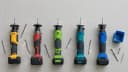
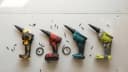
Best Cordless Angle Grinder 2026: DeWalt, Milwaukee, Bosch, Makita

Quick answer: buy the grinder that runs on the batteries you already own. A bare tool is $63 to $160; a battery and charger is another $65 to $95, which is usually more than the difference between any two grinders on this page. If you own no cordless tools at all, the maths changes — see the cost table below.
| If you already own | Buy | Why |
|---|---|---|
| DeWalt 20V MAX | DeWalt DCG413B | Most reviewed |
| Milwaukee M18 | Milwaukee 2880-20 M18 FUEL | Best all-round |
| Makita 18V LXT | Makita XAG04Z | Smartest electronics |
| Bosch 18V | Bosch GWX18V-8N | Fastest disc changes |
| Craftsman V20 | Craftsman CMCG400M1 kit | Only ready-to-use kit |
| Ryobi ONE+ | Ryobi R18AG-0 | Cheapest way in |
Prices and ratings are verified from live listings, not copied from spec sheets. These are ordered by battery platform, not ranked 1–6 — a ranking would be meaningless when the right answer depends on what is already in your charger.
Author: Thomas Leroy, Construction & Renovation Specialist
Fifteen years of hands-on residential construction and renovation, using most of the power tools on the market across a wide range of brands. An angle grinder is the tool I reach for to cut rebar, clean up a slab edge and take rust off anything, and it is also the one I am most careful with. This page compares six by battery platform because that is how the decision actually gets made, and every price and rating below came from the live listing rather than a spec sheet.
What an Angle Grinder Is Actually For
Four jobs, and it is genuinely good at all of them. Cutting — rebar, bolts, angle iron, tile, concrete block, with the right disc. Grinding — knocking down welds, cleaning up a cut edge, removing material fast. Finishing — blending a weld smooth with a flap disc. Cleaning — rust, paint and scale with a wire wheel.
What it is not: a saw. It has no depth stop, no fence and no base plate, so it will not give you a straight controlled cut through lumber. It is also not a sander — it turns far too fast and will burn or gouge wood before you have finished thinking about it.
Starting From Zero
If you own no cordless tools, the grinder is not really the decision — the battery platform is. You are choosing a system you will keep buying into for years, and the grinder is one tool in it.
| If you want | Go with | Reasoning |
|---|---|---|
| The strongest tool range | Milwaukee M18 or DeWalt 20V MAX | Both have hundreds of tools on the same battery. You will not outgrow either. |
| The lowest cost to start | Ryobi ONE+ or Craftsman V20 | Cheaper tools, cheaper batteries, widely stocked. Ryobi ONE+ alone spans over 300 products. |
| To buy one thing and be done | Craftsman CMCG400M1 kit | Battery and charger in the box. No second purchase, no platform commitment. |
The Real Cost, Not the Sticker Price
Five of these six are bare tools. One is a kit. Lining up their prices in a column is the single most misleading thing a comparison can do, so here is the honest version.
| Grinder | Sticker | Also need | Real cost from zero |
|---|---|---|---|
| Ryobi R18AG-0 | $63.50 | battery + charger | roughly $130–160 |
| Bosch GWX18V-8N | $119.00 | battery + charger | roughly $185–215 |
| Milwaukee 2880-20 | $133.00 | battery + charger | roughly $200–230 |
| DeWalt DCG413B | $159.95 | battery + charger | roughly $225–255 |
| Craftsman CMCG400M1 | $189.00 | nothing | $189.00 |
| Makita XAG04Z | hidden | battery + charger | add to cart to see |
Read that table twice if you own no batteries. The Ryobi looks like it costs a third of the Craftsman and actually costs about the same once you can switch it on. If you already own batteries, ignore the last column entirely — the sticker price is your price, and the Ryobi genuinely is the cheapest way in.
The Six Grinders
Ordered by battery platform. Find yours and stop reading.


Prices and availability change — links go to current Amazon listings.
Corded vs Cordless
| Corded | Cordless | |
|---|---|---|
| Sustained power | Unlimited, never fades | Drops as the battery drains |
| Runtime | All day | Roughly 10–25 minutes of continuous cutting |
| Cost | $40–90 for a decent one | $63–190 bare, more with a battery |
| Best for | Long grinding sessions in one place | Short cuts, ladders, no outlet |
If you are doing hours of grinding in a shop with an outlet, corded is still the better tool and considerably cheaper. Cordless wins the moment you are on a ladder, in a crawlspace, or cutting three bolts in a yard with no power. Most homeowners want the cordless one because most homeowner grinder jobs are short.
Brushless vs Brushed — the Spec That Matters
Four of these six are brushless. The Craftsman and the Ryobi are brushed. That one difference tells you more than any other number on the box.
| Brushed | Brushless | |
|---|---|---|
| Motor life | Brushes wear and eventually need replacing | No brushes to wear out |
| Under load | Bogs down sooner | Holds speed better in a cut |
| Heat | Runs hotter | Runs cooler, longer runtime per charge |
| Price | Cheaper | $40–80 more, typically |
| In this group | Craftsman, Ryobi | DeWalt, Milwaukee, Makita, Bosch |
Specs Compared
| Grinder | Motor | Wheel | Switch | Mount | Rating |
|---|---|---|---|---|---|
| DeWalt DCG413B | Brushless | 4-1/2" | Paddle | Standard 5/8-11 | 4.8 / 9,555 |
| Milwaukee 2880-20 M18 FUEL | Brushless | 4-1/2" / 5" | Paddle, no-lock | Standard 5/8-11 | 4.8 / 2,411 |
| Makita XAG04Z | Brushless | 4-1/2" / 5" | Slide, lock-on | Standard 5/8-11 | 4.8 / 3,119 |
| Bosch GWX18V-8N | Brushless | 4-1/2" | Slide | X-LOCK | 4.7 / 213 |
| Craftsman CMCG400M1 kit | Brushed | 4-1/2" | Paddle | Standard 5/8-11 | 4.6 / 3,611 |
| Ryobi R18AG-0 | Brushed | 115 mm (4-1/2") | Paddle | Standard 5/8-11 | 4.6 / 4,722 |
Manufacturer specifications and live listing data. No hands-on testing is claimed here — these six have not been run side by side, and inventing test results would be worse than saying so.
Which Disc Do You Need
The grinder is half the purchase. The disc decides what it can actually do, and fitting the wrong one is how people get hurt.
Pick both and the right disc appears below, with what to watch for.
Prices and availability change — links go to current Amazon listings. The full reference table is below if you would rather read the whole picture.
| Disc | Use it for | Never use it for |
|---|---|---|
| Cut-off wheel (Type 1) | Cutting metal, rebar, bolts | Grinding — side pressure shatters it |
| Grinding wheel (Type 27) | Weld knockdown, heavy stock removal | Fine finishing |
| Flap disc | Grinding and finishing in one pass | Deep cutting |
| Diamond blade | Tile, concrete, block | Random metal cutting |
| Wire cup or wheel | Rust, paint and scale | Cutting anything |
What angle to hold it at
| Job | Angle to the work |
|---|---|
| Cutting | 90 degrees. No tilt, no twist, no steering. |
| Grinding with a Type 27 | 15–30 degrees. Start around 20–25. |
| Blending with a flap disc | 10–15 degrees. |
| Stock removal with a Type 29 | 15–25 degrees. |
Disc Mounts and Arbor Size
Nearly every grinder sold in North America uses a 5/8-11 spindle with a 7/8 in. (22.23 mm) disc bore. Five of the six here do. Buy any disc off the rack and it fits.
The Bosch is different. It uses X-LOCK, a click-in mount with no wrench, no backing flange and no lock nut. Disc changes take seconds and there is nothing to drop in the grass.
That is not a fault. Tool-free disc changes are a real improvement and Makita now sells X-LOCK grinders too. But it is a decision worth making knowingly rather than discovering the first time you try to fit a disc from the hardware store.
Before You Cut Anything
An angle grinder spins a brittle disc at around 9,000 RPM inches from your hands and face, and it is the tool most likely to hurt you in a home workshop. Wear safety glasses as an absolute minimum and a full face shield if you have one — sparks and disc fragments come off at eye level. Wear gloves, keep sleeves clear, and never remove the guard; rotate it so it sits between the wheel and your body. Check that the RPM printed on the disc is equal to or higher than the number on the grinder, and let a new disc spin for a minute at full speed with the guard on before you touch the work. Most serious injuries come from kickback, which happens when the wheel binds in the cut — support both sides of the workpiece so the kerf cannot close and pinch the disc, and let the wheel speed do the cutting rather than forcing it. And never lay a thin cut-off wheel over to grind with its side. It is built for straight-in loads only, and side pressure is what makes one come apart.
Best for Each Job
| Job | What matters | Pick |
|---|---|---|
| Cutting rebar | Sustained power, a brake helps | DeWalt DCG413B or Milwaukee 2880-20 |
| Grinding welds | Torque under load, 5 in. wheel capacity | Milwaukee 2880-20 or Makita XAG04Z |
| Rust and paint removal | Light, comfortable, cheap enough | Ryobi R18AG-0 or Craftsman kit |
| Cutting tile or block | Steady speed, dust everywhere | Makita XAG04Z |
| Changing discs constantly | Tool-free mount | Bosch GWX18V-8N |
| Occasional DIY, own nothing | One purchase, ready to go | Craftsman CMCG400M1 kit |
Common Mistakes
Frequently Asked Questions
Which cordless angle grinder should I buy?
The one that runs on the batteries you already own. A battery and charger costs $65 to $95, which is usually more than the difference between any two grinders on this page. If you own DeWalt tools buy the DeWalt, if you own Ryobi buy the Ryobi. If you own nothing, the Craftsman kit at $189 includes a battery and charger and works out about the same as a cheaper bare tool once you have bought the parts to run it.
Is a brushless angle grinder worth it?
For regular use, yes. A brushless motor has no brushes to wear out, holds speed better under load and runs cooler, which also means longer runtime per charge. It typically costs $40 to $80 more. For occasional rust removal and the odd cut, a brushed tool like the Ryobi or the Craftsman is a fair trade at the price.
What size angle grinder do I need?
4-1/2 inch handles almost everything a homeowner does — cutting bolts and rebar, grinding welds, rust removal, cutting tile. Five inch gives you a little more depth in a cut and is worth having if your grinder takes both, as the Milwaukee and Makita do. Six and seven inch tools are for production work and are heavier than most people want.
Do X-LOCK discs fit a normal angle grinder?
Yes. X-LOCK discs keep the standard 22.23 mm centre bore, so they mount on a conventional 7/8 in. arbor grinder with the usual flange and nut. The reverse is not true: a conventional disc cannot mount on an X-LOCK grinder, because there is no threaded arbor to clamp it to, and Bosch has said no adapter will be made.
What RPM should my angle grinder disc be rated for?
Equal to or higher than the maximum RPM printed on the grinder. That figure is the tool's no-load speed, and it is the speed the wheel reaches every time you lift it out of the cut. A disc rated 9,000 RPM does not belong on a grinder marked 9,200.
Can I use an angle grinder to cut concrete?
Yes, with a diamond blade rated for masonry. A 4-1/2 inch grinder cuts about an inch deep, which is enough for scoring, cutting block, or cutting rebar within concrete. For a full-depth slab cut you want a cut-off saw. Expect a great deal of dust, and wear a respirator — concrete dust contains silica.
Corded or cordless angle grinder?
Corded if you grind for long stretches in one place: it never fades, and a good corded grinder costs $40 to $90. Cordless if your work is short bursts, up a ladder, or away from an outlet. Most homeowner grinder jobs are short, which is why cordless usually wins for DIY.
Why does my angle grinder kick back?
The wheel has bound in the cut. Usually the workpiece is unsupported on one side so the kerf closes and pinches the disc, or the tool is being forced rather than allowed to cut at its own speed. Support both sides of the cut, ease off the pressure, and keep your body out of the line the tool would travel if it let go.
Related Guides
- Best Concrete Cut-Off Saw — when a 4-1/2 in. grinder is not enough depth
- Best Masonry Drill Bits — the other half of working in concrete and block
- How to Cut Concrete Block — the job a diamond blade on a grinder does best
- Best Oscillating Multi-Tool — the other tool with a blade-mount trap
- How to Remove Concrete Anchors — cutting a failed ancher flush is a grinder job
Free Tool · AI-Powered
Plan your whole project in 2 minutes
Tell our AI Foreman what you are building and get a complete tool list, materials shopping list, step-by-step plan, and mistakes to avoid.
Try the AI Foreman →
Thomas Leroy
Founder of BuildToolHQ, drawing on years of hands-on building, fabrication, and technical work, plus deep product and manufacturer research. Every guide is built on real documentation and real product research — not recycled advice — so tradespeople and serious DIYers get the same technical knowledge professionals use every day.
More about Thomas