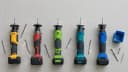
Best Concrete Cut-Off Saw 2026: DeWalt vs Milwaukee vs Bosch vs Makita

Cordless cut-off saws have closed most of the gap with gas over the last few years — but not all of it. All four tools compared here are 9" cordless saws, matched for a fair comparison, with real guidance on when cordless makes sense and when gas is still the better call.
Quick answer: Cutting 2 tanks of gas or less per day? Cordless is a clear win. 5–7 tanks a day? Stay gas. All four saws below are 9" class, roughly 3-1/4" to 3.4" cutting depth, matched for a fair comparison.
| Brand | Best If |
|---|---|
| DeWalt DCS690B | Already on 20V/60V FLEXVOLT, want a heavy-load indicator |
| Milwaukee 2786-20 | Already on M18, want RAPIDSTOP blade brake + tool tracking |
| Bosch GCS18V-230N | Switch between wet and dry cutting often |
| Makita GEC03 | Lowest-vibration belt-drive design, OSHA Table 1 water delivery |
At a Glance
| Brand | Cutting Depth | No-Load Speed | Weight |
|---|---|---|---|
| DeWalt DCS690B | 3-1/4" | 6,600 RPM | 10.85 lbs (bare) |
| Milwaukee 2786-20 | 3.4" | 6,600 RPM | 10.6 lbs (bare) |
| Bosch GCS18V-230N | 3.3" | Not confirmed | 11.8 lbs (bare) |
| Makita GEC03 | 3-1/2" | 6,600 RPM | 15.8 lbs (w/ battery) |
Weight Compared
*Makita weight includes its 40V XGT battery; the other three are bare-tool weights — not a fully apples-to-apples comparison, but the real weight you'd hold in each case.
Best Feature, at a Glance
Jump to the full spec comparison below. Specs verified against dewalt.com, milwaukeetool.com, boschtools.com, and makitatools.com.
These four cordless saws show how far battery technology has come — brushless motors delivering up to 6,600 RPM, real diamond-cutting power through concrete, rebar, brick, and metal, with none of the fuel mixing, pull-starts, or exhaust fumes of a gas saw. For the overwhelming majority of concrete and masonry cutting work, cordless isn’t a compromise anymore — it’s simply the easier, cleaner way to get the job done.
Real Specs by Brand
| Feature | DeWalt DCS690B | Milwaukee 2786-20 | Bosch GCS18V-230N | Makita GEC03 |
|---|---|---|---|---|
| Cutting depth | 3-1/4" | 3.4" | 3.3" | 3-1/2" |
| No-load speed | 6,600 RPM | 6,600 RPM | Not independently confirmed | 6,600 RPM |
| Weight | 10.85 lbs (bare) | 10.6 lbs (bare) | 11.8 lbs (bare) | 15.8 lbs (with battery) |
| Battery platform | 20V/60V FLEXVOLT | M18 | 18V | 40V max XGT |
Specs verified against manufacturer product pages and official instruction manuals. Makita’s weight includes its single 40V XGT battery, since the platform has no separate bare-tool spec; the other three are bare-tool weights. Bosch’s no-load speed was not independently confirmed.
Recommended Tools by Brand
All four are 9" class for a fair comparison — stay on your existing battery ecosystem if you have one.
Prices and availability change — links go to current Amazon listings. As an Amazon Associate, BuildToolHQ earns from qualifying purchases.
Blades & Wet vs Dry Cutting
Getting the right blade matters as much as the saw itself:
- Wet cutting feeds water to the blade during the cut — it controls dust, cools the blade, and meaningfully extends blade life. It’s often the practical choice for OSHA Table 1 silica dust compliance on continuous cutting.
- Dry cutting skips the water, simpler for quick or occasional cuts, but generates more heat and dust — requires a blade specifically designed for dry use, since wet-only blades overheat quickly without water.
- Diamond blade bond hardness should match the material: a softer bond wears away faster to expose fresh diamonds, which suits harder aggregate; a harder bond lasts longer on softer, more abrasive material. Using the wrong bond hardness either wears the blade out fast or glazes over and stops cutting effectively.
Depth matters more than it first appears: all four saws here cap out around 3.25–3.5" in a single pass, which isn’t enough to get through a standard 4" concrete slab in one cut. For material deeper than your blade’s reach, cut from one side to full depth, then flip the material or reposition on the opposite face and complete the cut from there — never force a single-pass cut deeper than the blade is rated for, which risks binding, kickback, or blade damage.
For the blade itself, a purpose-built masonry blade and a multi-material blade serve different needs. Diablo’s segmented turbo rim is built specifically for concrete, concrete with rebar, brick, and block — a dedicated masonry choice rated close to these saws’ actual RPM range. Evolution’s multi-material blade trades some masonry-specific optimization for the ability to cut both concrete and metal with the same blade — genuinely useful if a job mixes material types, and its steel core also won’t shatter under stress the way a bonded abrasive wheel can. Each brand also sells its own matched blade for its saw — DeWalt’s DWAFV8900, Milwaukee’s 49-93-7025, Bosch’s DB961, and Makita’s E-02515 are all genuine options if you’d rather stay with the same brand as your tool.
Prices and availability change — links go to current Amazon listings. As an Amazon Associate, BuildToolHQ earns from qualifying purchases.
Independent Testing: Cutting Speed and Ergonomics
Concord Carpenter ran a real head-to-head comparison across nine cordless and gas 9-10" cut-off saws in 2025, including all four tools compared here. Their cutting-speed test — five cuts through 1x12 pavers, using water and proper step-cutting technique, timed with fresh batteries — found a genuine, meaningful spread: DeWalt finished fastest at roughly 8.24 seconds per cut, Makita close behind at 8.4 seconds, Milwaukee at 8.9 seconds, and Bosch noticeably slower at over 14 seconds.
The same testing turned up two other real, practical differences worth knowing before you buy. Milwaukee and Makita use a one-handed guard adjustment that testers preferred; DeWalt and Bosch use a dual-activation guard that takes more deliberate effort to reposition. And on indicator lights specifically — Bosch, DeWalt, and Makita all have them, but testers found they’re often obscured by your own hand during normal operation, a real usability gap even on tools that otherwise test well.
Kickback: The Real Risk With Cut-Off Saws
The most serious hazard with any cut-off saw isn’t a slipped blade — it’s kickback: the cutting wheel suddenly binds or pinches in the material, and the saw’s own rotational energy throws it violently up and back toward the operator. It’s a documented cause of serious and fatal injuries on construction sites, and it happens fast enough that reaction time alone isn’t a reliable defense.
The single most effective prevention technique, repeated across every safety source on this: cut with the lower quadrant of the blade, never the upper quadrant. Cutting with the lower portion means that if the wheel does bind, the saw’s natural reaction pulls it away from you rather than up toward you. Beyond blade position, most kickback traces back to a short list of causes: side-loading the blade (pushing it sideways instead of straight through the cut), re-entering a cut that’s already started before the blade is back up to full speed, a damaged or worn blade, or the workpiece itself shifting and pinching the wheel mid-cut — which is why supporting material on both sides of the cut matters as much as blade technique.
Stance matters too: stand parallel to the saw rather than directly behind it, so that if kickback does happen, the saw’s backward arc passes beside you instead of into you.
This is exactly what the kickback-response features covered in the brand sections below are built for — Milwaukee’s RAPIDSTOP blade brake and Makita’s AFT both exist specifically to cut power the instant the wheel is forced to stop, reducing how much of that reactive energy actually reaches the saw body before it shuts down.
DeWalt DCS690B
The DCS690B runs on DeWalt’s 20V/60V FLEXVOLT platform, cutting up to 3-1/4" deep at 6,600 RPM. A heavy-load indicator light gives real-time feedback on power draw and runtime during demanding cuts, and the battery compartment is latched and sealed for protection against dust and moisture on harsh job sites. A 5-position guard lets you choose your cutting angle for better visibility. DeWalt publishes a runtime figure none of the other three brands match with a comparable spec: up to 25.5 ft of 1-inch scoring in cured concrete per charge.
Milwaukee 2786-20
Part of Milwaukee’s M18 FUEL lineup, the 2786-20 cuts up to 3.4" deep at 6,600 RPM and weighs 10.6 lbs bare. RAPIDSTOP blade brake stops the blade quickly after the trigger is released, a real safety feature for a spinning abrasive or diamond wheel. ONE-KEY integration lets you track and manage the tool wirelessly, and a dual-trigger safety design requires a secondary spring-loaded flap before the main trigger will engage.
Bosch GCS18V-230N
The GCS18V-230N cuts up to 3.3" deep on Bosch’s 18V platform. Its standout feature is a built-in water shut-off valve, letting you switch between wet and dry cutting on the fly without swapping equipment — genuinely useful if your job moves between indoor dry cuts and outdoor wet cuts in the same day. A spindle lock lever simplifies wheel changes, and a 6-position guard covers a range of cutting angles.
Makita GEC03
The GEC03 runs on Makita’s 40V max XGT platform with a single battery, delivering up to 6,600 RPM through a belt-drive design that runs smoother and with lower vibration than a direct-drive motor. Active Feedback-sensing Technology (AFT) shuts the motor off if the wheel is suddenly forced to stop, and an electric brake stops the cutting wheel in under 2 seconds. An integrated water delivery system with adjustable flow is built specifically for OSHA Table 1 compliance in concrete cutting.
Need More Power Than These Four Offer?
If you need more than about 3.5" of cutting depth, or you’re cutting all day, every day, these 9" saws aren’t the right tool — you need a genuine gas-saw-replacement tier:
- Milwaukee MX FUEL 14" Cut-Off Saw — a real gas-saw replacement, cutting up to 5" deep, but a completely different class of tool: roughly $2,499 and 32 lbs, built for continuous commercial use, not a lighter handheld saw.
- DeWalt PowerShift 12" Cut-Off Saw (DCPS612AG2) — announced at World of Concrete 2026, billed by DeWalt as the most powerful cordless cut-off saw in the industry across both battery and gas power sources, cutting up to 4-3/4" deep. Announced for release fall 2026 — may not be available for purchase yet.
Who Should Actually Buy Which
- Already own batteries on one of these platforms? Buy that brand — the performance gap between all four is smaller than the cost of starting a second battery ecosystem.
- Switching between wet and dry cuts throughout the day? Bosch’s built-in water shut-off valve makes that switch fast without extra equipment.
- Want the lowest vibration for extended cutting sessions? Makita’s belt-drive design is built specifically to reduce vibration compared to a direct-drive motor.
- Cutting near people or in high-traffic areas? Milwaukee’s RAPIDSTOP blade brake stops the wheel quickly once you release the trigger.
- Cutting more than 2 tanks of gas worth of material a day? None of these four — look at the heavy-equipment tier above, or stay gas.
Common Mistakes
Gas vs Cordless — Which Do You Need?
This is the real first decision, before any brand comparison. A widely-used industry rule of thumb: if you’re cutting 2 tanks of gas or less per day, you’re in the sweet spot to convert to cordless. If you’re running 5 to 7 tanks a day, stay with gas or plan to invest heavily in extra batteries — cordless runtime can’t match that pace yet.
- Cordless wins on: instant start (no fuel mixing or pull-starting), zero fumes for indoor use, roughly 50% less vibration and noise than gas, less maintenance
- Gas wins on: continuous runtime with no charging downtime, established power for extreme daily use, lower upfront cost per tool
Tool Box Buzz, an independent trade-focused review team, frames these tools well: they’re not gas replacements, they’re expansion tools for contractors already on a battery platform — genuine “80% tools,” meaning they’ll handle roughly 80% of what a gas saw does. Real use cases where that 80% is exactly enough: fast, straight cuts through 8" PVC pipe for mechanical contractors, basement drain and foundation cuts, “first-pass” door entry cuts, and callback or punch-list cuts in occupied spaces where hauling out a gas saw isn’t practical.
Reference thresholds based on established industry guidance, not a hard rule for every job.
Frequently Asked Questions
Should I get a gas or cordless cut-off saw?
It depends on daily use. If you’re cutting through 2 tanks of gas or less per day, cordless is a clear win — no fuel mixing, instant start, no fumes, less vibration. At 5–7 tanks a day, stay gas or invest heavily in extra batteries; cordless runtime can’t match that pace yet. Between 2 and 5 tanks, it depends on your ability to charge batteries on-site.
What is the difference between wet and dry cutting?
Wet cutting feeds water to the blade during the cut — it controls dust, cools the blade, and extends blade life, and is often required for OSHA Table 1 silica dust compliance. Dry cutting skips the water, which is simpler for quick or occasional cuts but generates more dust and heat, requiring a blade designed for dry use.
How deep can a 9-inch cut-off saw cut?
Around 3–3.5" depending on the model — the four saws compared here range from 3.3" to 3.4" (Bosch and Milwaukee) up to 3-1/4" (DeWalt). For deeper cuts, you need a larger-diameter saw, like Milwaukee’s 14" MX FUEL, which reaches roughly 5".
Is Milwaukee or DeWalt better for a cut-off saw?
Both are close in the 9" class. Milwaukee’s 2786-20 adds RAPIDSTOP blade brake and ONE-KEY tool tracking; DeWalt’s DCS690B adds a heavy-load indicator light and a sealed battery box for harsh conditions. As with most cordless comparisons, the deciding factor is usually whichever battery platform you’re already invested in.
Do I need a bigger saw than these four?
Only if you need more than about 3.5" of cutting depth or you’re cutting all day, every day. Milwaukee’s MX FUEL 14" Cut-Off Saw is a genuine gas-saw replacement built for that heavier tier, and DeWalt has a new 12" PowerShift saw announced for release in fall 2026. Both are a different class of tool — heavier, pricier, and built for continuous commercial use.
Related Guides
- Best SDS-Max Rotary Hammer 2026 — For drilling, coring, and demolition work
- Drill Bit Size for Concrete Anchors — Right bit for every anchor
- Best Cordless Angle Grinder 2026 — For cuts too small or too tight for a cut-off saw
Free Tool · AI-Powered
Plan your whole project in 2 minutes
Tell our AI Foreman what you are building and get a complete tool list, materials shopping list, step-by-step plan, and mistakes to avoid.
Try the AI Foreman →
Thomas Leroy
Founder of BuildToolHQ, drawing on years of hands-on building, fabrication, and technical work, plus deep product and manufacturer research. Every guide is built on real documentation and real product research — not recycled advice — so tradespeople and serious DIYers get the same technical knowledge professionals use every day.
More about Thomas